Living in Brutalist Britain

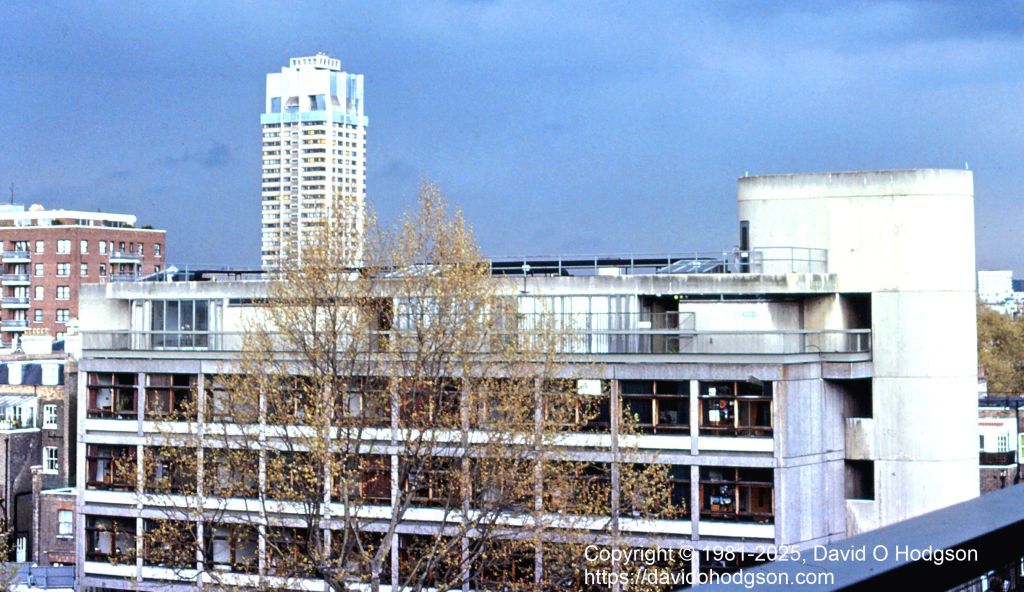
Linstead Hall, Imperial College, London, from my residence in Southside Halls

A few weeks ago, my wife and I went to see the movie The Brutalist. The extent of the hype for this movie was truly breathtaking, which may be partly why I was not surprised that it did not live up to its “promise”.

I must admit that media coverage led me to question whether those who were singing its praises even understood anything about the movie’s subject matter! For example, a fawning item about it on ABC News included paroxysms of praise for the movie’s stars and director, but never actually mentioned what the movie is about, nor was there any explanation of what the title “Brutalist” referred to! I guessed that it must have something to do with Brutalist Architecture, and it turned out that I was correct, but that was no thanks to ABC. Did the presenters really not understand it themselves, or had they decided that the explanation was too “intellectual” for their audience?

Perhaps that is, in fact, the key to the praise that the movie has received. It seems that the less a reviewer knows about its subject, the more they like the movie. Those who do understand its subject matter, professional architects, have been highly critical of its blunders and implausibility, to the extent that they are described as “hating” it in this article.

I also thought that, given its thin, questionable plot and appalling examples of ignorance, the movie was much too long at 3 hours, 35 minutes. As the Guardian reviewer states sarcastically:

“The architecture world awaits with bated breath the director’s five-hour marathons, The Postmodernist, The Deconstructivist, and The Parametricist – each to be shot with period-appropriate equipment and based on a brief skim through a coffee-table book”

Personally, the only benefit that I obtained from the movie experience was that it prompted me to think once again about the real Brutalist architecture that I grew up in and around, the history of which I find infinitely more interesting than any aspect of the movie.

Growing up, Brutalist architecture was a constant background theme in my life, and I even lived in one example of it for a while.

Brutal Aylesbury

I never actually lived in the Buckinghamshire county town of Aylesbury, but, as I recounted in a previous post, my first visit there involved a job interview and a “computer programming aptitude test” that had a profound effect on my view of my own abilities in that field.

During the period from the 1930s to the 1970s, the British Government made major investments in a group of what were referred to as London Overspill Towns. There was a deliberate policy of moving population en masse out of London, to more rural locations. The goal was mainly to reduce further “ribbon development” of the London suburbs, which would eventually have spread across the entire South-East of England. There were also health implications, since prior to the 1960s, London’s air was seriously polluted, leading to increased healthcare costs.

During the 1960s, various existing towns were targeted for substantial redevelopment and expansion, and a few entirely new towns were created. Most of these were within commuting distance of London, but even Grantham in the East Midlands was included.

The map below is from the 1963 book New Architecture of London.
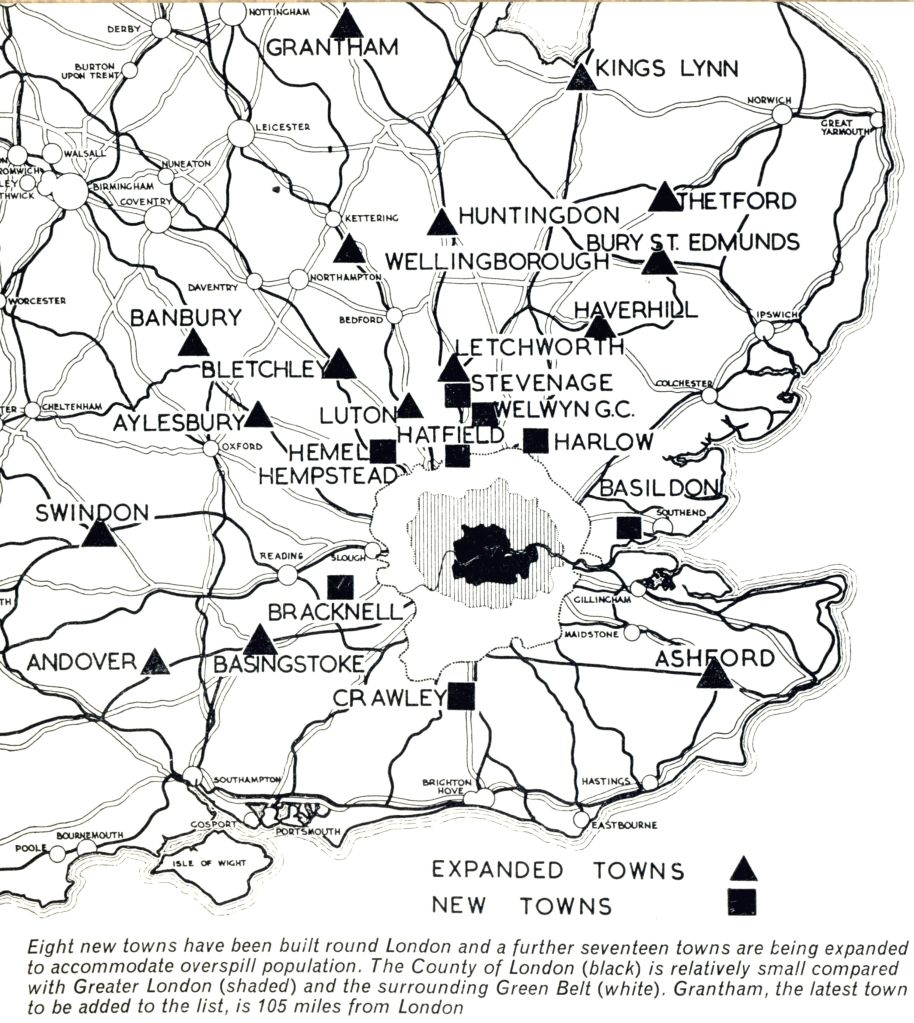
Map of London Expansion Towns. Copyright © 1963, British Travel and Holidays Association

As shown, one of the “expansion towns” was Aylesbury, which had until then been a quaint market town, famous mostly for its ducks.

Development plans for expansion towns invariably included the construction of new shopping centers and civic buildings, and some of these were designed along brutalist architectural lines. In 1967, Aylesbury found itself lumbered with a new shopping center, Friars Square, which quickly came to be seen as such an outstanding example of a dystopian nightmare environment that, in 1971, scenes for the movie Clockwork Orange were filmed there!

My 1980 photo below shows the centerpiece of Friars Square, the Cadena Cafe, after it had become a Wimpy Bar. As with many examples of brutalism, the building had a relatively short life, being demolished in 1993 when the shopping center was redeveloped.
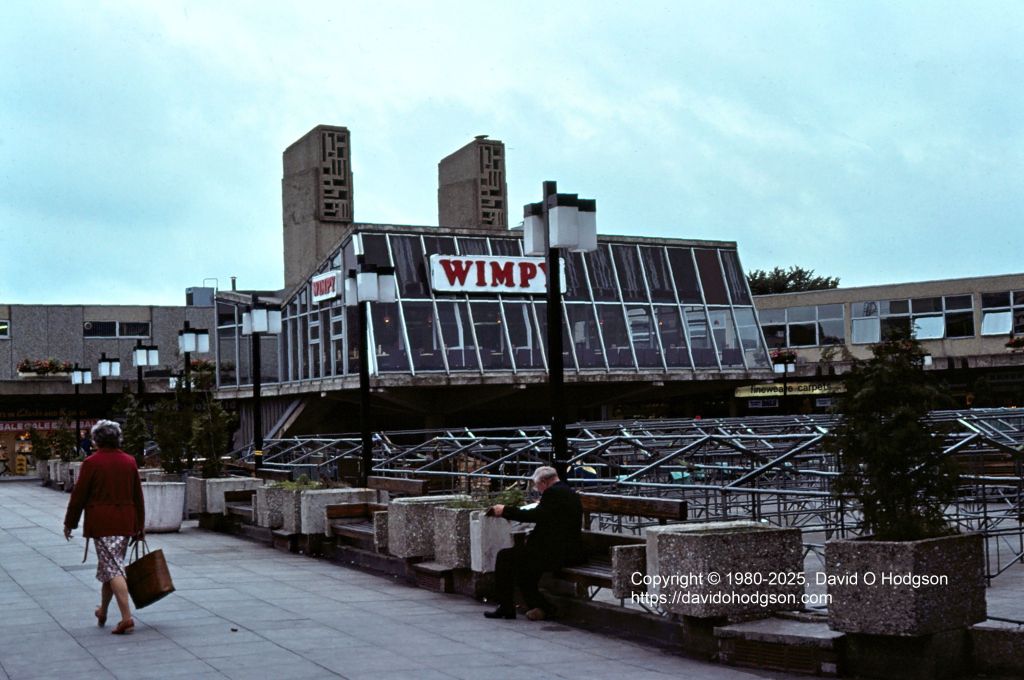
Friars Square & Cadena Cafe, Aylesbury

Elain Harwood’s book Brutalist Britain offers an extensive listing of brutalist architecture in the country, and describes another Aylesbury example, the Buckinghamshire County Council office tower.

The cover of Brutalist Britain, Copyright © 2023, Elain Harwood, Batsford Publishers

My 1980 photo below shows the County Council tower looming above Market Square in Aylesbury, with the Bell Hotel in the foreground.
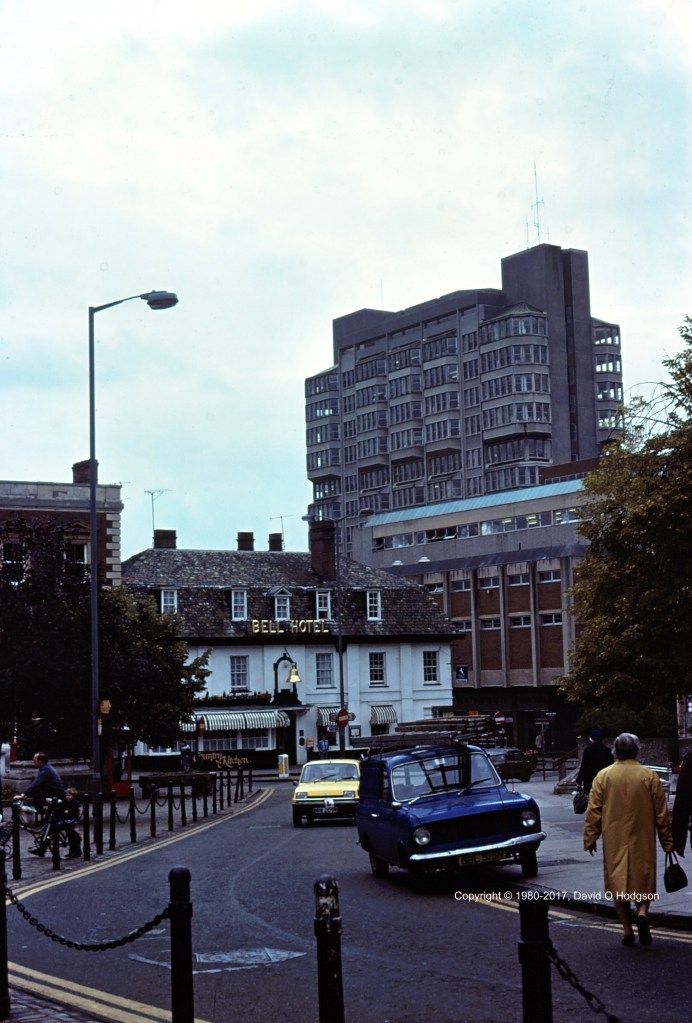
The Bell Hotel, Aylesbury, with the Buckinghamshire County Offices beyond, in 1980

Brutal Birmingham

Birmingham New Street Signal Box, 1980

It seems perhaps most appropriate that Brutalist architecture would be chosen for the design of industrial buildings, and even British Railways constructed a few examples. One of the most famous in Britain must surely be Birmingham New Street Signal Box, which has towered above the gloomy subterranean station since 1966, and is clearly visible from street level, as shown in my 1980 photo above. Although it closed as a signal box in 2022, the building is listed, is still standing, and continues to be used by Network Rail.

Again, Birmingham was not a city in which I ever lived, but when traveling between Coventry and York, I usually had to change trains at Birmingham New Street. I also applied to, and was accepted by, Aston University in Birmingham, so I attended an interview there in 1980.

Brutal London

Approximately a year after visiting Aylesbury for that job interview, I found myself moving to London, as I began my Electronic Engineering studies at Imperial College.

Many first-year undergraduate students were accommodated in Halls of Residence, situated in South Kensington near the college campus. Generally, we were assigned to one of the halls, and were not given any option as to which hall we preferred. I was assigned a single-bed room in Selkirk Hall, which was a subdivision of the huge Southside Halls building, located, as the name indicates, on the south side of Prince’s Gardens.

The photo at the head of this article shows the view looking north from Selkirk Hall over Princes Gardens, one stormy afternoon. The building in the foreground is Linstead Hall, which was of similar architectural style to Southside. In the distance, the tower of another Brutalist edifice is visible; Hyde Park Barracks, which was and still is the home of the Horse Guards.

Cover of Lost Futures. Copyright © 2017, Owen Hopkins, Royal Academy of Arts

Unfortunately, while living in Selkirk Hall, I never photographed the outside of the building itself (partly because the trees in front of it obscured most of it). However, Owen Hopkins’ book Lost Futures includes an article about Southside Halls, which also mentions the smaller Weeks Hall, situated on the north side of Prince’s Gardens.

The photo below, borrowed from “Lost Futures”, shows an excellent panorama of Southside, before the trees in front of it grew too large.
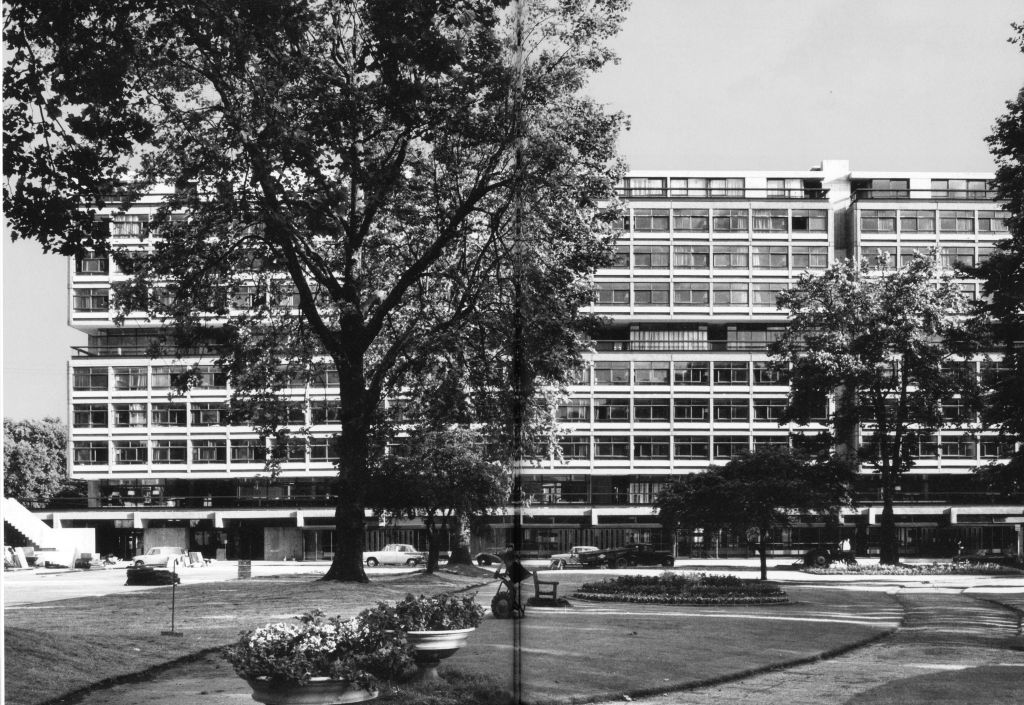
Southside Halls, Imperial College. Copyright © 2017, Owen Hopkins, Royal Academy of Arts

Unfortunately (or perhaps fortunately, depending on your view of their aesthetics!), the passage of time has revealed that many Brutalist buildings were not well-constructed, and in some cases not even well-designed. I had personal experience of this while living in Selkirk Hall.

I lived in the building for only one academic year, but even during that time there were serious maintenance problems. Each bedroom had its own sink, whereas kitchen and bath facilities were shared. The sink in my room was out-of-action, and boarded off, for several weeks during my residency, due to plumbing problems. It seems that the design of the building had a major flaw, whereby pipes and other service conduits were buried directly within the concrete, instead of being placed in accessible service ducts. As a result, any plumbing maintenance work required drilling out the concrete to access the pipes! The quality of the concrete also seems to have been defective, and large chunks of it eventually began to disintegrate.

The upkeep of Southside became so problematic that, despite its being a listed building, permission was eventually granted to demolish it in 2005. That permission was granted on condition that the smaller Weeks Hall, on the north side of Prince’s Gardens, and also a listed building, be retained and refurbished. In my photo below, looking north from Southside, you can just see Weeks Hall towards the right.

Skyline from Princes Gardens, with Weeks Hall

One of the more successful examples of Brutalist architecture, which still exists and is in use today, is the Barbican Centre, in the City of London. My photo below shows part of the complex shortly after its official opening in 1982. I visited the Centre many times, usually to go to the Museum of London, which was housed within it.

Despite having been voted the “Ugliest Building in London”, the Barbican apparently remains popular with apartment renters, thanks to its views and convenient location.
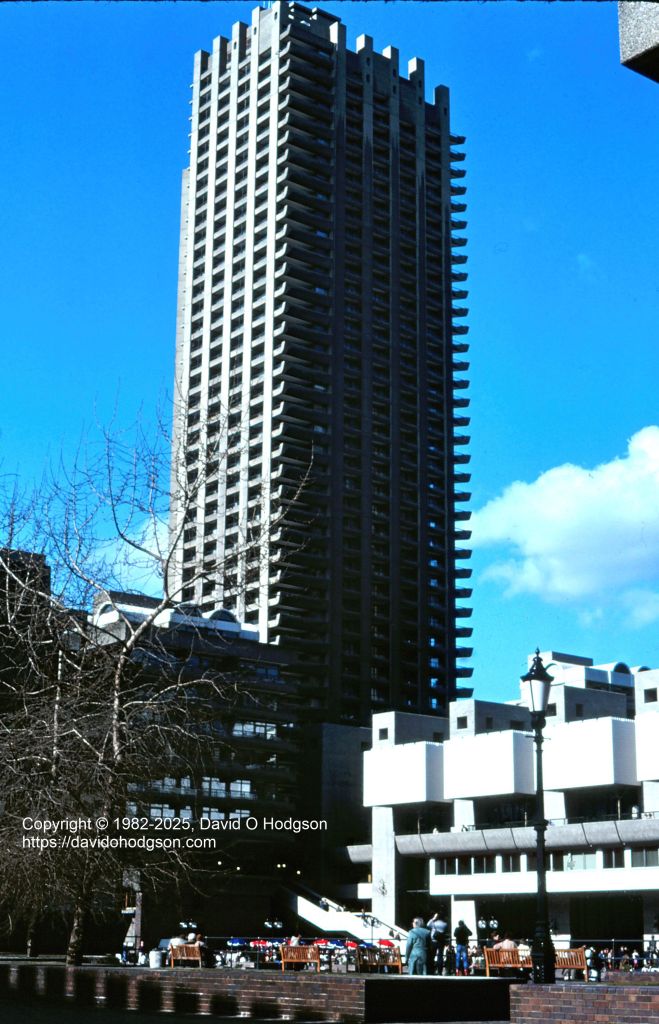
Barbican Centre, London

Brutal Scarborough

Even my home town of Scarborough suffered the attentions of architects with brutalist leanings. In 1973, the imposing Pavilion Hotel, immediately opposite the main railway station, was controversially demolished and eventually replaced by an office block that has been described as the “ugliest building in Scarborough”. I reproduce below an article from the Scarborough Mercury of 15th September 1973, showing how the new building was to look, along with hopelessly-optimistic predictions of its future uses.
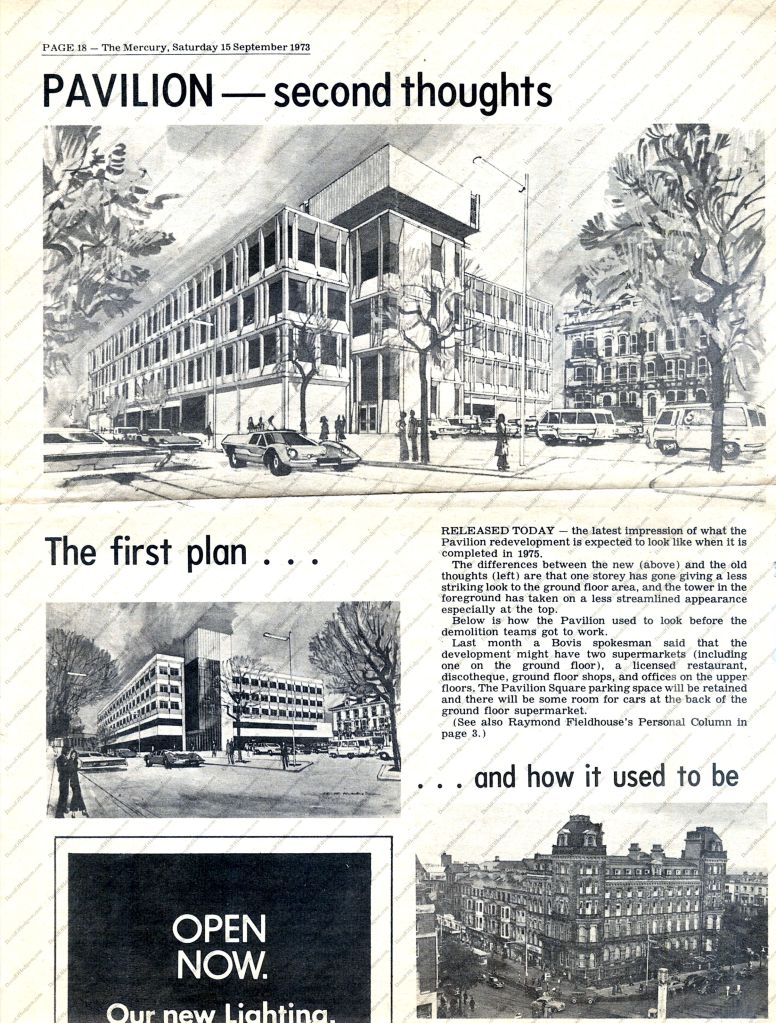
Scarborough Mercury article about Pavilion House. Copyright © 1973, Scarborough News

The building did eventually gain one supermarket, on the ground floor, although, as I recall, that store managed to look run-down from the day it was opened! As regards actual other uses for the new building, I can only remember it as the home of Scarborough Job Centre, in which I spent many useless hours not finding a worthwhile job. It seems perhaps appropriate; a depressing and ugly location for a depressing and hopeless office!

There’s no question that, whatever the aesthetic qualities of those Brutalist buildings, they were and are each unique, and they formed a memorable backdrop to my life in those days.

Working at the BBC: Illusory Limitations

BBC Broadcasting House, from Portland Place

BBC Broadcasting House, from Portland Place

The photo above is, sadly, the only one that I ever took of BBC Broadcasting House, even though I worked there and walked in and out of the building regularly. With the benefit of 40 years of hindsight, I regret that, from 1984 through 1987, I took no photographs at all. At that time, it simply never occurred to me that I might one day want to describe and illustrate what was happening to me! I was only prompted to restart taking photographs when I visited California for a job interview in October, 1987. Therefore, this article, and others discussing the events of this time period, are unfortunately quite lacking in personalized images!

In a previous post, I mentioned how, during the early 1980s, my primary goal in obtaining an Electronics degree had been to obtain what I sincerely thought would be my “dream job”, as a video engineer at the British Broadcasting Corporation (BBC). I finally obtained that job in 1984, almost exactly 40 years ago, so this seems like an appropriate time to review the details of what happened then, and my reactions to it.

Having completed my degree at Imperial College, London, I interviewed for and obtained an entry-level Engineering job with BBC Studio Capital Projects Department (SCPD), which was responsible for building and renovating studios. The final interview seemed to go so well that I actually had the temerity to ask the intimidating board of three interviewers about my chances, given that I’d already received a job offer from the Philips television systems design plant in Croydon (which I did not want to lose, if the BBC turned me down again).

The interview board asked me to leave the room for a few minutes while they discussed my case. When I re-entered the room, they informed me that, subject to their receiving confirmation of my degree grade, I’d got the job! The only further thing they wanted to know from me was, “how come you know so much about television?” I explained that I’d just spent the last 2 years as a volunteer and then Chairman of Imperial College Student Television, which had given me experience in every production job, from producing through presenting to videotape editing.

Now, with the benefit of so much hindsight, I see that I should perhaps have been tipped off by that final question that something was amiss, but, after all, in those days I was just a naïve young graduate, who naturally trusted that my new employer would be acting in my best interests!

Letter from the BBC, informing me that I'd been selected

Letter from the BBC, informing me that I’d been selected

I was overjoyed at being offered the opportunity that I had sought for so long, but unfortunately I was soon to discover that the reality of my new job was not at all what I’d anticipated.

Digression: The Realities of Auntie

For readers who do not live in Britain, I should perhaps explain something about the exalted status of the BBC (nicknamed “Auntie”) in that country’s national mindset. (This reputation has been seriously damaged by recent scandals, including official cover-ups of abusive and pedophile behavior by certain BBC celebrities, but, back in those days, that was all kept firmly secret.)

It may come as a surprise to you to learn that, in a country that is supposedly a cradle of free speech, the BBC was for many decades a monopoly broadcaster in Britain. For many decades, by law, only the BBC could broadcast radio or television services. As from 1923, all British residents had to pay an annual licence fee to operate broadcast reception equipment, although since 1971, only television receivers have required a licence. Any other organization that attempted to broadcast was a “pirate”, and the British government made strenuous efforts to shut down such organizations whenever they could. Nonetheless, broadcast advertising was such a lucrative market that many pirate radio stations did operate. As I recounted in a previous post, the governor of my own school was a director of one such pirate station!

Despite its monopoly, the BBC was not officially an arm of government. It was nominally independent, and, although it usually toed the government line, its independence was sometimes the cause of friction between the Corporation and officialdom.

The BBC lost its monopoly on television broadcasting in 1955, when the Independent Television Authority began broadcasting a rival, regionally-distributed, ITV service, supported by advertising. Nonetheless, the BBC was still regarded as the “high-brow” service, and was accorded perhaps-undue respect for that.

As regards engineering training, the reality for many years was that only the BBC offered any professional training. ITV’s contractors usually simply poached trained engineers from the BBC. Therefore, it seemed to me that the only way to get into broadcasting was to undergo the BBC’s training, and the only way to obtain that was to work there.

It turned out that I was wrong, on many counts.

It’s Not Licence-Payers’ Money We’re Wasting!

I began working for the BBC on 13th August, 1984. The location of my office was the so-called “Woodlands” building, which was at 80 Wood Lane, quite close to Television Centre in White City.

BBC Television Centre, as illustrated in the Ladybird book "How it works: Television". The employee canteen looked out onto the "Blue Peter Garden", which was located in the area marked "20" in the diagram. Copyright © 1968, Wills & Hepworth Ltd.

BBC Television Centre, as illustrated in the Ladybird book “How it works: Television”. The employee canteen looked out onto the “Blue Peter Garden”, which was located in the area marked “20” in the diagram. Copyright © 1968, Wills & Hepworth Ltd.

I went through the expected employee induction process, but, as I settled into the job, it began to seem that there was actually very little for me to do. Having asked to be assigned some work, I was given various unnecessary tasks, such as auditing the acceptance of a new audio mixing desk, which in fact had already been accepted. I was provided with no information about the expected performance characteristics of the audio desk, so my review was mostly meaningless anyway.

As I recall, the single highlight of that period of my employment occurred one day when we got an urgent message that a radio microphone had failed at Broadcasting House, a few hours prior to a live broadcast. I rushed over there with two colleagues to investigate, only to discover that a wire had come loose within the microphone base. We obtained a soldering iron, and (thanks to my EP1 training at Ferranti), all was fixed a few minutes before the broadcast! Seriously, that was as “cutting-edge” as things got!

South Elevation of Broadcasting House, from the book "London Deco", by Thibaud Hérem[20]. Copyright © 2013 Nobrow Press

South Elevation of Broadcasting House, from the book “London Deco”, by Thibaud Hérem. Copyright © 2013 Nobrow Press

I complained to management about the lack of available work, but got nothing except shoulder-shrugging in response. Initially, they explained that it was because they had done me a favor by allowing me to start early, prior to the official training date at the Evesham training school. That excuse might have made sense, except for the fact that it was obvious that my fully-trained colleagues didn’t have sufficient work either!

I became disillusioned with the justifications that were being offered to me by SCPD management, and by what seemed to be a haughty refusal to engage with me. Having selected some of the best graduates from the best British universities, apparently they now expected those same people to accept seemingly illogical decisions without question! It seemed obvious to me that, despite their heads-in-the-sand attitude, they would not be able to maintain the charade indefinitely, and that the likely ultimate result was that at least some of us would be made redundant. The only remotely meaningful response that I ever got was, “Don’t rock the boat”. What “boat”? Why were my concerns about the true situation “rocking” anything?

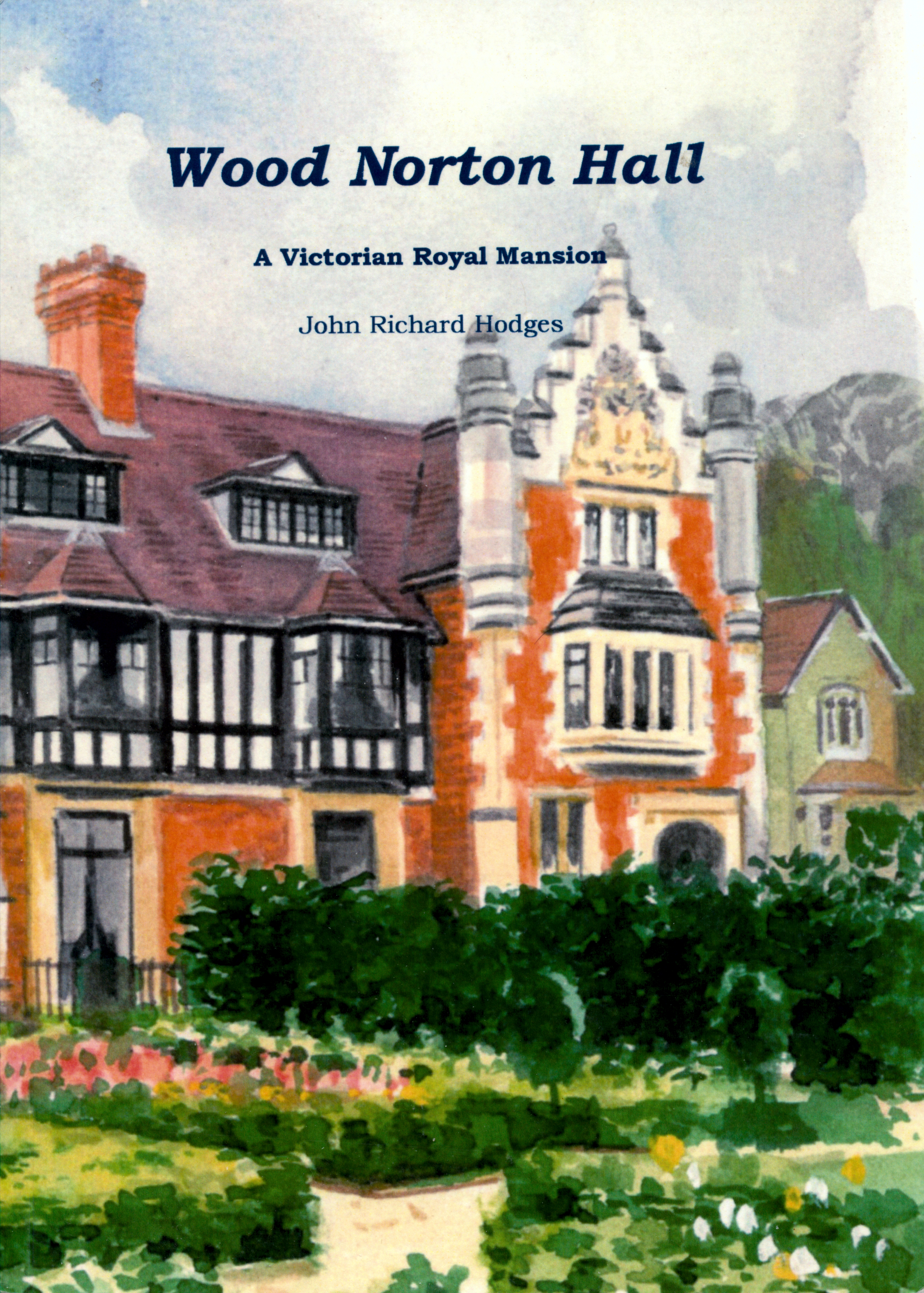
Following a few months of this tedium, I was sent along with many other new-hire engineers for the formal residential training sessions at the BBC Engineering Training School, which was located at Wood Norton Hall, in Evesham, Worcestershire (and which still exists, but is now a hotel). There is an entire book about Wood Norton Hall. It’s out-of-print, but can be obtained used, at, for example, https://www.amazon.co.uk/Wood-Norton-Hall-Victorian-Mansion/dp/0955405793/ref=sr_1_1

The cover of the book about Wood Norton Hall. Copyright © 2014 John Richard Hodges

The cover of the book about Wood Norton Hall. Copyright © 2014 John Richard Hodges

As part of that course, we were required to undergo the EP1 training specified by the Institution of Electrical Engineers (IEE). As I mentioned in a previous post, I had already spent several months completing exactly that training at Ferranti, and had a certified notebook to prove it. Why, then, should I spend time redoing exactly the same training? When I asked that question, it became apparent that I was by no means the only new BBC trainee who had already completed the EP1 training.

I pointed out to management that forcing us all through the same training again was a serious waste of money. The BBC were always sensitive to the suggestion that they were squandering licence-payers’ money, so management was eager to defend their stance, with this appalling justification: “It’s not licence-payers’ money we’re wasting. The Engineering Industry Training Board (EITB) reimburses us for the cost of EP1, so it’s the EITB’s money we’re wasting!”

Wood Norton Hall as it appeared when I worked there. The upper floors had been destroyed in a fire during World War II, and never replaced! Copyright © 2014 John Richard Hodges

Wood Norton Hall as it appeared when I worked there. The upper floors had been destroyed in a fire during World War II, and never replaced! Copyright © 2014 John Richard Hodges

Sorry; Your Degree is too Good

At around that time, it struck me that the job I’d accepted at the BBC was not the role that I’d originally had in mind. My initial application, in 1980, had been for an “Operations” job, that is, as a technician who operated or maintained broadcasting equipment. Those were the kind of roles I’d noticed when I visited Yorkshire Television, and which had stimulated my interest in working in the field in the first place.

Therefore, I asked my manager whether I could transfer from SCPD to one of the Operations Departments. His astonishing answer to me was along the lines of, “Oh no. Those jobs are for people with third-class degrees. Your degree is too good for that!”

So, apparently I’d gone from being underqualified for the BBC job in 1980, to being overqualified for it in 1984!

Having made no headway in trying to argue the problem with management, I eventually began looking for alternative employment, even if that would mean leaving the field of “video engineering”. After various interviews, I was offered an exciting position as “Technical Sales Engineer” by an electronics distributor called Swift-SASCO, who were based in Crawley, Sussex (but not in any way related to my previous employer, Swifts of Scarborough). Not only was the salary in that position comparable to what I was earning at the BBC, but they also offered an all-expenses-paid company car, plus the potential for sales bonuses. The offer was simply too good to ignore, so I accepted it and handed in my notice at SCPD, thinking sadly but mistakenly that that would be the end of my short career in video!

Retrospective: My Alternatives

Alternatively, I realize that I could perhaps have viewed my unproductive months of training at the BBC as being merely “paid education” and patiently plodded through it without complaint. I could also have spent my “enforced idleness” in exploring more of those historic buildings in which I found myself working. Perhaps I could then have moved to one of the ITV contractors? I’ll never know whether that would have worked out, but it would certainly have propelled the remainder my life in a very different direction, so in retrospect, I’m glad I did not.

In fact, I had overestimated the value of the BBC training. I’ve subsequently worked with many expatriate British engineers, quite a few of them specializing in video equipment design, yet not one of them ever underwent that BBC training! I discovered that the BBC’s engineering expertise simply was not held in high regard in the electronics or computer industries. As one former boss told me, “The BBC think they know it all, because they think they invented television. They don’t and they didn’t.”

After leaving the BBC, I stayed in contact with some of my former colleagues for a while. The word that got back to me was that, following my departure, management seems to have implicitly realized that the situation had been mishandled, and had made an effort to change their attitude. When one of my colleagues subsequently complained about some other unsatisfactory situation, his manager’s response was, “I’m glad you let us know. We don’t want anyone else to leave”!

I also discovered in the same way that, about six months after I resigned, many of my former colleagues were, in fact, made redundant from SCPD. My foreboding had been correct.

Why the Secrecy?

Nobody at the BBC ever offered me an explanation of what seemed to be the unreasonable behavior of SCPD’s management. Therefore, I can only surmise what was really happening at that time, based on descriptions and opinions I’ve received from other video engineers, inside and outside the BBC.

Here is what I was told:

Why did Studio Capital Projects have insufficient work?

As discussed in detail here, the then Prime Minister, Margaret Thatcher, and her Tory government, were engaged in a rather ridiculous ideological dispute with the BBC. The BBC (rightly) valued its independence, and its goal of providing objective, unbiased news reporting. Thatcher, on the other hand, took the view that, being funded by a licence fee, the BBC should in fact be a government propaganda arm. Unable to shut down or defund the BBC, she made petty attempts to hobble its position in other ways.

One such way was to insist that the BBC must “operate competitively”, supposedly to obtain value for money for licence-payers. Previously, whenever a BBC studio required refurbishment, the work had automatically gone to SCPD. Now, however, the BBC were forced to request bids for such work, not only from SCPD within the corporation, but also from external private companies.

The result was that external contractors always underbid, and so were awarded the contracts, leaving SCPD (which had bid according to the true costs of a project) without any work.

Logically, of course, if SCPD had no work, then the department should have closed or been repurposed. However, in that case, Thatcher would have won what was really a purely political battle, and some in the BBC were apparently determined not to concede.

Why did Studio Capital Projects hire more Engineers?

Given that SCPD had insufficient work for the engineers that it already employed, why would it nonetheless go ahead and hire even more engineers?

It was later suggested to me that this probably occurred because the BBC was “not a commercial organization”. Its annual income was essentially fixed by the licence fee collections, so the BBC’s budget was based on dividing up that fixed income among the various departments.

The primary way that a particular department could argue for a higher portion of the fixed budget was to employ more people. Hence, the goal of hiring more staff became completely detached from the question of whether such staff were actually needed!

Bad Times on the Horizon

The management issues that affected my employment at the BBC came as a great shock and disappointment to me at that time. Little did I realize back then that it would be just the start of a frustrating sequence of jobs with UK engineering employers, which would continue until I “escaped” to California (and relative sanity!) in 1987. Through no failing of my own, I worked for several employers during that 3-year period, with the management of each company being at best unstable, and at worst incompetent, as I experienced firsthand a portion of the terminal decline and failure of Britain’s electronics and computer industries. I hope to write more about some of those experiences in future posts.

It seems that the kind of mismanagement that plagued my employment experience in Britain is not a thing of the past. I was shocked by the recent news of the appalling Horizon Scandal in Britain, which seems to have stemmed from technical incompetence, and subsequent attempts by management to cover that up at any cost.

I am So Glad I Left

Let me emphasize once more that, in hindsight, I am so glad I quit that BBC job when I did! If I had not done that, but instead had listened to the discouraging comments of certain timid naysayers around me, and had clung on there, I would probably never have had the opportunity to move to California and work in “Silicon Valley”. As I have described in several earlier posts, there’s no question that the move to California changed my life immensely and permanently for the better.

I gave some thought to the wording of the title of this post. The phrase “illusory limitations” reflects both the way that I underestimated my own potential skills at that time, and the way that others attempted to impose false limitations on me. When I joined the BBC in that role, I really thought that it was the best I could do. I did not seriously imagine in those days that I could become a design engineer, and certainly not a patent-holding inventor. Fortunately, I didn’t ultimately settle for an underachieving career!

The message that I hope this tale of my experiences will convey to readers is not to be cowed by the unreasonable demands of any employer. Be confident in your own position, and don’t sacrifice your own future for the convenience of others who ultimately do not have your best interests at heart.

BBC Broadcasting House, from Portland Place

BBC Broadcasting House, from Portland Place

Michael Palin Interview: Out-Takes

In an earlier post, I described some thought-provoking comments about the Monty Python movie “The Life of Brian” that Michael Palin made to me during my student TV video interview with him, back in 1983.

Recently, I’ve been reformatting an ancient video recording of that interview. The entire interview is over 30 minutes in length, and some of it has become quite outdated. Nonetheless, there are some sections that could still be relevant.

For this post, I decided to edit together some of the clips that did not make it into the interview. These were “out-takes”, in which something went wrong (intentionally or otherwise!) during the shot. I can’t honestly say that these have never before been broadcast, because most of them were actually included in the Student TV’s annual “bloopers” program that was screened just before Christmas. Anyway, they’re still quite funny, after all this time.

The content of the clips probably speaks for itself, but I should perhaps explain why the shots appear the way that they do. The interview was an “outside broadcast” for us, so we took along only one camera (because in those days when camcorders were new technology, we had only one portable camera). Therefore, to shoot the main interview, we locked off the camera pointing at Michael, and recorded the entire session like that. That’s why, in most of the video, you can only see him, and hear me talking to him in the background.

Once the main interview had been recorded, we moved the camera to an over-the-shoulder shot of the two of us, then recorded some video of that for cutaways, which would be edited into the main tape.

Finally, after Michael left, we moved the camera to point at me, and recorded all my questions and reactions again, with me facing an empty chair.

I must apologize again for the poor video quality, due to the number of format conversions that this recording has undergone over the years. It’s worse in this case because some of the video was recorded during setup, so the camera is shaking around and there are even color bars over some of it. Nonetheless, I think it’s still sufficiently funny to be worth viewing.

The photo below is the best-quality shot that I have remaining from that occasion, because it’s a professional publicity shot of Michael Palin.

Michael Palin Publicity Photo c.1983


Pallab and the Wide-Mouthed Frog

As I described in an earlier post, I first met Pallab Ghosh when we were both undergraduates at Imperial College, London. Pallab later went on to have a distinguished career in science journalism, becoming a major BBC Science Correspondent.

In 1983, Pallab asked me to create a fantasy portrait of him, to be used as a poster for his campaign for election as Editor of the Imperial College student newspaper, Felix. My portrait of him is reproduced again below. Pallab duly won that election.

Pallab Ghosh as "Super-Ed" (Superman)

Pallab Ghosh as “Super-Ed” (Superman)

Even before becoming Editor of the student newspaper, Pallab had gained a reputation in the college for telling one particular joke, “The Wide-Mouthed Frog”. He didn’t create the joke, which was already in circulation when I was at school, but there was something about “the way he told it”!

Recently, I unearthed a VHS videotape that was an off-air recording of one of the news shows broadcast by Student Television of Imperial College (STOIC). This edition included an interview that I had just recorded with Pallab in the TV studio.

I apologise here for the poor video quality of the clip, and for the crude jump-cut. In the early part of the interview, we discussed Pallab’s predecessor as Felix Editor, and his plans for the publication, which are unlikely to be of much interest after all this time! Thus I removed those portions of the recording.


Are You Being Served?

Bloomsbury Square, London, in Snow, 1981

Bloomsbury Square, London, in Snow, 1981

The photo above, which I took in 1981, shows Bloomsbury Square, London, following a seasonal snowfall. At the time that I took the photo, I was working part-time at Selfridges, a well-known department store on nearby Oxford Street.

In previous posts, I’ve described how I moved to London in October 1981, to begin my studies for an Electronic Engineering degree at Imperial College.

In Britain, each undergraduate academic year is divided into three terms: Autumn, Spring and Summer. There’s a short Christmas break between the Autumn and Spring terms, and another Easter break between the Spring and Summer terms. Typically, during the short breaks, young students return home to their parents, and take the time off.

My family situation, however, was somewhat different. My father had died in 1979, and my mother was struggling to support herself, so I did not feel that I could just go back and expect her to support me as well. Instead, I decided that I would try to stay in London and obtain temporary work during the short breaks. I found that it was possible to stay in my student accommodations during the breaks if I paid additional rent.

Finding suitable work turned out to be relatively easy, but, in retrospect, I have come to doubt that the job choices I made were for the best.

The Scarborough Pattern

During my schooldays, I had become accustomed to seeking work in menial jobs during the school holidays. In a seaside resort like Scarborough, that usually meant working as a waiter in a hotel or café, or perhaps as a shop assistant. Even if I had had the skills to do more sophisticated work at that age, such work was probably not available in that town anyway.

Thus, when I found myself becoming a student again, this time in London, I fell into the mindset of seeking out types of temporary work that were similar to those that I’d done in Scarborough.

That was a mistake; I should have searched for jobs that would have made better use of my special skills, and would probably have paid better. I was in the very unusual situation of having just worked fulltime in accounting for 2 years prior to starting my studies. Surely, in a world financial center such as London, I could have obtained some temporary work in that field!

The only good aspect of these menial jobs was that the experiences have left me with a cache of anecdotes about the events that occurred.

Mister Selfridge

Prior to the Christmas break for my first academic year in London, I applied to Selfridges Department Store for a sales assistant position, and was accepted.

As a teenager growing up during the 1970s, I was very familiar with the popular (but low-brow) situation comedy series Are You Being Served?, which actually ran on the BBC from 1972 through 1985. The show was set in a fictitious London store called Grace Brothers, but, as I was to discover, the staff uniform of Grace Brothers was strangely similar to that of Selfridges.

More recently, Selfridges has gained worldwide fame as a result of the television series Mister Selfridge, which portrays the early history of the business. Although the TV series used specially-built sets to depict the store, many of these seemed very accurate, and reminded me of the rooms and corridors within the huge building.

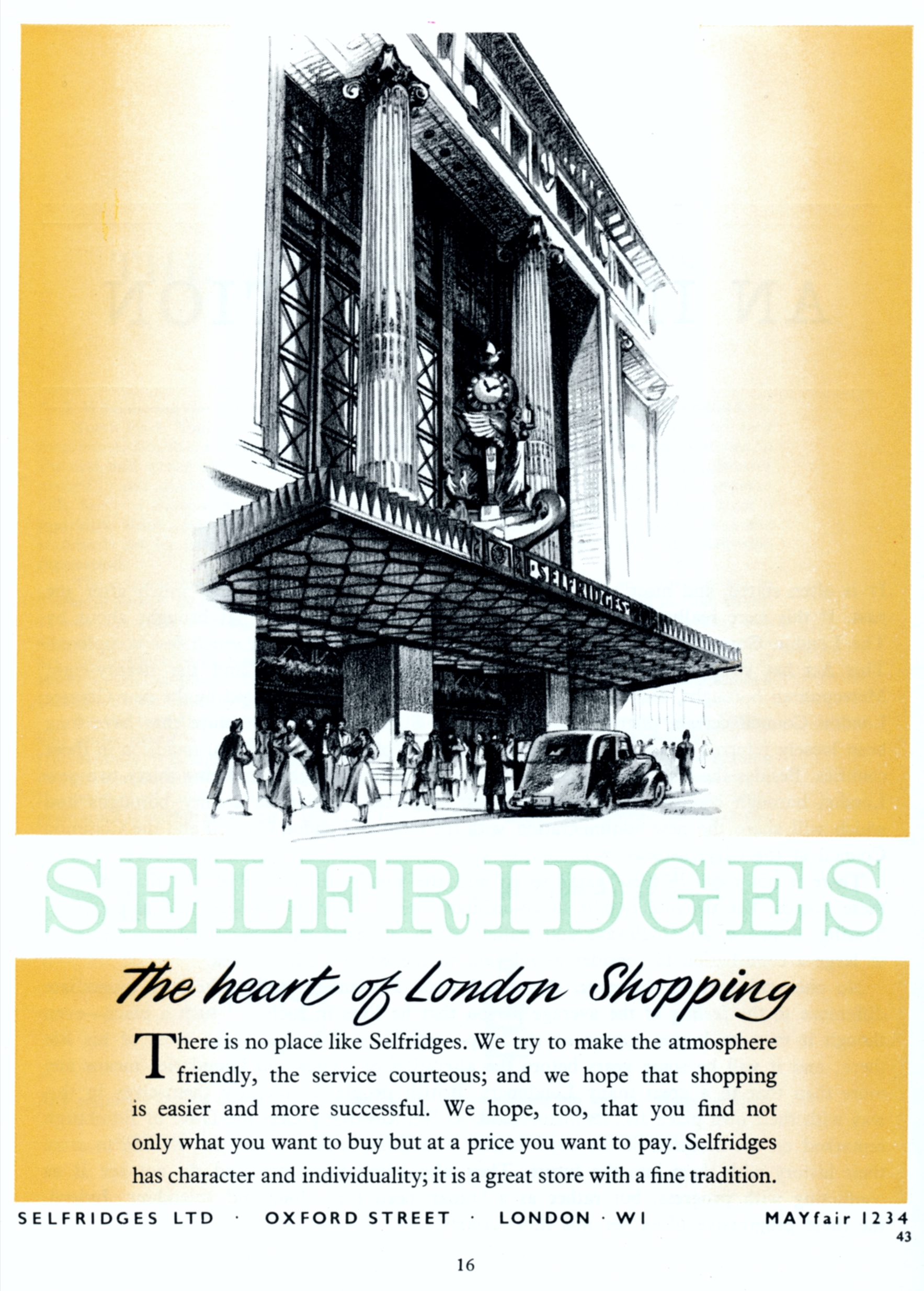
The illustration below is an advertisement that Selfridges ran in a 1964 book about London boroughs.

Advertisement for Selfridges, 1964

Advertisement for Selfridges, 1964

There are many stories to tell of surprising and amusing incidents that I experienced while working at Selfridges (and also at Harrods, during one break), or in some cases heard about from other employees, but there isn’t room to tell all of them in this article. Between Christmas 1981 and Spring 1983, I worked in several different Selfridges departments, including luggage, gifts, and finally electronics.

The Electronics Department

In this article, I’ll jump ahead to what turned out to be my final stint as a part-time employee at Selfridges. During the Spring of 1983, I worked Saturdays-only in the Electronics Department in the Oxford Street store.

Now, surely, this department was ideal for me. After all, I was an undergraduate EE student, so now I would be able to bring that knowledge directly to bear in helping Selfridges’ customers. While that turned out to be true, I discovered later that my special skills were not received in a similar light by the department’s regular staff. Although the store hired many students as part-time workers, there was also a substantial staff of full-time employees, whose entire career was wrapped up in their work there.

One Saturday, I was standing at the counter in the Electronics Department when I was approached by an apparently exasperated customer. He explained to me that he wanted to power an item of equipment from a 12V car battery. He knew the maximum current that the battery could supply, but didn’t know whether the battery could supply sufficient power for the equipment.

I explained to him the simple equation relating electrical power to voltage and current (W = VI) that I’d learned during my O-level Physics classes at school. We were able to determine that his battery would be able to supply more than sufficient power for the equipment.

After we’d finished performing the calculation, the customer had a question for me:

“How come I’ve asked this question of every assistant in this department, and you’re the only one who could tell me?”

I responded, truthfully, that it was probably because I was the only undergraduate electrical engineering student working in the department.

I thought nothing more of the incident, which seemed at the time to be just another of the usual daily problems that arose, and which I had successfully handled. My Saturdays-only employment terminated by mutual consent, and as far as I was aware, there was nothing but goodwill between myself and my employer.

The Assistant Who Knew Too Much

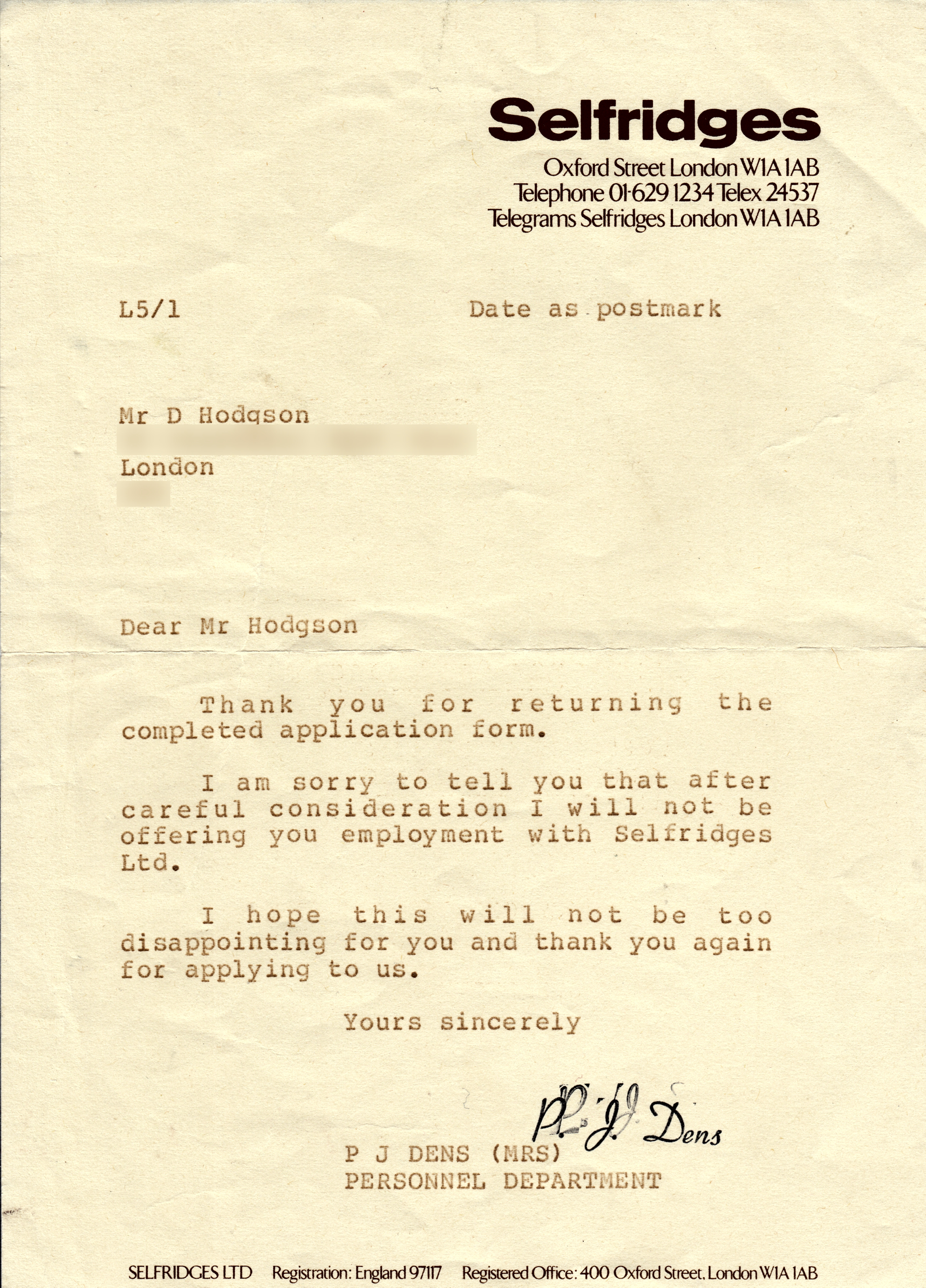
When I subsequently applied for re-employment during Christmas 1983, I received the following surprising and mystifying response:

Rejection!

Rejection!

I can only believe that, unbeknown to me until then, my unusual expertise in electronics had ruffled some feathers somewhere among the store’s fulltime staff. The content of the letter is strangely brusque and unhelpful; it’s obviously a form letter, personalized with my name and address, but not the date!

Unfortunately, there are no photos of me working at Selfridges (or at any of the other London locations where I did temporary work). However, the photo below was taken at about the same time that I was doing those Saturday stints at Selfridges, and just after I had produced a video interview with Sir Cliff Richard at the Imperial College TV Studio.

Me (left) following a video interview with Sir Cliff Richard

Me (left) following a video interview with Sir Cliff Richard, 1983

Don’t Sell Yourself Short

In retrospect, then, I have come to believe that working in those menial jobs was a mistake, and I recommend others in a similar situation to think very seriously before committing to such work.

The issue isn’t simply that you’ll be wasting your time and skills, and perhaps accepting lower compensation than necessary in return. There’s also the problem that your superior skills are likely to cause resentment among others, who in some cases may go to considerable lengths to combat what they see as your “unfair advantage”.

Bloomsbury Square, London, in Snow, 1981

Bloomsbury Square, London, in Snow, 1981

Centenary of the Great War Armistice

St Clement Danes Church, London

St Clement Danes Church, London

The photo above, which I took during an early visit to London, shows the RAF memorial church of St Clement Danes. The building was completely destroyed during the Second World War, and fully restored in 1958, to act as a war memorial for the Air Force.

As most people are probably aware, today (11th November 2018) marks the centenary of the end of the First World War (known earlier as the Great War). There has been and continues to be much debate about the causes of that devastating war, and the issue will probably never be completely settled. What does seem clear is that, in those days, many European nations saw warfare as a satisfactory way to resolve disputes or gain territory, and had created detailed plans defining exactly whom they were going to attack and how. Their autocratic leaders were really just “spoiling for a fight”, and were supremely (but mistakenly) confident that they could win a swift, decisive victory.

It seems clear now that, if the conflict hadn’t been sparked by the assassination of Archduke Ferdinand by a Yugoslav nationalist, then some other equally parochial incident would have served as the trigger.

The situation was made more volatile by the nationalistic attitudes of the general populations, who tended to see war as a spectator sport. Many were quite prepared to sit happily on the sidelines and cheer as their “team” slogged it out with the opposition. Warfare had usually been conducted that way for centuries, but all that was to change as the Great War turned into “total war”, involving substantial portions of the civilian populations.

The Invasion of Leeds?

Of course, I’m not nearly old enough to have lived through the First World War, let alone remember anything about it. However, my father was 5 years old when the war began in 1914, and he did have some memories of the time.

His family lived in Leeds, Yorkshire, which is some 60 miles from the coast of the North Sea, and thus was not likely to be in any direct danger from enemy action. Nonetheless, my father’s mother was apparently certain of an immediate German invasion, and insisted upon placing sandbags around the house on the outbreak of war! Apparently, even then, not everyone believed that the war would take place on faraway fields.

Raid on Scarborough

My home town of Scarborough became a flashpoint during the First World War, after being subjected to a German naval raid during December 1914. That attack was characterized as a brazen assault on civilians (and it’s difficult to see how it could have served much other purpose), and had the presumably-unintended consequence of offering a major propaganda opportunity for the Allied nations.

During the bombardment, Scarborough’s lighthouse was one of many buildings that were hit and damaged, but it was subsequently repaired, as shown in my photo below.

Scarborough Lighthouse, 2007

Scarborough Lighthouse, 2007

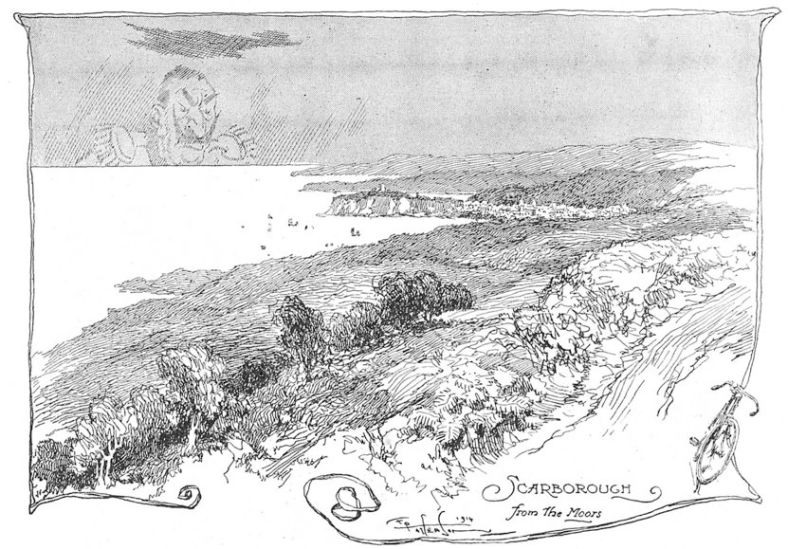
British illustrator Frank Patterson, whom I’ve mentioned in a previous post on my professional web site, normally avoided propaganda-style artwork. Apparently, however, he was so incensed by the attack on Scarborough that he produced the illustration below, showing a thunderous Kaiser glowering at the town from over the horizon.

Scarborough from the Moors, 1914. Copyright Frank Patterson

Scarborough from the Moors, 1914. Copyright Frank Patterson

A Changed World

Whatever its actual causes and motivations, there can be no doubt that the First World War changed the course of history very significantly, and not only in terms of international relations and territorial dominance.

The war essentially spelled the end of the colonial empires created by European powers during the preceding few centuries. Admittedly, some empires (such as the British and French) clung on for a few more decades, but the new order of affairs was already being set up at the end of the First War.

On the social level, agreements made during the War led to women eventually obtaining the right to vote in several countries, such as Britain. From the modern perspective, it seems astonishing that such a development took so long, and no sane, educated person would now suggest that women should not have such a right.

The First World War was undoubtedly a disaster of immense proportions, but some social good did eventually come of it.

St Clement Danes Church, London

St Clement Danes Church, London

London’s Post Office Tower: My First & Only Visit

Cover of my School Study, 1971

Cover of my School Study, 1971

At the age of eleven, I produced the illustration above for the cover of a “London Study” that we were required to write and illustrate at school. The study was created in connection with our school visit to the capital city, which had taken place in May 1971, just before I drew the cover.

As you may expect (given my interests), my cover drawing emphasized modes of transport. Additionally, I chose as the centerpiece a striking modern building to which we had paid a surprise visit during the trip, and which had substantially impressed me. Little did I know at that time that it would probably be my only opportunity ever to visit that iconic building.

The building in my drawing was the recently-built Post Office Tower (now known as the BT Tower). Even before that first visit to London, I was well aware of the existence of that structure, which was feted as a prime example of Britain’s dedication to the anticipated “White Heat of Technology”. In addition to its role as an elevated mount for microwave antennas, the Tower offered public viewing galleries providing spectacular views over Central London. There was also the famous revolving restaurant, leased to Butlin’s, the famous operator of down-market holiday camps.

The Tower and its restaurant began to feature prominently in the pop culture of the time. An early “starring” role was in the comedy movie Smashing Time, where, during a party in the revolving restaurant, the rotation mechanism supposedly goes out of control, resulting in a power blackout all over London.

In the more mundane reality of 1971, our school class arrived in London and settled into a rather seedy hotel in Russell Square. One evening, our teacher surprised us by announcing an addition to our itinerary. We would be visiting the public viewing galleries of the Post Office Tower, to watch the sun go down over London, and the lights come on! Needless to say, we were thrilled, even though we had no inkling that that would be our only-ever chance to do that.

There were actually several public viewing gallery floors, some of which featured glazing, while others were exposed to the elements, except for metal safety grilles. Fortunately, the weather during the evening that we visited was not exceptionally windy!

Concretopia

I’m currently reading the book Concretopia, by John Grindrod, which provides a fascinating history of Britain’s postwar architectural projects, both public and private.

Cover of Concretopia Book

One chapter of the book is dedicated to what was originally called the Museum Radio Tower (referring to the nearby British Museum). It provides detailed descriptions of the decisions that led to the construction of the tower, and reveals that at least one floor is still filled with the original 1960s-era communications technology.

Due to subsequent changes both in communications technology and British government policies regarding state involvement in such industries, much of the original function for which the Tower was built has now been rendered obsolete or moved elsewhere, leaving the building as something of a huge museum piece (ironically, in view of its original name).

The Once-and-Only Visit

In October 1971, a few months after my school class visit, a bomb exploded in the roof of the men’s toilets at the Top of the Tower Restaurant. Initially it was assumed that the IRA was responsible, but in fact the attack was accomplished by an anarchist group.

Fortunately, nobody was hurt in the incident, but it drew attention to the security vulnerabilities created by allowing public access to the Tower. The result was that the public viewing galleries were immediately closed down, never to be reopened, and Butlins’ Top of the Tower restaurant was informed that its lease would not be renewed after that expired in 1980.

Nonetheless, the Tower continued to appear in the media as an instantly recognizable icon. At around the same time, it was supposedly attacked by a particularly unlikely monster—Kitten Kong [link plays video]—in the British TV comedy series The Goodies.

My younger brother took the same school trip to London two years after me, but it was already too late; the Tower’s public viewing galleries were closed, so he never got to see the London twilight from that unique vantage point.

The Unexpected Technologist

On that first visit to London in 1971, I had no notion that I personally would ever be a participant in the kind of exciting technological innovation signified by the Tower. In my family’s view, such advances were just something that “people like us” observed and marveled at, from a remote state of consumer ignorance.

I never anticipated, therefore, that I would return to London as an adult only ten years later, to begin my Electronics degree studies at Imperial College, University of London. I had to visit the University’s administration buildings in Bloomsbury to obtain my ID and other information, and there was that familiar building again, still looming over the area. (The University Senate House is also famous for its architectural style, but I’ll discuss that in a future post!)

My 1982 photo below, taken during my undergraduate days, offers an ancient-and-modern architectural contrast, showing the top of the Tower from a point near the Church of Christ the King, Bloomsbury.

Post Office Tower & Bloomsbury, 1982

Post Office Tower & Bloomsbury, 1982

The Museum Tower

The photo below shows the Tower again, during a visit in 2010, now with its “BT” logo prominently on display. Externally, the tower looks little different from its appearance as built, and, given that it’s now a “listed building”, that is unlikely to change much in future.

BT Tower, 2010

BT Tower, 2010

For me, the Post Office Tower stands as a memorial to the optimistic aspirations of Britain’s forays into the “White Heat of Technology”. It seems that, unfortunately, the country’s “Natural Luddites” (which C P Snow claimed were dominant in the social and political elite) won the day after all.

Cover of my School Study, 1971

Cover of my School Study, 1971

Ally Pally

IMG0012Cright

Alexandra Palace, London, 1982

I took the photo above, of the remains of Alexandra Palace (colloquially known as “Ally Pally”), while I was a student in London in 1982. I’d seen the Palace from a distance many times before I actually visited it, but eventually I was prompted to go there, partly by a connection to my intended future career.

This immense building in North London is hardly a major tourist attraction, having had a rather unfortunate history and a wide variety of uses since it was built in 1873 (ostensibly as a counterpoint to South London’s Crystal Palace). Nonetheless, the structure remains usable to some extent, and there are currently plans for a major renovation.

The reason that I’d seen Ally Pally so many times before is because it stands prominently on a hilltop, where it can be seen from the East Coast Main (Railway) Line. When traveling between York and London by train, I frequently caught a glimpse of the structure through the carriage window.

I mentioned that the Palace has had a rather chequered past, having burned down on at least two occasions. In fact, there had been a major fire in 1980, just before the visits during which I took these photos. Despite the partial dereliction of the building itself, the grounds are still worth visiting, because of the spectacular views they offer over much of Central London.

The World’s First HDTV Transmitter

Thanks (presumably) to the building’s prominent position, it was chosen in 1935 by the BBC as the site of their first television transmitter. Studios were inserted into the building immediately below the transmitter tower. When the television service first began in 1936, there were alternate transmissions of Logie Baird’s 240-line system and the Marconi-EMI 405-line “High Definition” system.

At the time of my photograph above, the rooms below the transmitter mast were still in use for the broadcasting of Open University programs. As I’ve mentioned in earlier posts, I was studying Electronic Engineering in London because I wanted to get a job with the BBC (which I eventually did), hence my interest in the history of Ally Pally.

Public Events at the Palace

On another occasion when I visited the Palace in 1982, a public festival was underway, and several historic buses from the London Transport collection were ferrying visitors between the Palace and the nearest railway station.

London Transport RT 1 at Alexandra Palace, 1982

London Transport RT 1 at Alexandra Palace, 1982

One notable vehicle that was operating that day was RT 1 (shown above), which was the prototype of the highly-successful AEC RT class of London buses that preceded the famous Routemaster. RT 1 was built in 1939, and was the forerunner of what eventually were 4674 buses of that class, some of which continued in service until 1979.

RT 1 waiting for Custom, Alexandra Palace, 1982

RT 1 waiting for Custom, Alexandra Palace, 1982

RT 1 is seen again here, hemmed in by cars, and earning its keep by shuttling visitors to the nearest railway station. The TV transmitter and studios are visible in the background.

Rails to the Palace

In earlier days, there had been a much closer railway station. To coincide with the opening of the Palace, a railway branch was built from Highgate to the site, which terminated in a station just north of the palace building. The station building still exists today as a community centre, but should not be confused with the modern Alexandra Palace station on the main line.

The line was built by the Muswell Hill Railway, which was eventually taken over by the Great Northern Railway and finally became part of the London & North Eastern Railway group.

Tubes to the Northern Heights

During the late 1930s, London Transport developed major plans to extend its tube railway services in North London, as the so-called “Northern Heights” extensions  of the Northern Line.

Some portions of these lines were to be entirely new, while others were to be electrified sections of existing steam-operated lines. The Alexandra Palace branch became part of the plan, and work to electrify the line began in 1939.

This excerpt from the published 1937 London Underground diagram shows the planned Northern Line extensions, including the branch from Highgate to Alexandra Palace. The line from Edgware to Elstree was to be entirely new, and I mentioned my visit to the “Arches Field” that formed part of the works for that line in an earlier post.

Excerpt from 1937 London Underground map

Excerpt from 1937 London Underground map

Unfortunately, the start of World War II intervened, bringing to a halt all work on the extensions.

After the war, development priorities in Greater London had changed, and it was eventually decided not to complete some of the extensions. British Railways, which had taken over the LNER’s lines, continued to operate passenger trains from Finsbury Park to Alexandra Palace until 1954, when the service ceased.

Ghost Trains of Highgate

The London Transport station at Highgate has its own unusual history. As shown below, due to the cancellation of the Northern Heights extensions, part of Highgate Station ended up as a “ghost” which is still standing unused today.

Things to Come... But they Never Did. Abandoned Highgate Station, 1982

Things to Come… But they Never Did. Abandoned Highgate Station, 1982

The surface-level station was rebuilt in Art Deco style at the same time as the new tube station was constructed beneath it. The tube station remains in use today, which accounts for the bizarre survival of the disused platforms above it.

At the time of my visit to the “ghost” station, it was little known, and was extremely overgrown as shown in my picture, but it has now become quite famous as a “Hidden London” site.

St. Martins School of Art: A Life-Changing Experience

Life Drawing Sketch, St Martins School of Art, 1982

Life Drawing Sketch, St Martins School of Art, 1982

The illustration above shows one of my very earliest “from life” pencil sketches. It was done during an Illustration class at St. Martins School of Art, London, during 1982. Strangely, prior to that, I had never participated in a formal “life drawing” art class anywhere.

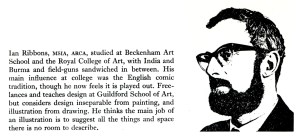
My tutor at that class was an artist called Ian Ribbons. I’m ashamed to say that I knew nothing about Mr. Ribbons at the time, and it was only many years later that I discovered that he was in fact a successful and famous illustrator in his own right.

Developing a Technique

In earlier posts, I’ve exhibited a few later examples of my figure drawings from live models. Those examples were drawn when I’d already gained some experience of life drawing, and some confidence with my preferred technique. However, that knowledge was hard-won, and, as I’ve previously indicated, I seriously lacked confidence in my figure drawing skills until I reached my early twenties.

My lack of competence wasn’t entirely due to my own shortcomings. The inadequacy of what was offered to me as “Art education” at school did nothing to reinforce my confidence or help me to improve. We were not given any classes in drawing the human figure, ever, even as part of the so-called “Advanced Level” course, which seems appalling in retrospect. Occasionally we were given a homework assignment to “do a self-portrait” or “draw some people”, but with no accompanying guidance or help, so inevitably the results were disappointing and demotivating.

(I’m aware that I wasn’t the only one to suffer from this “teachers shouldn’t try to teach” approach to education. There seemed to be a weird but common attitude that trying to inculcate drawing or aesthetic expertise was somehow tyrannizing innocent students, who should instead be left to wallow in ignorance. The result was that we now encounter many “artists” who seem unable to summon much actual artistic skill, which must surely be frustrating for those who are aware of it.)

It was only when I got to Imperial College, and volunteered to be the Publicity Officer of the H G Wells Society, that it dawned on me that I might have “bitten off more than I could chew”. I realized that I was probably going to have to draw people, for public display, and make it look good! It somehow occurred to me that some professional instruction might help, so I sought out the course at St Martins.

Ian Ribbons

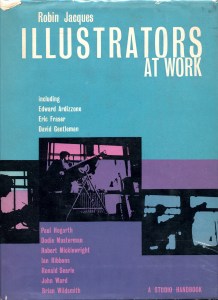
As I mentioned above, my tutor at St. Martins was Ian Ribbons. Years after taking the Illustration class there, I stumbled across a copy of a 1963 book called Illustrators at Work, at a secondhand book shop. The book’s dustcover is shown below.

Illustrators at Work, 1963

Illustrators at Work, 1963

As the cover shows, the book was compiled by the famous British illustrator Robin Jacques (who was the brother of the actress Hattie Jacques), but it includes biographies and samples of the work of many other British artists. There, on page 45, was a section about Ian Ribbons, complete with the following biography:

Ian Ribbons Biography from "Illustrators at Work"

Ian Ribbons Biography from “Illustrators at Work”

Incidentally, the same book also includes a section on Ronald Searle, another well-known British artist, who happened to be a bunkmate of my mother’s first husband in the Japanese POW camp at Changi, Singapore, during World War II. I’ll have more to say about him in a future post! [9/25/20: Now posted. See The POW Artists of Changi]

Benefits of the St Martins Class

There’s no doubt that Ian Ribbons’ guidance was excellent, and it helped me gain some vital artistic confidence, in a way that I had not remotely anticipated. Without that inspiration, I probably would not have produced much of the publicized artwork that I subsequently created while I was a student in London.

For the first time ever, I felt that I had the ability to produce work that could credibly be displayed in a public setting without inducing (unintended) laughter. In retrospect, not all of what I produced in those days was good, but at least I wasn’t paralyzed by perfectionist concerns.

I must add that another major benefit of the Illustration class at St. Martins was simply the opportunity to work alongside other not-so-famous, but very competent, professional artists. There wasn’t really any program of formal instruction, but each of us was working on our own drawings and developing our own techniques.

If I saw another artist using a technique that interested me, I could simply lean across and ask, “How did you do that?”

That was, in fact, how I learned the ballpoint pen technique that I used for the portrait of Pallab Ghosh. Another artist at the class had already used that technique (for a portrait of actor Roger Moore, as I recall), so I simply asked him about it, then tried it myself. I doubt that I would ever have thought of such a technique without his example to look at!

Pallab Ghosh as "Super-Ed" (Superman)

Pallab Ghosh as “Super-Ed” (Superman)

I don’t think that I have ever before or since found myself working among such a concentrated group of talented artists. Presumably that was due to the location: we were in Central London.

Jeopardizing My Degree?

When my tutor at Imperial College learned that I was taking a part-time class at St. Martins, he expressed concern that it could detract from my engineering studies, and possibly even jeopardize my prospects of obtaining a degree! (I was working at Selfridges on Saturdays too, which was also deemed inadvisable.) Fortunately, all those concerns turned out to be nonsense, and I’m really glad now that I took that opportunity to “broaden my horizons”.

London Terror Attack: Don’t Surrender our Freedoms

London Bridge Station & Southwark Cathedral, 1983

London Bridge Station & Southwark Cathedral, 1983

I was very saddened to hear the news yesterday of the latest pointless terror attack in London. Naturally, my best wishes and thoughts go out to all those affected by the incident.

This latest incident reminded me of the ever-present terrorist threat that existed when I lived in London during the 1980s. In those days, almost all the threats (real or hoax) came from the IRA, and there were several actual bombings in London while I was there.

As a result of living in London for a few years, I was forced to think about the delicate balance of opportunities and dangers presented by living in a free society.

Bag Searches

In response to the IRA bombings, every building in London that admitted the public adopted a policy of searching the bags of visitors entering the premises. This naturally included the museums near Imperial College on Exhibition Road, such as the Victoria & Albert Museum. Nonetheless, it seemed clear to me that there was really nothing that could be done to prevent all such threats, and that it was inevitable that some attacks would succeed.

I became quite accustomed to the bag searches when going into a building, but, on one occasion, the guard searching my bag admitted that these efforts wouldn’t really deter a serious threat. He said to me, “This is really just to reassure the public. You could put a bomb in a cigarette packet and walk in with it in your pocket, and we’d never spot it.” Sad but true.

While I was a student, I also worked as a Sales Assistant at Selfridges Store in Oxford Street, London. In that job, bomb threats were a daily nuisance, although, while I was there, all of them fortunately turned out to be hoaxes.

The point I want to make here is that, during all the years that I lived in London, I was never personally involved in an actual attack of any kind. The press coverage naturally given to such events makes it seem that they are more widespread than they really are. The attacks of the IRA were a real danger and a constant worry during those years, but they failed in their aims, and they never prevented Londoners from going about their lives.

Unfortunately, it suits the purposes of some politicians to exploit this kind of event to whip up fears and con the public into signing away their own freedoms. We’ve just seen a particularly transparent attempt to do that, with the irrelevant and unhelpful tweeting of Tweedle Don, trying to link the London atrocity in the UK to his unconstitutional travel ban in the US.

Don’t be Intimidated into Surrendering our Freedom!

Given the possibilities for committing terrorist attacks in large conurbations such as London, it’s actually a relief that so few actually succeed. I realize that this is no consolation for those whose lives are affected by these atrocities, but, for the remainder of the population, it’s important not to blow these events out of proportion.

The only way to guarantee that such attacks could not happen would be to implement a surveillance police state, which would entail giving up many of our existing freedoms. However, most of us value our freedom, and wouldn’t want to live in such a state. The price of living in a free society is the risk that a few such horrific events will occur.

Of course, that realization makes it no less shocking when these things do happen.