Living in Brutalist Britain

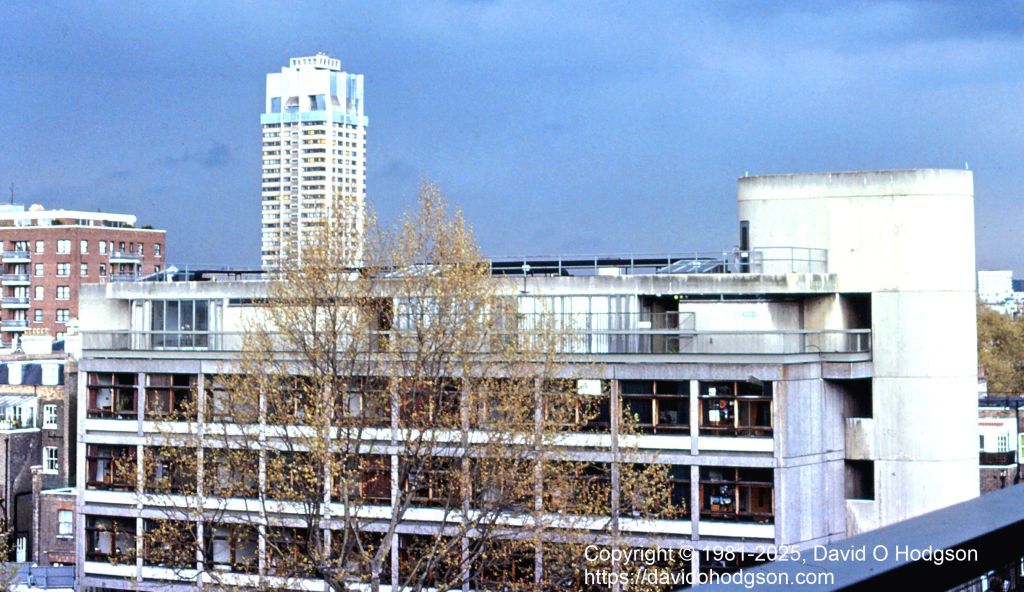
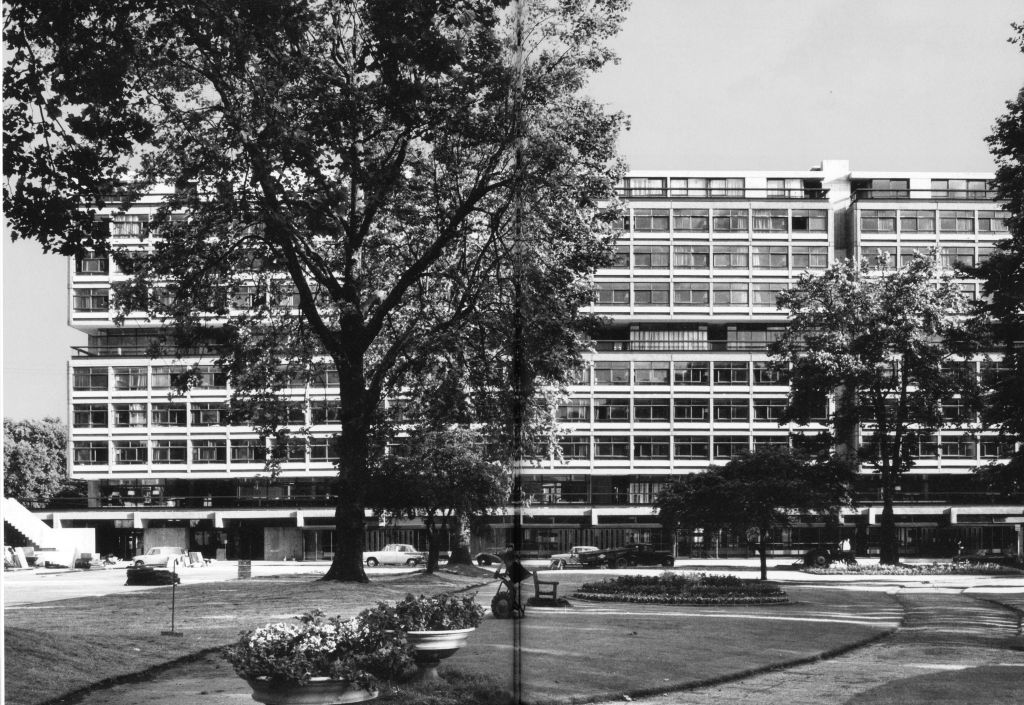
Linstead Hall, Imperial College, London, from my residence in Southside Halls

A few weeks ago, my wife and I went to see the movie The Brutalist. The extent of the hype for this movie was truly breathtaking, which may be partly why I was not surprised that it did not live up to its “promise”.

I must admit that media coverage led me to question whether those who were singing its praises even understood anything about the movie’s subject matter! For example, a fawning item about it on ABC News included paroxysms of praise for the movie’s stars and director, but never actually mentioned what the movie is about, nor was there any explanation of what the title “Brutalist” referred to! I guessed that it must have something to do with Brutalist Architecture, and it turned out that I was correct, but that was no thanks to ABC. Did the presenters really not understand it themselves, or had they decided that the explanation was too “intellectual” for their audience?

Perhaps that is, in fact, the key to the praise that the movie has received. It seems that the less a reviewer knows about its subject, the more they like the movie. Those who do understand its subject matter, professional architects, have been highly critical of its blunders and implausibility, to the extent that they are described as “hating” it in this article.

I also thought that, given its thin, questionable plot and appalling examples of ignorance, the movie was much too long at 3 hours, 35 minutes. As the Guardian reviewer states sarcastically:

“The architecture world awaits with bated breath the director’s five-hour marathons, The Postmodernist, The Deconstructivist, and The Parametricist – each to be shot with period-appropriate equipment and based on a brief skim through a coffee-table book”

Personally, the only benefit that I obtained from the movie experience was that it prompted me to think once again about the real Brutalist architecture that I grew up in and around, the history of which I find infinitely more interesting than any aspect of the movie.

Growing up, Brutalist architecture was a constant background theme in my life, and I even lived in one example of it for a while.

Brutal Aylesbury

I never actually lived in the Buckinghamshire county town of Aylesbury, but, as I recounted in a previous post, my first visit there involved a job interview and a “computer programming aptitude test” that had a profound effect on my view of my own abilities in that field.

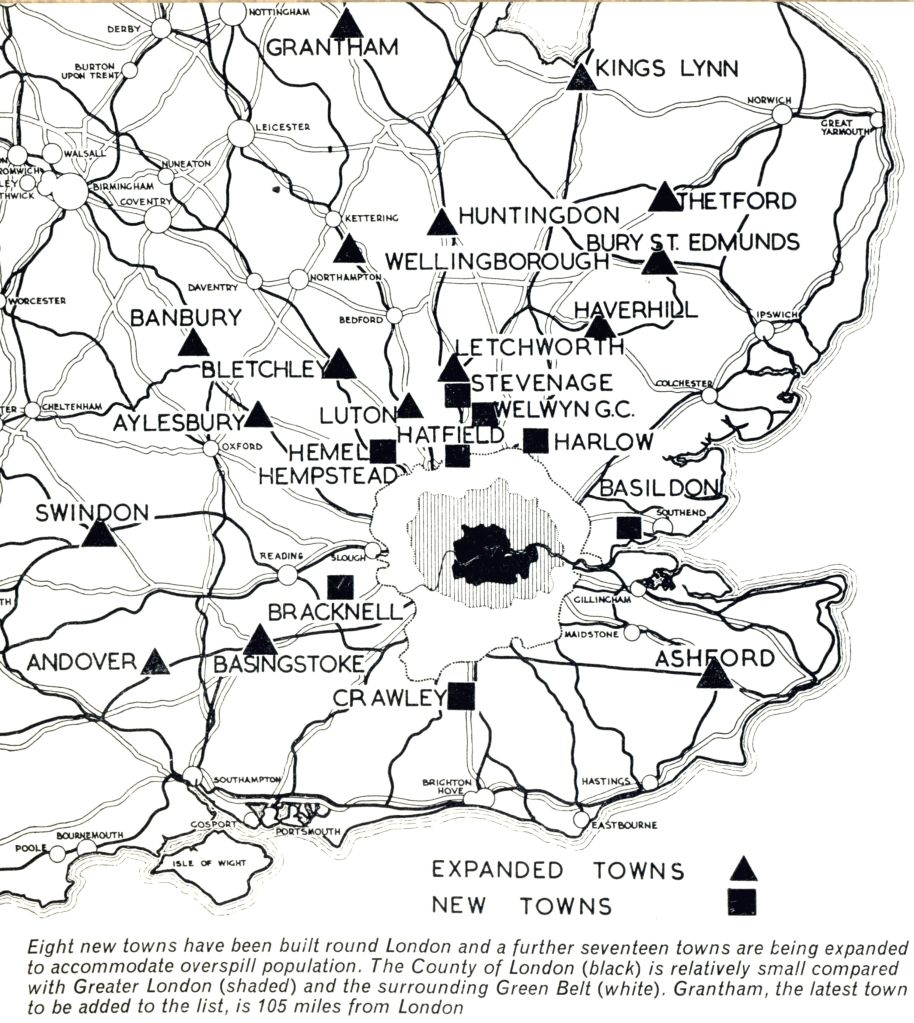
During the period from the 1930s to the 1970s, the British Government made major investments in a group of what were referred to as London Overspill Towns. There was a deliberate policy of moving population en masse out of London, to more rural locations. The goal was mainly to reduce further “ribbon development” of the London suburbs, which would eventually have spread across the entire South-East of England. There were also health implications, since prior to the 1960s, London’s air was seriously polluted, leading to increased healthcare costs.

During the 1960s, various existing towns were targeted for substantial redevelopment and expansion, and a few entirely new towns were created. Most of these were within commuting distance of London, but even Grantham in the East Midlands was included.

The map below is from the 1963 book New Architecture of London.

Map of London Expansion Towns. Copyright © 1963, British Travel and Holidays Association

As shown, one of the “expansion towns” was Aylesbury, which had until then been a quaint market town, famous mostly for its ducks.

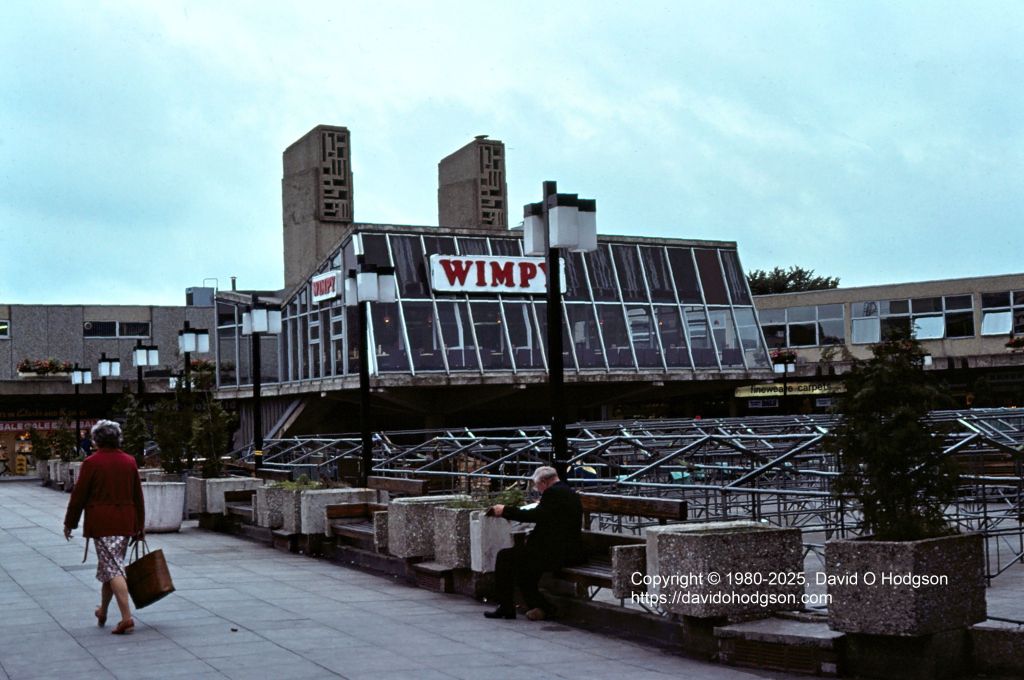
Development plans for expansion towns invariably included the construction of new shopping centers and civic buildings, and some of these were designed along brutalist architectural lines. In 1967, Aylesbury found itself lumbered with a new shopping center, Friars Square, which quickly came to be seen as such an outstanding example of a dystopian nightmare environment that, in 1971, scenes for the movie Clockwork Orange were filmed there!

My 1980 photo below shows the centerpiece of Friars Square, the Cadena Cafe, after it had become a Wimpy Bar. As with many examples of brutalism, the building had a relatively short life, being demolished in 1993 when the shopping center was redeveloped.

Friars Square & Cadena Cafe, Aylesbury

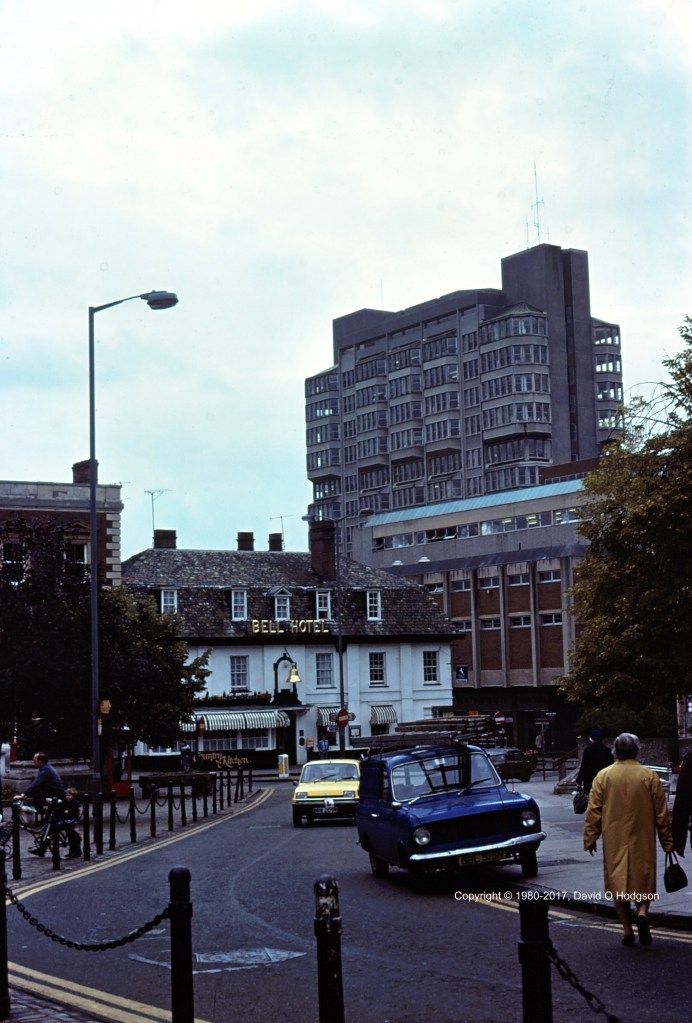
Elain Harwood’s book Brutalist Britain offers an extensive listing of brutalist architecture in the country, and describes another Aylesbury example, the Buckinghamshire County Council office tower.

The cover of Brutalist Britain, Copyright © 2023, Elain Harwood, Batsford Publishers

My 1980 photo below shows the County Council tower looming above Market Square in Aylesbury, with the Bell Hotel in the foreground.

The Bell Hotel, Aylesbury, with the Buckinghamshire County Offices beyond, in 1980

Brutal Birmingham

Birmingham New Street Signal Box, 1980

It seems perhaps most appropriate that Brutalist architecture would be chosen for the design of industrial buildings, and even British Railways constructed a few examples. One of the most famous in Britain must surely be Birmingham New Street Signal Box, which has towered above the gloomy subterranean station since 1966, and is clearly visible from street level, as shown in my 1980 photo above. Although it closed as a signal box in 2022, the building is listed, is still standing, and continues to be used by Network Rail.

Again, Birmingham was not a city in which I ever lived, but when traveling between Coventry and York, I usually had to change trains at Birmingham New Street. I also applied to, and was accepted by, Aston University in Birmingham, so I attended an interview there in 1980.

Brutal London

Approximately a year after visiting Aylesbury for that job interview, I found myself moving to London, as I began my Electronic Engineering studies at Imperial College.

Many first-year undergraduate students were accommodated in Halls of Residence, situated in South Kensington near the college campus. Generally, we were assigned to one of the halls, and were not given any option as to which hall we preferred. I was assigned a single-bed room in Selkirk Hall, which was a subdivision of the huge Southside Halls building, located, as the name indicates, on the south side of Prince’s Gardens.

The photo at the head of this article shows the view looking north from Selkirk Hall over Princes Gardens, one stormy afternoon. The building in the foreground is Linstead Hall, which was of similar architectural style to Southside. In the distance, the tower of another Brutalist edifice is visible; Hyde Park Barracks, which was and still is the home of the Horse Guards.

Cover of Lost Futures. Copyright © 2017, Owen Hopkins, Royal Academy of Arts

Unfortunately, while living in Selkirk Hall, I never photographed the outside of the building itself (partly because the trees in front of it obscured most of it). However, Owen Hopkins’ book Lost Futures includes an article about Southside Halls, which also mentions the smaller Weeks Hall, situated on the north side of Prince’s Gardens.

The photo below, borrowed from “Lost Futures”, shows an excellent panorama of Southside, before the trees in front of it grew too large.

Southside Halls, Imperial College. Copyright © 2017, Owen Hopkins, Royal Academy of Arts

Unfortunately (or perhaps fortunately, depending on your view of their aesthetics!), the passage of time has revealed that many Brutalist buildings were not well-constructed, and in some cases not even well-designed. I had personal experience of this while living in Selkirk Hall.

I lived in the building for only one academic year, but even during that time there were serious maintenance problems. Each bedroom had its own sink, whereas kitchen and bath facilities were shared. The sink in my room was out-of-action, and boarded off, for several weeks during my residency, due to plumbing problems. It seems that the design of the building had a major flaw, whereby pipes and other service conduits were buried directly within the concrete, instead of being placed in accessible service ducts. As a result, any plumbing maintenance work required drilling out the concrete to access the pipes! The quality of the concrete also seems to have been defective, and large chunks of it eventually began to disintegrate.

The upkeep of Southside became so problematic that, despite its being a listed building, permission was eventually granted to demolish it in 2005. That permission was granted on condition that the smaller Weeks Hall, on the north side of Prince’s Gardens, and also a listed building, be retained and refurbished. In my photo below, looking north from Southside, you can just see Weeks Hall towards the right.

Skyline from Princes Gardens, with Weeks Hall

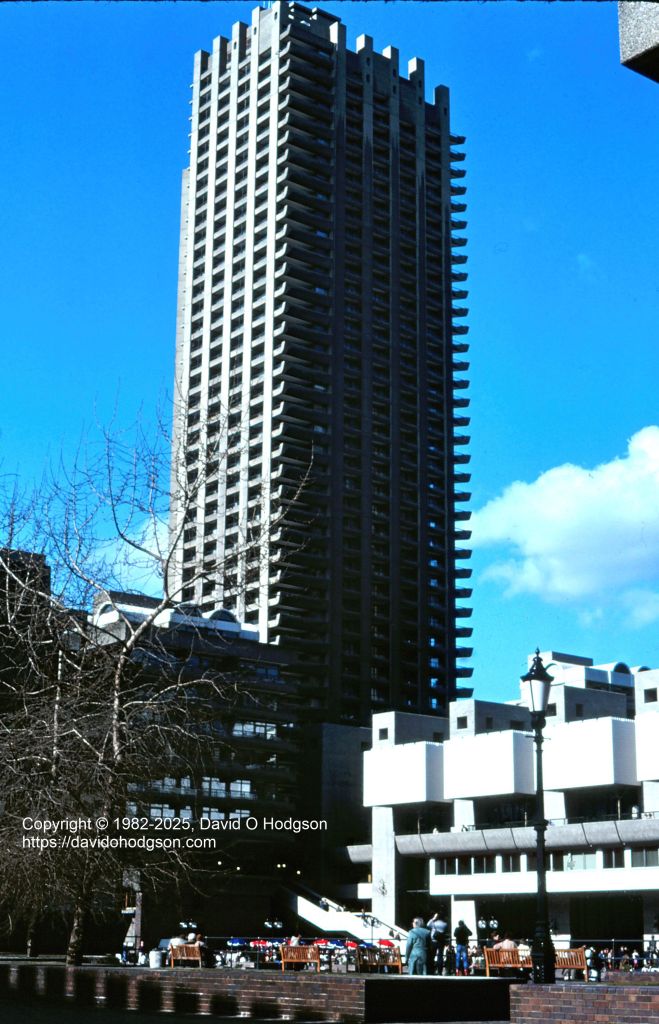
One of the more successful examples of Brutalist architecture, which still exists and is in use today, is the Barbican Centre, in the City of London. My photo below shows part of the complex shortly after its official opening in 1982. I visited the Centre many times, usually to go to the Museum of London, which was housed within it.

Despite having been voted the “Ugliest Building in London”, the Barbican apparently remains popular with apartment renters, thanks to its views and convenient location.

Barbican Centre, London

Brutal Scarborough

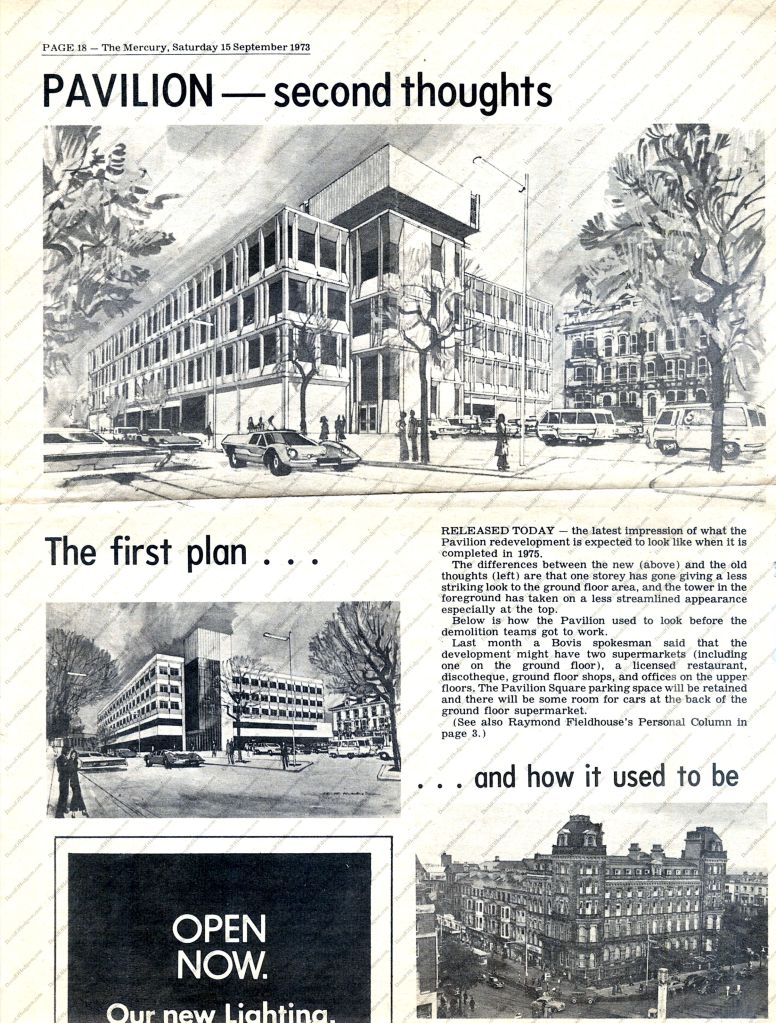
Even my home town of Scarborough suffered the attentions of architects with brutalist leanings. In 1973, the imposing Pavilion Hotel, immediately opposite the main railway station, was controversially demolished and eventually replaced by an office block that has been described as the “ugliest building in Scarborough”. I reproduce below an article from the Scarborough Mercury of 15th September 1973, showing how the new building was to look, along with hopelessly-optimistic predictions of its future uses.

Scarborough Mercury article about Pavilion House. Copyright © 1973, Scarborough News

The building did eventually gain one supermarket, on the ground floor, although, as I recall, that store managed to look run-down from the day it was opened! As regards actual other uses for the new building, I can only remember it as the home of Scarborough Job Centre, in which I spent many useless hours not finding a worthwhile job. It seems perhaps appropriate; a depressing and ugly location for a depressing and hopeless office!

There’s no question that, whatever the aesthetic qualities of those Brutalist buildings, they were and are each unique, and they formed a memorable backdrop to my life in those days.

Yuletide Greetings

Happy Holidays, everyone!

The image above was my design for our greeting cards this year. It depicts our two cats supposedly sharing a cracker (which of course they would never do in reality!). It’s not a painting, of course, but at least this year I was able to create something original, instead of sending out commercial cards, as we did last year.

I also published our seasonal letter, which you can read here if you wish:

https://davidohodgson.com/yuletide-letter-2024/

Happy New Year for 2025!

Westwood Bus Station, Scarborough

My Scale Drawing of the Westwood Bus Station Building

When I was exploring the streets of Scarborough in 1977-78, conducting research for my A-Level Art project on architectural aspects of the local road and rail industries, it was impossible to know what the future might bring for the subjects of my study. Many of those locations and buildings have in fact survived to the present day, and some have even been renovated. Others, however, have vanished completely. In some cases, even the land on which the buildings stood has been redeveloped to the extent that it is now unrecognizable.

The subject of this article is one such example. Westwood Bus/Coach Station occupied a central site in Scarborough, right next to the main railway station. During the 1970s, the bus station was still quite heavily used, particularly during the summer months, when it was often completely filled with visiting excursion coaches. It was also still the terminus for scheduled bus services. During the 1980s, however, the station was shut down, and the entire hillside on which it stood was excavated to create a new superstore and underground car park, which still exists today. As a result, no trace remains of this bus station.

The image above is a digitized version of a gouache painting that I produced for the A-level thesis. It is to scale and shows the northerly elevation of the waiting room and ticket office building at Westwood, which was the only permanent structure on the site. If you don’t like the color scheme, please don’t complain to me! Those were the actual colors of the building at the time of my survey; very “Seventies”!

Note that the location described in this article is not the East Yorkshire bus park currently referred to as “Westwood”. The old location was on the south side of Westwood, where the Tesco store now is. At that time, the current bus park was part of Scarborough railway station.

Three Bus Stations

I’d been familiar with that place for as long as I could remember. When I was very young, Westwood was the terminus for services operated by East Yorkshire Motor Services (EYMS). At that time, there were two other regional bus companies running services into Scarborough, but each had its own station. United Automobile Services used Valley Bridge Bus Station, whereas West Yorkshire Road Car (WYRC) used a station on Northway.

During the late 1960s, after all three companies had become part of the National Bus Company, operations were merged, and the opportunity was taken to reduce costs by eliminating some of the facilities. Northway was closed in 1970, and WYRC services then operated from Valley Bridge. Similarly, EYMS ceased to use Westwood in 1970 (see letter below), and transferred its operations to Valley Bridge.

Another independent user of Northway Bus Station prior to its closure had been Hardwick’s Services, which was a company owned by the famous holiday tour operator Wallace Arnold. Following Northway’s closure, Hardwick’s began to use Westwood as the terminus for its scheduled services to Ebberston.

As such, by the time of my study, Westwood was used only for Hardwick’s Services, and to handle summer excursion traffic visiting Scarborough. I didn’t specifically take any photos of the bus station, but mostly of vehicles that happened to be parked there.

The photo below does show part of the site. The view is looking towards Valley Bridge, with Westwood on the left. The building that I drew is on the right. In the foreground is a former Mansfield District Bristol Lodekka, which was in use for driver training.

Westwood Bus Station in Summer 1977

An Undeveloped Prime Location

It always struck me as odd that the site of Westwood Bus Station was relatively undeveloped, given that it was in a central location right next to the railway station. There was only one building, and the concrete parking surfaces were steeply sloped, having never been leveled. Parts of the parking area were never even concreted, and were simply filled with stone rubble, as shown in my photo below.

The muddy unmetalled part of Westwood Bus Station, under a low winter sun

Surely such a site would have been snapped up by an eager developer for construction of a hotel or some similar profitable structure.

I eventually discovered that the reason for this was that the land on which Westwood stood was railway-owned. It had been bought up in the late nineteenth century by the North Eastern Railway (NER), with a view to the extension of Scarborough Central station. However, the railway’s planners soon realized that, due the existence of villas immediately west of their newly-acquired land, it would be impossible to create the necessary fan of extra lines to extend the station footprint there.

As a result, the NER dropped that plan and, instead, in 1907 constructed an entirely new station further west at Londesborough Road, on the site of a former goods depot. Additionally, a new complex of sidings was built alongside the Scarborough-Whitby running line at Northstead. This arrangement proved very effective for handling the extra excursion traffic that Scarborough experienced every summer, so the land in Westwood was no longer needed.

According to an old photograph that I’ve seen, the railway-owned land was let out for allotments until after World War II. When EYMS needed a new bus station in Scarborough during the 1950s, British Railways presumably sold the land to them (EYMS was by then part of the privately-owned British Electric Traction group).

While researching my A-level Art project, I could find very little published information about Westwood, so I wrote a letter to EYMS directly, requesting some details. The letter below is the response I received from them.

Letter from EYMS providing details of Westwood Bus Station, etc.

The book Prestige Series: East Yorkshire, by John Banks, shows color photos of Westwood on the front and back covers, and there are several monochrome photos of the location inside the book.

Front Cover of Prestige Series: East Yorkshire. Copyright © Venture Publications 1999

As I mentioned above, the entire site was excavated during the 1980s, and a Hillards supermarket with underground parking was built on the site. Hillards was taken over by Tesco in 1987. Here is the current Google Streetview of the Tesco supermarket from Westwood. Due to the redevelopment, it’s no longer possible to stand in the location from which I took the 1977 photo above.

Hardwick’s Services

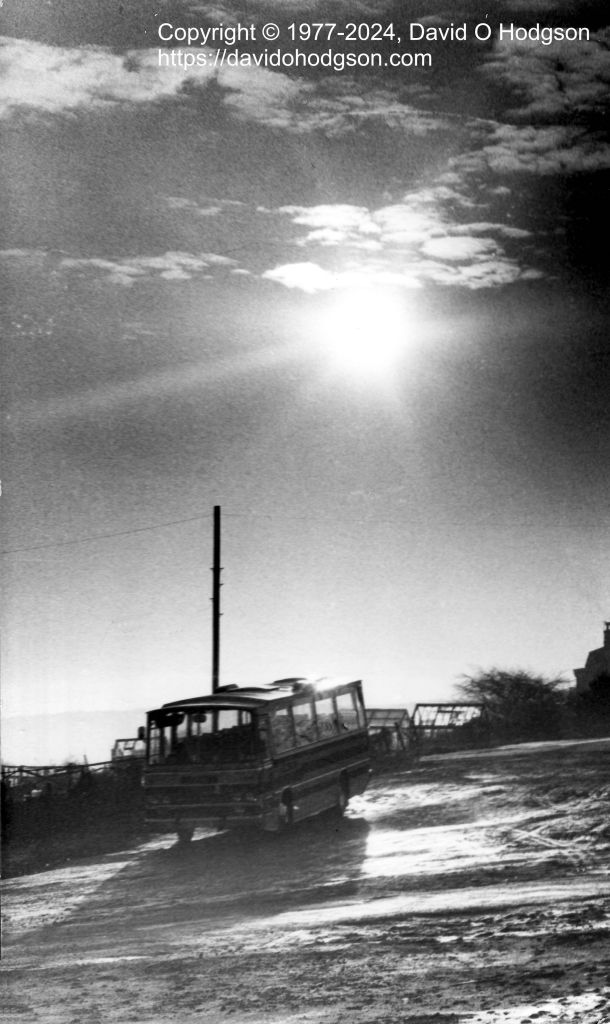
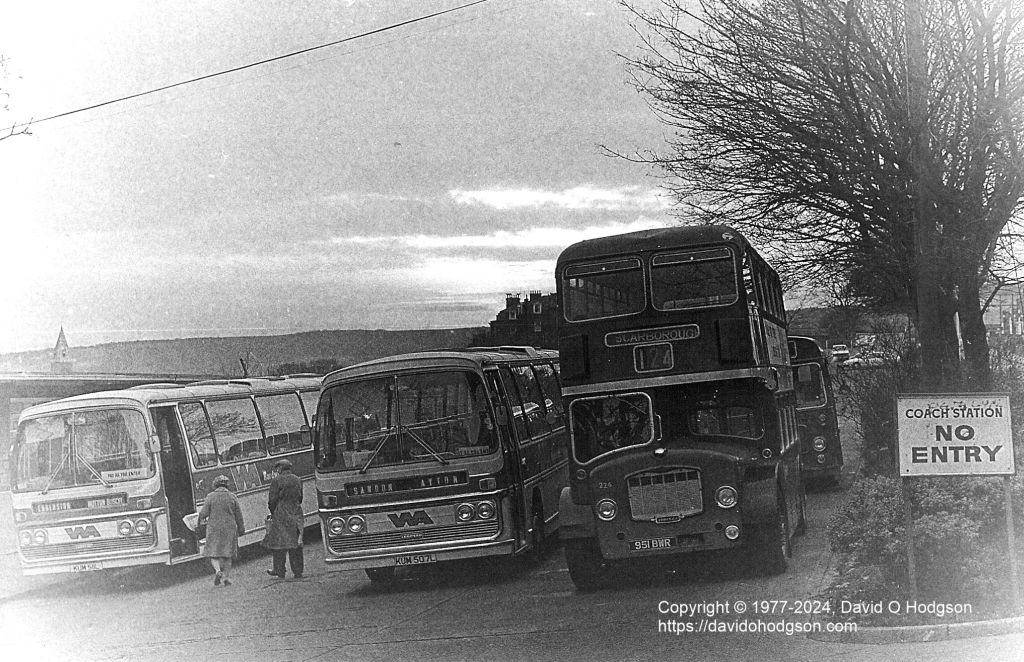
My photo below, taken in Winter 1977, shows the buses of Hardwick’s Services using Westwood as their Scarborough terminus. As you can see, Hardwick’s used vehicles with Plaxton coach bodies, but fitted with bus seats. Presumably the reason for that was for parts interchangeability with other vehicles in the Wallace Arnold fleet.

Westwood on another chilly winter’s afternoon

As is visible in the photo, NBC buses were still sometimes parked temporarily at Westwood, because there wasn’t sufficient space in the nearby Valley Bridge Bus Station, and Westwood was closer than the United depot on Vernon Road.

Incidentally, the vignetted and “frosty” look of my photo was accidental; during cold-weather development of the negatives, I failed to wash off the fixer properly! However, in this case I liked the effect, so I kept it.

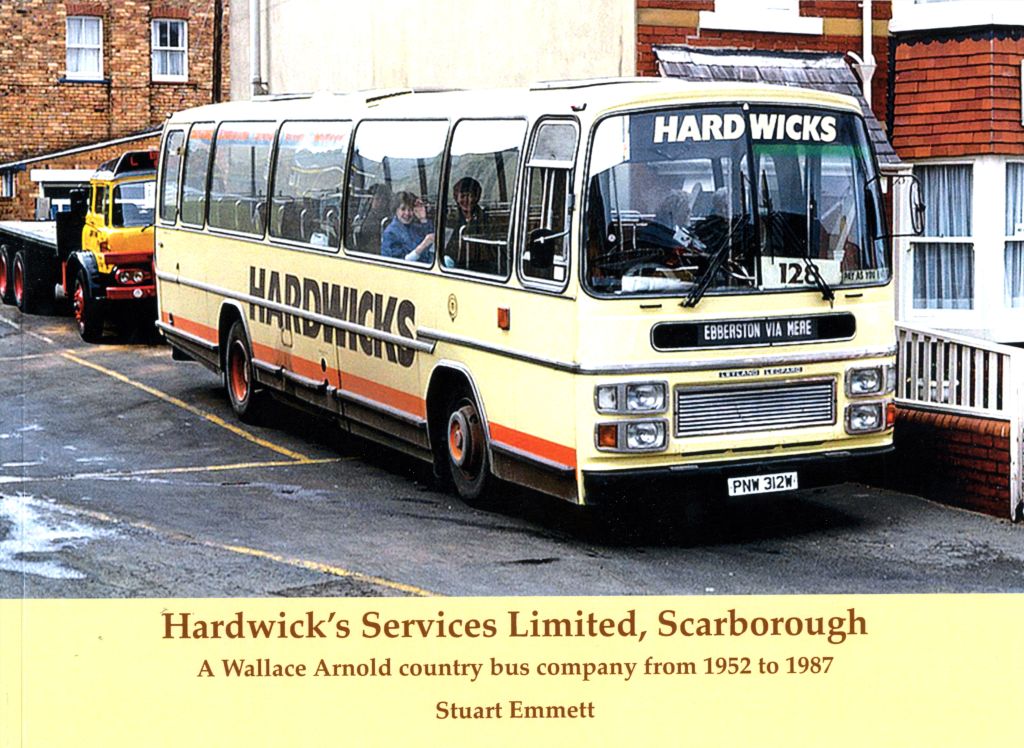
Full details and history of Hardwick’s Services can be found in this book.

Hardwick’s Services Limited, by Stuart Emmett. Copyright © 2020, Stenlake Publishing Ltd.

DIY Tip: Custom-Sizing an HVAC Filter

This is not intended to be a “DIY Tips” blog, and I don’t consider myself to be a “home handyman”. However, I recently found a solution to a maintenance problem that has frustrated us for the entire 11 years since we bought the house we’re living in. Since none of the so-called “professionals” that we’ve hired during that time seemed able to come up with this solution, it may help other homeowners if I share my tip.

If you don’t live in North America, this may be irrelevant to you, because most homes here rely on a ducted-air central heating and cooling (HVAC) system. This is so that the same ducting can be used for both heating and air-conditioning. By contrast, most homes in Europe rely on central hot-water-based heating systems, and have no central air-conditioning at all.

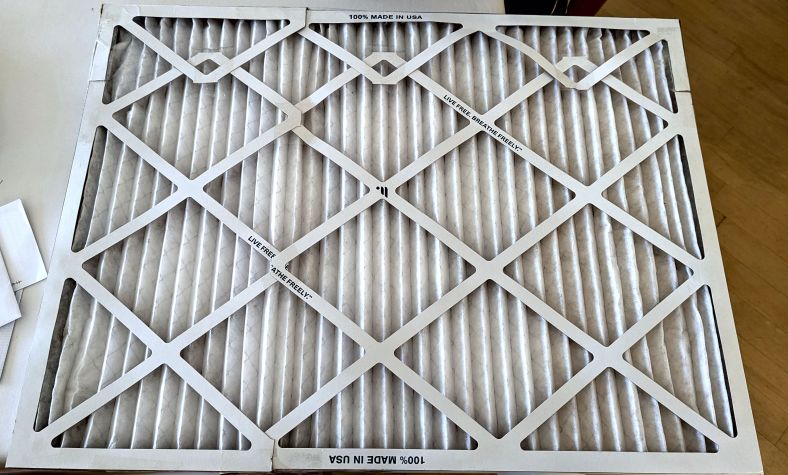
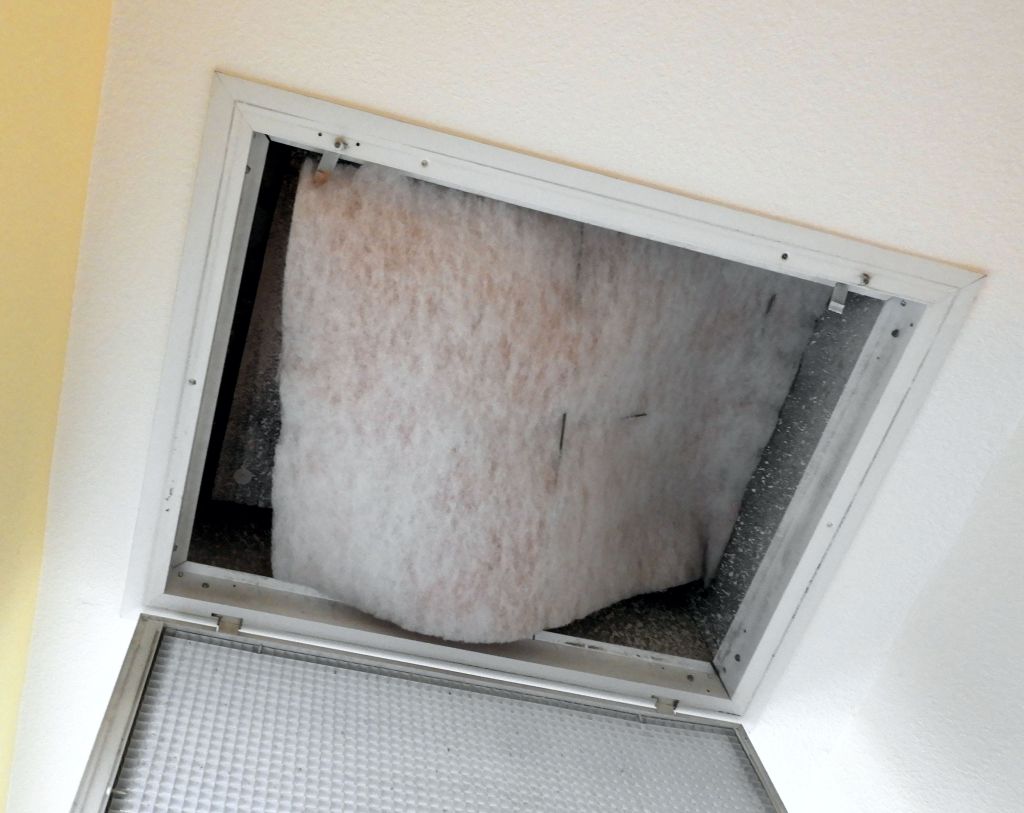
Ducted-air HVAC systems use a series of delivery vents, in ceilings, floors, or walls, and then one or more return vents to return the air to the furnace/air conditioner. Unfortunately, our house was built in 1999 with a non-standard size a/c return vent, so the filters have to be custom sized. The filters have to be replaced every 6 months or so. The image below shows the main return duct filter in the hallway ceiling. The aperture size is roughly 29″ x 22″.

The Ceiling Aperture for the Filter

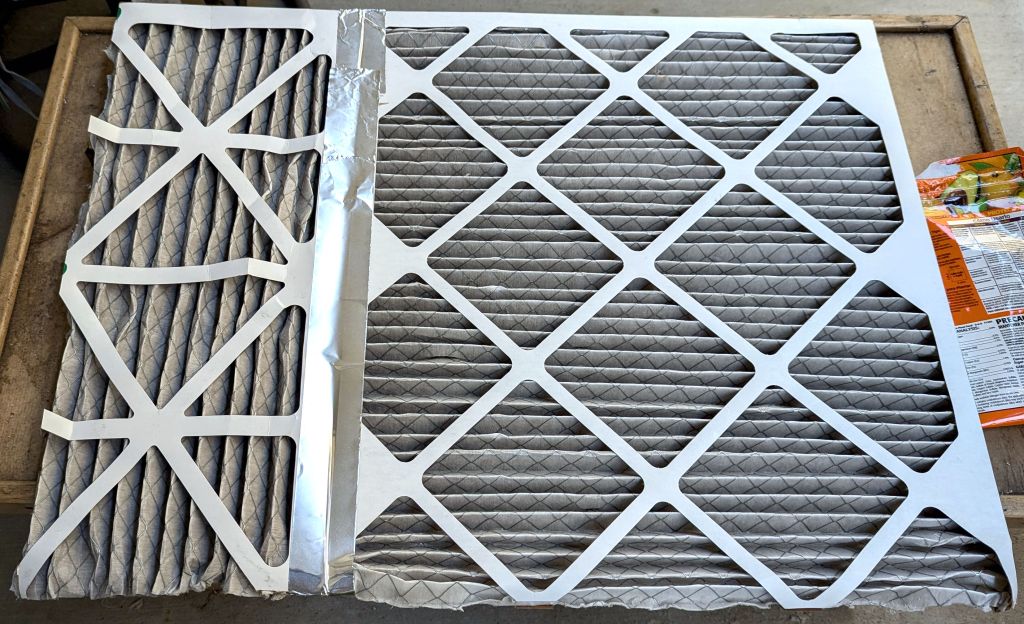
The following photo shows the efforts of so-called professionals, who at great expense hacked up 2 smaller filters to fit. As you can see, part of the filter’s frame is now missing. The problem with the missing frame is that, when the filter is in position, air pressure tends to force it up into the duct, which means that it does not do an effective job, since there are now gaps around the edges. You can also see that the maker didn’t quite get the size correct, with the result that he had to crush the filter material.

The Best Solution of So-Called Professionals!

Recently, I took matters into my own hands, and discovered that cutting the edges of a standard 24″x30″ filter and sliding the cardboard over itself can achieve an exact fit, without all that mess! Also, a pack of 3 filters costs only $40!

The steps are:

  • Determine the actual aperture size
  • Cut the cardboard sides of the oversized filter neatly along the edge that is too long. If the filter is too long and too wide, you’ll need to do this separately in both directions
  • Use a knife to cut the filter material away from the shorter portion of the cut frame
  • If necessary, shorten the filter material to fit the smaller aperture. I used tinsnips to do this, because the filter material contains a mesh of wire reinforcement
  • Slide the edges of the shorter portion of the frame over the edges of the longer portion, until the frame is a snug fit for the aperture. I used 2 large slide clamps, set respectively to the length and width of the aperture, to check for a snug fit
  • Tape the cut edges firmly back together

The result is as shown below. You can see where the edges were cut in both directions, then slid over each other and taped back together.

My Solution to the Same Problem

I’ve sometimes felt that the HVAC professionals we hire are “not the brightest sparks in the fire”, and I think I’ve just demonstrated that.

[Added 11/1/24]. I found a photograph of an earlier failed “professional” solution to our problem. In this case, the technicians used a piece of porous fiber material, but reinforced it with steel rods. As shown in the photo below, the result was that the filter did not fit properly into the aperture. When the circulation fan was running, the filter was pulled up into the duct, which meant that not only did it not function properly, but there was a danger that it would be sucked into the furnace intake.
The company that created this inept solution was https://www.hansonheatingandair.com/. A few months after they had installed their attempt at a filter, we noticed that it wasn’t working, and called to invite them to see the problem. Instead of showing any concern for the quality of their work, their receptionist started screaming at me, falsely claiming that I was “trying to get something for nothing”! Needless to say, we will never consider hiring them again, and we recommend that you also should avoid their questionable competence.

An Earlier Failed “Professional Solution”

Scarborough Tramways Company

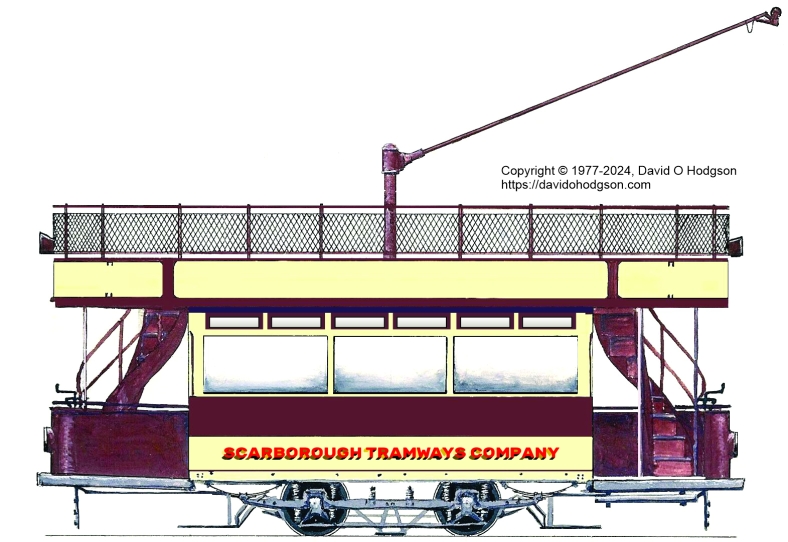
My technical illustration of a Scarborough tramcar. Based on the drawing of a Brush-manufactured tram in “Scale Model Electric Tramways

This article describes an aspect of the history of my home town that definitely does not derive from my personal memories, because the Scarborough Tramways Company ceased to exist many decades before I was born.

However, as part of my ‘A’ Level Art project, I included some details of the long-defunct system in my thesis (written during 1976-78) on “Road & Rail Transport in Scarborough”. At that time, there was very little published information available regarding the system, so my researches were based on limited resources. Since then, at least a couple of books have been published on the topic, as detailed in Published References below.

The cover of my Art project thesis also featured a somewhat distorted painting of a Scarborough tram alongside its modern equivalent, as shown below.

The Cover of my A-Level Art Project

Great Expectations

At the turn of the twentieth century, an electric tramway system was a prestigious asset for any British town. This was before the age of the motorbus, and electric trams were seen as the most modern and most efficient way to provide urban mass transport.

By 1904, following various rejected proposals, Scarborough Corporation had arranged for the construction and operation of a tramway system by Edmundson’s Electricity Corporation. The first trams ran on 6th May, 1904, but unfortunately the subsequent history of the system was marred by disputes with the town Corporation, which ultimately led to the early abandonment of the system. The last tram ran on 30th September 1931.

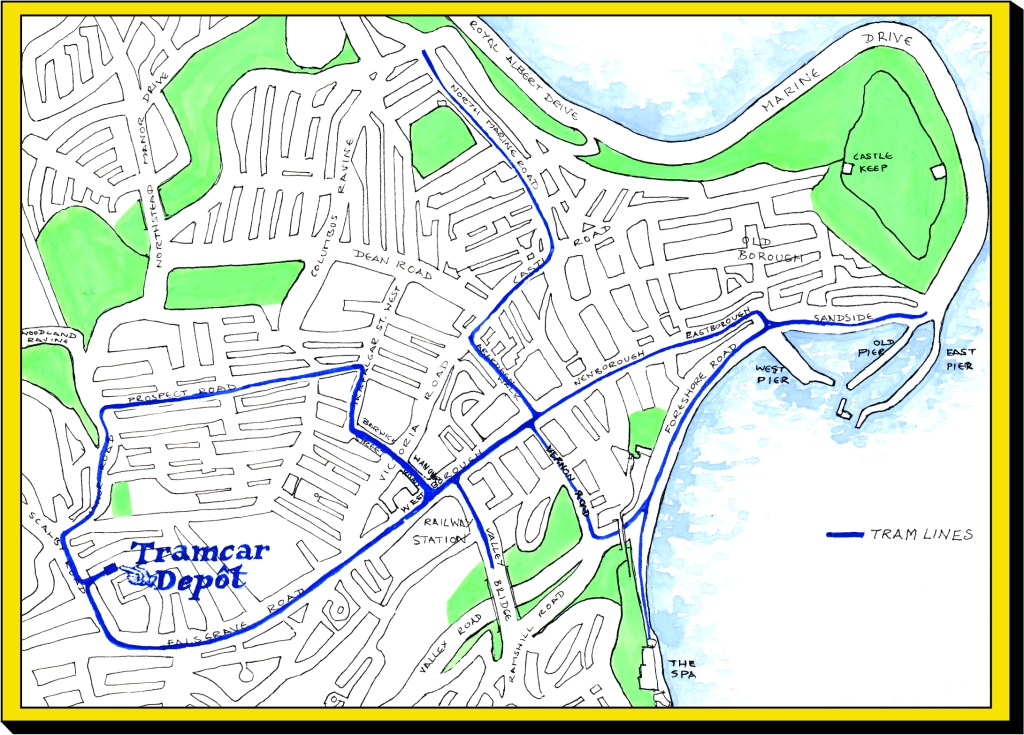
The map below shows the extent of the system as constructed, and the location of the car depot on Scalby Road. The company also had parliamentary authorization to build a line along the Marine Drive, linking the stub on Sandside to that on North Marine Road, via Peasholm Glen, but that line was never built.

My map of Scarborough Tramways System

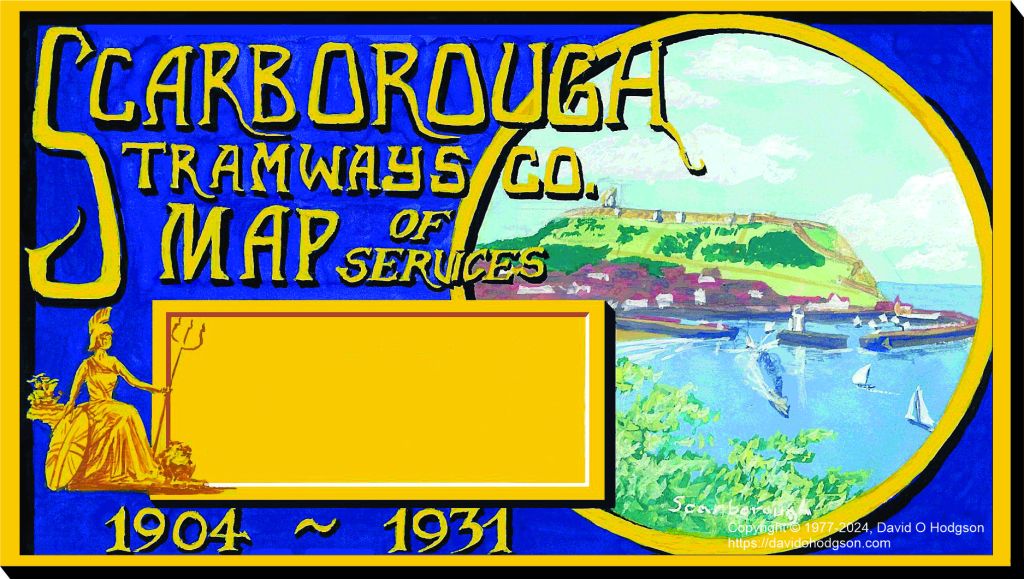
The design below is a fictitious Art Nouveau styled header that I created for the presentation of the tramway map in my Art study.

My fictitious Art Nouveau Header for the Scarborough Tramways Map

The tramway depot on Scalby Road survived until the 1960s, in derelict condition, when it was finally demolished to make way for the construction of Harley Close.

Other than that, there was generally no remaining evidence that the system had ever existed. Occasionally, however, disused tram tracks would reappear through the surface of existing roads, as shown in my photo below, which shows the truncated tracks protruding through the surface of Hanover Road in 1979.

Tram rails protruding through the surface of Hanover Road, Scarborough, in 1979

Thwarted Ambitions

One reason that has been suggested for the failure of the tramway system was that it did not expand as Scarborough grew in size. For example, the tramway system never extended to the rapidly-developing South Cliff over the Valley Bridge. However, it seems that there was a proposal to add a line across the bridge, then up West Street, terminating at Holbeck Hill. This very reasonable proposal was quashed by opposition from local residents! During 1970-78, I lived on West Street, and the photo below was taken from my bedroom window, showing a United Automobile Services bus operating the 100 service, which followed the route of the never-built tramway extension.

From my bedroom window in West Street, a United AS Bristol VR on the 100 Service. This route was a proposed extension to the Scarborough Tramways system, but was blocked by local opposition

A Premature Demise?

The troubles that beset the Scarborough Tramways Company throughout most of its existence seem to have been largely caused by an initial failure to agree on whether the system was to be run on a purely for-profit basis, or as a non-commercial public utility. As I’ve mentioned in another post, Scarborough’s population reliably swelled with visitors during the summer months, making the tramway profitable during those months. However, during the inevitable quiet months in winter, demand for tram services declined to the point where the company felt justified in suspending operations. Scarborough Corporation objected to this, even though they had failed to specify in the agreement how the service would be supported during lean times.

Needless to say, it was not only Scarborough Tramways that suffered from such hopelessly inconsistent economic expectations. British Railways notoriously suffered from conflicting demands by successive British governments; sometimes demanding that it should operate at an absolute profit, then at other times that it should provide a public utility without regard for cost.

Between the 1930s and the 1970s, all British electric tramway systems were shut down and abandoned, with only one exception (Blackpool). It wasn’t until the 1980s that the prevailing view in Britain that tramways were obsolete began to be superseded by economic realities. Subsequently, some tramways were partially reinstated, and some completely new systems have been built. At the time of writing, there are 9 operating tramway systems in Britain.

In his 1961 book “The British Tram,” author Frank E Wilson seems to have fully accepted the obsolescence of tramways. Horrifically, but thankfully inaccurately, the book’s last sentence reads:

Perhaps some of the babes in arms today will live to see the time when trains, buses, cars and probably aircraft have gone to join the tram in history—leaving them with hovercraft or rockets for earth and space travel, unless they have themselves, with the whole lot, disappeared in nuclear fission

Cover of “The British Tram” by Frank E Wilson. Copyright © 1961, Model & Allied Publications Ltd.

Scarborough Tram Week, 1981

Apparently, in October 1981, Scarborough’s local bus operator, United Automobile Services, held a “Scarborough Tram Week”, commemorating the fiftieth anniversary of the end of tram services in the town. Unfortunately for this history, and as I’ve mentioned elsewhere, I had just then left Scarborough for ever, to begin my undergraduate studies at Imperial College, London.

It seems that United AS repainted a contemporary Bristol VR bus in a fairly accurate version of the Scarborough Tramways colors, as shown in the photo below. Unfortunately, this monochrome image is the only one that I’ve ever been able to find of that vehicle. The image probably came from a book, but at present I can find no record of which. If anyone can provide copyright details, or another color image, then I will be grateful to acknowledge that!

United AS Bristol VR painted in replica Scarborough Tramways livery, 1981. Copyright © TBD

Published References

During the 1970s, when I did the research for my Art project, I could find no published books describing Scarborough’s tramway system. The only source material available was a few articles in old editions of the “Scarborough Evening News”.

Now, however, the situation is much better. Perhaps the definitive work is Barry Marsden’s “Scarborough Tramways”, published in 2007.

Copyright © 2007, Middleton Press

In 1981, which was the fiftieth anniversary of the closure of the tramway system, Scarborough’s local bus operator, United Automobile Services, self-published a small but informative booklet, titled “Trams by the Sea”.

Copyright © 1981, United Automobile Services
My technical illustration of a Scarborough tramcar. Based on the drawing of a Brush-manufactured tram in “Scale Model Electric Tramways”

Working at the BBC: Illusory Limitations

BBC Broadcasting House, from Portland Place

BBC Broadcasting House, from Portland Place

The photo above is, sadly, the only one that I ever took of BBC Broadcasting House, even though I worked there and walked in and out of the building regularly. With the benefit of 40 years of hindsight, I regret that, from 1984 through 1987, I took no photographs at all. At that time, it simply never occurred to me that I might one day want to describe and illustrate what was happening to me! I was only prompted to restart taking photographs when I visited California for a job interview in October, 1987. Therefore, this article, and others discussing the events of this time period, are unfortunately quite lacking in personalized images!

In a previous post, I mentioned how, during the early 1980s, my primary goal in obtaining an Electronics degree had been to obtain what I sincerely thought would be my “dream job”, as a video engineer at the British Broadcasting Corporation (BBC). I finally obtained that job in 1984, almost exactly 40 years ago, so this seems like an appropriate time to review the details of what happened then, and my reactions to it.

Having completed my degree at Imperial College, London, I interviewed for and obtained an entry-level Engineering job with BBC Studio Capital Projects Department (SCPD), which was responsible for building and renovating studios. The final interview seemed to go so well that I actually had the temerity to ask the intimidating board of three interviewers about my chances, given that I’d already received a job offer from the Philips television systems design plant in Croydon (which I did not want to lose, if the BBC turned me down again).

The interview board asked me to leave the room for a few minutes while they discussed my case. When I re-entered the room, they informed me that, subject to their receiving confirmation of my degree grade, I’d got the job! The only further thing they wanted to know from me was, “how come you know so much about television?” I explained that I’d just spent the last 2 years as a volunteer and then Chairman of Imperial College Student Television, which had given me experience in every production job, from producing through presenting to videotape editing.

Now, with the benefit of so much hindsight, I see that I should perhaps have been tipped off by that final question that something was amiss, but, after all, in those days I was just a naïve young graduate, who naturally trusted that my new employer would be acting in my best interests!

Letter from the BBC, informing me that I'd been selected

Letter from the BBC, informing me that I’d been selected

I was overjoyed at being offered the opportunity that I had sought for so long, but unfortunately I was soon to discover that the reality of my new job was not at all what I’d anticipated.

Digression: The Realities of Auntie

For readers who do not live in Britain, I should perhaps explain something about the exalted status of the BBC (nicknamed “Auntie”) in that country’s national mindset. (This reputation has been seriously damaged by recent scandals, including official cover-ups of abusive and pedophile behavior by certain BBC celebrities, but, back in those days, that was all kept firmly secret.)

It may come as a surprise to you to learn that, in a country that is supposedly a cradle of free speech, the BBC was for many decades a monopoly broadcaster in Britain. For many decades, by law, only the BBC could broadcast radio or television services. As from 1923, all British residents had to pay an annual licence fee to operate broadcast reception equipment, although since 1971, only television receivers have required a licence. Any other organization that attempted to broadcast was a “pirate”, and the British government made strenuous efforts to shut down such organizations whenever they could. Nonetheless, broadcast advertising was such a lucrative market that many pirate radio stations did operate. As I recounted in a previous post, the governor of my own school was a director of one such pirate station!

Despite its monopoly, the BBC was not officially an arm of government. It was nominally independent, and, although it usually toed the government line, its independence was sometimes the cause of friction between the Corporation and officialdom.

The BBC lost its monopoly on television broadcasting in 1955, when the Independent Television Authority began broadcasting a rival, regionally-distributed, ITV service, supported by advertising. Nonetheless, the BBC was still regarded as the “high-brow” service, and was accorded perhaps-undue respect for that.

As regards engineering training, the reality for many years was that only the BBC offered any professional training. ITV’s contractors usually simply poached trained engineers from the BBC. Therefore, it seemed to me that the only way to get into broadcasting was to undergo the BBC’s training, and the only way to obtain that was to work there.

It turned out that I was wrong, on many counts.

It’s Not Licence-Payers’ Money We’re Wasting!

I began working for the BBC on 13th August, 1984. The location of my office was the so-called “Woodlands” building, which was at 80 Wood Lane, quite close to Television Centre in White City.

BBC Television Centre, as illustrated in the Ladybird book "How it works: Television". The employee canteen looked out onto the "Blue Peter Garden", which was located in the area marked "20" in the diagram. Copyright © 1968, Wills & Hepworth Ltd.

BBC Television Centre, as illustrated in the Ladybird book “How it works: Television”. The employee canteen looked out onto the “Blue Peter Garden”, which was located in the area marked “20” in the diagram. Copyright © 1968, Wills & Hepworth Ltd.

I went through the expected employee induction process, but, as I settled into the job, it began to seem that there was actually very little for me to do. Having asked to be assigned some work, I was given various unnecessary tasks, such as auditing the acceptance of a new audio mixing desk, which in fact had already been accepted. I was provided with no information about the expected performance characteristics of the audio desk, so my review was mostly meaningless anyway.

As I recall, the single highlight of that period of my employment occurred one day when we got an urgent message that a radio microphone had failed at Broadcasting House, a few hours prior to a live broadcast. I rushed over there with two colleagues to investigate, only to discover that a wire had come loose within the microphone base. We obtained a soldering iron, and (thanks to my EP1 training at Ferranti), all was fixed a few minutes before the broadcast! Seriously, that was as “cutting-edge” as things got!

South Elevation of Broadcasting House, from the book "London Deco", by Thibaud Hérem[20]. Copyright © 2013 Nobrow Press

South Elevation of Broadcasting House, from the book “London Deco”, by Thibaud Hérem. Copyright © 2013 Nobrow Press

I complained to management about the lack of available work, but got nothing except shoulder-shrugging in response. Initially, they explained that it was because they had done me a favor by allowing me to start early, prior to the official training date at the Evesham training school. That excuse might have made sense, except for the fact that it was obvious that my fully-trained colleagues didn’t have sufficient work either!

I became disillusioned with the justifications that were being offered to me by SCPD management, and by what seemed to be a haughty refusal to engage with me. Having selected some of the best graduates from the best British universities, apparently they now expected those same people to accept seemingly illogical decisions without question! It seemed obvious to me that, despite their heads-in-the-sand attitude, they would not be able to maintain the charade indefinitely, and that the likely ultimate result was that at least some of us would be made redundant. The only remotely meaningful response that I ever got was, “Don’t rock the boat”. What “boat”? Why were my concerns about the true situation “rocking” anything?

Following a few months of this tedium, I was sent along with many other new-hire engineers for the formal residential training sessions at the BBC Engineering Training School, which was located at Wood Norton Hall, in Evesham, Worcestershire (and which still exists, but is now a hotel). There is an entire book about Wood Norton Hall. It’s out-of-print, but can be obtained used, at, for example, https://www.amazon.co.uk/Wood-Norton-Hall-Victorian-Mansion/dp/0955405793/ref=sr_1_1
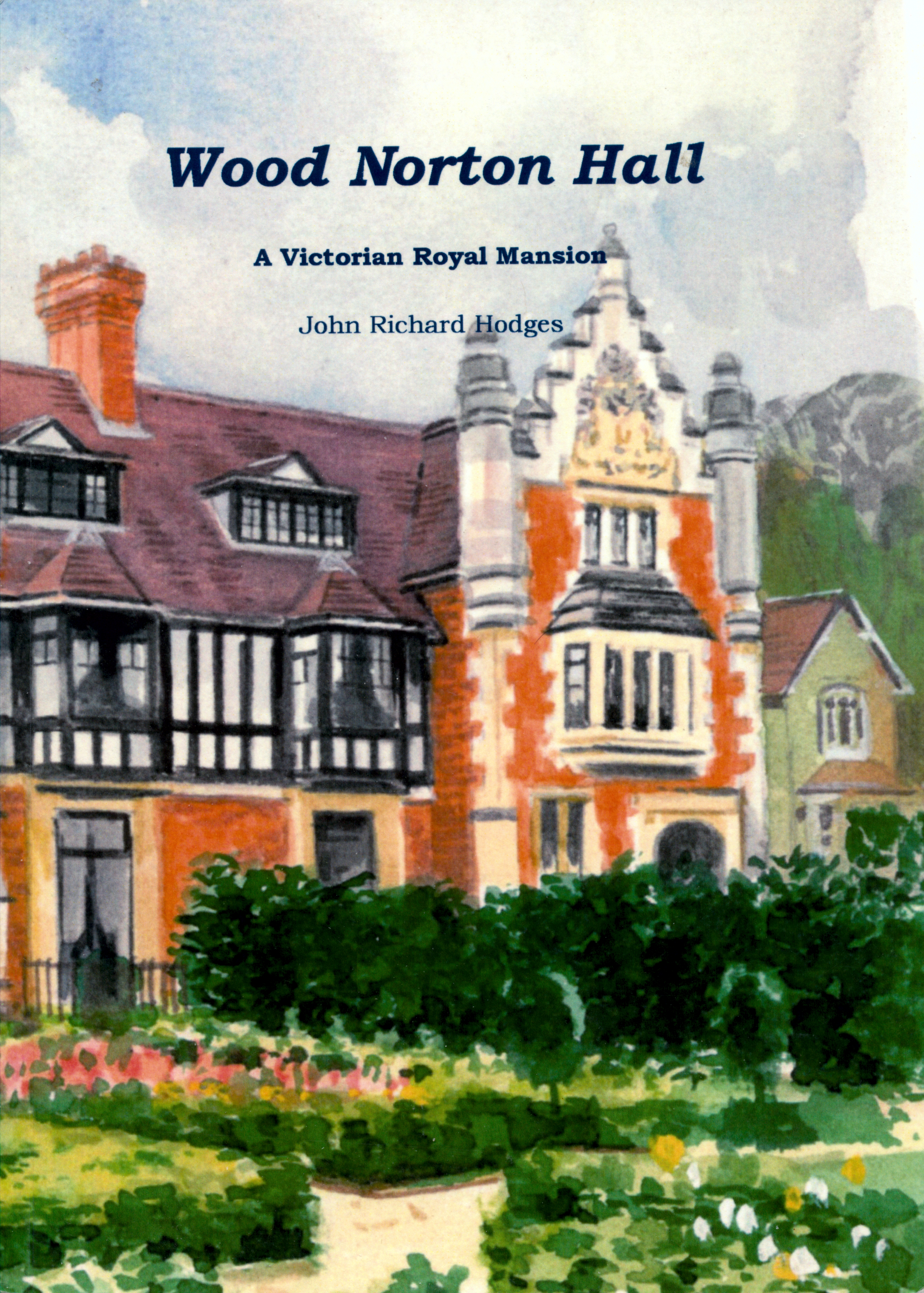
The cover of the book about Wood Norton Hall. Copyright © 2014 John Richard Hodges

The cover of the book about Wood Norton Hall. Copyright © 2014 John Richard Hodges

As part of that course, we were required to undergo the EP1 training specified by the Institution of Electrical Engineers (IEE). As I mentioned in a previous post, I had already spent several months completing exactly that training at Ferranti, and had a certified notebook to prove it. Why, then, should I spend time redoing exactly the same training? When I asked that question, it became apparent that I was by no means the only new BBC trainee who had already completed the EP1 training.

I pointed out to management that forcing us all through the same training again was a serious waste of money. The BBC were always sensitive to the suggestion that they were squandering licence-payers’ money, so management was eager to defend their stance, with this appalling justification: “It’s not licence-payers’ money we’re wasting. The Engineering Industry Training Board (EITB) reimburses us for the cost of EP1, so it’s the EITB’s money we’re wasting!”

Wood Norton Hall as it appeared when I worked there. The upper floors had been destroyed in a fire during World War II, and never replaced! Copyright © 2014 John Richard Hodges

Wood Norton Hall as it appeared when I worked there. The upper floors had been destroyed in a fire during World War II, and never replaced! Copyright © 2014 John Richard Hodges

Sorry; Your Degree is too Good

At around that time, it struck me that the job I’d accepted at the BBC was not the role that I’d originally had in mind. My initial application, in 1980, had been for an “Operations” job, that is, as a technician who operated or maintained broadcasting equipment. Those were the kind of roles I’d noticed when I visited Yorkshire Television, and which had stimulated my interest in working in the field in the first place.

Therefore, I asked my manager whether I could transfer from SCPD to one of the Operations Departments. His astonishing answer to me was along the lines of, “Oh no. Those jobs are for people with third-class degrees. Your degree is too good for that!”

So, apparently I’d gone from being underqualified for the BBC job in 1980, to being overqualified for it in 1984!

Having made no headway in trying to argue the problem with management, I eventually began looking for alternative employment, even if that would mean leaving the field of “video engineering”. After various interviews, I was offered an exciting position as “Technical Sales Engineer” by an electronics distributor called Swift-SASCO, who were based in Crawley, Sussex (but not in any way related to my previous employer, Swifts of Scarborough). Not only was the salary in that position comparable to what I was earning at the BBC, but they also offered an all-expenses-paid company car, plus the potential for sales bonuses. The offer was simply too good to ignore, so I accepted it and handed in my notice at SCPD, thinking sadly but mistakenly that that would be the end of my short career in video!

Retrospective: My Alternatives

Alternatively, I realize that I could perhaps have viewed my unproductive months of training at the BBC as being merely “paid education” and patiently plodded through it without complaint. I could also have spent my “enforced idleness” in exploring more of those historic buildings in which I found myself working. Perhaps I could then have moved to one of the ITV contractors? I’ll never know whether that would have worked out, but it would certainly have propelled the remainder my life in a very different direction, so in retrospect, I’m glad I did not.

In fact, I had overestimated the value of the BBC training. I’ve subsequently worked with many expatriate British engineers, quite a few of them specializing in video equipment design, yet not one of them ever underwent that BBC training! I discovered that the BBC’s engineering expertise simply was not held in high regard in the electronics or computer industries. As one former boss told me, “The BBC think they know it all, because they think they invented television. They don’t and they didn’t.”

After leaving the BBC, I stayed in contact with some of my former colleagues for a while. The word that got back to me was that, following my departure, management seems to have implicitly realized that the situation had been mishandled, and had made an effort to change their attitude. When one of my colleagues subsequently complained about some other unsatisfactory situation, his manager’s response was, “I’m glad you let us know. We don’t want anyone else to leave”!

I also discovered in the same way that, about six months after I resigned, many of my former colleagues were, in fact, made redundant from SCPD. My foreboding had been correct.

Why the Secrecy?

Nobody at the BBC ever offered me an explanation of what seemed to be the unreasonable behavior of SCPD’s management. Therefore, I can only surmise what was really happening at that time, based on descriptions and opinions I’ve received from other video engineers, inside and outside the BBC.

Here is what I was told:

Why did Studio Capital Projects have insufficient work?

As discussed in detail here, the then Prime Minister, Margaret Thatcher, and her Tory government, were engaged in a rather ridiculous ideological dispute with the BBC. The BBC (rightly) valued its independence, and its goal of providing objective, unbiased news reporting. Thatcher, on the other hand, took the view that, being funded by a licence fee, the BBC should in fact be a government propaganda arm. Unable to shut down or defund the BBC, she made petty attempts to hobble its position in other ways.

One such way was to insist that the BBC must “operate competitively”, supposedly to obtain value for money for licence-payers. Previously, whenever a BBC studio required refurbishment, the work had automatically gone to SCPD. Now, however, the BBC were forced to request bids for such work, not only from SCPD within the corporation, but also from external private companies.

The result was that external contractors always underbid, and so were awarded the contracts, leaving SCPD (which had bid according to the true costs of a project) without any work.

Logically, of course, if SCPD had no work, then the department should have closed or been repurposed. However, in that case, Thatcher would have won what was really a purely political battle, and some in the BBC were apparently determined not to concede.

Why did Studio Capital Projects hire more Engineers?

Given that SCPD had insufficient work for the engineers that it already employed, why would it nonetheless go ahead and hire even more engineers?

It was later suggested to me that this probably occurred because the BBC was “not a commercial organization”. Its annual income was essentially fixed by the licence fee collections, so the BBC’s budget was based on dividing up that fixed income among the various departments.

The primary way that a particular department could argue for a higher portion of the fixed budget was to employ more people. Hence, the goal of hiring more staff became completely detached from the question of whether such staff were actually needed!

Bad Times on the Horizon

The management issues that affected my employment at the BBC came as a great shock and disappointment to me at that time. Little did I realize back then that it would be just the start of a frustrating sequence of jobs with UK engineering employers, which would continue until I “escaped” to California (and relative sanity!) in 1987. Through no failing of my own, I worked for several employers during that 3-year period, with the management of each company being at best unstable, and at worst incompetent, as I experienced firsthand a portion of the terminal decline and failure of Britain’s electronics and computer industries. I hope to write more about some of those experiences in future posts.

It seems that the kind of mismanagement that plagued my employment experience in Britain is not a thing of the past. I was shocked by the recent news of the appalling Horizon Scandal in Britain, which seems to have stemmed from technical incompetence, and subsequent attempts by management to cover that up at any cost.

I am So Glad I Left

Let me emphasize once more that, in hindsight, I am so glad I quit that BBC job when I did! If I had not done that, but instead had listened to the discouraging comments of certain timid naysayers around me, and had clung on there, I would probably never have had the opportunity to move to California and work in “Silicon Valley”. As I have described in several earlier posts, there’s no question that the move to California changed my life immensely and permanently for the better.

I gave some thought to the wording of the title of this post. The phrase “illusory limitations” reflects both the way that I underestimated my own potential skills at that time, and the way that others attempted to impose false limitations on me. When I joined the BBC in that role, I really thought that it was the best I could do. I did not seriously imagine in those days that I could become a design engineer, and certainly not a patent-holding inventor. Fortunately, I didn’t ultimately settle for an underachieving career!

The message that I hope this tale of my experiences will convey to readers is not to be cowed by the unreasonable demands of any employer. Be confident in your own position, and don’t sacrifice your own future for the convenience of others who ultimately do not have your best interests at heart.

BBC Broadcasting House, from Portland Place

BBC Broadcasting House, from Portland Place
The POW Artists of Changi

Fred Binns in Changi Gaol

My mother’s first husband, Fred Binns, in Changi Gaol, 1943

The painting above depicts my mother’s first husband, Fred Binns, as a Japanese Prisoner-Of-War (POW) in Changi Prison, Singapore, in April 1943. It’s quite astonishing that this painting not only survived Fred’s imprisonment and subsequent liberation, but also that it was inherited from Fred by my mother, and then passed down to me from her.

If the painting could speak, it would surely tell a harrowing tale, of how it was perhaps painted using strips of bamboo and human hair, using tints mixed from different soils, then hidden from confiscation by being placed under the corpses of cholera victims. Despite all that horror, it depicts a joyous scene, showing Fred enthusiastically playing the double bass. If the proportions of the bass seem odd, that’s not due to any lack of skill on the part of the artist. That was in fact the appearance of the real instrument, because Fred had built it himself from scrap wood.

Changi Prison seems to have housed an astonishing concentration of creative talent. As shown above, Fred was himself a keen amateur musician, but there were also many artists in the prison.

Sadly, despite having survived all the horrors of imprisonment in Singapore for 4 years, Fred died prematurely of tuberculosis in 1949. He had contracted what was then usually a fatal disease during his internment, but was not aware of it at the time. By the time he died, he had married my mother, and she caught the disease from him. She was admitted to the ominously-named Killingbeck Sanatorium, and it was only thanks to the development of new “wonder drugs” that she survived at all. Her curative treatment was long and unpleasant, involving the complete collapse of each lung in turn, to rid it of the disease. Nonetheless, she survived the hideous disease that had killed her husband, and was able to resume a healthy life, which eventually included marrying my father and giving birth to me!

Ronald Searle, Des Bettany & Fred Binns

Perhaps the most famous of Fred’s bunkmates in Changi was the artist Ronald Searle. My mother knew that this painting of Fred was not by Searle, but we were not able to identify the actual artist. There is a signature in the corner, but it was too smudged to be readable.

Recently, while researching for this article, I viewed images of artwork by other Changi prisoners via the internet, and was able to match the style, and the color palette, to a man called Des Bettany. Now that I’ve seen Bettany’s signature, it matches that on the painting, so I have finally established the identity of the artist who painted Fred.

Des Bettany went on to have a successful career as a cartoonist, and eventually migrated to Australia, where he taught art, eventually rising to become Acting Principal at the South Australian School of Art in Adelaide.

The Heyday of St Trinians

Searle is probably most famous for having created the fictitious girls’ school St. Trinian’s. The drawing below is the first-ever published “St. Trinian’s” cartoon, although the caption reveals that the girls shown are pupils of an anonymous opposing school.

Searle's First St. Trinian's Cartoon

The first St. Trinian’s cartoon by Ronald Searle, 1941. Copyright © Estate of Ronald Searle

Searle had drawn the cartoon before leaving England, but it wasn’t actually published until late 1941, when Searle saw it in Lilliput magazine while fighting on the streets of Singapore!

Although Searle’s invention of St. Trinian’s predated his wartime experiences, he did use some of those cruel experiences as inspiration for his subsequent cartoons. For example, there is a St. Trinian’s cartoon titled “Bloody Sportsdays…”, which depicts the girls being forced to pull a roller to flatten grass. This was adapted from Searle’s wartime sketch “Light Duties for Sick Men”, which showed prisoners being forced to haul trees for land-clearing, during 1944.

By the early 1950s, the St. Trinians’ cartoons had become so popular that they became the basis for a series of movies (The Belles of St. Trinian’s, Blue Murder at St Trinian’s, The Pure Hell of St Trinian’s, and The Great St Trinian’s Train Robbery). In most of the movies, the headmistress of the school (Miss Fritton) is played by Alastair Sim, who also plays the headmistress’ brother! One of my favorite Sim quotations from the first movie sums up the ethos of the school:

In other schools girls are sent out quite unprepared into a merciless world, but when our girls leave here, it is the merciless world which has to be prepared.

Even in modern times, movies in the St. Trinian’s genre continue to be produced, although it must be said that the themes seem increasingly anachronistic.

The image below shows the publicity poster for the latest St. Trinian’s movie, The Legend of Fritton’s Gold (2009). Incidentally, the actor in the center, who played head girl Annabelle Fritton in the movie, is Talulah Riley, who is in reality the ex-wife of entrepreneur Elon Musk.

[Postscript 8/15/20: What a coincidence. I just discovered that Talulah Riley’s grandfather was also at Changi, as she mentions in this Twitter post: https://twitter.com/TalulahRiley/status/1294569052258664451]

Poster for Movie: The Legend of Fritton's Gold

Publicity Poster for the Movie: The Legend of Fritton’s Gold

If you are interested in more details of Ronald Searle’s life, there is an excellent biography by Russell Davies. Further details of Des Bettany’s life can be found here. For details of the life of Fred Binns, however, I’m afraid that it seems you’ll have to rely on me!

I feel truly privileged to have inherited such a unique and wonderful piece of artwork, but also very glad that I never had to endure any of the horrors that led to its creation!

For more details of the POW artists in Changi, see changipowart.com. [Update 11/20/20: Des Bettany’s son, Keith, asked me for permission to post the artwork on the Changi POW web site, and of course I granted that. The page can be viewed at: https://changipowart.com/archives/5882].

Fred Binns in Changi Gaol

My mother’s first husband, Fred Binns, in Changi Gaol, 1943

Michael Palin Interview: Out-Takes

In an earlier post, I described some thought-provoking comments about the Monty Python movie “The Life of Brian” that Michael Palin made to me during my student TV video interview with him, back in 1983.

Recently, I’ve been reformatting an ancient video recording of that interview. The entire interview is over 30 minutes in length, and some of it has become quite outdated. Nonetheless, there are some sections that could still be relevant.

For this post, I decided to edit together some of the clips that did not make it into the interview. These were “out-takes”, in which something went wrong (intentionally or otherwise!) during the shot. I can’t honestly say that these have never before been broadcast, because most of them were actually included in the Student TV’s annual “bloopers” program that was screened just before Christmas. Anyway, they’re still quite funny, after all this time.

The content of the clips probably speaks for itself, but I should perhaps explain why the shots appear the way that they do. The interview was an “outside broadcast” for us, so we took along only one camera (because in those days when camcorders were new technology, we had only one portable camera). Therefore, to shoot the main interview, we locked off the camera pointing at Michael, and recorded the entire session like that. That’s why, in most of the video, you can only see him, and hear me talking to him in the background.

Once the main interview had been recorded, we moved the camera to an over-the-shoulder shot of the two of us, then recorded some video of that for cutaways, which would be edited into the main tape.

Finally, after Michael left, we moved the camera to point at me, and recorded all my questions and reactions again, with me facing an empty chair.

I must apologize again for the poor video quality, due to the number of format conversions that this recording has undergone over the years. It’s worse in this case because some of the video was recorded during setup, so the camera is shaking around and there are even color bars over some of it. Nonetheless, I think it’s still sufficiently funny to be worth viewing.

The photo below is the best-quality shot that I have remaining from that occasion, because it’s a professional publicity shot of Michael Palin.

Michael Palin Publicity Photo c.1983


Pallab and the Wide-Mouthed Frog

As I described in an earlier post, I first met Pallab Ghosh when we were both undergraduates at Imperial College, London. Pallab later went on to have a distinguished career in science journalism, becoming a major BBC Science Correspondent.

In 1983, Pallab asked me to create a fantasy portrait of him, to be used as a poster for his campaign for election as Editor of the Imperial College student newspaper, Felix. My portrait of him is reproduced again below. Pallab duly won that election.

Pallab Ghosh as "Super-Ed" (Superman)

Pallab Ghosh as “Super-Ed” (Superman)

Even before becoming Editor of the student newspaper, Pallab had gained a reputation in the college for telling one particular joke, “The Wide-Mouthed Frog”. He didn’t create the joke, which was already in circulation when I was at school, but there was something about “the way he told it”!

Recently, I unearthed a VHS videotape that was an off-air recording of one of the news shows broadcast by Student Television of Imperial College (STOIC). This edition included an interview that I had just recorded with Pallab in the TV studio.

I apologise here for the poor video quality of the clip, and for the crude jump-cut. In the early part of the interview, we discussed Pallab’s predecessor as Felix Editor, and his plans for the publication, which are unlikely to be of much interest after all this time! Thus I removed those portions of the recording.


A Swallowtail Stops By

Western Tiger Swallowtail Butterfly

My photo above shows a beautiful example of the Western Tiger Swallowtail butterfly. This one spent a while in our front garden one afternoon earlier this week. These are very large butterflies; the wingspan of this one was about four inches.

Normally, although large and easy to see, these butterflies refuse to keep still for more than a moment, with the result that it’s almost impossible to get a good photograph of them. In this case, however, this individual seemed very happy to take its time and rest while feeding, so I was able to obtain a sharp image.

An Abundance of Butterflies

When I first set foot in California over thirty years ago (as described in an earlier post), it was a warm October and I was staying at a hotel in suburban San Mateo.

I really hadn’t thought much about the local wildlife here before making the journey, but I did expect it to be different from that in England. Among the first examples that I noticed were huge, brightly-colored butterflies, which were commonly to be seen flitting between flowers, even in fairly urban settings.

Of course, butterflies are common in England too, and many are brightly-colored, but those California species were particularly noticeable because of their size.

Below is another photo of the same Swallowtail.

Western Tiger Swallowtail Butterfly

A California Sister

Another native species of butterfly that appeared in our garden a few years ago, and which stayed still long enough to be photographed, was this slightly-bedraggled California Sister.

California Sister Butterfly

California’s most famous butterfly is perhaps the Monarch, notable because of its habit of migrating en masse. Although I’ve seen many of those over the years, none have yet stayed sufficiently still to be photographed by me! Nonetheless, I’ll just keep trying.

Western Tiger Swallowtail Butterfly