Old Money & LSD

British Ten Shilling Note

British Ten Shilling Note

If you’ve concluded from the title of this post that I’m going to discuss illegal psychedelic drugs, then you may be in for a disappointment! What I’m actually going to discuss is the old British currency system, which has now vanished, but was still in use for much of my childhood.

The image above shows the front of the old “ten shilling note”. Until I scanned this image, I hadn’t handled one of these notes since they were withdrawn in 1969!

As a result of the arcane symbols used for its 3 denominations (explained below), the pre-decimal British currency came to be known as the LSD System.

In a previous post on my professional blog, I discussed some of the illogical and inconsistent spelling conventions of the English language. The old British currency system seemed equally illogical and arcane! Some have even suggested that whoever concocted the LSD System must have done so after taking a significant dose of some psychedelic drug!

By the time that I was born, in 1960, this system had been in use for many hundreds of years, so that acquiring fluency in it was accepted as a necessary and natural part of our education.

The LSD System

Under the LSD System, the primary unit of currency was the pound, but one pound was subdivided into twenty shillings, and each shilling was further divided into twelve pence.

1 Pound = 20 Shillings

1 Shilling = 12 Pence (Pennies)

There was a half-penny coin (called a ha’penny, and pronounced hayp-ny), and a quarter-penny coin (called a farthing) had been withdrawn only in 1960.

You could be forgiven for thinking that, in view of the actual names of the 3 currency denominations, the currency system would have been known as the “PSP System”, but that would have been far too obvious! Instead, obscure non-English terms were used, as follows.

LSD = Libra, Solidus, Denarius

Libra

The symbol used for the pound was “£”, which (my father assured me) was in fact an upper-case letter “L” with a cross through it!

One might have been forgiven for expecting that the symbol for pound would be some variation on the letter “P”, but that would have been too obvious. Why use pedestrian English, when there are so many other languages from which words may be borrowed? In this case, the “L” was derived from the Latin word libra, meaning “pound”.

[Update 1/12/21: Thanks to commenter Chris Kaye for pointing out that the term for pound is “libra”. I’ve now fixed that error.]

Solidus

The symbol used for “shilling” was the refreshingly straightforward “s”, although it would be naïve to jump to the conclusion that the symbol was merely the initial letter of that word.

On the contrary, the “s” was the first letter of the Latin word solidus, which had been a Roman coin denomination, worth 1/72nd of one pound of gold.

Denarius

The symbol used for penny, or pence, was “d”. Why so?

If you think back approximately two thousand years, to the period when what is now England was a province of the Roman Empire, you may just recall that the Romans minted a silver coin that they called a denarius. Following the collapse of the Roman Empire in the West, the kingdoms that sprang up to fill the power vacuum continued to mint denarii of their own.

Around the year 755, King Offa of Mercia (a kingdom that later became part of England) introduced a new silver coin, the penny, as an equivalent to the Frankish denier.

British pennies ceased to be minted from silver after 1795, but the “d” symbol stuck.

LSD Arithmetic

The arithmetic of the LSD system involved carrying twelves from the pennies to the shillings column, and carrying twenties from the shillings to the pounds column.

As students, we accepted the difficulties associated with working with bases of twelve and twenty, if only because we had already been taught time computations, which did, and still do, involve base-sixty and modulo twelve calculations.

The Cryptic Codes

Having learned the cryptic symbols used to identify the currency denominations, we might have expected that an amount such as, for example, one pound nine shillings and six pence would be written as ‘£1 9s 6d.’

Such a representation was acceptable, but there were also many other possible configurations. The same amount could also be written as £1-9-6 or £1/9/6.

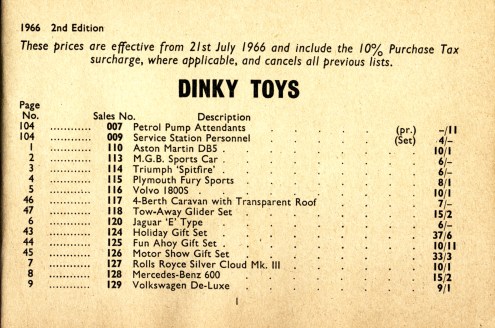
In certain price lists, to save space, there was no ‘pounds’ column, so the same amount would be written 29/6. See the Dinky Toys catalog example below.

For amounts less than one pound (such as the prices of groceries), it was usual to write, for example, one shilling and nine pence as 1/9, read as “one and nine”.

In cases where the price was an exact number of shillings, a further quirk was deployed. Instead of writing, for example, 3/0, the accepted formulation was 3/-.

Needless to say, it took me as a child some considerable time to master these peculiar shorthand forms.
Dinky Toys 1966 Price List

Dinky Toys 1966 Price List

The image above shows part of the price list from the 1966 Dinky Toys catalog. The conventions used for displaying prices in shillings and pence can be seen on the right. Note that for items costing more than £1, the price is still shown in shillings and pence only. For example, the “Holiday Gift Set” costs “37/6”, which is actually £1/17/6.

Strange Names

The colloquial name for a pound was a quid, and you can still use that term for the modern pound today.

Most British coins had acquired names (either officially, or as slang) in addition to their values. I’ve already mentioned the ha’penny and farthing (whose name was derived from “fourthing”), but there were many other colorful epithets.

Tanners, Bobs & Florins

The slang term for the sixpence coin was a tanner; that for a one shilling coin was a bob; while the two shilling coin was officially named the florin (because it had originally displayed a floral design). In fact, the florin was a rather late introduction, having been created during Queen Victoria’s reign (in 1849), ostensibly as a first step towards decimalization (the florin being worth one tenth of a pound). If indeed it was the first step towards decimalization, then it was also the last during Victoria’s reign!
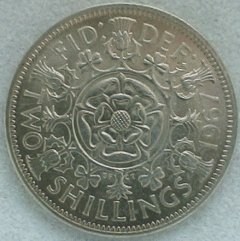
The Last British Florin Design

The Last British Florin Design

Thruppenny Bit

There was also a three pence coin, which was colloquially referred to by the relatively obvious name of thruppenny bit. The inconveniently small silver thruppenny bit was withdrawn in 1942, and replaced by a twelve-sided nickel-brass coin.

This enforced a change in Christmas tradition. It had been the practice to cook a silver thruppence in each Christmas pudding, the lucky finder of which kept this small treasure trove. However, the new nickel-brass coin reacted with the pudding’s ingredients, to produce an unpleasant taste. Therefore, inflation took its effect, such that it was now necessary to cook a silver sixpence in Christmas puddings!

Half-Crown

Moving on up the value scale, the half crown coin was worth two shillings and six pence. There had, in earlier days, been a crown coin, worth five shillings, but, by the time that I came into the world, the crown was no longer in general circulation, and was minted only for special occasions. (The occasion of Sir Winston Churchill’s funeral, in 1965, was the first time that I saw one.)

Sovereign

During my lifetime, there was no pre-decimal coin in circulation having a higher value than the half crown. The denominations of bank notes were ten shillings, one pound, five pounds, and so on upwards.

When first introduced (in 1489), the pound had been a gold coin, called a sovereign (because its design depicted the King—in the person of Henry VII—at the time). Gold sovereigns are still minted today, but, if anyone should offer to sell you one of these for a pound, don’t expect it to be real!

Guinea

As if all the above were not sufficiently complex, the British managed to add a further layer of intricacy by adding elements of the class system to the currency system!

Minted alongside the pound, there had, for centuries, been a gold coin called a guinea (primarily because the coins had originally been minted, in 1663, using gold obtained from “Guinea” by the West Africa Company). Because of its intrinsic value, the equivalent in shillings of a guinea varied over the years, from twenty shillings when first introduced, up to thirty shillings in the 1690s, and then finally settling at twenty-one shillings.

By the twentieth century, however, the guinea coin had been long withdrawn, and the guinea was not an official currency denomination. Nonetheless, an attitude had developed among the upper classes that dealing in mere pounds was the grubby necessity of those who must work for a living. The leisured classes should never be seen to debase themselves with such proletarian considerations! Therefore, those who considered themselves as belonging to the “professional” class, or higher, always dealt in guineas (one guinea being worth twenty-one shillings), rather than in pounds.

A satirical example of this practice appears in Lewis Carroll’s tale: Through the Looking Glass. One character in the story, the Mad Hatter, always wears a top hat, in the brim of which is affixed a label stating; “In this style: 10/6”. The ‘10/6’ is the price—ten shillings and sixpence, or half a guinea, indicating—via the additional sixpence—that the hat is intended for a “professional” clientele.

The class distinction implied by the use of the guinea was satirized for perhaps the last time in the 1960s television show The Avengers.

In the episode entitled The Morning After, the hero, Steed, has captured a double agent called Jimmy Merlin. As they walk along, handcuffed together, Merlin decides to try to buy Steed off.

Merlin: “Any chance of making a deal?”

Steed: “I shouldn’t have thought so, but keep talking.”

Merlin: “Twenty thousand, in a Swiss bank account? No names; no strings?”

Steed: “Pounds?”

Merlin: “Yes.”

Steed: “Very sorry, old chap, only deal in guineas.”

Winds of Change

That was the way things were, and they had been that way for centuries. But no sooner had I learned the arithmetic of the LSD system, when, during the mid-1960s, someone announced: “You know that money system that we’ve been using for hundreds of years? Well, we’re not going to do that any more!”

Between 1968 and 1971, adjustments were made to the existing coinage, to bring it more closely into alignment with the planned decimal system.

In 1968, the minting of shilling and florin coins was terminated, and instead were minted, respectively, five new pence and ten new pence coins. The replacement coins were of the same size, shape and weight as their predecessors, but displayed the new values. During the next few years, various withdrawals occurred of denominations that would not convert conveniently to decimal values.

D-Day

Then came “D-Day” (the “D” standing, in this case, for “decimalization”). On February 15, 1971, the entire nation changed over from the official usage of one currency to the other, literally overnight.

On ‘D-Day’, all the surviving old coin denominations were called in, and the half new pence, new penny, and two new pence coins were issued for the first time. This vast changeover was achieved efficiently, by the expedient of placing the burden of the conversion upon sellers!

Sellers were to display their prices in the decimal currency as from D-Day, and, when purchasers wished to pay using the old currency, the seller would have to convert the amount for them. The seller accepted the old currency equivalent, paid back any change in the new currency, and then turned in the old coinage to their bank in the normal course of events.

The Chaos Caused by New P

In the decimal system, the pound was retained, with the same nominal value as the LSD pound.

There were to be one hundred new pence to one pound, with no denomination equivalent to the shilling. This implied that one new penny would be equivalent to 2.4 old pennies. The symbol for the decimal pound was retained as “£” (the crossed “L”), since this would cause no confusion, but the symbol for the new penny was to be “p”. This led to the practice of referring to, say, ten new pence as “ten pee”, to avoid the ambiguity that would arise from the use of the phrase “ten pence”.

Nonetheless, the requirement to specify ‘new pence’ played havoc with the colloquial terminology that had been commonplace until then.

The half new penny coin, for example, was never referred to as a “new ha’penny”, but initially as a “half new pence,” and later, when the word ‘new’ was dropped, a “halfpence.”

The nation’s Boy Scouts, who had traditionally undertaken their annual “Bob a Job” week, whereby they offered to perform chores for payment of one shilling, now found themselves forced to offer the less linguistically satisfying “Five New Pence a Job” week.

Goodbye to Ten Bob

As I mentioned above, the ‘ten bob note’ was withdrawn, and replaced with the seven-sided fifty new pence coin, in 1969.

Other than that, however, no changes were made to the paper money denominations as part of the decimalization plan.

Sing a Song of Two Sixpences Only, Please

I have not mentioned the withdrawal of the pre-decimal sixpence coin, because, in fact, this survived in use for some years following decimalization, but under the extremely quaint constraint that these coins be used only in pairs!

It was acceptable to pay an amount of five new pence using two sixpence coins, but it was illegal to use one sixpence coin to pay two and a half new pence!

Fading Memories

For those Britons who did not live through the decimalization era, the details of the LSD system described above fall very firmly into the category of rapidly receding ‘ancient history’.

That fact was brought home to me when my nephew, on seeing a reproduction of a 1930s travel advertisement stating, “Return Fare: 1/9,” asked me, “What does it mean: ‘Return Fare: one-ninth’?”
Complexity from Simplicity

Commodore776M

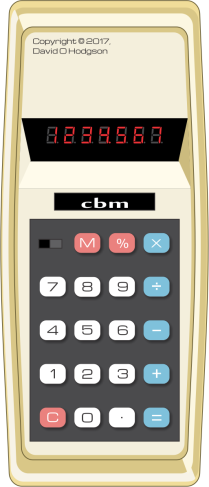
Commodore 776M Calculator: Our Family’s First Computer!

This flashback is slightly unusual, in that, instead of discussing an old photograph, I’m thinking about something that, back in the 1970s, seemed to me to be a technological miracle. Learning how it worked, and how to design even more complex devices, provided a valuable lesson in how amazingly complex systems can be built from simple components. The image above is my drawing of the first “digital computer” that my family ever owned: a Commodore 776M calculator.

This article explains how, in the space of less than 10 years, I went from regarding computers as mysterious marvels, to learning not only how they work, but also how to design and build them. I even obtained patents for my own new digital circuitry inventions. I’ve tried to keep the technical discussion as basic as possible, while still trying to show how complex systems are built up from simple components.

As I mentioned in a previous post, when I was at school I studied Advanced-Level Math and Physics, but much of what we were taught, even in Physics, was very theoretical, and it wasn’t at all clear how the principles applied to real-world technology, or indeed how real devices worked. To learn how real systems worked, I often had to resort to teaching myself.

Computers as Black Boxes

The same was true for understanding how computers worked. I was very excited when I was told that, as part of the Physics syllabus, we were going to learn to understand computers, but I was quite disappointed by what we were actually taught.

The teacher explained to us that digital computers use binary arithmetic (the value of every digit can only be 0 or 1), and that computers are built from simple circuits such as so-called “AND” and “OR” gates. The binary 0 and 1 values are represented in the computer by “low” and “high” voltages respectively.

We were able to play around with pluggable electronic “black box” modules that implemented these functions, and we confirmed the results of combining them. We could use Boolean Logic to combine the outputs from these gates.

But I still thought, “How do you get from that to a digital calculator?”

The answer (as I was to learn later on) is by combining thousands or millions of those basic gates together to make devices of increasing complexity.

Even after a career of designing digital electronic systems and the software associated with them, I still find it really astonishing how extremely complex devices can be created from such simple basic blocks.

Building Everything from NAND Gates

There are three basic types of digital computer logic circuit or “gate”:

  1. NOT gate. The output level is the opposite of the single input level.
  2. OR gate. The output level is high if any of the input levels is high. A NOR gate is the same but with the output inverted (i.e., an OR gate plus a NOT gate).
  3. AND gate. The output level is high only if all the input levels are high. A NAND gate is the same but with the output inverted (i.e., an AND gate plus a NOT gate).

It turns out that all three basic types of digital computer circuit can be built by combining one basic type of circuit, the NAND Gate.

A Real NAND Gate

My Advanced-Level Physics studies did not include electronic circuit design, of course, so it would have been unreasonable to expect to be taught exactly how these gates were implemented. I learned the details later on while studying for my Electronics degree.

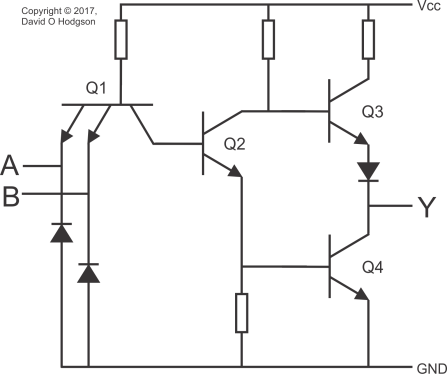
The actual circuit for a real NAND Gate, implemented as Transistor-Transistor Logic (TTL) is as shown below. This is the diagram for one quarter of the Texas Instruments 7400 NAND Gate (because the actual chip contained 4 such circuits).

Circuit Diagram of Texas Instruments 7400 NAND Gate

Circuit Diagram of Texas Instruments 7400 NAND Gate

At the time that I began designing hardware, during the 1980s, TTL logic such as this was still the standard way of implementing many designs. I used these gates myself for many designs, starting with my undergraduate final-year project at Imperial College.

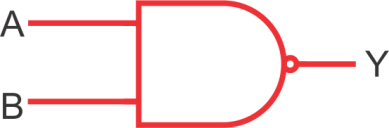
To avoid all the circuit details, the entire NAND gate can be represented with a symbol, as below.

NANDGateSymbol

NAND Gate in Symbolic Form

The diagram below shows how the connections on the symbol correspond to those in the actual circuit.

7400TTLCircuit2

TI 7400 NAND Gate: Symbol & Circuit

Memory from NAND Gates

To create a useful computer, you need to be able to store numbers in some type of memory.

It turns out that, by combining together a few NAND gates, you can create a simple memory for one bit of information. The combination is called a bistable circuit (aka a flip-flop), because (while the power is on) it remains in one of two stable states until an input causes it to change state. This allows you to store the outputs from logic circuits. Each bistable circuit allows you to store 1 bit of binary data.

Here is a diagram of a bistable 1-bit memory circuit, constructed entirely from NAND gates.

DataFlipFlopNANDs1

Data Flip-Flop (1-bit Memory) built from NAND Gates

The “Clock” input in this circuit can be obtained from another simple circuit constructed from NAND gates; the astable circuit, whose output continually oscillates between low and high states.

By lining up 8 bistables in parallel, you can store one byte of data.

From Gates to Functions

Well, that seemed simple enough, but I still didn’t understand how to get from that to a digital calculator.

Building a set of flip-flops gives you a way to store a number, but how do you combine numbers together? After all, the device is called a “computer” so how does it actually “compute”?

Well it turns out that you can also construct arithmetic circuits from—you’ve guessed it!—NAND gates. For example, you can build an adding circuit (called a Full Adder) to add together two 1-bit numbers, as shown below.

1-Bit Full Adder Circuit built from NAND Gates

1-Bit Full Adder Circuit built from NAND Gates

The circuit adds two 1-bit numbers, A and B, and accepts a carry-in bit from another adder (Cin). It generates the sum of the bits and the Cin  at S, and also a carry-out at Cout. By arranging any number of these adding circuits in parallel, and connecting their Cin inputs and Cout outputs to each other, you can build an adding circuit for numbers of any size.

Displaying Numbers

When you’ve constructed all the circuitry to allow users to type in numbers and compute the results, you still need a way to display the result to the user, because your calculator will be fairly useless without that.

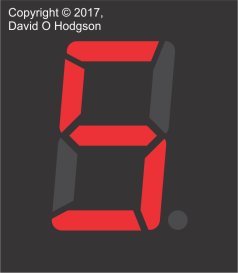
Those early calculators used “seven segment” displays, which are sets of light-emitting diodes arranged so that, by switching segments on and off, any digit between 0 and 9 can be displayed in a human-readable form.

SevenSegmentDisplay

Seven-Segment Digital Display

So, how do you make the segments light up to display a particular number? Well, as you may have guessed by now, the answer is another logic circuit, called a Seven-Segment Display Driver. Texas Instruments also produced an integrated circuit to provide this function; the 7447 IC.

Complexity in Biology

Learning how complex computers (such as the device on which you’re reading this article) can be built from large numbers of very simple components made it easier for me to understand how the same principle could apply in other fields.

For example, in biology, evolution has created incredibly complex organisms (such as humans) from huge numbers of very basic cellular components. It’s much easier to understand such processes when you know how other complex systems are created, even though the results remain astonishing in all cases.

Ganton Railway Station: Flashback 40 Years

GantonSignalBox770823cright

Ganton Signal Box and Railway Crossing, North Yorkshire, August 1977

I mentioned in a previous post that during 1977-78, as part of the research for my A-level Art study, I surveyed local road and rail architecture. One site that I visited was that of Ganton Railway Station, on the line from Scarborough to York.

The photo above was taken on 23rd August 1977 (almost exactly 40 years ago), which was obviously a beautiful day. Ganton signal box basks in the sunlit calm, awaiting the next train, with the signalman’s Mini car parked alongside. The signal box was a standard North Eastern Railway Southern Division design of about 1870, but an interesting and unusual feature of it was the large oriel window on the left side. The extra window was provided so that the signalman could have a view up and down the road before closing the crossing gates.

The road that crosses the railway here never saw much traffic, because it leads only to Ganton Golf Course and a few farms. Nonetheless, the crossing was fully guarded and the signal box, which also controlled a block section of the railway line, was manned during operational hours.

Ganton Station had already closed long before my visit, and even at that date the station building itself had been demolished and replaced by a private house (the garden of which is visible on the right in the photo above). The station actually closed to passengers very long ago, in October 1930, along with all the other intermediate stations on the same line.

It was all part of a forward-thinking experiment by the LNER, to streamline operations on the York-Scarborough line by closing all intermediate stations and replacing the stopping services with buses. Much later, during the 1950s and 1960s, such closures and bus replacements became common, but it was quite a new concept in 1930.

All the stations remained open for freight (and occasional excursion trains) until the mid-1960s, when they finally closed completely, and the platforms were demolished.

Even though the railway line remains open, much of the railway architecture along its length has been demolished over the intervening years, leaving an empty and derelict landscape.

GantonSignalBoxSite2007

Site of Ganton Signal Box, 2007

I returned to the site of Ganton Station one dull afternoon in 2007, while back in Scarborough temporarily, seeing my family there. As shown above, what is left is ugly and depressing. The hedges around the private house (on the right) have grown up, but the signal box and all other railway buildings are gone. The crossing is now fully automatic, and there is very little evidence that there was ever a station at the site.

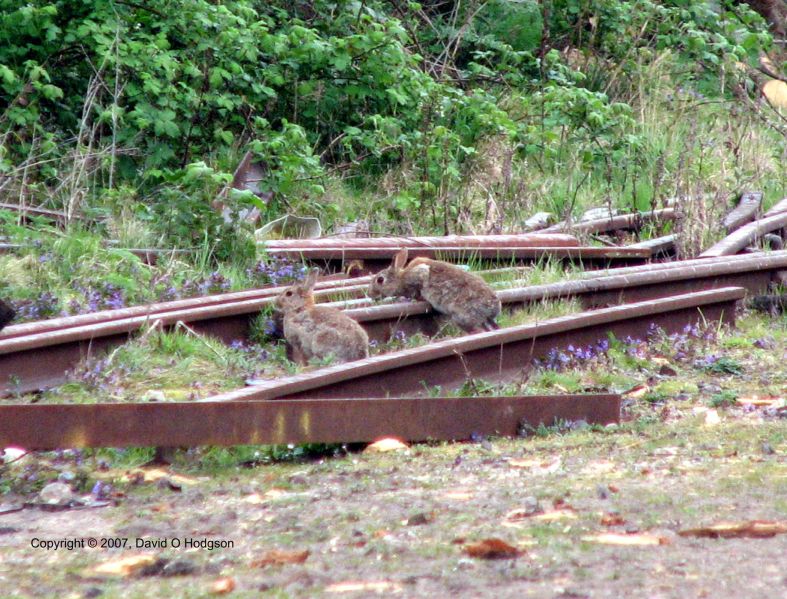
The lack of human presence at the site may be welcomed by the local wildlife, however. During my 2007 visit, a couple of wild rabbits were exploring in abandoned rails in the former coal yard by the side of the track, as shown below.

GantonSignalBoxRabbits2007

Rabbits at the site of Ganton Coal Yard, 2007

The Speeders of August

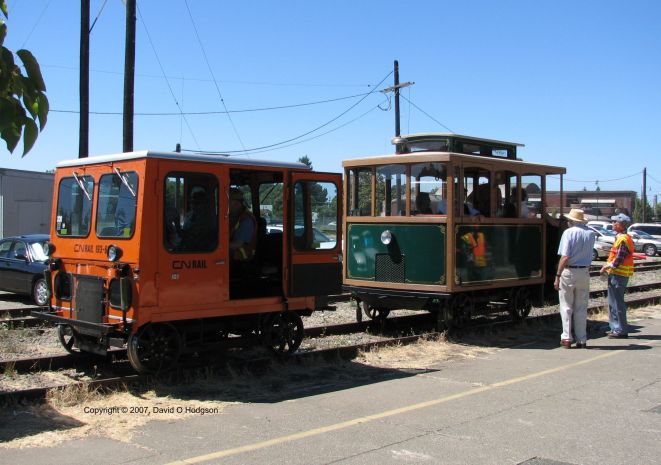
Speeders in Santa Rosa, 2007

Speeders in Santa Rosa, 2007

Ten years ago, my wife Mary and I spent an enjoyable afternoon traveling on a short stretch of what at that time was the disused North Western Pacific Railroad line in Santa Rosa. The small “Speeder” in which we rode the rails is the dark green vehicle shown in the photo above.

At that time, a group of enthusiasts used to bring their rail speeders to Santa Rosa annually, to ride the derelict line one day per year. The event took place at Santa Rosa’s North Western Pacific Railroad Depot, which, amazingly, has survived from its construction in 1904 (just before the major earthquake of 1906) to this day, as shown below.

Santa Rosa NWP Depot, 2007

Santa Rosa NWP Depot, 2007

The depot building also featured in the 1943 Alfred Hitchcock movie Shadow of a Doubt, which I described in a previous post.

Although the last regular passenger service on the line ended in 1958, freight service continued after that, and the counties bought the track and right-of-way during the 1990s (via the North Coast Railroad Authority). In contrast to the fate of many railway lines abandoned and lost forever as part of the “Beeching Cuts” in Britain, this fortunate act saved the railroad’s right-of-way for its modern renaissance.

That day in 2007, the Speeder owners were offering free rides to the public, so Mary and I hopped aboard. As shown in the picture above, we chose a green Speeder that had custom bodywork to make it resemble a San Francisco cable car. Given that the Speeders have only 4 wheels, the ride is quite bumpy, but it was a fun experience, and one that we will never get the opportunity to try again, at least on that line.

Below is a short video viewed from the Speeder as we were riding in it:

Railroad Renaissance

The good news is that this line is no longer disused, because it now forms part of the SMART line from San Rafael to Santa Rosa Airport. Test trains are already running on the line, and full passenger service is expected to start some time this summer.

The bad news about that is that, because the line is now occupied, we’ll never again be able to ride a Speeder on it as we did ten years ago!

A Tribute to Graham Roberts

Graham Roberts and Co-conspirators, 1975

Graham Roberts and Co-conspirators, 1975

“I’m not a Yorkshireman, but I play one on the radio.” For several decades, that could have been the motto of actor Graham Roberts, shown on the left in the 1975 photo above. Continuing the Yorkshire theme of my previous post, I’m taking the opportunity to pay a small tribute to one of the most amiable men I ever met. My friendship with Graham also had a significant, if perhaps unanticipated, influence on the direction of my own life.

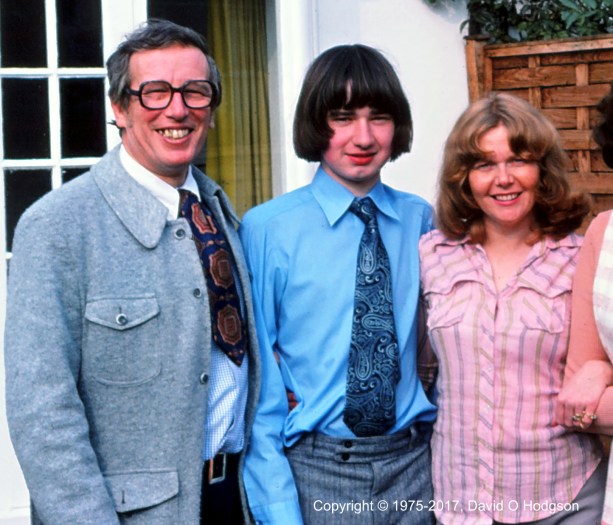
The photo was taken by my father during a visit to Graham’s home in Leeds. Yes, that’s me to the right of Graham, with full 1970s “mop” haircut! To the far right is Graham’s wife, singer Yvonne Robert.

For an astonishing 31 years (1973-2004), Graham played the character of George Barford on the BBC radio soap opera The Archers. That show was first broadcast on radio in 1950—initially as a way for the Ministry of Agriculture to educate farmers, it seems!—and is still running today.

Graham was born in Chester, and studied in Manchester, but he had an excellent ear for accents and dialects, so he probably had little difficulty picking up the Yorkshire accent he needed for his role in the Archers. Living in Leeds, he heard it all around him every day.

During the 1970s, vocal impersonations were a popular form of comedy (bringing fame to Mike Yarwood and featuring on TV shows such as “The Impressionists”), so Graham and I spent much of our time inventing silly names and speaking to each other in a variety of outlandish voices!

A Day that Shaped the Rest of my Life

I met Graham during the 1970s, when, in addition to his Archers role, he had a regular job as a Continuity Announcer for Yorkshire Television. In those days, it was deemed necessary for each TV channel to have a live announcer, who would welcome viewers and announce programs. The announcer was also expected to handle occasional technical emergencies that could occur during broadcasting. I’m sure that Graham found that job quite mundane, but it was regular and reliable employment, which is a relatively unusual benefit for those in the acting profession. Graham is listed as one of the station’s “Former Announcers” on the Wikipedia page.

One day, Graham took me with him to his announcer job at Yorkshire Television’s studios in Leeds. For me, this was an introduction to a whole new world, which had seemed completely inaccessible until then.

Some years later, that one day’s experience would lead (via a contorted path that I’ll describe in other posts) to my decision to try to become a video engineer. To that end, I obtained an electronics degree, and eventually secured a broadcast engineering job at the BBC. I doubt that I would ever have embarked on that career path, had it not been for Graham’s perhaps unintended prompt.

The Unrecognized Celebrity

Strangely, although Graham’s voice was heard on the airwaves of Britain for many decades, both on TV and on radio, he rarely appeared in vision, so he usually went unrecognized in public. This gave him the advantage of being able to go about his life without being pestered by the autograph-seekers and celebrity-followers who would otherwise no doubt have hounded him.

Outstanding Empathy

For me, Graham’s most remarkable quality was his outstanding empathy for others. It seemed that, whatever you were interested in, Graham could take an interest in it too.

It was all quite genuine and I don’t think Graham could have faked that ability. I’m sure we all know that, if you’re not interested in something, it’s very difficult to give the consistent impression that you are.

Were it not for Graham’s influence, I almost certainly would not be doing what I do today, nor probably living where I live today. I feel very fortunate to have met him and been able to spend some enjoyable times with him.

Sadly, Graham passed away in 2004, and there were many fascinating obituaries, of which two can be read here and here.

Monochrome Illustration Techniques

Young H G Wells (Incomplete)

Young H G Wells (Incomplete)

The image above was intended as a portrait of the young H G Wells. I started work on it while I was an undergraduate student, but, unfortunately in retrospect, I never finished it.

Even though the drawing is incomplete, I’ve scanned and posted it now because it is one of the few surviving examples of my artwork that uses a monochrome stippling technique.

Over on my professional blog, I just published a new post—The Age of Monochrome Illustration—reflecting on the significant changes in commercial illustration practices that have taken place during the past quarter century or so. On looking back at the work that inspired me in those days, I was astonished to realize just how much things have changed since then. It was a “given” back then that most illustration work would be printed in monochrome, and it had been that way since the dawn of mass printing.

Looking through my own remaining artwork to find images for the post, I had no difficulty finding examples of artwork that used cross-hatching, but an example of the stippling technique was less readily available.

I can think of only one area of electronic publishing where monochrome artwork may still be preferred, and that is for eBooks that are to be read on eInk devices such as the Kindle Paperwhite. However, that’s not necessarily much of a restriction, because the same publications can, in general, be read on compatible readers with full-color screens. I’m not aware of any cases where eBook artwork was deliberately created in monochrome for that reason.

Kirkham Priory Postscript

My Pencil Drawing of Kirkham Priory, 1974-75

My Pencil Drawing of Kirkham Priory Gatehouse, 1974-75

The image above is a pencil drawing that I executed at school in 1974-75, when I was about fourteen. It shows the gatehouse of Kirkham Priory, which was the topic of my previous post.

The gatehouse of the Priory is probably the most famous and recognizable portion of the remains, and has been drawn, painted and photographed many times over the centuries. My own effort wasn’t entirely original, being heavily based on a lithograph produced by William Richardson in 1848.

As I mentioned in the previous post, Kirkham was and is a major tourist attraction, and the same portion of the ruins even featured in railway posters during the twentieth century.

Edit 7/23/17: I obtained the press photograph below via eBay some time ago. The print is dated October 24th, 1927.  It shows the remains of Kirkham Priory just before the Office of Works began excavations.

Kirkham Priory before Excavation, 1927

Kirkham Priory before Excavation, 1927 (Copyright the Times)

The caption on the back of the photo says:

A view of part of the ruins of Kirkham Abbey, in the valley of the Derwent, Yorkshire, which have recently been handed over to the Office of Works by Sir Edward Allen Brotherton. The Abbey was founded by Walter L’Espee [sic], the founder of another Yorkshire abbey, that of Rievaulx, in the North Riding. The work of preservation, which the Office of Works is carrying out, will probably take two years to complete.

Picnic at Kirkham Priory

Picnic at Kirkham Priory, August 1964

Picnic at Kirkham Priory, August 1964

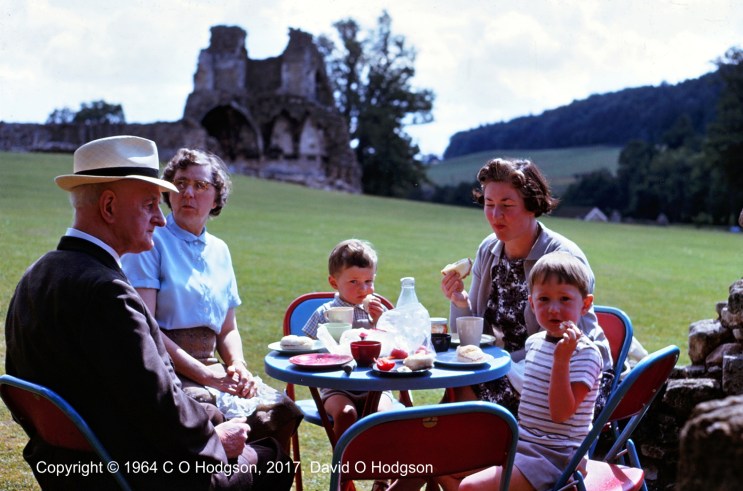
The photo above, from August 1964, shows our family picnic at Kirkham Priory, Yorkshire, during one pleasant weekend afternoon. I’m on the far right, with my mother behind me.

I mentioned in a previous post that the area in which I grew up is scattered with the ruins of many huge medieval (or older) buildings. Some are castles and other fortifications, but there are also a large number of ruined abbeys and other religious buildings. These were all forcibly closed down and partially demolished during Henry VIII’s Dissolution of the Monasteries in 1538-40. The lands seized by the King during that process were then given or sold to personal favorites, so these sites were in private hands for many centuries thereafter.

In the early years of the twentieth century, concerns increased regarding the continuing collapse of the remains of these buildings, which were coming to be regarded as national heritage sites. The Office of Works was pressured to take the properties into public ownership, and it induced the owners to sell, primarily by demanding that they maintain the ruins, and threatening them with huge repair bills if further deterioration occurred!

The Setting of Kirkham Priory

Although Kirkham Priory is by no means the largest or most impressive of the ruins, it enjoys a particularly pretty setting, by the banks of the River Derwent, which was navigable until about 1940. On the opposite bank of the river is the York-Scarborough railway line, and, during the 1920s, the enterprising Station Master of Kirkham Abbey started running a tea room and renting out boats to tourists, further popularizing the spot.

Family Outings

The man on the far left in the photo above is my grandfather, Allen E Martin, and my grandmother is to his right. I described in a previous post how my grandfather spent most of his career working for Leeds City Corporation, then in the 1950s he retired and moved to Scarborough to live with my parents. At that time, my father was the only member of the family who could drive, so he would often take all of us out for a “run”.

We picnicked at Kirkham Priory quite frequently, but the occasion shown in the photo was memorable because of the thoughtfulness of the attendant at the ruins that day. We were going to sit down on a blanket on the ground, but the grass was wet (not unusually in Britain). The attendant saw what we were trying to do, and brought out from a shed the table and chairs shown, especially for our use.

French Place Names


Notre Dame on a Rainy Evening, 2014

Notre Dame on a Rainy Evening, 2014

Happy Bastille Day (for the 14th)!

I took the photo above in Paris, one rainy evening in October, 2014. As most of you will probably be aware, it shows the cathedral of Notre Dame, on the Île de la Cité. Mary and I were staying nearby on the Île Saint-Louis at the time, and I was out for an evening stroll after the rain.

I just learned that the father of the current French President, Emmanuel Macron, is an expert on cat sneezing! During our visit, we spotted this Parisian resident, not sneezing, but gazing out over the River Seine from a balcony on the Rue Chanoinesse.

Cat on a Ledge, Paris 2014

Cat on a Ledge, Paris 2014

On that occasion, we visited not only Paris (unlike President Trump’s seemingly imaginary friend Jim), but also southwestern France, and stayed for a while in the Dordogne, which is a beautiful and fascinating region that I’d never previously seen.

We stayed in the village of Bézenac, and visited several nearby locations. One of the best known of those is perhaps Beynac, which has been nominated as one of the world’s most beautiful villages. Perched on a cliff high above the village is the Château de Beynac, as shown in my photo below.

Beynac from below, 2014

Beynac from below, 2014

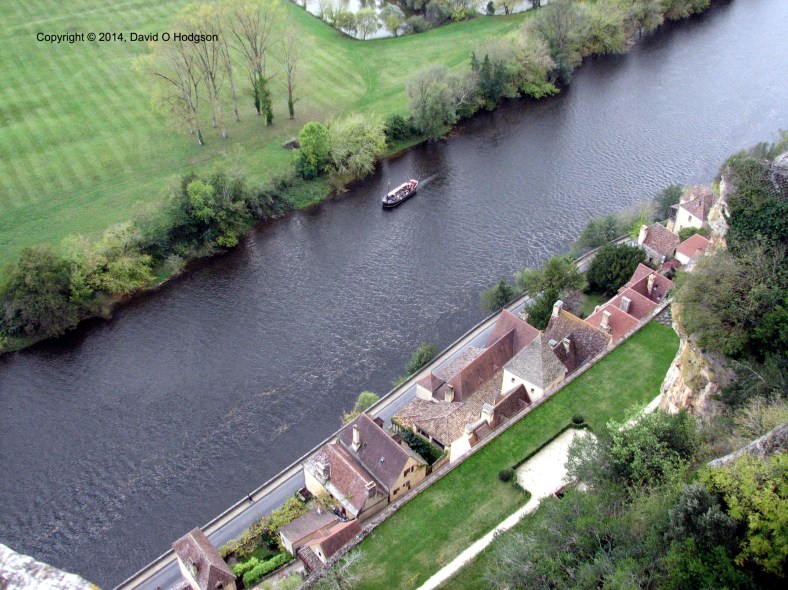
The opposite view, shown below, shows the scene from the walls of the Château de Beynac, looking down towards the Dordogne River. Incidentally, at one time in the Middle Ages, the near side of the river was in France while the far side was English territory!

Beynac from above, 2014

Beynac from above, 2014

Langue d’Oc & Langue d’Oïl

The South of France is often referred to as the “Languedoc”, and the origin of that name is linguistic. In medieval times, there were two major dialects of French, which were named according to their respective words for “Yes”.

  • In the North, the Latin expression for “yes”—hoc ille—had evolved into “oïl”.
  • In the South, the same Latin expression had become “oc”, hence the language was the “Langue d’Oc”.

All Those “Acs”

I was naturally curious as to why so many of the place names in the Languedoc end in “ac”. I assumed that it must refer to some characteristic of the settlements so-named, as for similar recurring endings in British place names, such as “ham”, “thorpe”, etc.

After we returned home, I bought a copy of a book that explains the origins of place names in that region: Origine des noms de villes et villages de la Dordogne (Cassagne, Korsak).

NomsDordogne

The book explains that the “ac” ending refers to the existence of a villa at the location during Gallo-Roman times. The Gallic names for such places ended in “acos”, which the Romans Latinized as “acum”. For example, the village we stayed in, Bézenac, was originally Bisenacum (the “villa of Bisenus”).

However, the Latin “acum” place name ending morphed into a modern ending differently, according to the region. For example, in parts of the North, “ac” became “ai”, such as in Cambrai, while in areas near Paris it became “y”, such as in Orly.

In a previous post, I described how the Roman name Eboracum evolved via several contortions into the modern place name York, in Northern England.

Perhaps I should have spotted that all those “ac” place names in Languedoc were really just that same “acum” ending that I’d already encountered in Yorkshire as a child!

Last Train to British Museum

British Museum Station, London, 1982

British Museum Station, London, 1982

The photograph above, of what seems to be a fairly unremarkable structure, shows the surface building of the London Underground tube station called British Museum. When I took the photo in 1982, I’d already missed the last train to that station… by about 50 years.

At that time, there were threats to close various London tube stations, either because they were little used, or because they were thought to require substantial maintenance work that could not be justified economically. I’d missed British Museum’s closure, though, by virtue of not having being born at the time.

As it turned out, some of the stations that were still open in the 1980s were indeed closed later, but others remain open to this day.

In my photo above, you can see the glazed terracotta faience covering the ground floor exterior walls of the building, which was a characteristic of Central London Railway stations. Originally, the station building consisted only of that one storey, but later an office building was added above it.

British Museum Station was on the Central London Railway (later the Central Line), and was opened along with the line in 1902. The line crossed the Great Northern, Piccadilly & Brompton Railway (later the Piccadilly Line) near Holborn, but there was no underground connection between the two stations, which was very inconvenient for passengers.

It soon became obvious that a common station was desirable, and authorization to build a new station, on the Central Line, was granted before the First World War, but work was delayed by the war. Eventually the new station was completed, and connected to the existing Piccadilly Line station. British Museum station was then permanently closed in 1933.

While riding the Central Line during the 1980s, I remember being able to see the remains of British Museum station through the gloom, as my train approached Holborn. The station’s platforms had been removed, but the white glazed tiles of the station walls were still barely visible, underneath decades of grime.

I’m glad that I took that photo of the surface building in 1982, because, in 1989, everything that remained on the surface was demolished, and there’s now no evidence whatsoever that there was a station there, as is apparent in the current Google Streetview of this location.

Department S

Department S Logo

Department S Logo

Strangely, I had a hint of the existence of the long-closed station long before I had even visited London, because it was mentioned (albeit not shown) in a 1968 episode of the ITC thriller series Department S.

In the episode titled “Last Train to Redbridge”, agent Stewart Sullivan is quizzing Jason King about a mysterious location, to which King was abducted and taken in a drugged state. Piecing together his incomplete memories, King makes sense of the details.

Jason King: An Underground Railway Station…

Stewart Sullivan: Old, disused. That would tie in with the murders. Are there any stations like that?

Jason King: Let’s see. On the Central London Line: two. British Museum, which was closed when they opened Holborn, and when they opened St. Pauls, they closed … Post Office

The dialog is partially factual. The description of British Museum and Holborn is accurate, but there is no closed station called Post Office, because the original Post Office station still exists, having been renamed St. Pauls in 1937.

There is also a station called Redbridge on the Central Line, although it’s not a terminus, so trains don’t generally show it as their final destination. Presumably the title image of the Department S episode shows the actual Redbridge Station nameboard.

Department S: Episode Title

Department S: Episode Title

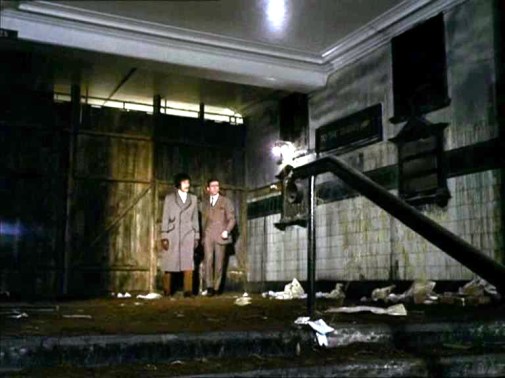
The Department S scenes showing the fictitious Post Office station seem to have been filmed in a real Underground station, as in the scene below. The surroundings just seem too detailed to be a studio set.

Department S: "Post Office" Station

Department S: “Post Office” Station

The station used seems to have been Aldwych, which was still open at that time (albeit only during “peak” hours), but closed later on. I also visited Aldwych in 1982.

Aldwych Station

I mentioned above the Great Northern, Piccadilly & Brompton Railway, which eventually became the Piccadilly Line. This line was formed from the merger of two earlier schemes, one of which was the Great Northern and Strand Railway.

The southern terminus of the GN&SR was a station called “Strand”, which, due to the merger of the two schemes, was eventually built on a branch from the “main line”.

Aldwych Station, 1982

Aldwych Station, 1982

This tatty-looking area is the end of the track at Aldwych Station, as it looked in 1982. The tiling of the walls here was never completed, during the entire life of the station. Given that all trains terminated here, then reversed direction, only the westerly platform was in use, and the track to the other platform had been lifted as long ago as 1917.

During my 1982 visit, I noticed that, on one of the glazed tile walls of the station, the original name was still partially visible, as shown in the rather blurry photo below.

Aldwych Station: Original Name

Aldwych Station: Original Name

Aldwych was closed to the public in 1994, when the sole lift (elevator) at the station required renewal. The site is now used only for private filming purposes. London Transport even keeps a complete tube train on the branch, for use in filming.