Living in Brutalist Britain

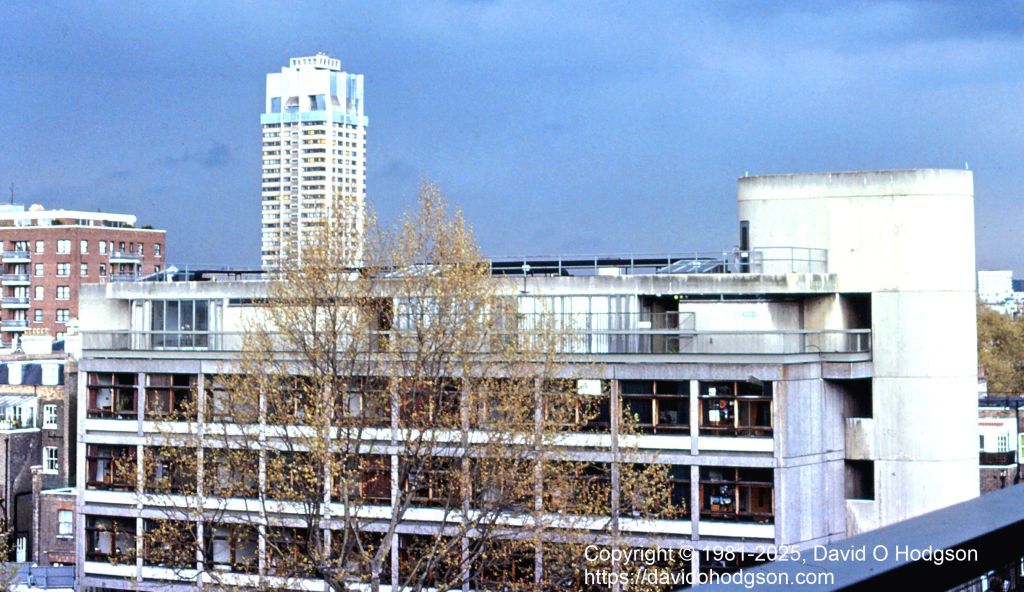
Linstead Hall, Imperial College, London, from my residence in Southside Halls

A few weeks ago, my wife and I went to see the movie The Brutalist. The extent of the hype for this movie was truly breathtaking, which may be partly why I was not surprised that it did not live up to its “promise”.

I must admit that media coverage led me to question whether those who were singing its praises even understood anything about the movie’s subject matter! For example, a fawning item about it on ABC News included paroxysms of praise for the movie’s stars and director, but never actually mentioned what the movie is about, nor was there any explanation of what the title “Brutalist” referred to! I guessed that it must have something to do with Brutalist Architecture, and it turned out that I was correct, but that was no thanks to ABC. Did the presenters really not understand it themselves, or had they decided that the explanation was too “intellectual” for their audience?

Perhaps that is, in fact, the key to the praise that the movie has received. It seems that the less a reviewer knows about its subject, the more they like the movie. Those who do understand its subject matter, professional architects, have been highly critical of its blunders and implausibility, to the extent that they are described as “hating” it in this article.

I also thought that, given its thin, questionable plot and appalling examples of ignorance, the movie was much too long at 3 hours, 35 minutes. As the Guardian reviewer states sarcastically:

“The architecture world awaits with bated breath the director’s five-hour marathons, The Postmodernist, The Deconstructivist, and The Parametricist – each to be shot with period-appropriate equipment and based on a brief skim through a coffee-table book”

Personally, the only benefit that I obtained from the movie experience was that it prompted me to think once again about the real Brutalist architecture that I grew up in and around, the history of which I find infinitely more interesting than any aspect of the movie.

Growing up, Brutalist architecture was a constant background theme in my life, and I even lived in one example of it for a while.

Brutal Aylesbury

I never actually lived in the Buckinghamshire county town of Aylesbury, but, as I recounted in a previous post, my first visit there involved a job interview and a “computer programming aptitude test” that had a profound effect on my view of my own abilities in that field.

During the period from the 1930s to the 1970s, the British Government made major investments in a group of what were referred to as London Overspill Towns. There was a deliberate policy of moving population en masse out of London, to more rural locations. The goal was mainly to reduce further “ribbon development” of the London suburbs, which would eventually have spread across the entire South-East of England. There were also health implications, since prior to the 1960s, London’s air was seriously polluted, leading to increased healthcare costs.

During the 1960s, various existing towns were targeted for substantial redevelopment and expansion, and a few entirely new towns were created. Most of these were within commuting distance of London, but even Grantham in the East Midlands was included.

The map below is from the 1963 book New Architecture of London.
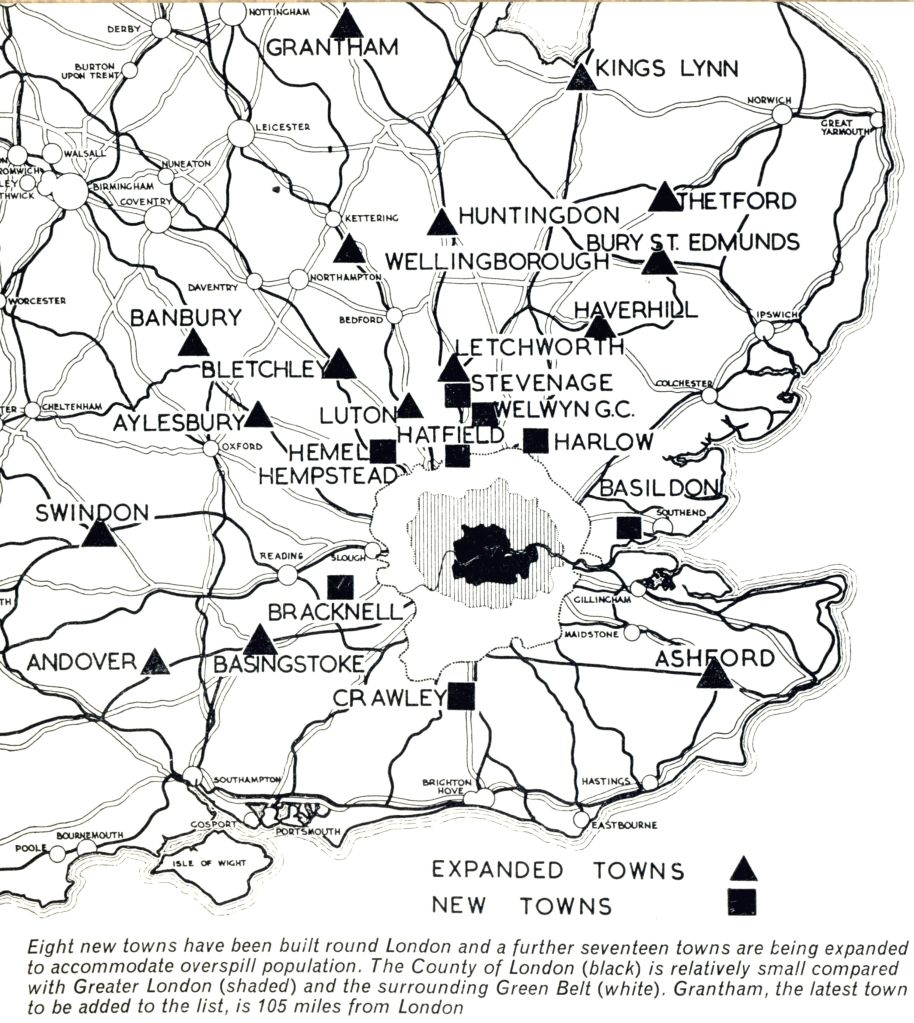
Map of London Expansion Towns. Copyright © 1963, British Travel and Holidays Association

As shown, one of the “expansion towns” was Aylesbury, which had until then been a quaint market town, famous mostly for its ducks.

Development plans for expansion towns invariably included the construction of new shopping centers and civic buildings, and some of these were designed along brutalist architectural lines. In 1967, Aylesbury found itself lumbered with a new shopping center, Friars Square, which quickly came to be seen as such an outstanding example of a dystopian nightmare environment that, in 1971, scenes for the movie Clockwork Orange were filmed there!

My 1980 photo below shows the centerpiece of Friars Square, the Cadena Cafe, after it had become a Wimpy Bar. As with many examples of brutalism, the building had a relatively short life, being demolished in 1993 when the shopping center was redeveloped.
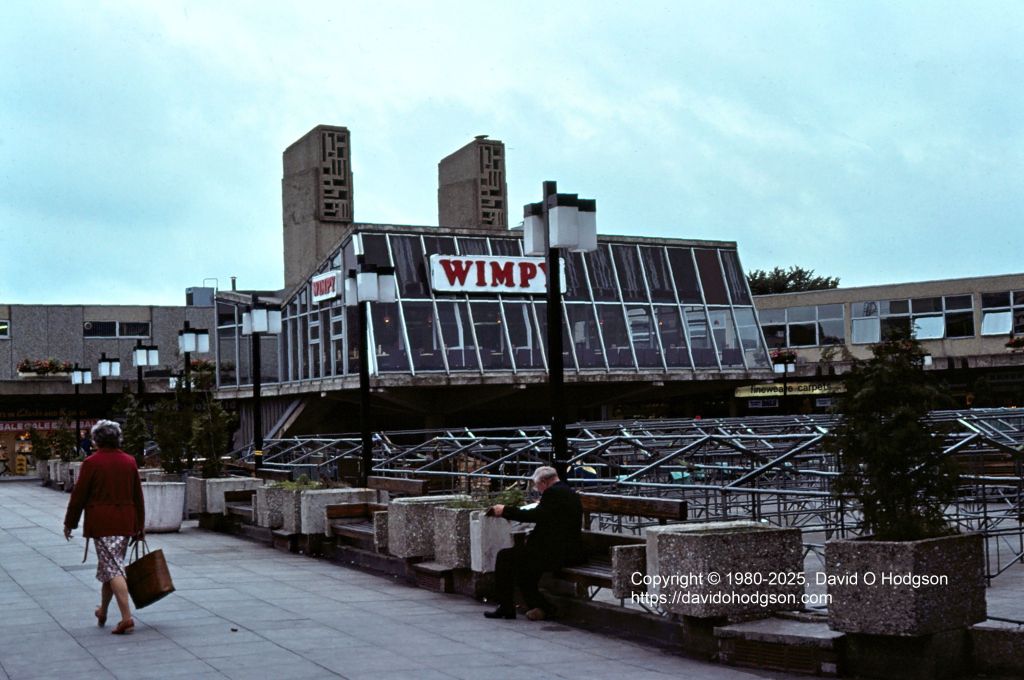
Friars Square & Cadena Cafe, Aylesbury

Elain Harwood’s book Brutalist Britain offers an extensive listing of brutalist architecture in the country, and describes another Aylesbury example, the Buckinghamshire County Council office tower.

The cover of Brutalist Britain, Copyright © 2023, Elain Harwood, Batsford Publishers

My 1980 photo below shows the County Council tower looming above Market Square in Aylesbury, with the Bell Hotel in the foreground.
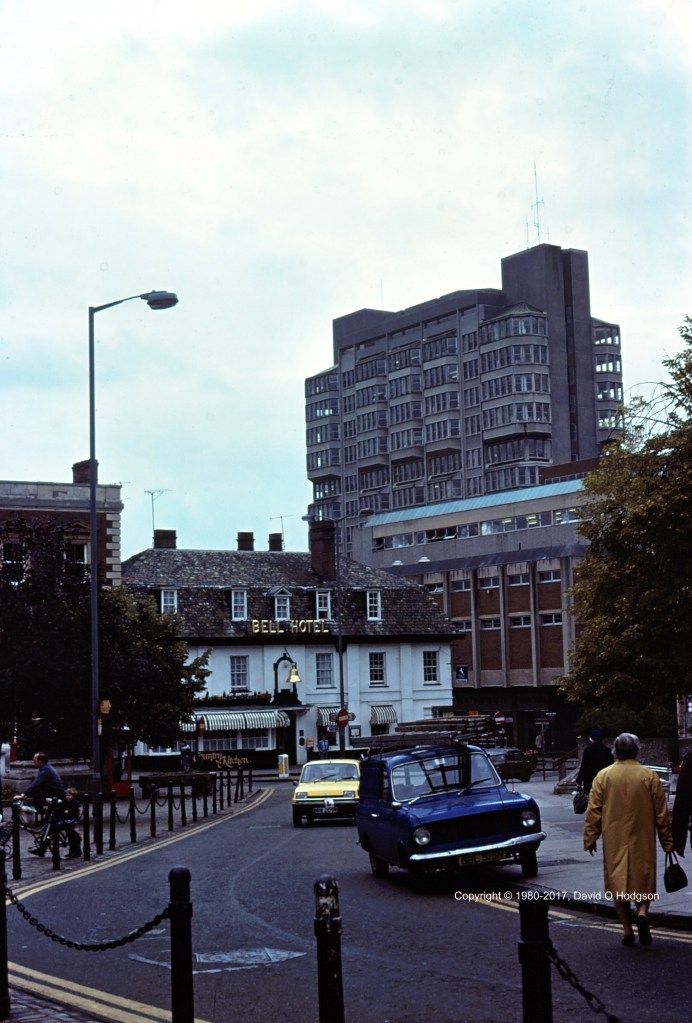
The Bell Hotel, Aylesbury, with the Buckinghamshire County Offices beyond, in 1980

Brutal Birmingham

Birmingham New Street Signal Box, 1980

It seems perhaps most appropriate that Brutalist architecture would be chosen for the design of industrial buildings, and even British Railways constructed a few examples. One of the most famous in Britain must surely be Birmingham New Street Signal Box, which has towered above the gloomy subterranean station since 1966, and is clearly visible from street level, as shown in my 1980 photo above. Although it closed as a signal box in 2022, the building is listed, is still standing, and continues to be used by Network Rail.

Again, Birmingham was not a city in which I ever lived, but when traveling between Coventry and York, I usually had to change trains at Birmingham New Street. I also applied to, and was accepted by, Aston University in Birmingham, so I attended an interview there in 1980.

Brutal London

Approximately a year after visiting Aylesbury for that job interview, I found myself moving to London, as I began my Electronic Engineering studies at Imperial College.

Many first-year undergraduate students were accommodated in Halls of Residence, situated in South Kensington near the college campus. Generally, we were assigned to one of the halls, and were not given any option as to which hall we preferred. I was assigned a single-bed room in Selkirk Hall, which was a subdivision of the huge Southside Halls building, located, as the name indicates, on the south side of Prince’s Gardens.

The photo at the head of this article shows the view looking north from Selkirk Hall over Princes Gardens, one stormy afternoon. The building in the foreground is Linstead Hall, which was of similar architectural style to Southside. In the distance, the tower of another Brutalist edifice is visible; Hyde Park Barracks, which was and still is the home of the Horse Guards.

Cover of Lost Futures. Copyright © 2017, Owen Hopkins, Royal Academy of Arts

Unfortunately, while living in Selkirk Hall, I never photographed the outside of the building itself (partly because the trees in front of it obscured most of it). However, Owen Hopkins’ book Lost Futures includes an article about Southside Halls, which also mentions the smaller Weeks Hall, situated on the north side of Prince’s Gardens.

The photo below, borrowed from “Lost Futures”, shows an excellent panorama of Southside, before the trees in front of it grew too large.
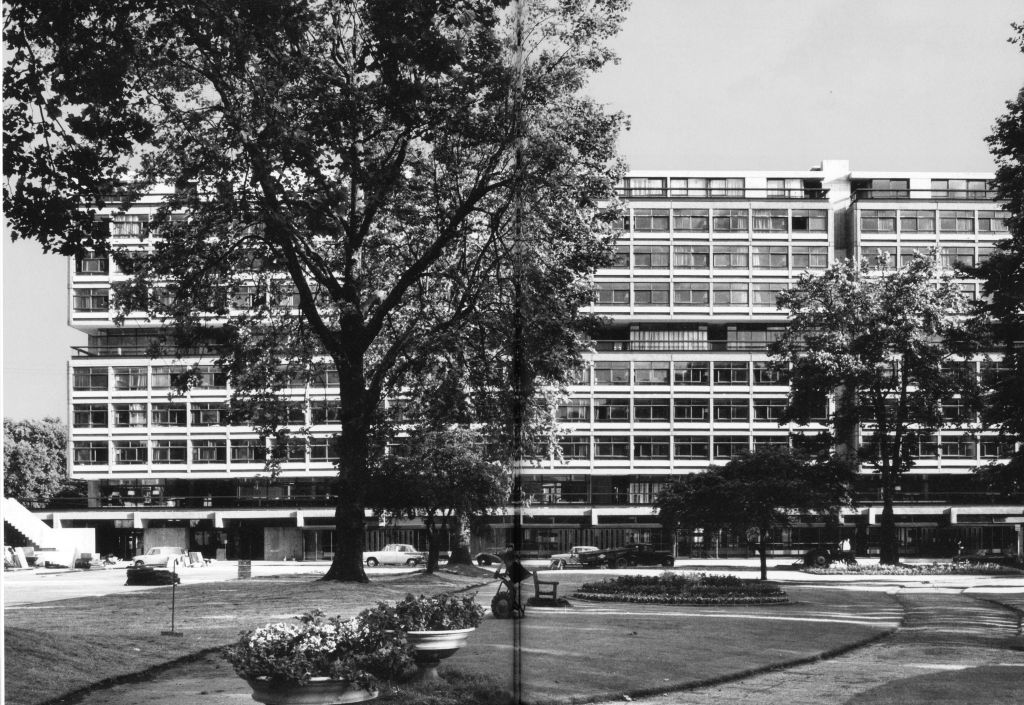
Southside Halls, Imperial College. Copyright © 2017, Owen Hopkins, Royal Academy of Arts

Unfortunately (or perhaps fortunately, depending on your view of their aesthetics!), the passage of time has revealed that many Brutalist buildings were not well-constructed, and in some cases not even well-designed. I had personal experience of this while living in Selkirk Hall.

I lived in the building for only one academic year, but even during that time there were serious maintenance problems. Each bedroom had its own sink, whereas kitchen and bath facilities were shared. The sink in my room was out-of-action, and boarded off, for several weeks during my residency, due to plumbing problems. It seems that the design of the building had a major flaw, whereby pipes and other service conduits were buried directly within the concrete, instead of being placed in accessible service ducts. As a result, any plumbing maintenance work required drilling out the concrete to access the pipes! The quality of the concrete also seems to have been defective, and large chunks of it eventually began to disintegrate.

The upkeep of Southside became so problematic that, despite its being a listed building, permission was eventually granted to demolish it in 2005. That permission was granted on condition that the smaller Weeks Hall, on the north side of Prince’s Gardens, and also a listed building, be retained and refurbished. In my photo below, looking north from Southside, you can just see Weeks Hall towards the right.

Skyline from Princes Gardens, with Weeks Hall

One of the more successful examples of Brutalist architecture, which still exists and is in use today, is the Barbican Centre, in the City of London. My photo below shows part of the complex shortly after its official opening in 1982. I visited the Centre many times, usually to go to the Museum of London, which was housed within it.

Despite having been voted the “Ugliest Building in London”, the Barbican apparently remains popular with apartment renters, thanks to its views and convenient location.
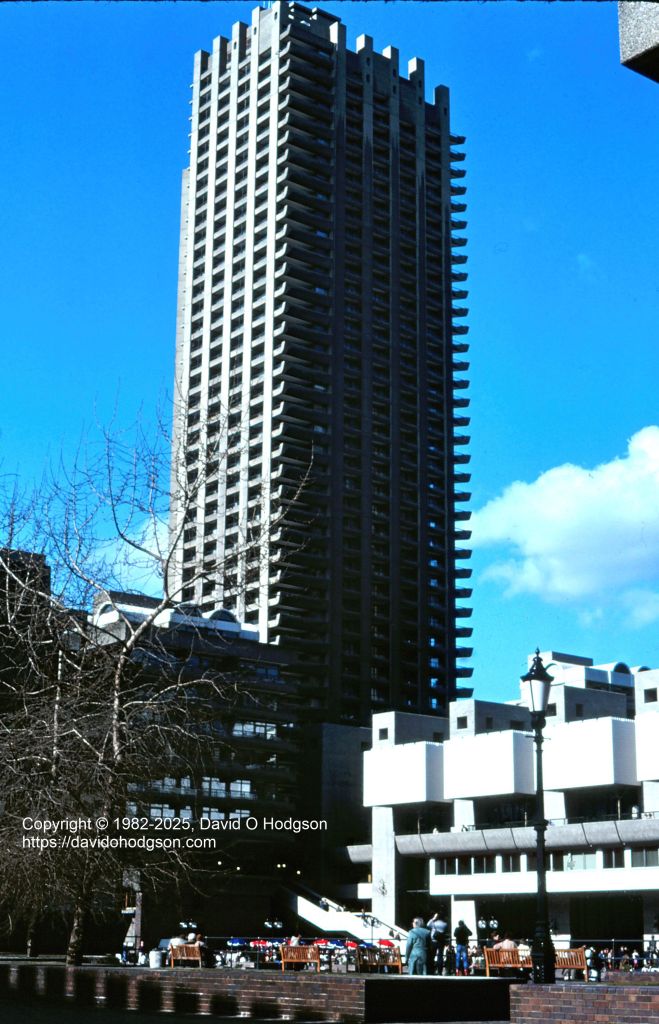
Barbican Centre, London

Brutal Scarborough

Even my home town of Scarborough suffered the attentions of architects with brutalist leanings. In 1973, the imposing Pavilion Hotel, immediately opposite the main railway station, was controversially demolished and eventually replaced by an office block that has been described as the “ugliest building in Scarborough”. I reproduce below an article from the Scarborough Mercury of 15th September 1973, showing how the new building was to look, along with hopelessly-optimistic predictions of its future uses.
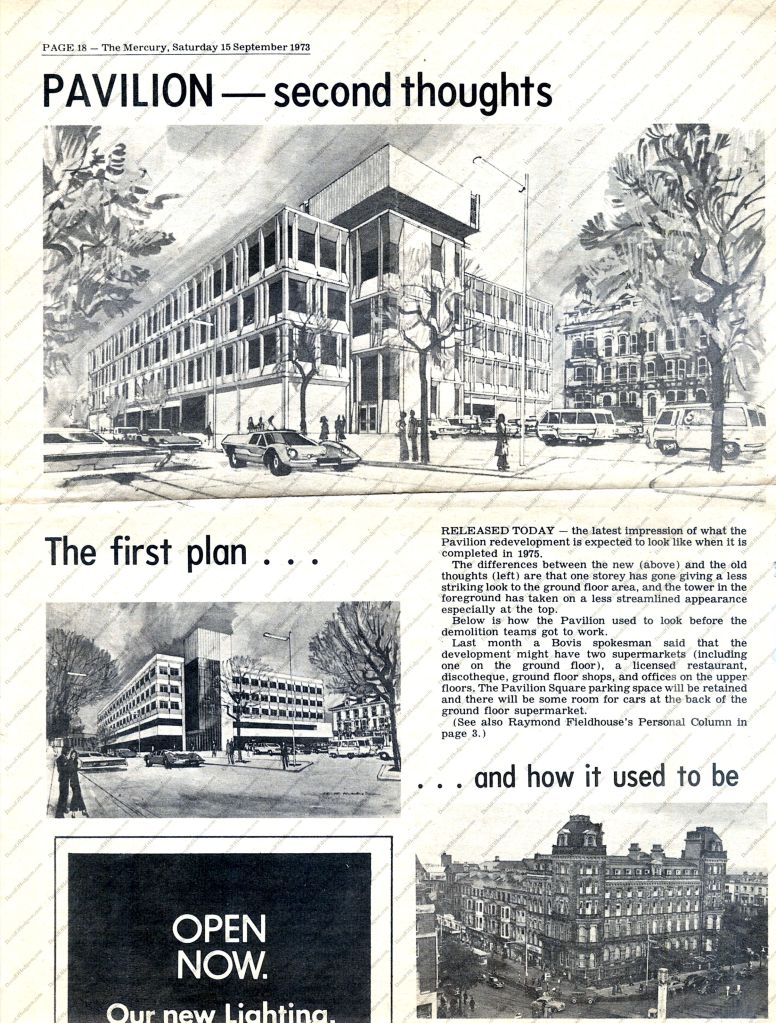
Scarborough Mercury article about Pavilion House. Copyright © 1973, Scarborough News

The building did eventually gain one supermarket, on the ground floor, although, as I recall, that store managed to look run-down from the day it was opened! As regards actual other uses for the new building, I can only remember it as the home of Scarborough Job Centre, in which I spent many useless hours not finding a worthwhile job. It seems perhaps appropriate; a depressing and ugly location for a depressing and hopeless office!

There’s no question that, whatever the aesthetic qualities of those Brutalist buildings, they were and are each unique, and they formed a memorable backdrop to my life in those days.

Westwood Bus Station, Scarborough

My Scale Drawing of the Westwood Bus Station Building

When I was exploring the streets of Scarborough in 1977-78, conducting research for my A-Level Art project on architectural aspects of the local road and rail industries, it was impossible to know what the future might bring for the subjects of my study. Many of those locations and buildings have in fact survived to the present day, and some have even been renovated. Others, however, have vanished completely. In some cases, even the land on which the buildings stood has been redeveloped to the extent that it is now unrecognizable.

The subject of this article is one such example. Westwood Bus/Coach Station occupied a central site in Scarborough, right next to the main railway station. During the 1970s, the bus station was still quite heavily used, particularly during the summer months, when it was often completely filled with visiting excursion coaches. It was also still the terminus for scheduled bus services. During the 1980s, however, the station was shut down, and the entire hillside on which it stood was excavated to create a new superstore and underground car park, which still exists today. As a result, no trace remains of this bus station.

The image above is a digitized version of a gouache painting that I produced for the A-level thesis. It is to scale and shows the northerly elevation of the waiting room and ticket office building at Westwood, which was the only permanent structure on the site. If you don’t like the color scheme, please don’t complain to me! Those were the actual colors of the building at the time of my survey; very “Seventies”!

Note that the location described in this article is not the East Yorkshire bus park currently referred to as “Westwood”. The old location was on the south side of Westwood, where the Tesco store now is. At that time, the current bus park was part of Scarborough railway station.

Three Bus Stations

I’d been familiar with that place for as long as I could remember. When I was very young, Westwood was the terminus for services operated by East Yorkshire Motor Services (EYMS). At that time, there were two other regional bus companies running services into Scarborough, but each had its own station. United Automobile Services used Valley Bridge Bus Station, whereas West Yorkshire Road Car (WYRC) used a station on Northway.

During the late 1960s, after all three companies had become part of the National Bus Company, operations were merged, and the opportunity was taken to reduce costs by eliminating some of the facilities. Northway was closed in 1970, and WYRC services then operated from Valley Bridge. Similarly, EYMS ceased to use Westwood in 1970 (see letter below), and transferred its operations to Valley Bridge.

Another independent user of Northway Bus Station prior to its closure had been Hardwick’s Services, which was a company owned by the famous holiday tour operator Wallace Arnold. Following Northway’s closure, Hardwick’s began to use Westwood as the terminus for its scheduled services to Ebberston.

As such, by the time of my study, Westwood was used only for Hardwick’s Services, and to handle summer excursion traffic visiting Scarborough. I didn’t specifically take any photos of the bus station, but mostly of vehicles that happened to be parked there.

The photo below does show part of the site. The view is looking towards Valley Bridge, with Westwood on the left. The building that I drew is on the right. In the foreground is a former Mansfield District Bristol Lodekka, which was in use for driver training.

Westwood Bus Station in Summer 1977

An Undeveloped Prime Location

It always struck me as odd that the site of Westwood Bus Station was relatively undeveloped, given that it was in a central location right next to the railway station. There was only one building, and the concrete parking surfaces were steeply sloped, having never been leveled. Parts of the parking area were never even concreted, and were simply filled with stone rubble, as shown in my photo below.

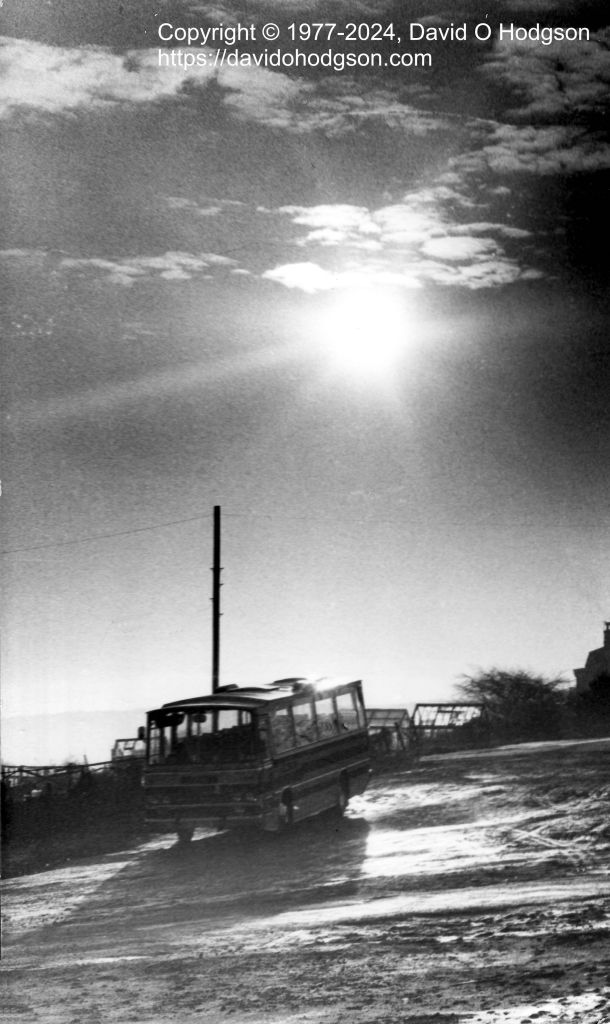
The muddy unmetalled part of Westwood Bus Station, under a low winter sun

Surely such a site would have been snapped up by an eager developer for construction of a hotel or some similar profitable structure.

I eventually discovered that the reason for this was that the land on which Westwood stood was railway-owned. It had been bought up in the late nineteenth century by the North Eastern Railway (NER), with a view to the extension of Scarborough Central station. However, the railway’s planners soon realized that, due the existence of villas immediately west of their newly-acquired land, it would be impossible to create the necessary fan of extra lines to extend the station footprint there.

As a result, the NER dropped that plan and, instead, in 1907 constructed an entirely new station further west at Londesborough Road, on the site of a former goods depot. Additionally, a new complex of sidings was built alongside the Scarborough-Whitby running line at Northstead. This arrangement proved very effective for handling the extra excursion traffic that Scarborough experienced every summer, so the land in Westwood was no longer needed.

According to an old photograph that I’ve seen, the railway-owned land was let out for allotments until after World War II. When EYMS needed a new bus station in Scarborough during the 1950s, British Railways presumably sold the land to them (EYMS was by then part of the privately-owned British Electric Traction group).

While researching my A-level Art project, I could find very little published information about Westwood, so I wrote a letter to EYMS directly, requesting some details. The letter below is the response I received from them.

Letter from EYMS providing details of Westwood Bus Station, etc.

The book Prestige Series: East Yorkshire, by John Banks, shows color photos of Westwood on the front and back covers, and there are several monochrome photos of the location inside the book.

Front Cover of Prestige Series: East Yorkshire. Copyright © Venture Publications 1999

As I mentioned above, the entire site was excavated during the 1980s, and a Hillards supermarket with underground parking was built on the site. Hillards was taken over by Tesco in 1987. Here is the current Google Streetview of the Tesco supermarket from Westwood. Due to the redevelopment, it’s no longer possible to stand in the location from which I took the 1977 photo above.

Hardwick’s Services

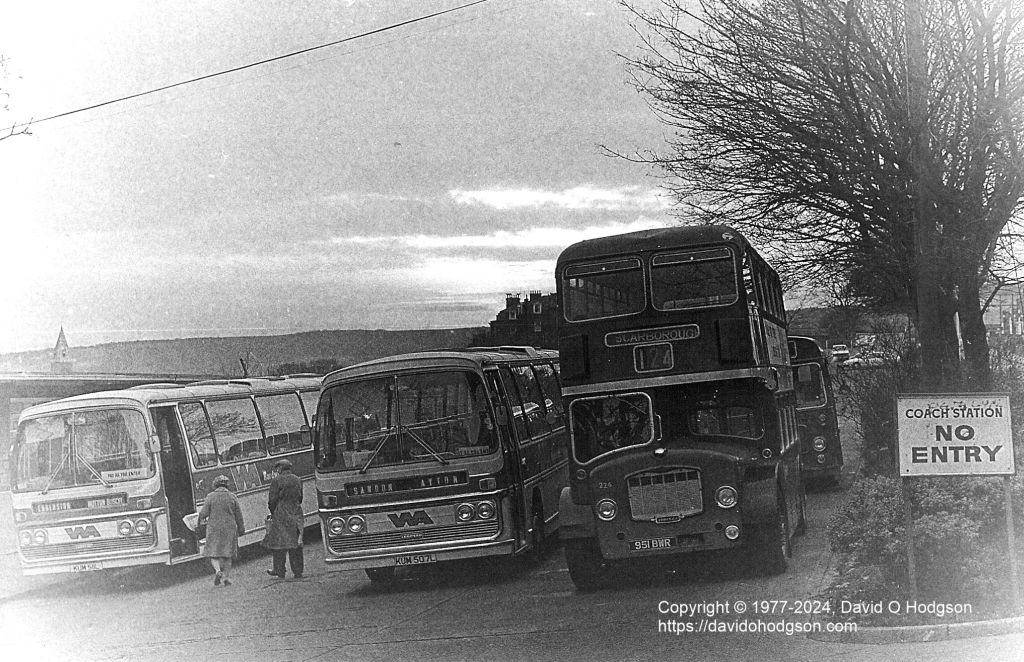
My photo below, taken in Winter 1977, shows the buses of Hardwick’s Services using Westwood as their Scarborough terminus. As you can see, Hardwick’s used vehicles with Plaxton coach bodies, but fitted with bus seats. Presumably the reason for that was for parts interchangeability with other vehicles in the Wallace Arnold fleet.

Westwood on another chilly winter’s afternoon

As is visible in the photo, NBC buses were still sometimes parked temporarily at Westwood, because there wasn’t sufficient space in the nearby Valley Bridge Bus Station, and Westwood was closer than the United depot on Vernon Road.

Incidentally, the vignetted and “frosty” look of my photo was accidental; during cold-weather development of the negatives, I failed to wash off the fixer properly! However, in this case I liked the effect, so I kept it.

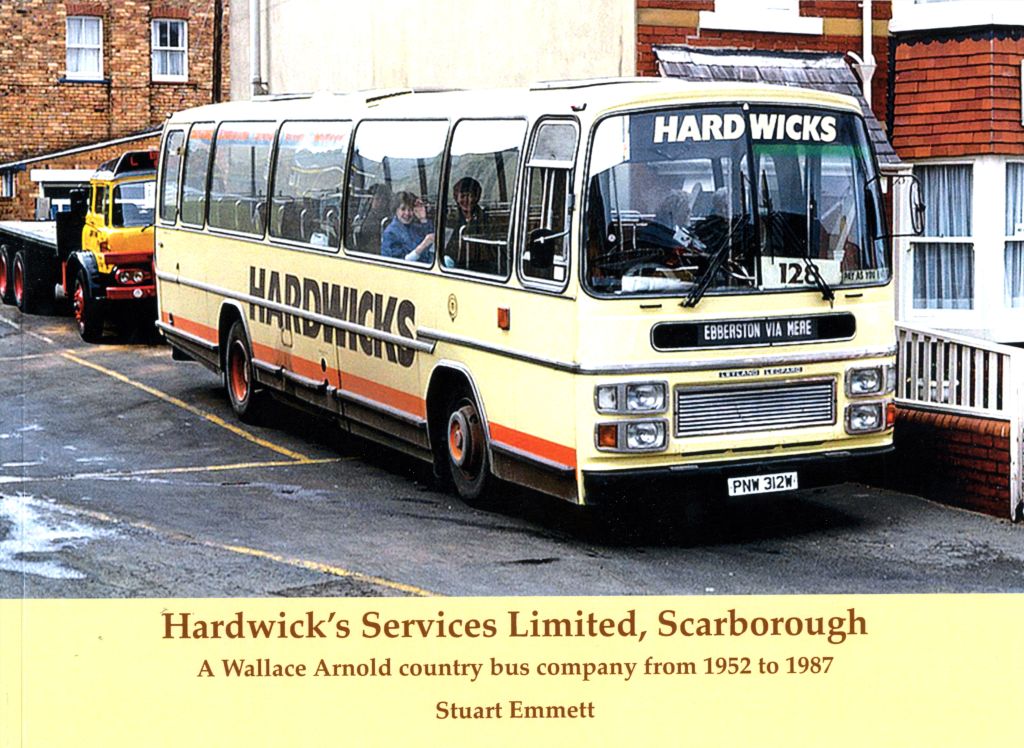
Full details and history of Hardwick’s Services can be found in this book.

Hardwick’s Services Limited, by Stuart Emmett. Copyright © 2020, Stenlake Publishing Ltd.

Working at the BBC: Illusory Limitations

BBC Broadcasting House, from Portland Place

BBC Broadcasting House, from Portland Place

The photo above is, sadly, the only one that I ever took of BBC Broadcasting House, even though I worked there and walked in and out of the building regularly. With the benefit of 40 years of hindsight, I regret that, from 1984 through 1987, I took no photographs at all. At that time, it simply never occurred to me that I might one day want to describe and illustrate what was happening to me! I was only prompted to restart taking photographs when I visited California for a job interview in October, 1987. Therefore, this article, and others discussing the events of this time period, are unfortunately quite lacking in personalized images!

In a previous post, I mentioned how, during the early 1980s, my primary goal in obtaining an Electronics degree had been to obtain what I sincerely thought would be my “dream job”, as a video engineer at the British Broadcasting Corporation (BBC). I finally obtained that job in 1984, almost exactly 40 years ago, so this seems like an appropriate time to review the details of what happened then, and my reactions to it.

Having completed my degree at Imperial College, London, I interviewed for and obtained an entry-level Engineering job with BBC Studio Capital Projects Department (SCPD), which was responsible for building and renovating studios. The final interview seemed to go so well that I actually had the temerity to ask the intimidating board of three interviewers about my chances, given that I’d already received a job offer from the Philips television systems design plant in Croydon (which I did not want to lose, if the BBC turned me down again).

The interview board asked me to leave the room for a few minutes while they discussed my case. When I re-entered the room, they informed me that, subject to their receiving confirmation of my degree grade, I’d got the job! The only further thing they wanted to know from me was, “how come you know so much about television?” I explained that I’d just spent the last 2 years as a volunteer and then Chairman of Imperial College Student Television, which had given me experience in every production job, from producing through presenting to videotape editing.

Now, with the benefit of so much hindsight, I see that I should perhaps have been tipped off by that final question that something was amiss, but, after all, in those days I was just a naïve young graduate, who naturally trusted that my new employer would be acting in my best interests!

Letter from the BBC, informing me that I'd been selected

Letter from the BBC, informing me that I’d been selected

I was overjoyed at being offered the opportunity that I had sought for so long, but unfortunately I was soon to discover that the reality of my new job was not at all what I’d anticipated.

Digression: The Realities of Auntie

For readers who do not live in Britain, I should perhaps explain something about the exalted status of the BBC (nicknamed “Auntie”) in that country’s national mindset. (This reputation has been seriously damaged by recent scandals, including official cover-ups of abusive and pedophile behavior by certain BBC celebrities, but, back in those days, that was all kept firmly secret.)

It may come as a surprise to you to learn that, in a country that is supposedly a cradle of free speech, the BBC was for many decades a monopoly broadcaster in Britain. For many decades, by law, only the BBC could broadcast radio or television services. As from 1923, all British residents had to pay an annual licence fee to operate broadcast reception equipment, although since 1971, only television receivers have required a licence. Any other organization that attempted to broadcast was a “pirate”, and the British government made strenuous efforts to shut down such organizations whenever they could. Nonetheless, broadcast advertising was such a lucrative market that many pirate radio stations did operate. As I recounted in a previous post, the governor of my own school was a director of one such pirate station!

Despite its monopoly, the BBC was not officially an arm of government. It was nominally independent, and, although it usually toed the government line, its independence was sometimes the cause of friction between the Corporation and officialdom.

The BBC lost its monopoly on television broadcasting in 1955, when the Independent Television Authority began broadcasting a rival, regionally-distributed, ITV service, supported by advertising. Nonetheless, the BBC was still regarded as the “high-brow” service, and was accorded perhaps-undue respect for that.

As regards engineering training, the reality for many years was that only the BBC offered any professional training. ITV’s contractors usually simply poached trained engineers from the BBC. Therefore, it seemed to me that the only way to get into broadcasting was to undergo the BBC’s training, and the only way to obtain that was to work there.

It turned out that I was wrong, on many counts.

It’s Not Licence-Payers’ Money We’re Wasting!

I began working for the BBC on 13th August, 1984. The location of my office was the so-called “Woodlands” building, which was at 80 Wood Lane, quite close to Television Centre in White City.

BBC Television Centre, as illustrated in the Ladybird book "How it works: Television". The employee canteen looked out onto the "Blue Peter Garden", which was located in the area marked "20" in the diagram. Copyright © 1968, Wills & Hepworth Ltd.

BBC Television Centre, as illustrated in the Ladybird book “How it works: Television”. The employee canteen looked out onto the “Blue Peter Garden”, which was located in the area marked “20” in the diagram. Copyright © 1968, Wills & Hepworth Ltd.

I went through the expected employee induction process, but, as I settled into the job, it began to seem that there was actually very little for me to do. Having asked to be assigned some work, I was given various unnecessary tasks, such as auditing the acceptance of a new audio mixing desk, which in fact had already been accepted. I was provided with no information about the expected performance characteristics of the audio desk, so my review was mostly meaningless anyway.

As I recall, the single highlight of that period of my employment occurred one day when we got an urgent message that a radio microphone had failed at Broadcasting House, a few hours prior to a live broadcast. I rushed over there with two colleagues to investigate, only to discover that a wire had come loose within the microphone base. We obtained a soldering iron, and (thanks to my EP1 training at Ferranti), all was fixed a few minutes before the broadcast! Seriously, that was as “cutting-edge” as things got!

South Elevation of Broadcasting House, from the book "London Deco", by Thibaud Hérem[20]. Copyright © 2013 Nobrow Press

South Elevation of Broadcasting House, from the book “London Deco”, by Thibaud Hérem. Copyright © 2013 Nobrow Press

I complained to management about the lack of available work, but got nothing except shoulder-shrugging in response. Initially, they explained that it was because they had done me a favor by allowing me to start early, prior to the official training date at the Evesham training school. That excuse might have made sense, except for the fact that it was obvious that my fully-trained colleagues didn’t have sufficient work either!

I became disillusioned with the justifications that were being offered to me by SCPD management, and by what seemed to be a haughty refusal to engage with me. Having selected some of the best graduates from the best British universities, apparently they now expected those same people to accept seemingly illogical decisions without question! It seemed obvious to me that, despite their heads-in-the-sand attitude, they would not be able to maintain the charade indefinitely, and that the likely ultimate result was that at least some of us would be made redundant. The only remotely meaningful response that I ever got was, “Don’t rock the boat”. What “boat”? Why were my concerns about the true situation “rocking” anything?

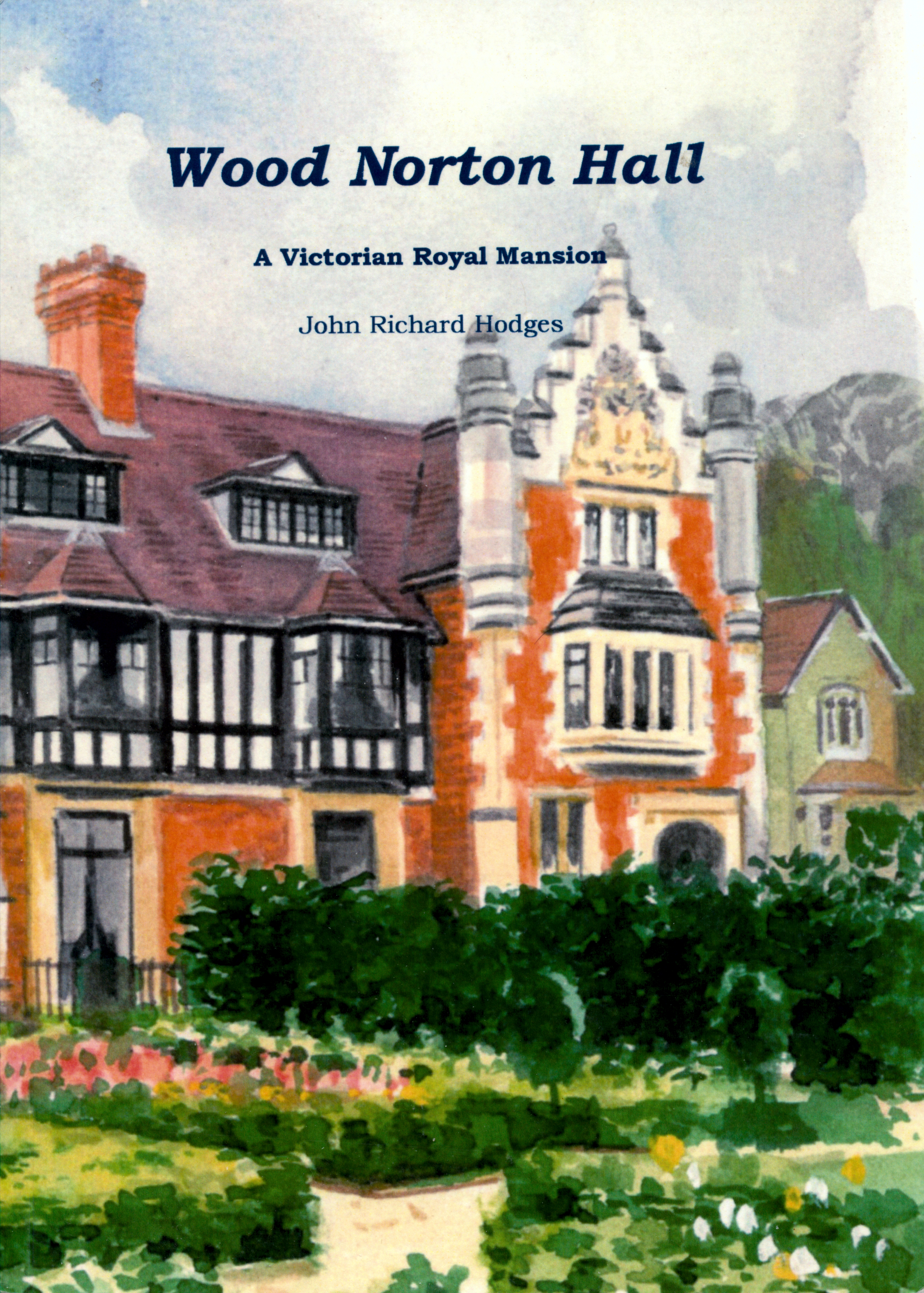
Following a few months of this tedium, I was sent along with many other new-hire engineers for the formal residential training sessions at the BBC Engineering Training School, which was located at Wood Norton Hall, in Evesham, Worcestershire (and which still exists, but is now a hotel). There is an entire book about Wood Norton Hall. It’s out-of-print, but can be obtained used, at, for example, https://www.amazon.co.uk/Wood-Norton-Hall-Victorian-Mansion/dp/0955405793/ref=sr_1_1

The cover of the book about Wood Norton Hall. Copyright © 2014 John Richard Hodges

The cover of the book about Wood Norton Hall. Copyright © 2014 John Richard Hodges

As part of that course, we were required to undergo the EP1 training specified by the Institution of Electrical Engineers (IEE). As I mentioned in a previous post, I had already spent several months completing exactly that training at Ferranti, and had a certified notebook to prove it. Why, then, should I spend time redoing exactly the same training? When I asked that question, it became apparent that I was by no means the only new BBC trainee who had already completed the EP1 training.

I pointed out to management that forcing us all through the same training again was a serious waste of money. The BBC were always sensitive to the suggestion that they were squandering licence-payers’ money, so management was eager to defend their stance, with this appalling justification: “It’s not licence-payers’ money we’re wasting. The Engineering Industry Training Board (EITB) reimburses us for the cost of EP1, so it’s the EITB’s money we’re wasting!”

Wood Norton Hall as it appeared when I worked there. The upper floors had been destroyed in a fire during World War II, and never replaced! Copyright © 2014 John Richard Hodges

Wood Norton Hall as it appeared when I worked there. The upper floors had been destroyed in a fire during World War II, and never replaced! Copyright © 2014 John Richard Hodges

Sorry; Your Degree is too Good

At around that time, it struck me that the job I’d accepted at the BBC was not the role that I’d originally had in mind. My initial application, in 1980, had been for an “Operations” job, that is, as a technician who operated or maintained broadcasting equipment. Those were the kind of roles I’d noticed when I visited Yorkshire Television, and which had stimulated my interest in working in the field in the first place.

Therefore, I asked my manager whether I could transfer from SCPD to one of the Operations Departments. His astonishing answer to me was along the lines of, “Oh no. Those jobs are for people with third-class degrees. Your degree is too good for that!”

So, apparently I’d gone from being underqualified for the BBC job in 1980, to being overqualified for it in 1984!

Having made no headway in trying to argue the problem with management, I eventually began looking for alternative employment, even if that would mean leaving the field of “video engineering”. After various interviews, I was offered an exciting position as “Technical Sales Engineer” by an electronics distributor called Swift-SASCO, who were based in Crawley, Sussex (but not in any way related to my previous employer, Swifts of Scarborough). Not only was the salary in that position comparable to what I was earning at the BBC, but they also offered an all-expenses-paid company car, plus the potential for sales bonuses. The offer was simply too good to ignore, so I accepted it and handed in my notice at SCPD, thinking sadly but mistakenly that that would be the end of my short career in video!

Retrospective: My Alternatives

Alternatively, I realize that I could perhaps have viewed my unproductive months of training at the BBC as being merely “paid education” and patiently plodded through it without complaint. I could also have spent my “enforced idleness” in exploring more of those historic buildings in which I found myself working. Perhaps I could then have moved to one of the ITV contractors? I’ll never know whether that would have worked out, but it would certainly have propelled the remainder my life in a very different direction, so in retrospect, I’m glad I did not.

In fact, I had overestimated the value of the BBC training. I’ve subsequently worked with many expatriate British engineers, quite a few of them specializing in video equipment design, yet not one of them ever underwent that BBC training! I discovered that the BBC’s engineering expertise simply was not held in high regard in the electronics or computer industries. As one former boss told me, “The BBC think they know it all, because they think they invented television. They don’t and they didn’t.”

After leaving the BBC, I stayed in contact with some of my former colleagues for a while. The word that got back to me was that, following my departure, management seems to have implicitly realized that the situation had been mishandled, and had made an effort to change their attitude. When one of my colleagues subsequently complained about some other unsatisfactory situation, his manager’s response was, “I’m glad you let us know. We don’t want anyone else to leave”!

I also discovered in the same way that, about six months after I resigned, many of my former colleagues were, in fact, made redundant from SCPD. My foreboding had been correct.

Why the Secrecy?

Nobody at the BBC ever offered me an explanation of what seemed to be the unreasonable behavior of SCPD’s management. Therefore, I can only surmise what was really happening at that time, based on descriptions and opinions I’ve received from other video engineers, inside and outside the BBC.

Here is what I was told:

Why did Studio Capital Projects have insufficient work?

As discussed in detail here, the then Prime Minister, Margaret Thatcher, and her Tory government, were engaged in a rather ridiculous ideological dispute with the BBC. The BBC (rightly) valued its independence, and its goal of providing objective, unbiased news reporting. Thatcher, on the other hand, took the view that, being funded by a licence fee, the BBC should in fact be a government propaganda arm. Unable to shut down or defund the BBC, she made petty attempts to hobble its position in other ways.

One such way was to insist that the BBC must “operate competitively”, supposedly to obtain value for money for licence-payers. Previously, whenever a BBC studio required refurbishment, the work had automatically gone to SCPD. Now, however, the BBC were forced to request bids for such work, not only from SCPD within the corporation, but also from external private companies.

The result was that external contractors always underbid, and so were awarded the contracts, leaving SCPD (which had bid according to the true costs of a project) without any work.

Logically, of course, if SCPD had no work, then the department should have closed or been repurposed. However, in that case, Thatcher would have won what was really a purely political battle, and some in the BBC were apparently determined not to concede.

Why did Studio Capital Projects hire more Engineers?

Given that SCPD had insufficient work for the engineers that it already employed, why would it nonetheless go ahead and hire even more engineers?

It was later suggested to me that this probably occurred because the BBC was “not a commercial organization”. Its annual income was essentially fixed by the licence fee collections, so the BBC’s budget was based on dividing up that fixed income among the various departments.

The primary way that a particular department could argue for a higher portion of the fixed budget was to employ more people. Hence, the goal of hiring more staff became completely detached from the question of whether such staff were actually needed!

Bad Times on the Horizon

The management issues that affected my employment at the BBC came as a great shock and disappointment to me at that time. Little did I realize back then that it would be just the start of a frustrating sequence of jobs with UK engineering employers, which would continue until I “escaped” to California (and relative sanity!) in 1987. Through no failing of my own, I worked for several employers during that 3-year period, with the management of each company being at best unstable, and at worst incompetent, as I experienced firsthand a portion of the terminal decline and failure of Britain’s electronics and computer industries. I hope to write more about some of those experiences in future posts.

It seems that the kind of mismanagement that plagued my employment experience in Britain is not a thing of the past. I was shocked by the recent news of the appalling Horizon Scandal in Britain, which seems to have stemmed from technical incompetence, and subsequent attempts by management to cover that up at any cost.

I am So Glad I Left

Let me emphasize once more that, in hindsight, I am so glad I quit that BBC job when I did! If I had not done that, but instead had listened to the discouraging comments of certain timid naysayers around me, and had clung on there, I would probably never have had the opportunity to move to California and work in “Silicon Valley”. As I have described in several earlier posts, there’s no question that the move to California changed my life immensely and permanently for the better.

I gave some thought to the wording of the title of this post. The phrase “illusory limitations” reflects both the way that I underestimated my own potential skills at that time, and the way that others attempted to impose false limitations on me. When I joined the BBC in that role, I really thought that it was the best I could do. I did not seriously imagine in those days that I could become a design engineer, and certainly not a patent-holding inventor. Fortunately, I didn’t ultimately settle for an underachieving career!

The message that I hope this tale of my experiences will convey to readers is not to be cowed by the unreasonable demands of any employer. Be confident in your own position, and don’t sacrifice your own future for the convenience of others who ultimately do not have your best interests at heart.

BBC Broadcasting House, from Portland Place

BBC Broadcasting House, from Portland Place

The POW Artists of Changi

Fred Binns in Changi Gaol

My mother’s first husband, Fred Binns, in Changi Gaol, 1943

The painting above depicts my mother’s first husband, Fred Binns, as a Japanese Prisoner-Of-War (POW) in Changi Prison, Singapore, in April 1943. It’s quite astonishing that this painting not only survived Fred’s imprisonment and subsequent liberation, but also that it was inherited from Fred by my mother, and then passed down to me from her.

If the painting could speak, it would surely tell a harrowing tale, of how it was perhaps painted using strips of bamboo and human hair, using tints mixed from different soils, then hidden from confiscation by being placed under the corpses of cholera victims. Despite all that horror, it depicts a joyous scene, showing Fred enthusiastically playing the double bass. If the proportions of the bass seem odd, that’s not due to any lack of skill on the part of the artist. That was in fact the appearance of the real instrument, because Fred had built it himself from scrap wood.

Changi Prison seems to have housed an astonishing concentration of creative talent. As shown above, Fred was himself a keen amateur musician, but there were also many artists in the prison.

Sadly, despite having survived all the horrors of imprisonment in Singapore for 4 years, Fred died prematurely of tuberculosis in 1949. He had contracted what was then usually a fatal disease during his internment, but was not aware of it at the time. By the time he died, he had married my mother, and she caught the disease from him. She was admitted to the ominously-named Killingbeck Sanatorium, and it was only thanks to the development of new “wonder drugs” that she survived at all. Her curative treatment was long and unpleasant, involving the complete collapse of each lung in turn, to rid it of the disease. Nonetheless, she survived the hideous disease that had killed her husband, and was able to resume a healthy life, which eventually included marrying my father and giving birth to me!

Ronald Searle, Des Bettany & Fred Binns

Perhaps the most famous of Fred’s bunkmates in Changi was the artist Ronald Searle. My mother knew that this painting of Fred was not by Searle, but we were not able to identify the actual artist. There is a signature in the corner, but it was too smudged to be readable.

Recently, while researching for this article, I viewed images of artwork by other Changi prisoners via the internet, and was able to match the style, and the color palette, to a man called Des Bettany. Now that I’ve seen Bettany’s signature, it matches that on the painting, so I have finally established the identity of the artist who painted Fred.

Des Bettany went on to have a successful career as a cartoonist, and eventually migrated to Australia, where he taught art, eventually rising to become Acting Principal at the South Australian School of Art in Adelaide.

The Heyday of St Trinians

Searle is probably most famous for having created the fictitious girls’ school St. Trinian’s. The drawing below is the first-ever published “St. Trinian’s” cartoon, although the caption reveals that the girls shown are pupils of an anonymous opposing school.

Searle's First St. Trinian's Cartoon

The first St. Trinian’s cartoon by Ronald Searle, 1941. Copyright © Estate of Ronald Searle

Searle had drawn the cartoon before leaving England, but it wasn’t actually published until late 1941, when Searle saw it in Lilliput magazine while fighting on the streets of Singapore!

Although Searle’s invention of St. Trinian’s predated his wartime experiences, he did use some of those cruel experiences as inspiration for his subsequent cartoons. For example, there is a St. Trinian’s cartoon titled “Bloody Sportsdays…”, which depicts the girls being forced to pull a roller to flatten grass. This was adapted from Searle’s wartime sketch “Light Duties for Sick Men”, which showed prisoners being forced to haul trees for land-clearing, during 1944.

By the early 1950s, the St. Trinians’ cartoons had become so popular that they became the basis for a series of movies (The Belles of St. Trinian’s, Blue Murder at St Trinian’s, The Pure Hell of St Trinian’s, and The Great St Trinian’s Train Robbery). In most of the movies, the headmistress of the school (Miss Fritton) is played by Alastair Sim, who also plays the headmistress’ brother! One of my favorite Sim quotations from the first movie sums up the ethos of the school:

In other schools girls are sent out quite unprepared into a merciless world, but when our girls leave here, it is the merciless world which has to be prepared.

Even in modern times, movies in the St. Trinian’s genre continue to be produced, although it must be said that the themes seem increasingly anachronistic.

The image below shows the publicity poster for the latest St. Trinian’s movie, The Legend of Fritton’s Gold (2009). Incidentally, the actor in the center, who played head girl Annabelle Fritton in the movie, is Talulah Riley, who is in reality the ex-wife of entrepreneur Elon Musk.

[Postscript 8/15/20: What a coincidence. I just discovered that Talulah Riley’s grandfather was also at Changi, as she mentions in this Twitter post: https://twitter.com/TalulahRiley/status/1294569052258664451]

Poster for Movie: The Legend of Fritton's Gold

Publicity Poster for the Movie: The Legend of Fritton’s Gold

If you are interested in more details of Ronald Searle’s life, there is an excellent biography by Russell Davies. Further details of Des Bettany’s life can be found here. For details of the life of Fred Binns, however, I’m afraid that it seems you’ll have to rely on me!

I feel truly privileged to have inherited such a unique and wonderful piece of artwork, but also very glad that I never had to endure any of the horrors that led to its creation!

For more details of the POW artists in Changi, see changipowart.com. [Update 11/20/20: Des Bettany’s son, Keith, asked me for permission to post the artwork on the Changi POW web site, and of course I granted that. The page can be viewed at: https://changipowart.com/archives/5882].

Fred Binns in Changi Gaol

My mother’s first husband, Fred Binns, in Changi Gaol, 1943

Do We Need A White Christmas?

Shoveling Snow: Winter 1962-63

Shoveling Snow: Winter 1962-63

The photo above was taken by my father during the severe winter of 1962-63, and shows me using our coal shovel to “help” clear snow from our front garden in Scarborough. Today marks the Winter Solstice here, so it seems like a good moment to reflect on something that many people seem to hope for at this time of year.

As the photo above demonstrates, some of my earliest memories of this time of year were associated with snow. This was largely because the winter depicted in the image was the coldest in Britain since 1895, a record which has still not been broken in the part of the country in which I was living.

As a result of that experience, as I grew up, I tended to assume that Christmases should be snowy, and I was most disappointed in later years when there was not only no snow on Christmas Day, but it was actually even sunny!

As I grew more mature, of course, I realized that my expectation was not particularly reasonable, and that it had in fact been instilled by episodes of weather that were anomalous, coupled with myths about what Christmas was supposed to be like.

Last weekend, I attended a “Holiday Soundtracks” concert by Michael Berkowitz at the Luther Burbank Center for the Arts in Santa Rosa where we heard, once again and as we do every year, melodies proclaiming the desirability of a “White Christmas”. The photo below shows a view of the concert.

LutherBurbankCenterXmasSoundtracks1

Holiday Soundtracks, Santa Rosa

In a pre-show discussion, Berkowitz himself pointed out the irony of a “Christmas” show being presented by a Jewish conductor, and indeed several of the writers of those famous songs were also Jewish.

The origin of my own childhood views about snowy holidays are obvious to me, but the concert led me once again to consider why so many other people should also want this end-of-year festival to be “white”, that is, to have snow on the ground.

A Northern European Tradition

Presumably the source of the association of the Yuletide festival with snow was that most of its traditions originated in Northern Europe, where there was usually snow at this time of year.

Later, in North America, many of the regions that were settled earliest by European peoples also experienced snowy winters, so those traditions continued.

In the Southern Hemisphere, of course, it’s Summer at this time of year, so the idea of a “White Christmas” makes little sense in many places. However, even in Australia, there are high-altitude ski resorts where you can experience snow in mid-summer if you really want to, as described in this article.

Maintaining the Myths

Many blame the media for propagating the myth of the desirability of a snowy holiday, as in this Boston Globe article. There is also the ever-popular Santa Claus myth, which includes the idea of his living at the North Pole.

When I discovered the truth about “Father Christmas”, after my mother admitted it to me when I was about 8 years old, I was actually quite angry that she had conspired with my father to deceive me for so long!

Snow in London

After leaving my home town, I attended university in London, and lived there for several years. The climate in London is only slightly milder than that in Northern England, so of course it also snows in London during the winter.

I took the photo below, of the Albert Memorial in Kensington Gardens, during my first winter as a London student.

AlbertMemorialSnow1981Cright

Albert Memorial, London, in Snow, 1981

There’s no question that it’s a pretty scene, but getting around in the city after a snowstorm wasn’t necessarily any fun. The snow quickly turned to dirty slush, which would often then refreeze overnight, creating black ice the following morning. Travel became unusually difficult and dangerous.

As I’ve said so many times since then, it’s great to be able to look at a snowy landscape, as long as you don’t have to go anywhere in it!

Snow in California

If anyone had asked me before I came here whether it snows in California, I may well have replied “No”, but I’d have been very wrong. At the higher elevations in the state, such as the Sierra Nevada, it snows every winter. In the lowland elevations where I live, however, it almost never snows. For example, I lived on the San Francisco Peninsula for about 20 years, and during that time it only snowed once at our house (and only very lightly), although we could sometimes see snow on the surrounding peaks.

The elevation of land in California ranges from sea level to about 14,000 feet above sea level, so the state has a corresponding variety of climates. Contrast that with the highest elevation in Britain, at about 4,400 feet, which is the peak of a mountain (Ben Nevis), while the whole of Lake Tahoe in California lies at 6,225 feet.

Thus, if I were to decide now that I would like a “White Christmas”, all I have to do is to get in my car and drive up to the Sierras. It’s nice to feel that, although I don’t need snow for the holiday, I have the option of it if I choose!

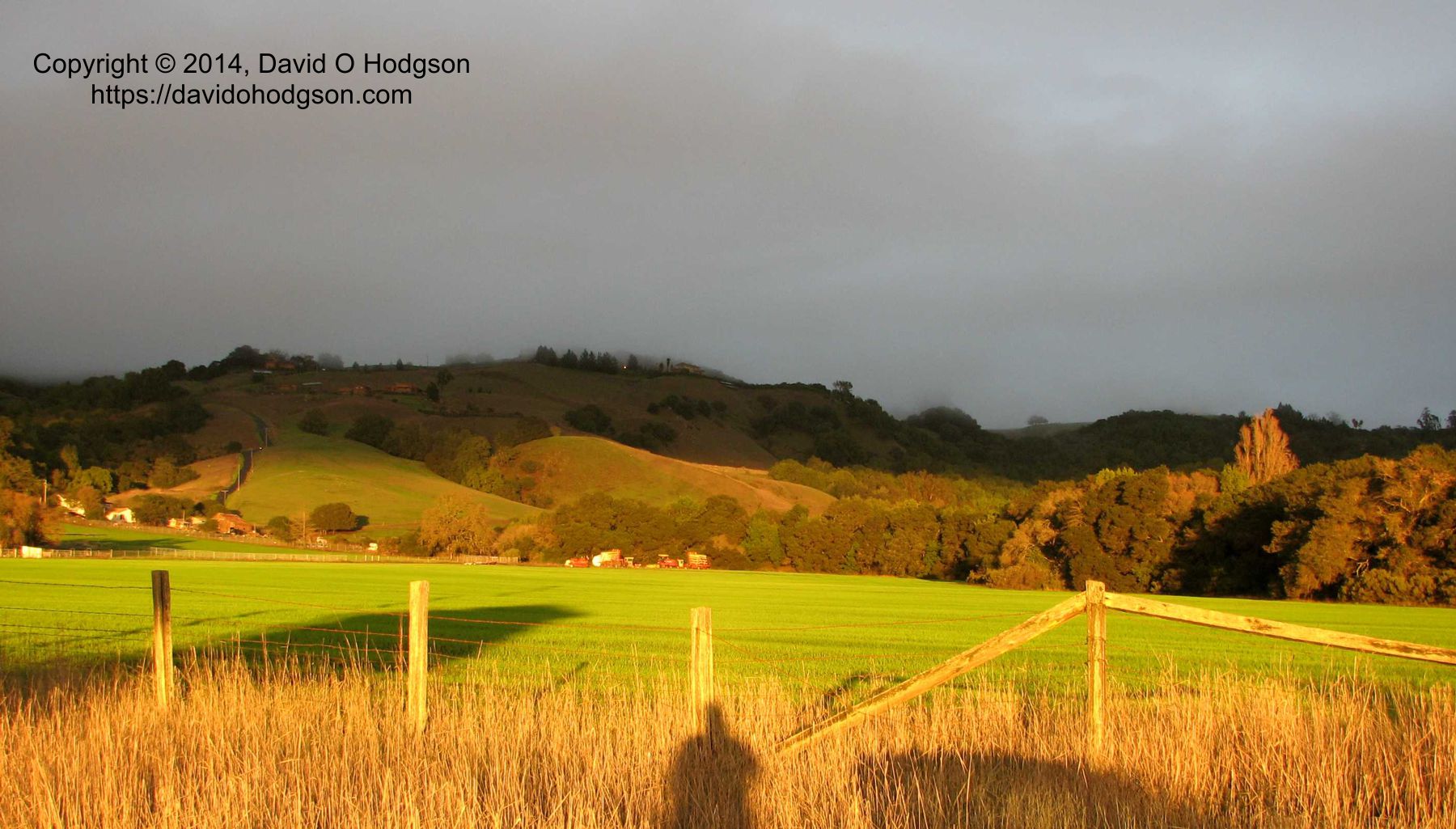
The photo below shows a typical local California view, taken near Cotati, on the occasion of the Winter Solstice in 2014. There’s mist over the hills, but no snow anywhere nearby.

Winter Solstice, Cotati, California

Winter Solstice, Cotati, California

Let It Go

If you happen to live somewhere that does not have snow at this time of year, then perhaps it will help to realize that its desirability is actually just a myth, and that there are actually definite benefits to a holiday without such weather!

Shoveling Snow: Winter 1962-63

Shoveling Snow: Winter 1962-63

Thanksgiving in Sonoma (Again)

Sonoma Plaza & City Hall, Thanksgiving 2018

Sonoma Plaza & City Hall, Thanksgiving 2018

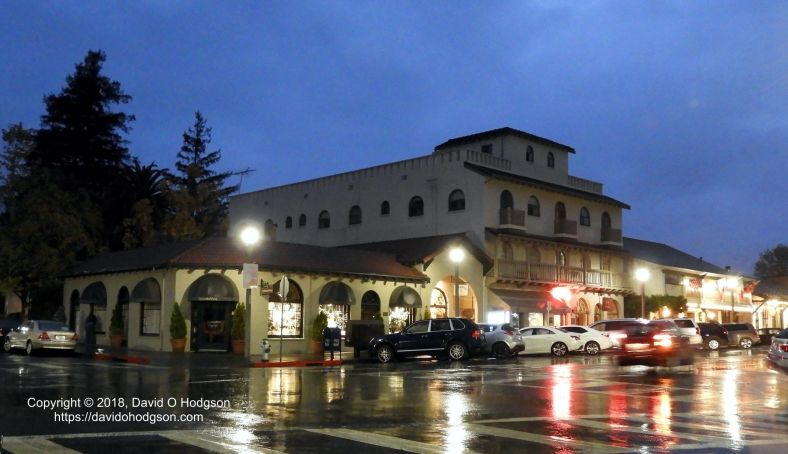
Yesterday, we traveled again to Sonoma for Thanksgiving dinner, which is how we’ve celebrated the occasion for the past few years. My photo above shows Sonoma Plaza lit up for the holidays. The large red letters spelling “LOVE” are a new addition this year.

One other difference that you may notice, relative to my Thanksgiving post last year, is that the roads in the photo above are wet. The rainy season started late this year, but we’re very glad that it has finally arrived, to wash away the lingering smoke from the Camp Fire, and also hopefully to extinguish the remains of that terrible fire.

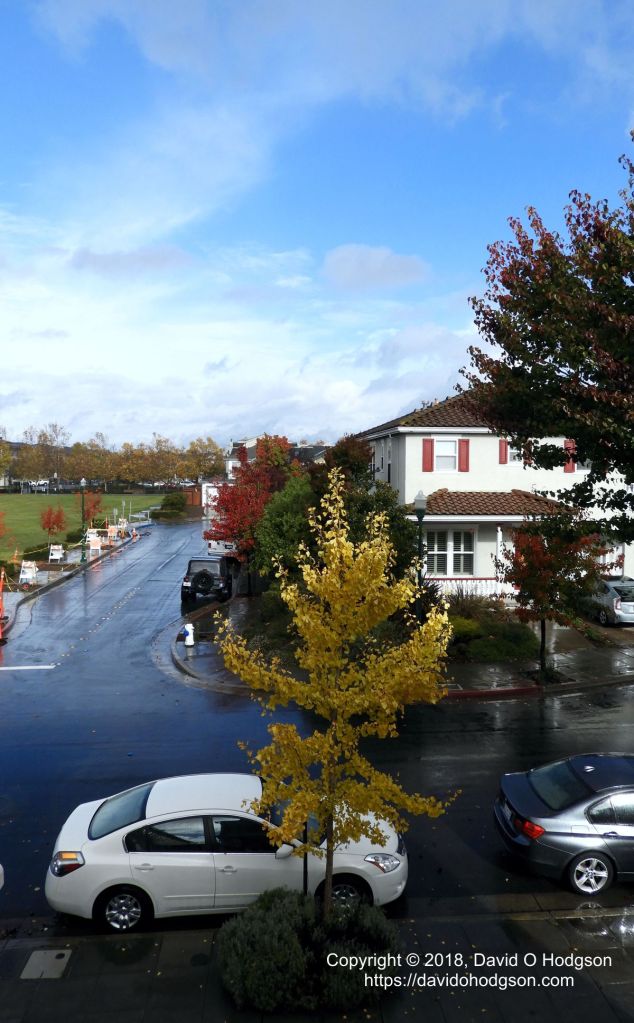
The photo below, taken from our bedroom window earlier in the day, shows a mixture of sun and rain as showers passed overhead. The view was brightened by the fact that the leaves on our ginkgo tree have just turned yellow. Unfortunately, the view was also marred by the work going on around the park (on the left) to remove and replace trees.

Rain, Sun & Autumn Leaves

Rain, Sun & Autumn Leaves

Sonoma’s Historic Plaza

As I’ve mentioned in earlier posts, Sonoma is today a rather small and quite sleepy city, but was once the military center of Mexican Alta California. It was probably for that reason that it became the hub of the Bear Flag Revolt, which led to California’s becoming independent of Mexico, and then soon after joining the United States.

I took the 2 photos below yesterday evening, with the wet roads reflecting the street lights. The first photo shows the northwest corner of the Plaza. On the right is the Swiss Hotel, which dates back to Mexican colonial days, having been built circa 1836 as a home for the brother of General Vallejo, who was one of the last Comandantes of Mexican Alta California, and went on to become a prominent citizen of the new US state of California.

Immediately to the left of the Swiss Hotel, where now stands the apartment building shown below, stood the main military barracks.

Sonoma Plaza, Northwest Corner

Sonoma Plaza, Northwest Corner

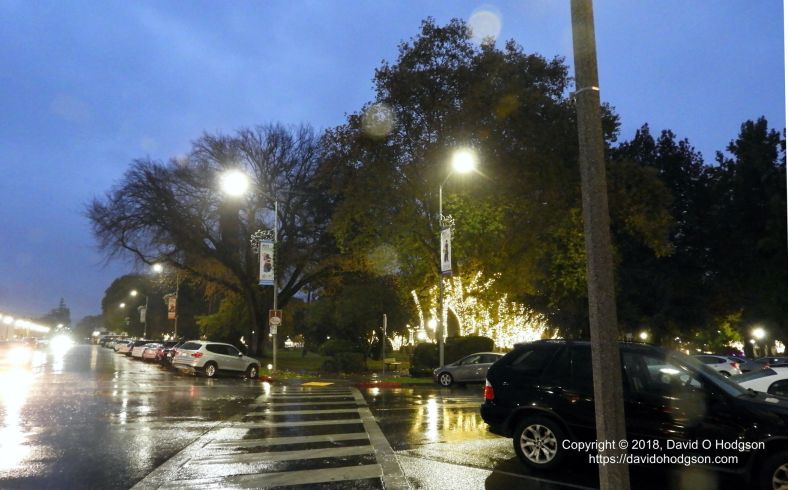
The second photo shows the north end of the Plaza itself, which until 1890 was the site of the city’s railroad depot. The main line ran along the road on the left, and the locomotive turntable was in the square, approximately where the tree lights are in the photo. Local property owners sued the railroad, and eventually forced the removal of the tracks and the depot several blocks northwards. The depot building was physically dragged all the way from this location to its present site.

Sonoma Plaza. Site of Railroad Depot

Sonoma Plaza. Site of Railroad Depot

If you celebrate Thanksgiving, then I hope you had an enjoyable one this year! If you’re not celebrating Thanksgiving, then I hope you enjoy your Black Friday, which now seems to have been embraced in many countries outside the US!

Sonoma Plaza & City Hall, Thanksgiving 2018

Sonoma Plaza & City Hall, Thanksgiving 2018

Centenary of the Great War Armistice

St Clement Danes Church, London

St Clement Danes Church, London

The photo above, which I took during an early visit to London, shows the RAF memorial church of St Clement Danes. The building was completely destroyed during the Second World War, and fully restored in 1958, to act as a war memorial for the Air Force.

As most people are probably aware, today (11th November 2018) marks the centenary of the end of the First World War (known earlier as the Great War). There has been and continues to be much debate about the causes of that devastating war, and the issue will probably never be completely settled. What does seem clear is that, in those days, many European nations saw warfare as a satisfactory way to resolve disputes or gain territory, and had created detailed plans defining exactly whom they were going to attack and how. Their autocratic leaders were really just “spoiling for a fight”, and were supremely (but mistakenly) confident that they could win a swift, decisive victory.

It seems clear now that, if the conflict hadn’t been sparked by the assassination of Archduke Ferdinand by a Yugoslav nationalist, then some other equally parochial incident would have served as the trigger.

The situation was made more volatile by the nationalistic attitudes of the general populations, who tended to see war as a spectator sport. Many were quite prepared to sit happily on the sidelines and cheer as their “team” slogged it out with the opposition. Warfare had usually been conducted that way for centuries, but all that was to change as the Great War turned into “total war”, involving substantial portions of the civilian populations.

The Invasion of Leeds?

Of course, I’m not nearly old enough to have lived through the First World War, let alone remember anything about it. However, my father was 5 years old when the war began in 1914, and he did have some memories of the time.

His family lived in Leeds, Yorkshire, which is some 60 miles from the coast of the North Sea, and thus was not likely to be in any direct danger from enemy action. Nonetheless, my father’s mother was apparently certain of an immediate German invasion, and insisted upon placing sandbags around the house on the outbreak of war! Apparently, even then, not everyone believed that the war would take place on faraway fields.

Raid on Scarborough

My home town of Scarborough became a flashpoint during the First World War, after being subjected to a German naval raid during December 1914. That attack was characterized as a brazen assault on civilians (and it’s difficult to see how it could have served much other purpose), and had the presumably-unintended consequence of offering a major propaganda opportunity for the Allied nations.

During the bombardment, Scarborough’s lighthouse was one of many buildings that were hit and damaged, but it was subsequently repaired, as shown in my photo below.

Scarborough Lighthouse, 2007

Scarborough Lighthouse, 2007

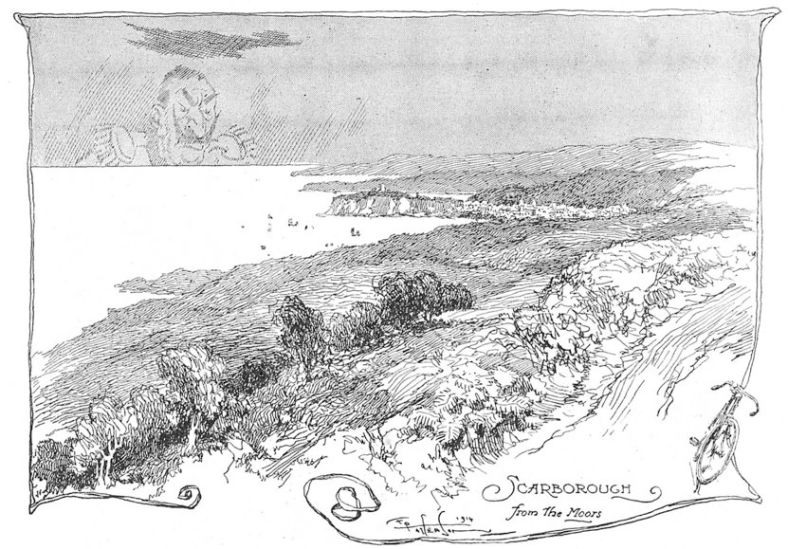
British illustrator Frank Patterson, whom I’ve mentioned in a previous post on my professional web site, normally avoided propaganda-style artwork. Apparently, however, he was so incensed by the attack on Scarborough that he produced the illustration below, showing a thunderous Kaiser glowering at the town from over the horizon.

Scarborough from the Moors, 1914. Copyright Frank Patterson

Scarborough from the Moors, 1914. Copyright Frank Patterson

A Changed World

Whatever its actual causes and motivations, there can be no doubt that the First World War changed the course of history very significantly, and not only in terms of international relations and territorial dominance.

The war essentially spelled the end of the colonial empires created by European powers during the preceding few centuries. Admittedly, some empires (such as the British and French) clung on for a few more decades, but the new order of affairs was already being set up at the end of the First War.

On the social level, agreements made during the War led to women eventually obtaining the right to vote in several countries, such as Britain. From the modern perspective, it seems astonishing that such a development took so long, and no sane, educated person would now suggest that women should not have such a right.

The First World War was undoubtedly a disaster of immense proportions, but some social good did eventually come of it.

St Clement Danes Church, London

St Clement Danes Church, London

Strange Sights in Sebastopol


Cat-Themed Road Sign in Sebastopol

Cat-Themed Road Sign in Sebastopol

Just a few miles to the west of our house is the small city of Sebastopol. There are sometimes strange things to see in Sebastopol, as I confirmed last week when, while driving along Main Street there, I spotted a huge traffic sign that immediately reminded me of our cat, Ginger (Tom).

The real Ginger is in fact no stranger to car travel, as seen below in San Francisco, during a visit that I described in an earlier post!

Ginger in the City

Ginger in the City

The city name Sebastopol perhaps seems surprising for California, and you could be forgiven for thinking that there must be a connection to the one-time Russian settlements along the California coast. However, those settlements were further north, having never reached further south than Fort Ross. In any case, by the time that Sebastopol came to be so named, during the 1850s, the Russians had already abandoned Fort Ross.

In fact, it seems that the name Sebastopol was chosen as a result of a local bar fight that reminded locals of the contemporary Siege of Sebastopol! The California settlement, which had originally been called Pinegrove, came to be known by the new name, and was incorporated under that name in 1902.

During the late nineteenth century, the area around Sebastopol developed into a major center for the growing of fruit and vegetables. Nowadays, most of the local crop consists of grapes for the wine trade, but back then a much wider variety of fruits were cultivated. One variety of apple that became very popular in the district was the Gravenstein (although it’s no longer a popular variety today).

The image below shows a real fruit label, probably from the mid-twentieth century, which I found in a local antique store. Although the apples shown on the label are not identified as Gravensteins, they probably were.

Kikuchi Apples Label

Kikuchi Apples Label

Move it by Rail

In those days, the usual way to preserve produce was to can it (since, even when refrigerated transport was available, most homes still did not have refrigerators), and the best way to ship it over any appreciable distance was of course by rail. Inevitably, therefore, railway lines were laid to Sebastopol. The first was the San Francisco & North Pacific Railroad, which eventually became the North Western Pacific (NWP). Their branch from Santa Rosa reached the town in 1890.

At the beginning of the twentieth century, a rival railroad called the Petaluma & Santa Rosa Railroad (P&SR) was proposed, including service to Sebastopol on its main line, the plan being for this to be an electrically-operated interurban network. Not surprisingly, the NWP violently opposed the construction of the P&SR, leading to the locally-famed Battle of Sebastopol Road in 1904.

Eventually, however, the P&SR was completed, the rival railroads learned to co-exist, and both served the people and industries of Sebastopol.

Petaluma & Santa Rosa Railroad

The P&SR station (depot) in Sebastopol faced onto Main Street, because the railroad itself ran down the middle of Main Street for some distance. The depot building was actually in the middle of a rail “wye” where the P&SR branch to Santa Rosa joined the main line between Petaluma and Forestville (which, thanks to the intervention of the 1906 earthquake, was as far north as the P&SR ever reached).

Fortunately, even though all the remaining railroads in the city were abandoned in 1983, and the rails removed shortly thereafter, the final depot building and nearby powerhouse have survived.

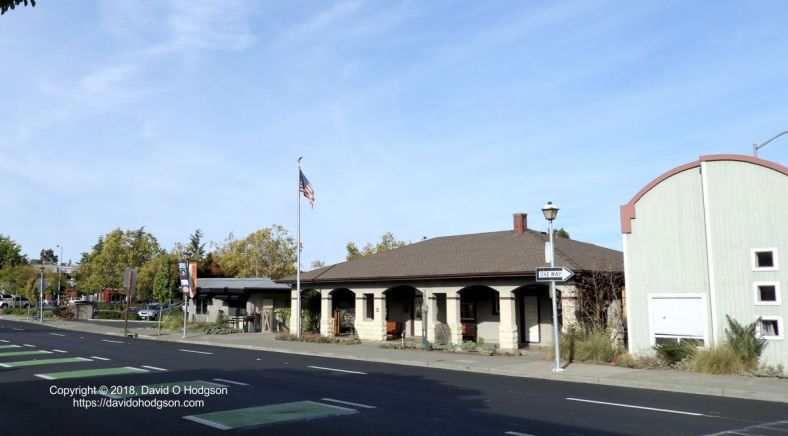
The final P&SR depot building, which was built in 1917 from stone quarried at the nearby Stony Point Quarry, has become the West County Museum. The museum is open to the public 4 afternoons per week, and displays various exhibits related to Sebastopol and its railroads.

The photo below shows the former depot facing Main Street. The P&SR main line ran along the middle of the street in the foreground, and the branches of the wye heading for Santa Rosa joined that line on either side of the building.

Former P&SR Rail Depot, Sebastopol

Former P&SR Rail Depot, Sebastopol

Immediately behind the depot building, on what appears to be a surviving short section of one of the storage tracks, is a former Pacific Fruit Express refrigerator car. Apparently, this box car now houses the museum’s stored collections, hence the steps visible in the photo below.

Refrigerator Car at P&SR Depot, Sebastopol

Refrigerator Car at P&SR Depot, Sebastopol

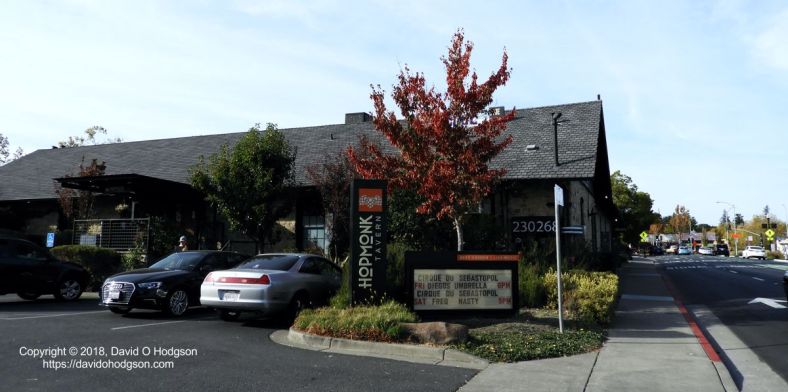
The former P&SR powerhouse, which was built from the same stone as the depot, has now become the very popular Hop Monk Tavern, as shown below.

Former P&SR Power House, Sebastopol

Former P&SR Power House, Sebastopol

All Change at Gravenstein

About a quarter-mile east of the surviving P&SR railroad depot is the site of the NWP’s depot and freight yard, where there was a substantial array of sidings serving the local canneries and industries. There’s nothing left of this complex, but, on the site of part of the sidings, a modern shopping center was built during the 1980s.

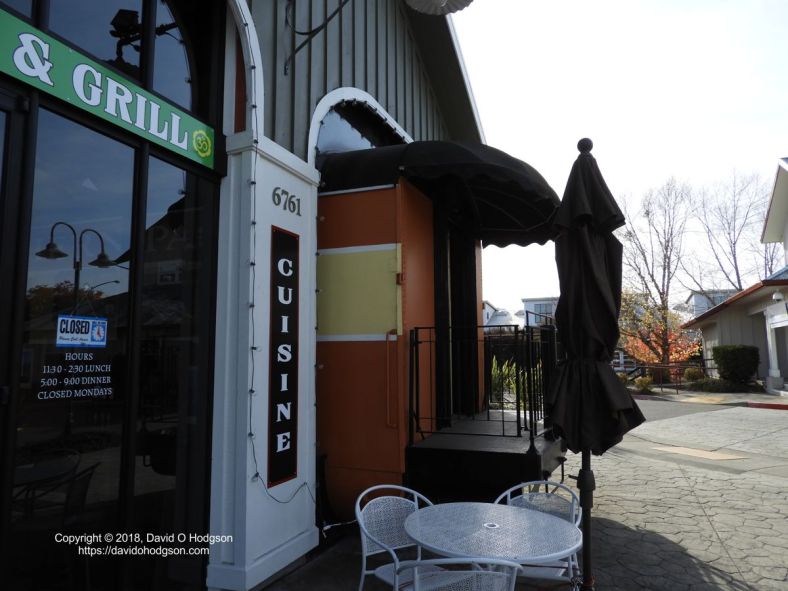
The shopping center is called Gravenstein Station, and incorporates various features that commemorate its railroad heritage. From the road, you can see what appears to be the end of a railroad carriage sticking out of the building, as shown in my photo below.

Another Strange Sight: Gravenstein Station

Another Strange Sight: Gravenstein Station

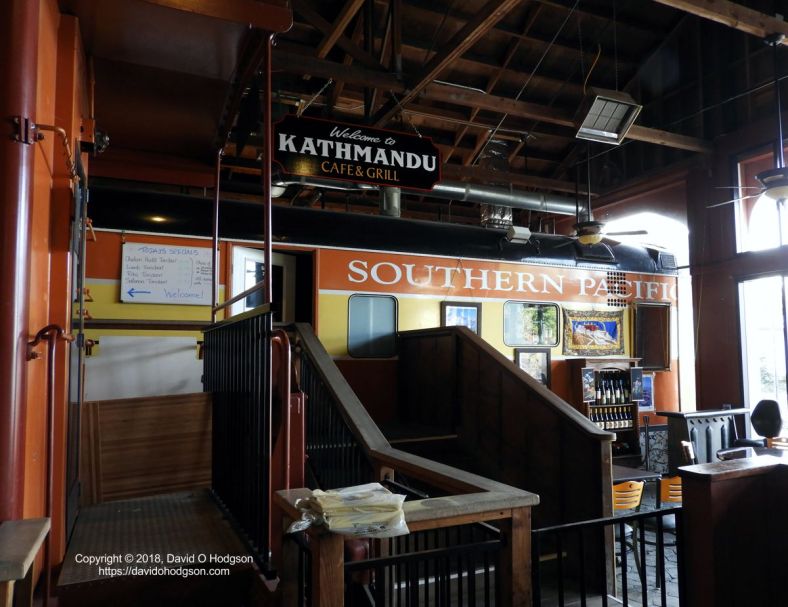
At first, I assumed that this carriage must be a fake, since it’s clearly too close to the ground to be standing on a track. However, on looking at it more closely, inside the building (as shown below), it seems that it must be the body of a real Southern Pacific dining car, now used as a restaurant. Presumably the body was removed from the chassis because it was too high for the building.

Gravenstein Station: Former  SP Dining Car

Gravenstein Station: Former SP Dining Car

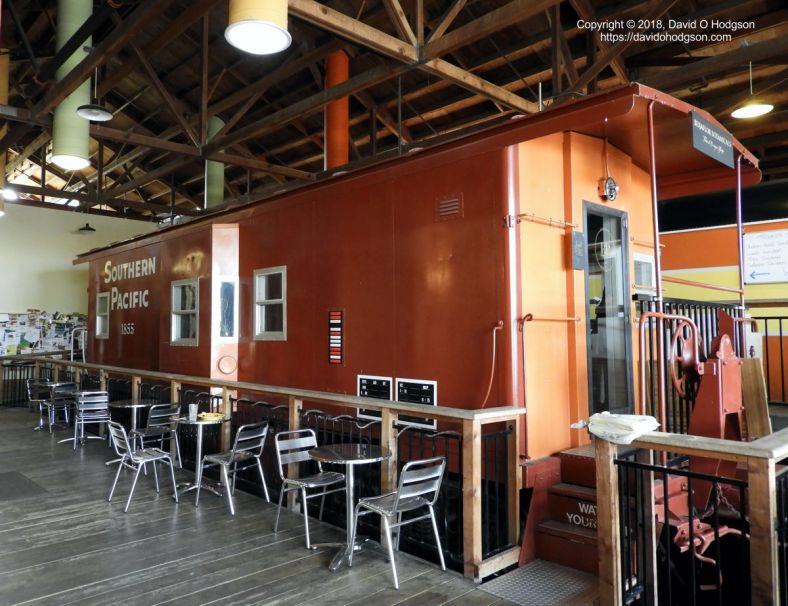
Also inside Gravenstein Station is a former Southern Pacific caboose, this time complete with its chassis and standing on a section of track. As shown in the photo below, it now houses a florist shop.

Gravenstein Station: Former  SP Caboose

Gravenstein Station: Former SP Caboose

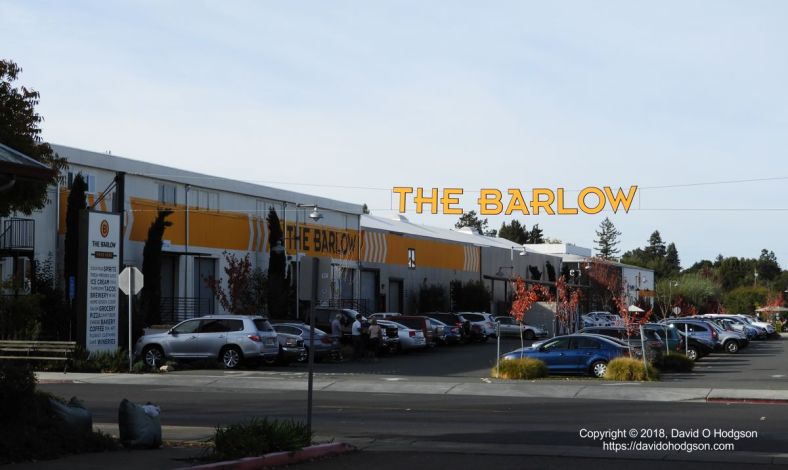
Across the road from Gravenstein Station, on the site of the former NWP depot, is the Barlow shopping and office center, as shown below. The line of the NWP track to its depot approximately followed the line of cars parked in front of the building.

The Barlow, Sebastopol

The Barlow, Sebastopol

Sebastopol is an intriguing little community that has succeeded in making the most of its location in California’s fertile Wine Country, and is well worth a visit if you’re in the area.

Cat-Themed Road Sign in Sebastopol

Cat-Themed Road Sign in Sebastopol

The Century Numbering Mystery

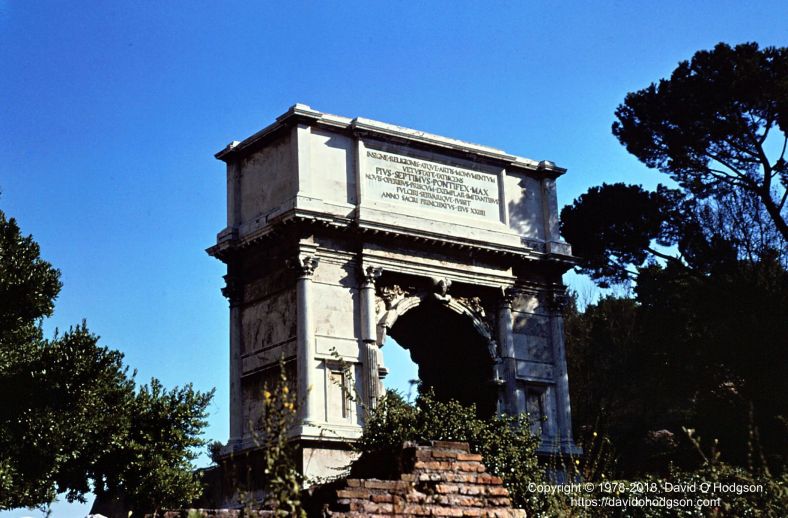
Arch of Titus, Via Sacra, Rome

Arch of Titus, Via Sacra, Rome

The photo above shows the Arch of Titus, spanning the Via Sacra near the forum in Rome, taken by me while on holiday there in 1978. Although the arch displays several Latin inscriptions commemorating the achievements of the Emperor Titus, nowhere in those inscriptions are any numeric year dates provided.

Historians believe that the arch was built in 82 AD, where AD (Anno Domini) is of course a reference to the supposed year of the birth of Jesus of Nazareth, but at that time Rome was not Christian, so obviously they would not have been numbering years “AD”. How then did the Romans, and other early civilizations, number the years?

What Have the Romans Ever Done for Us?

Given that so many aspects of our civilization can be traced back to the Classical times of Greece and Rome, it’s reasonable to assume that our system for numbering years would have Roman origins. However, thanks to an attempt to “Christianize” the Roman system, our current system has some strange quirks that continue to cause confusion.

Recently, during a news report, I heard the announcer state that an event that had occurred during the 1920s took place in the “Nineteenth Century”. In fact, as most people know, the period from 1901 through 2000 was the Twentieth Century, but exactly why is that? Why aren’t years from 1900 through 1999 referred to as the Nineteenth Century, and why did the Twentieth Century start in 1901?

I’ll answer those questions here, but I’m afraid that the answers may be rather uninspiring!

Trick Questions

When I was growing up, I used to spend quite a lot of time watching quiz shows on TV. (Well, we only had two channels, so there wasn’t much to watch!) Most of these were “trivia” contests, where the participants were asked questions to test their knowledge of a wide variety of subjects.

I’m not sure how educational those experiences were, but I do recall one type of “trick question” that was often asked on these shows. The quizmaster would ask something like, “What is the first year of the Twentieth Century?” The correct answer is 1901, but the anticipated wrong answers would be either “1900” or even “2000”.

These oddities sparked my curiosity, leading me to ask the questions listed above. I asked my schoolteachers about it, but they seemed unable to give a rational answer. Eventually, as an adult, I discovered that the reason for this mystery is, in part at least, ancient ignorance!

Year Zero

Our current “Common Era”/”Before Common Era” year numbering system (abbreviated to “CE/BCE”, and previously called the “AD/BC” system) is one among several systems that have been used during the past few thousand years. Some other systems are still in use now.

A common feature of all these systems is that the starting year is completely arbitrary. Some systems attempted to number years from the supposed creation of the Earth, but their estimates of Earth’s age were wildly inaccurate, so in effect the starting year was still arbitrary.

In fact, it may be just as well that we do have an arbitrary datum year, and that we don’t attempt to number years from the date of Earth’s creation. According to the latest research, Earth is about 4.54 billion years old. Every time you sign a check or contract, would you want to have to write out the year as something like “4,542,311,018”? I don’t think so!

The Years AUC

When Romans in the West wanted to provide a numeric year date, they sometimes numbered the years from the supposed “Founding of Rome”, which they named Ab Urbe Condita (AUC).

This date again was arbitrary, in the sense that there was no independent confirmation that Rome had really been founded in that year. In our current CE/BCE system, the year 1 AUC corresponds to 753 BCE.

The AUC system was not used consistently, and such dates may have been added in surviving literature.

The Years AM

The Byzantine Empire (which was the development of the Eastern Roman Empire) used a year numbering system known as AM (for Anno Mundi), which supposedly numbered the years from the date of Earth’s creation. The Year One AM was from September 1, 5509 BCE, to August 31, 5508 BCE.

This also illustrates the point that, even in our own calendar, the start of a year hasn’t always been on January 1st. This fact makes it more difficult to align year computations in different calendar systems.

In about 525 CE, a Christian monk called Dionysius Exiguus was once again engaged in an attempt to determine the age of the Earth from the Bible, and this led him to develop the CE/BCE (or AD/BC, as he called it) year numbering system that we now use.

Ancient Blunders

Frankie Howerd in a Funny Thing Happened on the Way to the Forum

Frankie Howerd in a Funny Thing Happened on the Way to the Forum

My illustration above shows Frankie Howerd performing in the stage play version of A Funny Thing Happened on the Way to the Forum. His expression seems appropriate in this context, because some details of the CE/BCE system seem like something that Howerd’s Roman slave character might have concocted!

The CE/BCE system also has an arbitrary start year; in this case the supposed birthdate of someone who may never have existed (and if he did exist, probably wasn’t born in that year)!

If you’ve learned about the history of arithmetic, then you’ll know that the concept of zero was introduced to Europe during the Middle Ages from the Arabic world, and was previously unknown to Western civilizations. Dionysius Exiguus apparently wasn’t familiar with the concept, so he omitted it from his year numbering system.

As a result of that ancient ignorance, there is no Year Zero in the CE/BCE system. The year numbering goes straight from 1 BCE to 1 CE. This is part of the reason why century numbering in this system seems so confusing.

The system also has no concept of a “Zeroth Century”, either BCE or CE. Thus, the years from 1 CE through 100 CE are the “First Century CE”, which accounts for the correct answer to that “trick question” about why the years from 1901 CE through 2000 CE are the Twentieth Century CE.

Below, I’ve created a table showing how the years AUC, CE and BCE align with century numbering. This should be a helpful reference, at least for people like me, who are more visually-oriented.

Centuries BCE and CE

Centuries BCE and CE

The general algebraic formulae for the centuries are as follows:

The Nth Century CE runs from [(N-1)*100 + 1] CE through N*100 CE

The Nth Century BCE runs from N*100 BCE through [(N-1)*100 + 1] BCE

Of course, as I mentioned above, years didn’t always start on January 1st, so this table is only a rough guide. There have also been date adjustments over the centuries, such as when the Gregorian calendar superseded the Julian calendar, so, before asserting the exact equivalence of two dates, further checking would be wise.

Arch of Titus, Via Sacra, Rome

Arch of Titus, Via Sacra, Rome

Flying North Again

Tatra T87 at the Minneapolis Institute of Art

Tatra T87 at the Minneapolis Institute of Art

The photo above shows a preserved Tatra T87 automobile, which, in my opinion, must surely be the ultimate “Art Deco Car”. Designed in Czechoslovakia in 1936, this particular example was built in 1948. The swooping lines and graceful curves of the design are highlighted in this case by the gleaming silver paintwork.

I’d have expected to find a car such as this on display in a prestigious European motor museum, so I was quite astonished this week when I visited the Minneapolis Institute of Art, in the Midwest of the USA, and found it there.

The reason for my visit to Minneapolis was simply because that’s my wife’s hometown. We went there to visit her family, most of who still live in or around that city. We had a great visit with everyone, but I must confess that, as I get older, I increasingly prefer the comforts of my home, so I was glad to get back!

Far Away is Close at Hand in Models of Elsewhere

Many years ago, during the 1970s, there was a famous item of graffiti that appeared near the approach to Paddington railway station in London, which ran:

FAR AWAY IS CLOSE AT HAND IN IMAGES OF ELSEWHERE

The first inkling that I ever had that there existed a place called the “Midwest” was when I was about 7 years old. In 1967, the Trans-World Model Railway opened at the Corner Café in Scarborough. This was a gigantic OO/HO scale model railway, which included inter-connected sections depicting Britain, France, Germany, and, via an “Atlantic Bridge”, the USA and Canada.

One of the US sections was captioned “The Midwest”, but of course I had no real idea where it was, nor did I ever expect to visit such a place, and I certainly never imagined that I might one day marry someone from there!

Having been married to Mary for some 27 years now, I’ve traveled with her to Minnesota on many occasions. We try to visit different places during each visit.

The Inland Beaches

As you might guess, the Midwest is far from either the Atlantic or Pacific Oceans, so there’s no ocean frontage to be found there. Nonetheless, given that Minnesota is the “Land of 10,000 Lakes”, there are still beaches within the state. The photo below shows one: Thomas Beach, on Lake Calhoun in Minneapolis, with the skyscrapers of downtown visible in the distance.

Thomas Beach & Downtown Minneapolis

Thomas Beach & Downtown Minneapolis

As a girl, my wife lived in an apartment that’s behind the trees on the far side of the lake, and she used to swim at this beach.

A Cultural Center

I realize that the Midwest may not generally be thought of as a center of culture, but in fact (probably thanks to its industrial wealth) Minneapolis has more than its “fair share” of cultural attractions.

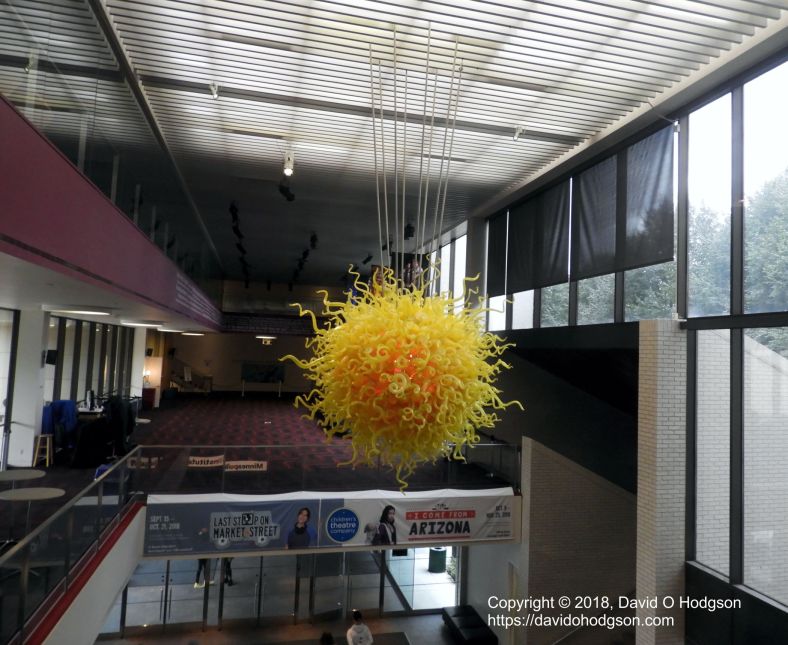
In the past, I’ve visited the Walker Art Center, and various local museums, but I’d never before been to the vast Minneapolis Institute of Art. Hanging above the lobby of the Institute is a large glass sculpture by Dale Chihuly, as shown below.

Dale Chihuly Exhibit, Minneapolis Institute of Art

Dale Chihuly Exhibit, Minneapolis Institute of Art

Inside the Institute, many substantial collections are on display, covering all time periods from the Stone Age to the present, and spanning all continents.

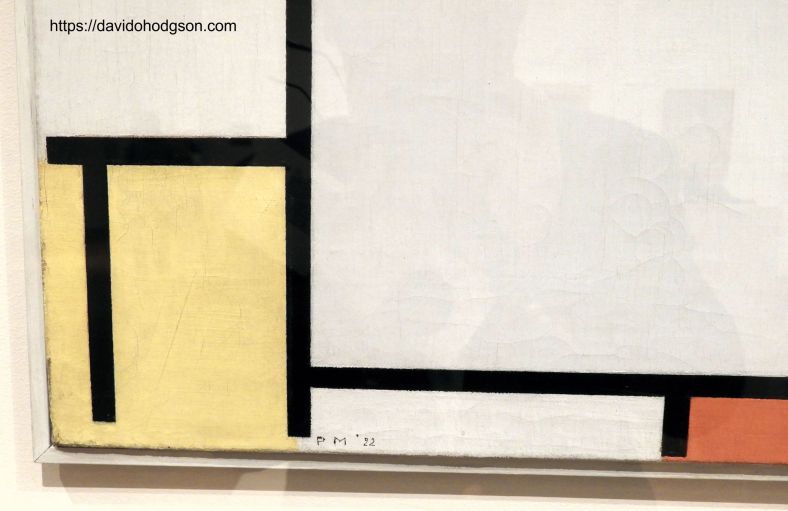
Amid the collection of Twentieth Century artwork, there’s one painting by Piet Mondrian, whose art and beliefs I discussed in an earlier post. The photo below shows a closeup of his initials at the bottom left of the painting, to prove that it’s really his, rather than some simulation that I cobbled together on my computer!

Mondrian's Initials

Mondrian’s Initials

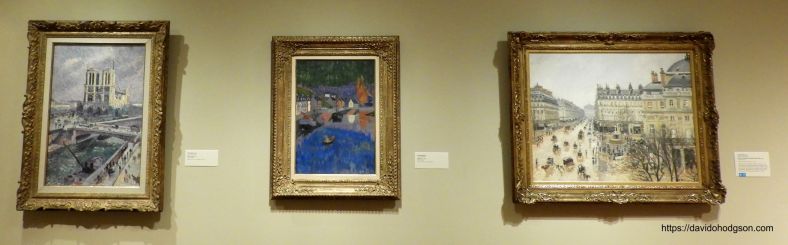
There’s also a large collection of Impressionist works, three of which are shown below. The painting on the left, Notre Dame de Paris by Maximilien Luce, sold in 2011 for $4.2 million, a record amount for an Impressionist work.

Some Impressionist Works

Some Impressionist Works

It’s impossible to do justice to the scale of the Institute’s collections in this short article, and I would encourage you to visit this amazing museum yourself if you’re ever in the vicinity.

The Scandinavian Diaspora

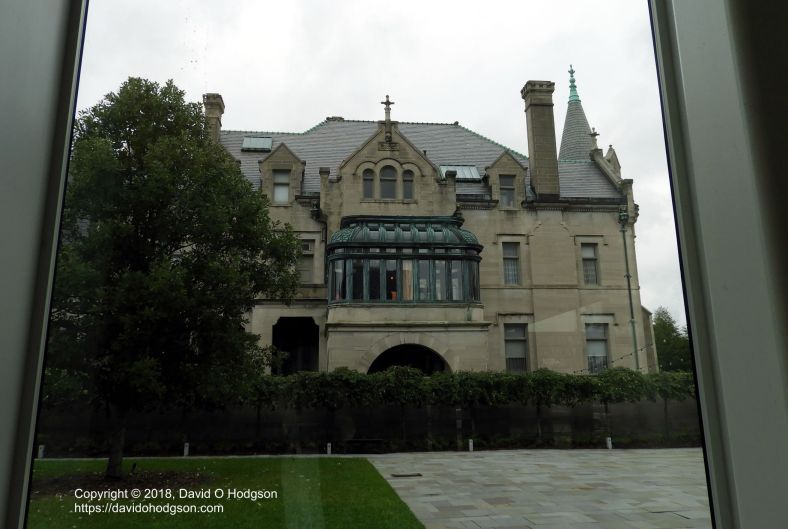
Many of the early European settlers in what’s now Minnesota came from the Scandinavian countries; Denmark, Sweden and Norway. Apparently, circa 1900, about 25% of the population of Minneapolis consisted of Swedish emigrés. Thus, it’s perhaps not surprising that Minneapolis is home to the American Swedish Institute. We visited this Institute too, and took the tour of the Turnblad Mansion, which was built in 1908 by the proprietor of a Swedish-language newspaper. The mansion is shown in the photo below, seen from inside the modern extension built next to it.

The American Swedish Institute

The American Swedish Institute

The ASI also has an excellent restaurant, FIKA, but it’s an understandably popular lunch venue, so you may have to wait for a table!

Flying Home

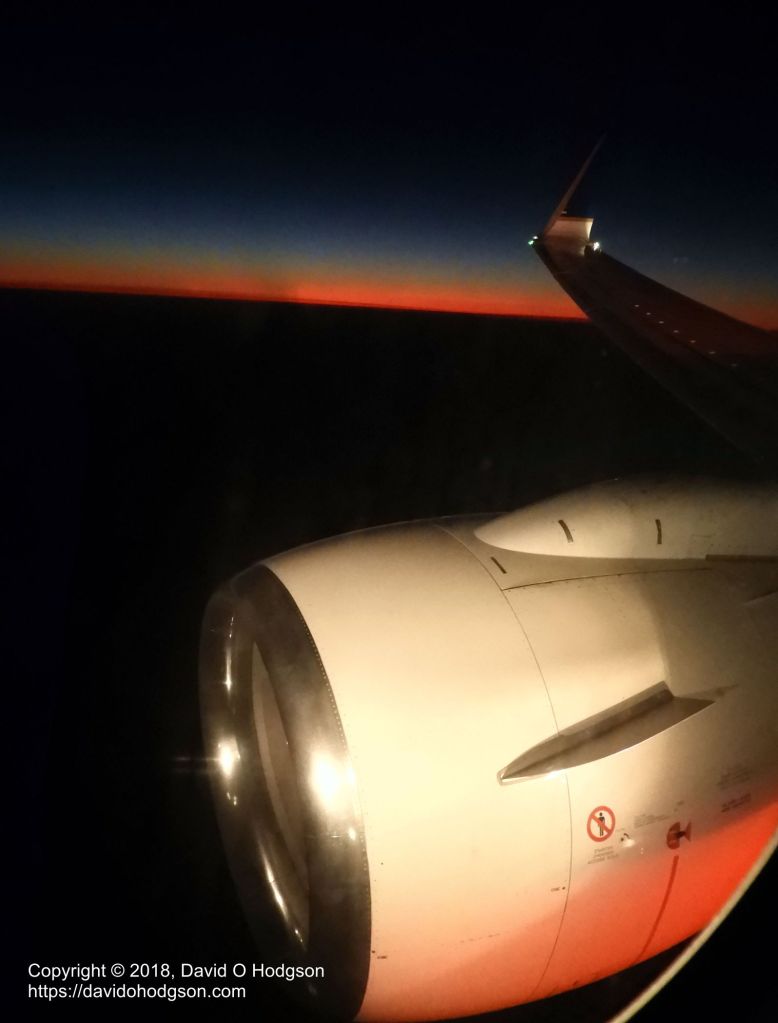
We returned to San Francisco airport directly from Minneapolis. I took the emotive photo below from my seat, as our Boeing 737-800 was descending to land in San Francisco. Our flight left Minneapolis at about 6.30pm, so we were “chasing the sunset” back to California as shown in the photo.

Boeing 737-800 Landing at Sunset

Boeing 737-800 Landing at Sunset

The circumstances of my flight reminded me of the lyrics of Thomas Dolby’s song Flying North, which was popular in the early 1980s when I was first traveling to the US. Part of the lyrics are:

Metal bird dip wing of fire

Whose airlanes comb dark Earth

The poles are tethers we were born in

Now I’m back in the London night

On a bench in a launderette

I’m staring right into my face

And I’m drawn out like a plot

And I’m flying North again

Tonight

These days, I’m no longer flying home to London, of course. Instead, we just had a wonderful dose of Midwest culture, and now it’s great to be back home in California!

Tatra T87 at the Minneapolis Institute of Art

Tatra T87 at the Minneapolis Institute of Art