Living in Brutalist Britain

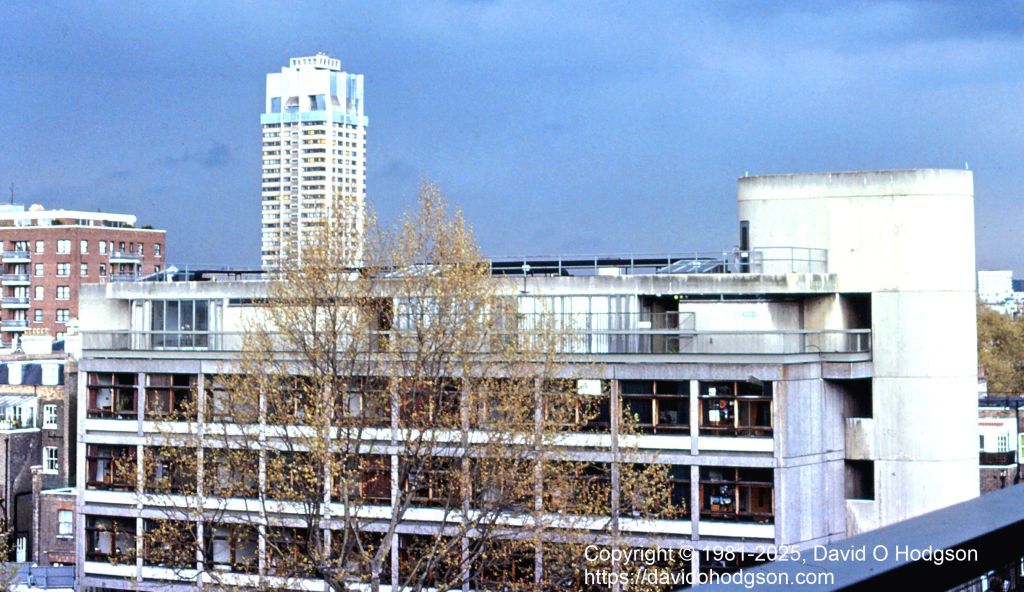
Linstead Hall, Imperial College, London, from my residence in Southside Halls

A few weeks ago, my wife and I went to see the movie The Brutalist. The extent of the hype for this movie was truly breathtaking, which may be partly why I was not surprised that it did not live up to its “promise”.

I must admit that media coverage led me to question whether those who were singing its praises even understood anything about the movie’s subject matter! For example, a fawning item about it on ABC News included paroxysms of praise for the movie’s stars and director, but never actually mentioned what the movie is about, nor was there any explanation of what the title “Brutalist” referred to! I guessed that it must have something to do with Brutalist Architecture, and it turned out that I was correct, but that was no thanks to ABC. Did the presenters really not understand it themselves, or had they decided that the explanation was too “intellectual” for their audience?

Perhaps that is, in fact, the key to the praise that the movie has received. It seems that the less a reviewer knows about its subject, the more they like the movie. Those who do understand its subject matter, professional architects, have been highly critical of its blunders and implausibility, to the extent that they are described as “hating” it in this article.

I also thought that, given its thin, questionable plot and appalling examples of ignorance, the movie was much too long at 3 hours, 35 minutes. As the Guardian reviewer states sarcastically:

“The architecture world awaits with bated breath the director’s five-hour marathons, The Postmodernist, The Deconstructivist, and The Parametricist – each to be shot with period-appropriate equipment and based on a brief skim through a coffee-table book”

Personally, the only benefit that I obtained from the movie experience was that it prompted me to think once again about the real Brutalist architecture that I grew up in and around, the history of which I find infinitely more interesting than any aspect of the movie.

Growing up, Brutalist architecture was a constant background theme in my life, and I even lived in one example of it for a while.

Brutal Aylesbury

I never actually lived in the Buckinghamshire county town of Aylesbury, but, as I recounted in a previous post, my first visit there involved a job interview and a “computer programming aptitude test” that had a profound effect on my view of my own abilities in that field.

During the period from the 1930s to the 1970s, the British Government made major investments in a group of what were referred to as London Overspill Towns. There was a deliberate policy of moving population en masse out of London, to more rural locations. The goal was mainly to reduce further “ribbon development” of the London suburbs, which would eventually have spread across the entire South-East of England. There were also health implications, since prior to the 1960s, London’s air was seriously polluted, leading to increased healthcare costs.

During the 1960s, various existing towns were targeted for substantial redevelopment and expansion, and a few entirely new towns were created. Most of these were within commuting distance of London, but even Grantham in the East Midlands was included.

The map below is from the 1963 book New Architecture of London.
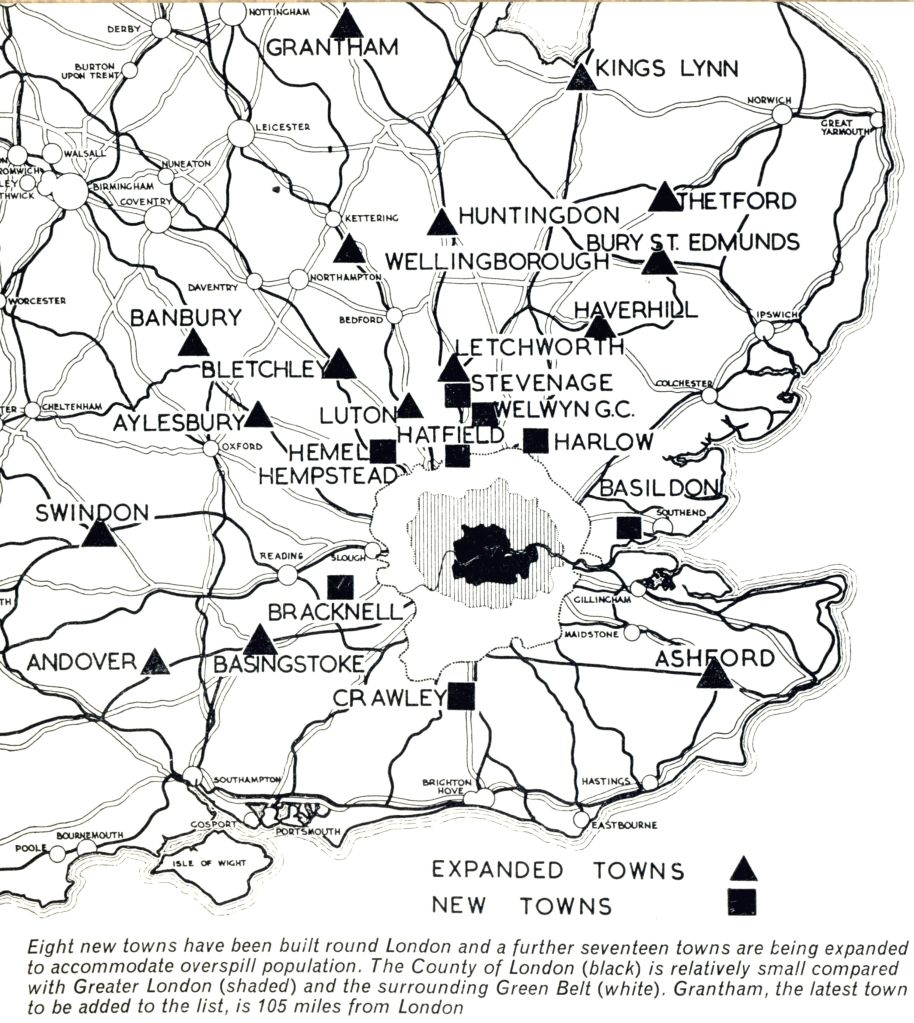
Map of London Expansion Towns. Copyright © 1963, British Travel and Holidays Association

As shown, one of the “expansion towns” was Aylesbury, which had until then been a quaint market town, famous mostly for its ducks.

Development plans for expansion towns invariably included the construction of new shopping centers and civic buildings, and some of these were designed along brutalist architectural lines. In 1967, Aylesbury found itself lumbered with a new shopping center, Friars Square, which quickly came to be seen as such an outstanding example of a dystopian nightmare environment that, in 1971, scenes for the movie Clockwork Orange were filmed there!

My 1980 photo below shows the centerpiece of Friars Square, the Cadena Cafe, after it had become a Wimpy Bar. As with many examples of brutalism, the building had a relatively short life, being demolished in 1993 when the shopping center was redeveloped.
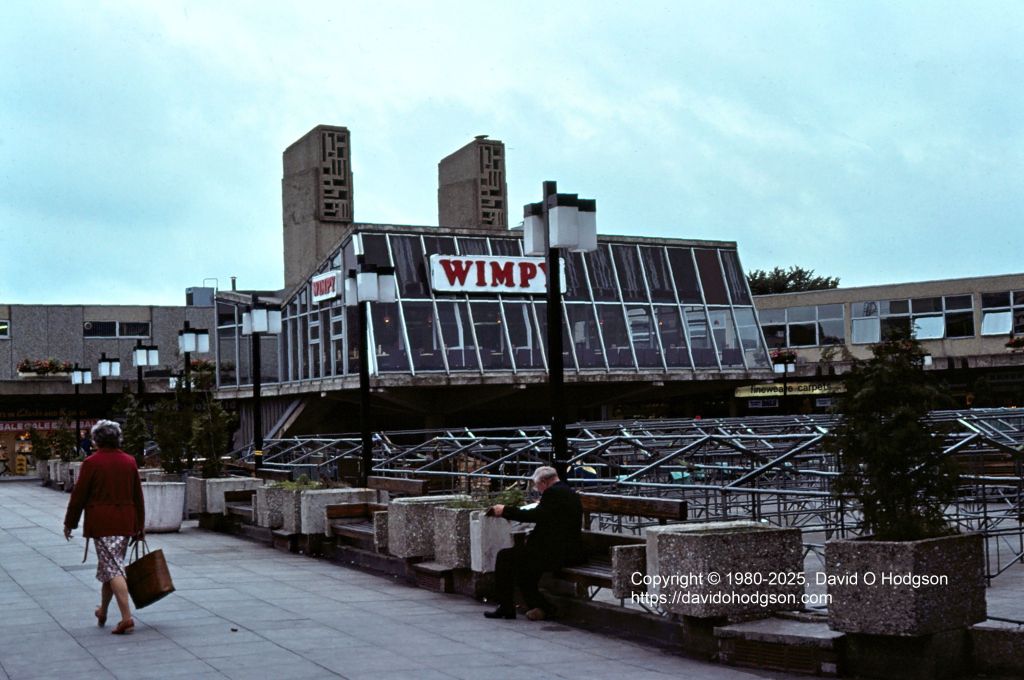
Friars Square & Cadena Cafe, Aylesbury

Elain Harwood’s book Brutalist Britain offers an extensive listing of brutalist architecture in the country, and describes another Aylesbury example, the Buckinghamshire County Council office tower.

The cover of Brutalist Britain, Copyright © 2023, Elain Harwood, Batsford Publishers

My 1980 photo below shows the County Council tower looming above Market Square in Aylesbury, with the Bell Hotel in the foreground.
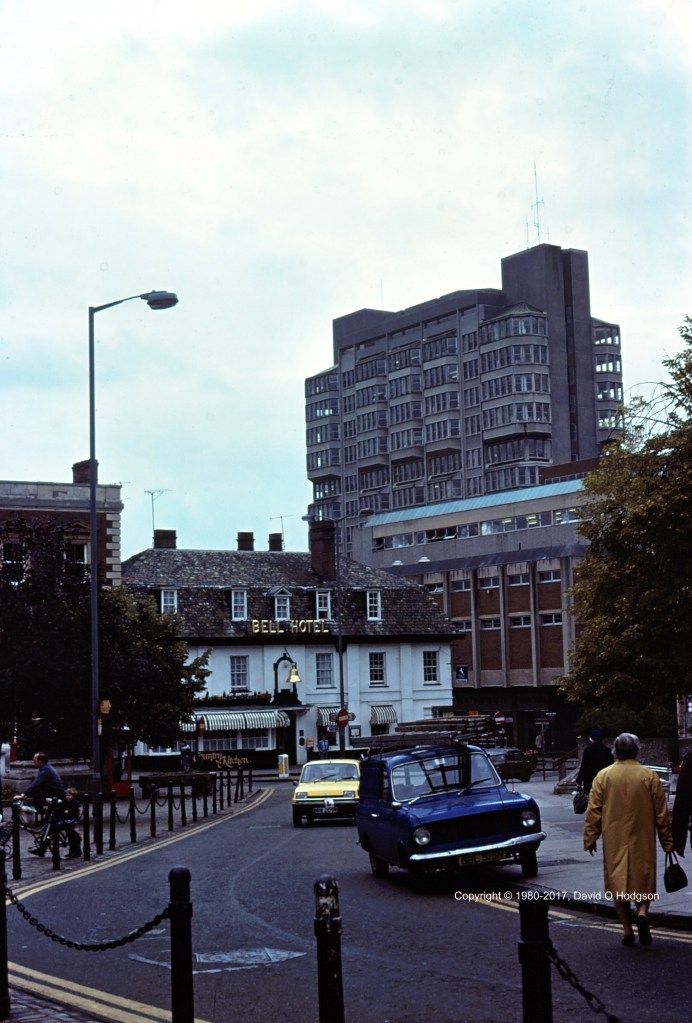
The Bell Hotel, Aylesbury, with the Buckinghamshire County Offices beyond, in 1980

Brutal Birmingham

Birmingham New Street Signal Box, 1980

It seems perhaps most appropriate that Brutalist architecture would be chosen for the design of industrial buildings, and even British Railways constructed a few examples. One of the most famous in Britain must surely be Birmingham New Street Signal Box, which has towered above the gloomy subterranean station since 1966, and is clearly visible from street level, as shown in my 1980 photo above. Although it closed as a signal box in 2022, the building is listed, is still standing, and continues to be used by Network Rail.

Again, Birmingham was not a city in which I ever lived, but when traveling between Coventry and York, I usually had to change trains at Birmingham New Street. I also applied to, and was accepted by, Aston University in Birmingham, so I attended an interview there in 1980.

Brutal London

Approximately a year after visiting Aylesbury for that job interview, I found myself moving to London, as I began my Electronic Engineering studies at Imperial College.

Many first-year undergraduate students were accommodated in Halls of Residence, situated in South Kensington near the college campus. Generally, we were assigned to one of the halls, and were not given any option as to which hall we preferred. I was assigned a single-bed room in Selkirk Hall, which was a subdivision of the huge Southside Halls building, located, as the name indicates, on the south side of Prince’s Gardens.

The photo at the head of this article shows the view looking north from Selkirk Hall over Princes Gardens, one stormy afternoon. The building in the foreground is Linstead Hall, which was of similar architectural style to Southside. In the distance, the tower of another Brutalist edifice is visible; Hyde Park Barracks, which was and still is the home of the Horse Guards.

Cover of Lost Futures. Copyright © 2017, Owen Hopkins, Royal Academy of Arts

Unfortunately, while living in Selkirk Hall, I never photographed the outside of the building itself (partly because the trees in front of it obscured most of it). However, Owen Hopkins’ book Lost Futures includes an article about Southside Halls, which also mentions the smaller Weeks Hall, situated on the north side of Prince’s Gardens.

The photo below, borrowed from “Lost Futures”, shows an excellent panorama of Southside, before the trees in front of it grew too large.
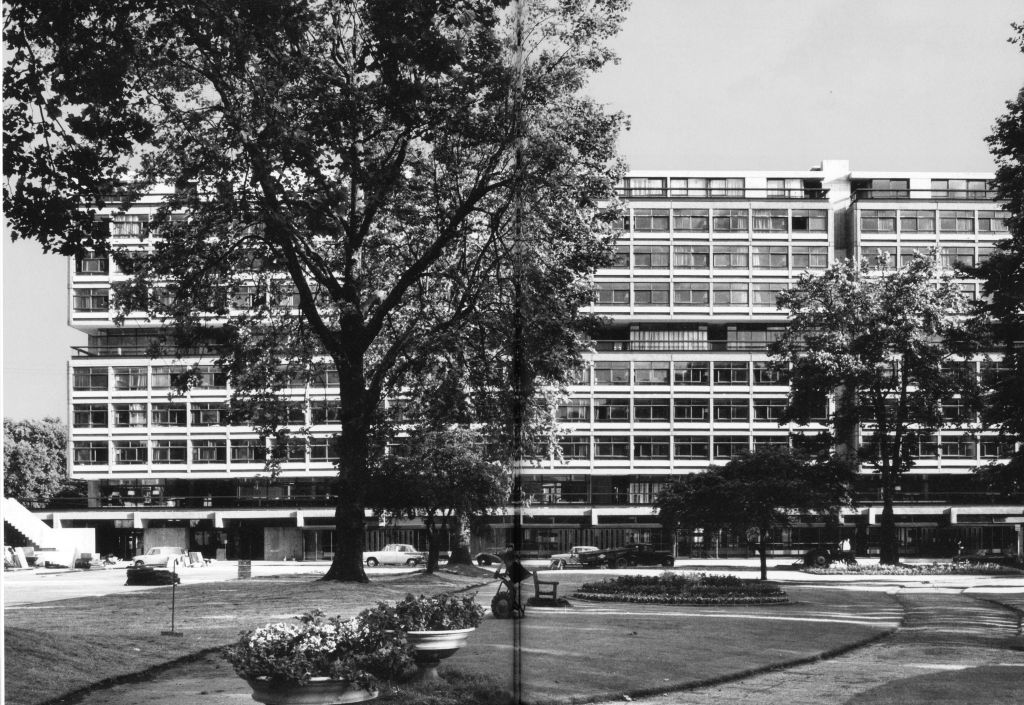
Southside Halls, Imperial College. Copyright © 2017, Owen Hopkins, Royal Academy of Arts

Unfortunately (or perhaps fortunately, depending on your view of their aesthetics!), the passage of time has revealed that many Brutalist buildings were not well-constructed, and in some cases not even well-designed. I had personal experience of this while living in Selkirk Hall.

I lived in the building for only one academic year, but even during that time there were serious maintenance problems. Each bedroom had its own sink, whereas kitchen and bath facilities were shared. The sink in my room was out-of-action, and boarded off, for several weeks during my residency, due to plumbing problems. It seems that the design of the building had a major flaw, whereby pipes and other service conduits were buried directly within the concrete, instead of being placed in accessible service ducts. As a result, any plumbing maintenance work required drilling out the concrete to access the pipes! The quality of the concrete also seems to have been defective, and large chunks of it eventually began to disintegrate.

The upkeep of Southside became so problematic that, despite its being a listed building, permission was eventually granted to demolish it in 2005. That permission was granted on condition that the smaller Weeks Hall, on the north side of Prince’s Gardens, and also a listed building, be retained and refurbished. In my photo below, looking north from Southside, you can just see Weeks Hall towards the right.

Skyline from Princes Gardens, with Weeks Hall

One of the more successful examples of Brutalist architecture, which still exists and is in use today, is the Barbican Centre, in the City of London. My photo below shows part of the complex shortly after its official opening in 1982. I visited the Centre many times, usually to go to the Museum of London, which was housed within it.

Despite having been voted the “Ugliest Building in London”, the Barbican apparently remains popular with apartment renters, thanks to its views and convenient location.
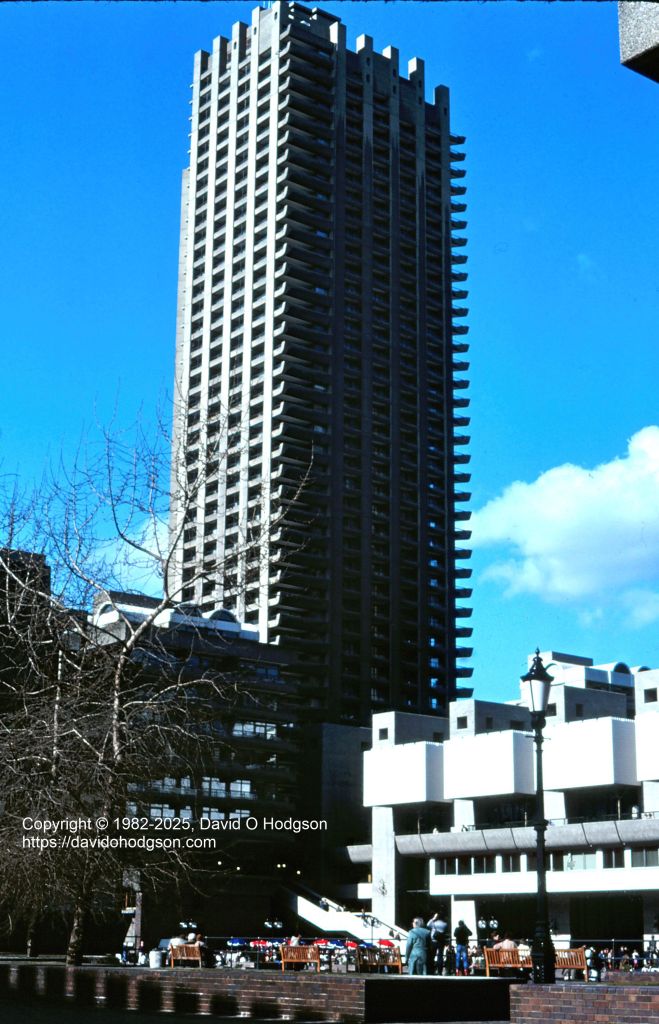
Barbican Centre, London

Brutal Scarborough

Even my home town of Scarborough suffered the attentions of architects with brutalist leanings. In 1973, the imposing Pavilion Hotel, immediately opposite the main railway station, was controversially demolished and eventually replaced by an office block that has been described as the “ugliest building in Scarborough”. I reproduce below an article from the Scarborough Mercury of 15th September 1973, showing how the new building was to look, along with hopelessly-optimistic predictions of its future uses.
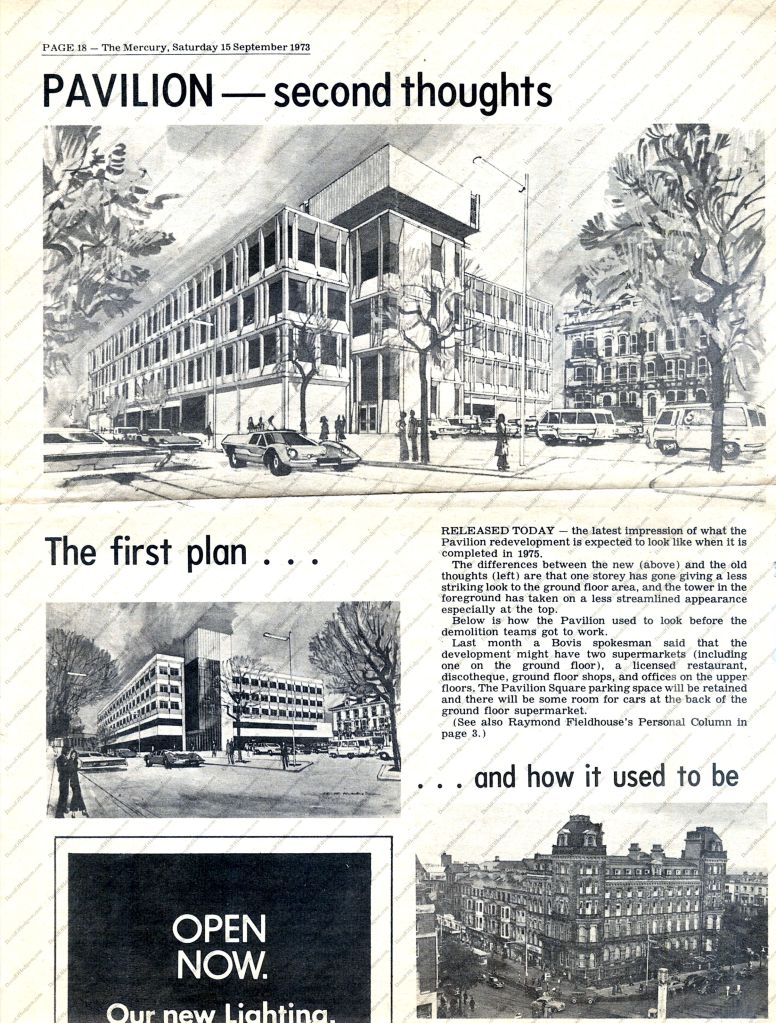
Scarborough Mercury article about Pavilion House. Copyright © 1973, Scarborough News

The building did eventually gain one supermarket, on the ground floor, although, as I recall, that store managed to look run-down from the day it was opened! As regards actual other uses for the new building, I can only remember it as the home of Scarborough Job Centre, in which I spent many useless hours not finding a worthwhile job. It seems perhaps appropriate; a depressing and ugly location for a depressing and hopeless office!

There’s no question that, whatever the aesthetic qualities of those Brutalist buildings, they were and are each unique, and they formed a memorable backdrop to my life in those days.

Westwood Bus Station, Scarborough

My Scale Drawing of the Westwood Bus Station Building

When I was exploring the streets of Scarborough in 1977-78, conducting research for my A-Level Art project on architectural aspects of the local road and rail industries, it was impossible to know what the future might bring for the subjects of my study. Many of those locations and buildings have in fact survived to the present day, and some have even been renovated. Others, however, have vanished completely. In some cases, even the land on which the buildings stood has been redeveloped to the extent that it is now unrecognizable.

The subject of this article is one such example. Westwood Bus/Coach Station occupied a central site in Scarborough, right next to the main railway station. During the 1970s, the bus station was still quite heavily used, particularly during the summer months, when it was often completely filled with visiting excursion coaches. It was also still the terminus for scheduled bus services. During the 1980s, however, the station was shut down, and the entire hillside on which it stood was excavated to create a new superstore and underground car park, which still exists today. As a result, no trace remains of this bus station.

The image above is a digitized version of a gouache painting that I produced for the A-level thesis. It is to scale and shows the northerly elevation of the waiting room and ticket office building at Westwood, which was the only permanent structure on the site. If you don’t like the color scheme, please don’t complain to me! Those were the actual colors of the building at the time of my survey; very “Seventies”!

Note that the location described in this article is not the East Yorkshire bus park currently referred to as “Westwood”. The old location was on the south side of Westwood, where the Tesco store now is. At that time, the current bus park was part of Scarborough railway station.

Three Bus Stations

I’d been familiar with that place for as long as I could remember. When I was very young, Westwood was the terminus for services operated by East Yorkshire Motor Services (EYMS). At that time, there were two other regional bus companies running services into Scarborough, but each had its own station. United Automobile Services used Valley Bridge Bus Station, whereas West Yorkshire Road Car (WYRC) used a station on Northway.

During the late 1960s, after all three companies had become part of the National Bus Company, operations were merged, and the opportunity was taken to reduce costs by eliminating some of the facilities. Northway was closed in 1970, and WYRC services then operated from Valley Bridge. Similarly, EYMS ceased to use Westwood in 1970 (see letter below), and transferred its operations to Valley Bridge.

Another independent user of Northway Bus Station prior to its closure had been Hardwick’s Services, which was a company owned by the famous holiday tour operator Wallace Arnold. Following Northway’s closure, Hardwick’s began to use Westwood as the terminus for its scheduled services to Ebberston.

As such, by the time of my study, Westwood was used only for Hardwick’s Services, and to handle summer excursion traffic visiting Scarborough. I didn’t specifically take any photos of the bus station, but mostly of vehicles that happened to be parked there.

The photo below does show part of the site. The view is looking towards Valley Bridge, with Westwood on the left. The building that I drew is on the right. In the foreground is a former Mansfield District Bristol Lodekka, which was in use for driver training.

Westwood Bus Station in Summer 1977

An Undeveloped Prime Location

It always struck me as odd that the site of Westwood Bus Station was relatively undeveloped, given that it was in a central location right next to the railway station. There was only one building, and the concrete parking surfaces were steeply sloped, having never been leveled. Parts of the parking area were never even concreted, and were simply filled with stone rubble, as shown in my photo below.

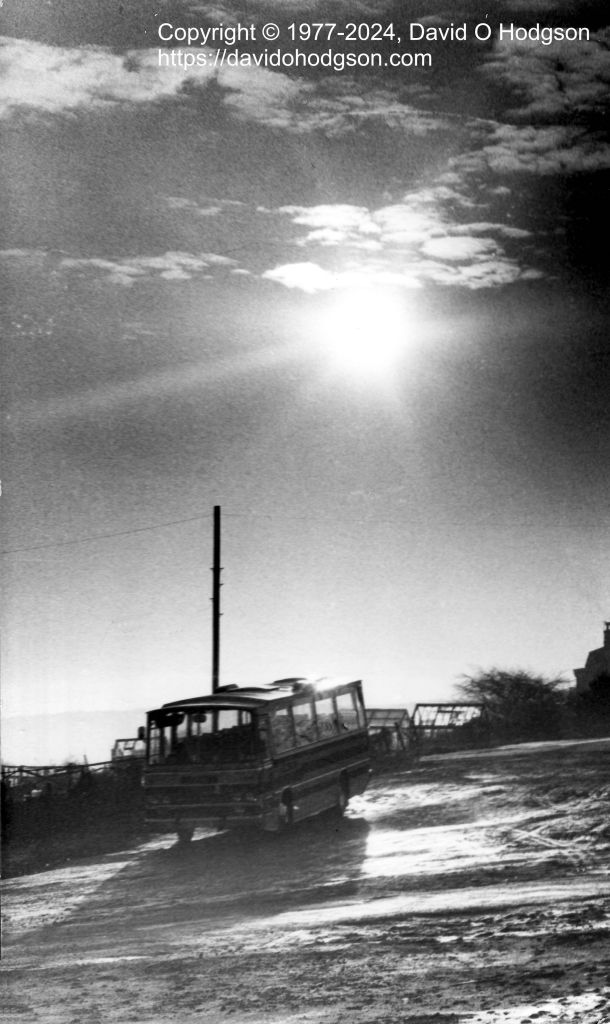
The muddy unmetalled part of Westwood Bus Station, under a low winter sun

Surely such a site would have been snapped up by an eager developer for construction of a hotel or some similar profitable structure.

I eventually discovered that the reason for this was that the land on which Westwood stood was railway-owned. It had been bought up in the late nineteenth century by the North Eastern Railway (NER), with a view to the extension of Scarborough Central station. However, the railway’s planners soon realized that, due the existence of villas immediately west of their newly-acquired land, it would be impossible to create the necessary fan of extra lines to extend the station footprint there.

As a result, the NER dropped that plan and, instead, in 1907 constructed an entirely new station further west at Londesborough Road, on the site of a former goods depot. Additionally, a new complex of sidings was built alongside the Scarborough-Whitby running line at Northstead. This arrangement proved very effective for handling the extra excursion traffic that Scarborough experienced every summer, so the land in Westwood was no longer needed.

According to an old photograph that I’ve seen, the railway-owned land was let out for allotments until after World War II. When EYMS needed a new bus station in Scarborough during the 1950s, British Railways presumably sold the land to them (EYMS was by then part of the privately-owned British Electric Traction group).

While researching my A-level Art project, I could find very little published information about Westwood, so I wrote a letter to EYMS directly, requesting some details. The letter below is the response I received from them.

Letter from EYMS providing details of Westwood Bus Station, etc.

The book Prestige Series: East Yorkshire, by John Banks, shows color photos of Westwood on the front and back covers, and there are several monochrome photos of the location inside the book.

Front Cover of Prestige Series: East Yorkshire. Copyright © Venture Publications 1999

As I mentioned above, the entire site was excavated during the 1980s, and a Hillards supermarket with underground parking was built on the site. Hillards was taken over by Tesco in 1987. Here is the current Google Streetview of the Tesco supermarket from Westwood. Due to the redevelopment, it’s no longer possible to stand in the location from which I took the 1977 photo above.

Hardwick’s Services

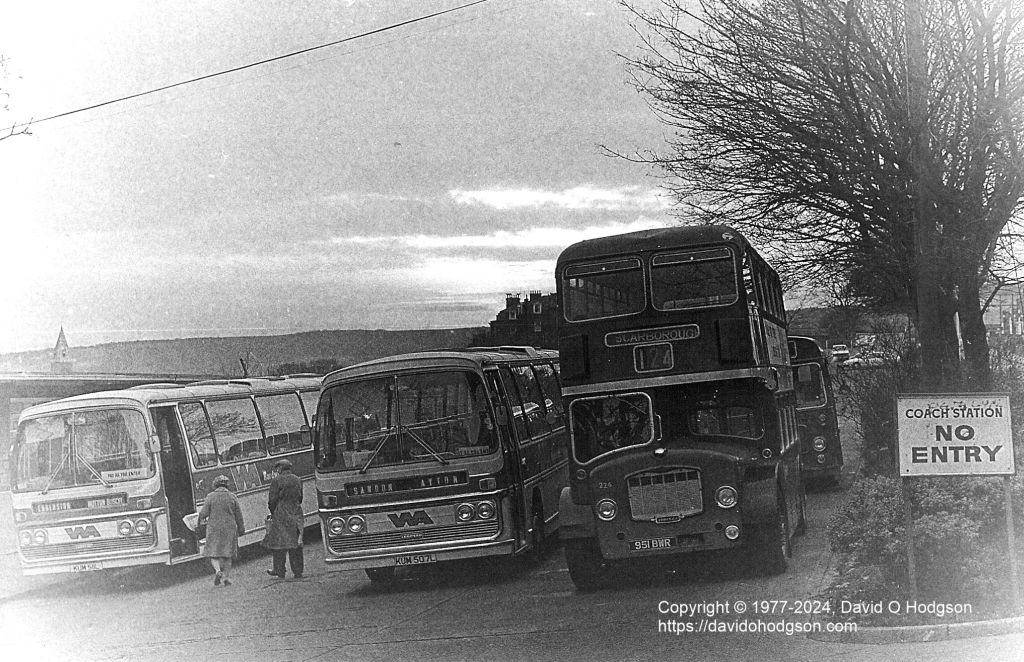
My photo below, taken in Winter 1977, shows the buses of Hardwick’s Services using Westwood as their Scarborough terminus. As you can see, Hardwick’s used vehicles with Plaxton coach bodies, but fitted with bus seats. Presumably the reason for that was for parts interchangeability with other vehicles in the Wallace Arnold fleet.

Westwood on another chilly winter’s afternoon

As is visible in the photo, NBC buses were still sometimes parked temporarily at Westwood, because there wasn’t sufficient space in the nearby Valley Bridge Bus Station, and Westwood was closer than the United depot on Vernon Road.

Incidentally, the vignetted and “frosty” look of my photo was accidental; during cold-weather development of the negatives, I failed to wash off the fixer properly! However, in this case I liked the effect, so I kept it.

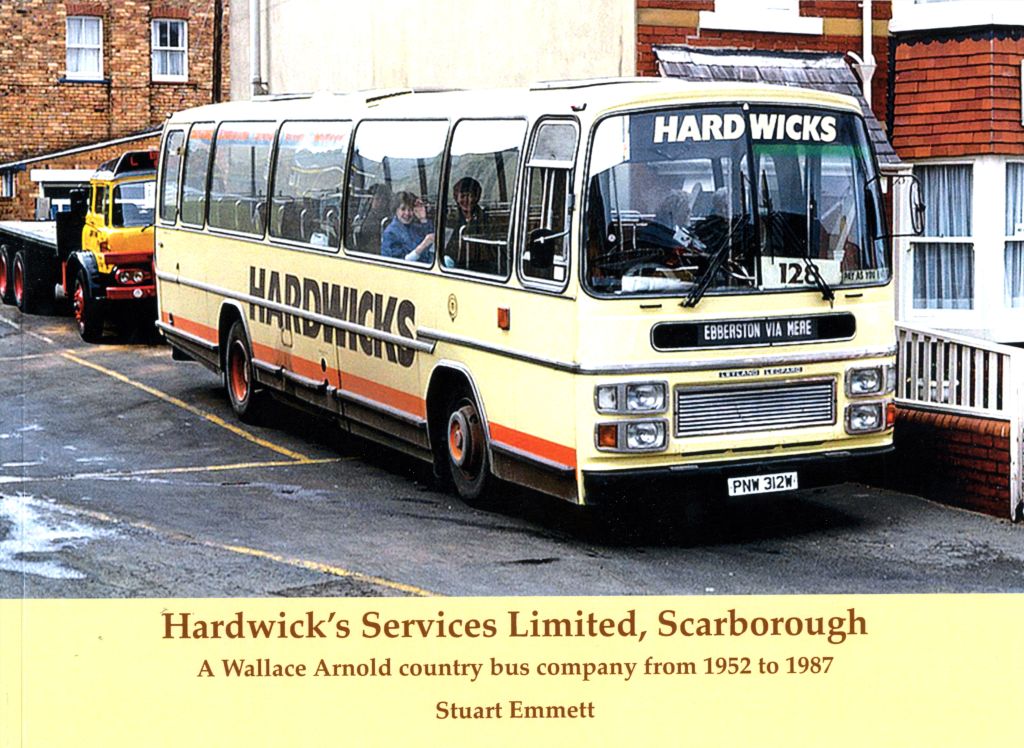
Full details and history of Hardwick’s Services can be found in this book.

Hardwick’s Services Limited, by Stuart Emmett. Copyright © 2020, Stenlake Publishing Ltd.

DIY Tip: Custom-Sizing an HVAC Filter

This is not intended to be a “DIY Tips” blog, and I don’t consider myself to be a “home handyman”. However, I recently found a solution to a maintenance problem that has frustrated us for the entire 11 years since we bought the house we’re living in. Since none of the so-called “professionals” that we’ve hired during that time seemed able to come up with this solution, it may help other homeowners if I share my tip.

If you don’t live in North America, this may be irrelevant to you, because most homes here rely on a ducted-air central heating and cooling (HVAC) system. This is so that the same ducting can be used for both heating and air-conditioning. By contrast, most homes in Europe rely on central hot-water-based heating systems, and have no central air-conditioning at all.

Ducted-air HVAC systems use a series of delivery vents, in ceilings, floors, or walls, and then one or more return vents to return the air to the furnace/air conditioner. Unfortunately, our house was built in 1999 with a non-standard size a/c return vent, so the filters have to be custom sized. The filters have to be replaced every 6 months or so. The image below shows the main return duct filter in the hallway ceiling. The aperture size is roughly 29″ x 22″.

The Ceiling Aperture for the Filter

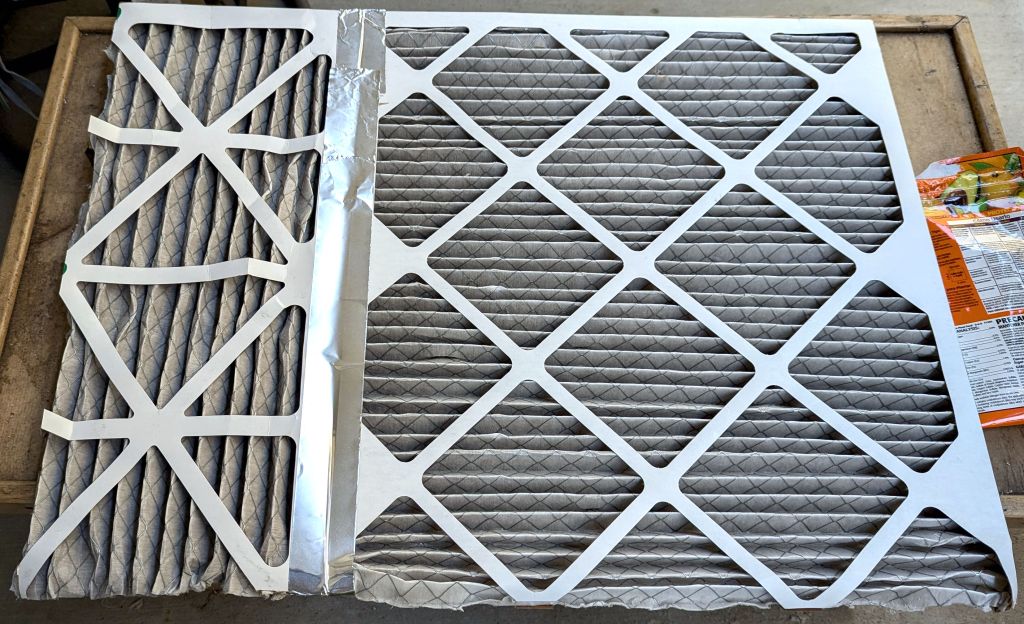
The following photo shows the efforts of so-called professionals, who at great expense hacked up 2 smaller filters to fit. As you can see, part of the filter’s frame is now missing. The problem with the missing frame is that, when the filter is in position, air pressure tends to force it up into the duct, which means that it does not do an effective job, since there are now gaps around the edges. You can also see that the maker didn’t quite get the size correct, with the result that he had to crush the filter material.

The Best Solution of So-Called Professionals!

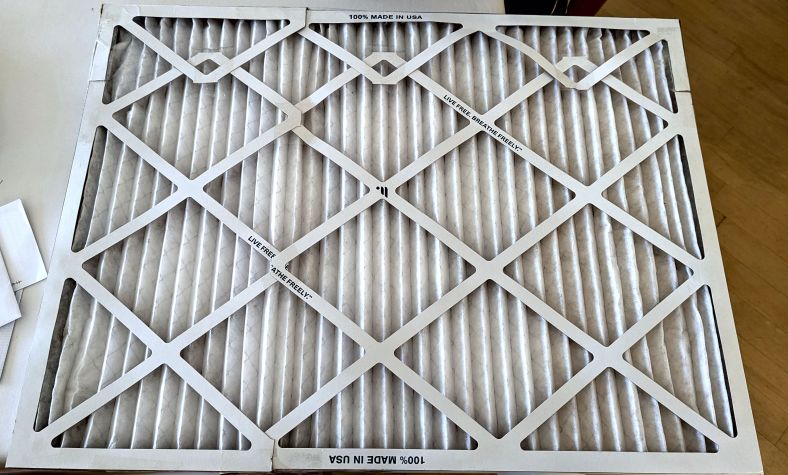
Recently, I took matters into my own hands, and discovered that cutting the edges of a standard 24″x30″ filter and sliding the cardboard over itself can achieve an exact fit, without all that mess! Also, a pack of 3 filters costs only $40!

The steps are:

  • Determine the actual aperture size
  • Cut the cardboard sides of the oversized filter neatly along the edge that is too long. If the filter is too long and too wide, you’ll need to do this separately in both directions
  • Use a knife to cut the filter material away from the shorter portion of the cut frame
  • If necessary, shorten the filter material to fit the smaller aperture. I used tinsnips to do this, because the filter material contains a mesh of wire reinforcement
  • Slide the edges of the shorter portion of the frame over the edges of the longer portion, until the frame is a snug fit for the aperture. I used 2 large slide clamps, set respectively to the length and width of the aperture, to check for a snug fit
  • Tape the cut edges firmly back together

The result is as shown below. You can see where the edges were cut in both directions, then slid over each other and taped back together.

My Solution to the Same Problem

I’ve sometimes felt that the HVAC professionals we hire are “not the brightest sparks in the fire”, and I think I’ve just demonstrated that.

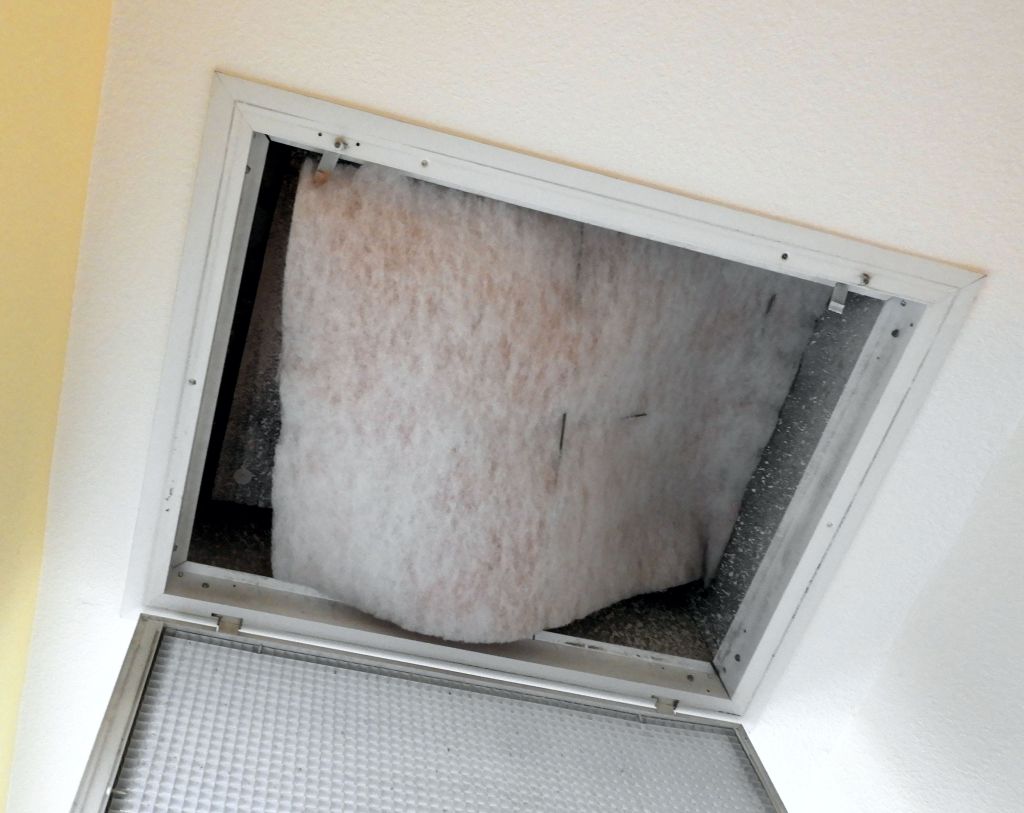
[Added 11/1/24]. I found a photograph of an earlier failed “professional” solution to our problem. In this case, the technicians used a piece of porous fiber material, but reinforced it with steel rods. As shown in the photo below, the result was that the filter did not fit properly into the aperture. When the circulation fan was running, the filter was pulled up into the duct, which meant that not only did it not function properly, but there was a danger that it would be sucked into the furnace intake.
The company that created this inept solution was https://www.hansonheatingandair.com/. A few months after they had installed their attempt at a filter, we noticed that it wasn’t working, and called to invite them to see the problem. Instead of showing any concern for the quality of their work, their receptionist started screaming at me, falsely claiming that I was “trying to get something for nothing”! Needless to say, we will never consider hiring them again, and we recommend that you also should avoid their questionable competence.

An Earlier Failed “Professional Solution”

Working at the BBC: Illusory Limitations

BBC Broadcasting House, from Portland Place

BBC Broadcasting House, from Portland Place

The photo above is, sadly, the only one that I ever took of BBC Broadcasting House, even though I worked there and walked in and out of the building regularly. With the benefit of 40 years of hindsight, I regret that, from 1984 through 1987, I took no photographs at all. At that time, it simply never occurred to me that I might one day want to describe and illustrate what was happening to me! I was only prompted to restart taking photographs when I visited California for a job interview in October, 1987. Therefore, this article, and others discussing the events of this time period, are unfortunately quite lacking in personalized images!

In a previous post, I mentioned how, during the early 1980s, my primary goal in obtaining an Electronics degree had been to obtain what I sincerely thought would be my “dream job”, as a video engineer at the British Broadcasting Corporation (BBC). I finally obtained that job in 1984, almost exactly 40 years ago, so this seems like an appropriate time to review the details of what happened then, and my reactions to it.

Having completed my degree at Imperial College, London, I interviewed for and obtained an entry-level Engineering job with BBC Studio Capital Projects Department (SCPD), which was responsible for building and renovating studios. The final interview seemed to go so well that I actually had the temerity to ask the intimidating board of three interviewers about my chances, given that I’d already received a job offer from the Philips television systems design plant in Croydon (which I did not want to lose, if the BBC turned me down again).

The interview board asked me to leave the room for a few minutes while they discussed my case. When I re-entered the room, they informed me that, subject to their receiving confirmation of my degree grade, I’d got the job! The only further thing they wanted to know from me was, “how come you know so much about television?” I explained that I’d just spent the last 2 years as a volunteer and then Chairman of Imperial College Student Television, which had given me experience in every production job, from producing through presenting to videotape editing.

Now, with the benefit of so much hindsight, I see that I should perhaps have been tipped off by that final question that something was amiss, but, after all, in those days I was just a naïve young graduate, who naturally trusted that my new employer would be acting in my best interests!

Letter from the BBC, informing me that I'd been selected

Letter from the BBC, informing me that I’d been selected

I was overjoyed at being offered the opportunity that I had sought for so long, but unfortunately I was soon to discover that the reality of my new job was not at all what I’d anticipated.

Digression: The Realities of Auntie

For readers who do not live in Britain, I should perhaps explain something about the exalted status of the BBC (nicknamed “Auntie”) in that country’s national mindset. (This reputation has been seriously damaged by recent scandals, including official cover-ups of abusive and pedophile behavior by certain BBC celebrities, but, back in those days, that was all kept firmly secret.)

It may come as a surprise to you to learn that, in a country that is supposedly a cradle of free speech, the BBC was for many decades a monopoly broadcaster in Britain. For many decades, by law, only the BBC could broadcast radio or television services. As from 1923, all British residents had to pay an annual licence fee to operate broadcast reception equipment, although since 1971, only television receivers have required a licence. Any other organization that attempted to broadcast was a “pirate”, and the British government made strenuous efforts to shut down such organizations whenever they could. Nonetheless, broadcast advertising was such a lucrative market that many pirate radio stations did operate. As I recounted in a previous post, the governor of my own school was a director of one such pirate station!

Despite its monopoly, the BBC was not officially an arm of government. It was nominally independent, and, although it usually toed the government line, its independence was sometimes the cause of friction between the Corporation and officialdom.

The BBC lost its monopoly on television broadcasting in 1955, when the Independent Television Authority began broadcasting a rival, regionally-distributed, ITV service, supported by advertising. Nonetheless, the BBC was still regarded as the “high-brow” service, and was accorded perhaps-undue respect for that.

As regards engineering training, the reality for many years was that only the BBC offered any professional training. ITV’s contractors usually simply poached trained engineers from the BBC. Therefore, it seemed to me that the only way to get into broadcasting was to undergo the BBC’s training, and the only way to obtain that was to work there.

It turned out that I was wrong, on many counts.

It’s Not Licence-Payers’ Money We’re Wasting!

I began working for the BBC on 13th August, 1984. The location of my office was the so-called “Woodlands” building, which was at 80 Wood Lane, quite close to Television Centre in White City.

BBC Television Centre, as illustrated in the Ladybird book "How it works: Television". The employee canteen looked out onto the "Blue Peter Garden", which was located in the area marked "20" in the diagram. Copyright © 1968, Wills & Hepworth Ltd.

BBC Television Centre, as illustrated in the Ladybird book “How it works: Television”. The employee canteen looked out onto the “Blue Peter Garden”, which was located in the area marked “20” in the diagram. Copyright © 1968, Wills & Hepworth Ltd.

I went through the expected employee induction process, but, as I settled into the job, it began to seem that there was actually very little for me to do. Having asked to be assigned some work, I was given various unnecessary tasks, such as auditing the acceptance of a new audio mixing desk, which in fact had already been accepted. I was provided with no information about the expected performance characteristics of the audio desk, so my review was mostly meaningless anyway.

As I recall, the single highlight of that period of my employment occurred one day when we got an urgent message that a radio microphone had failed at Broadcasting House, a few hours prior to a live broadcast. I rushed over there with two colleagues to investigate, only to discover that a wire had come loose within the microphone base. We obtained a soldering iron, and (thanks to my EP1 training at Ferranti), all was fixed a few minutes before the broadcast! Seriously, that was as “cutting-edge” as things got!

South Elevation of Broadcasting House, from the book "London Deco", by Thibaud Hérem[20]. Copyright © 2013 Nobrow Press

South Elevation of Broadcasting House, from the book “London Deco”, by Thibaud Hérem. Copyright © 2013 Nobrow Press

I complained to management about the lack of available work, but got nothing except shoulder-shrugging in response. Initially, they explained that it was because they had done me a favor by allowing me to start early, prior to the official training date at the Evesham training school. That excuse might have made sense, except for the fact that it was obvious that my fully-trained colleagues didn’t have sufficient work either!

I became disillusioned with the justifications that were being offered to me by SCPD management, and by what seemed to be a haughty refusal to engage with me. Having selected some of the best graduates from the best British universities, apparently they now expected those same people to accept seemingly illogical decisions without question! It seemed obvious to me that, despite their heads-in-the-sand attitude, they would not be able to maintain the charade indefinitely, and that the likely ultimate result was that at least some of us would be made redundant. The only remotely meaningful response that I ever got was, “Don’t rock the boat”. What “boat”? Why were my concerns about the true situation “rocking” anything?

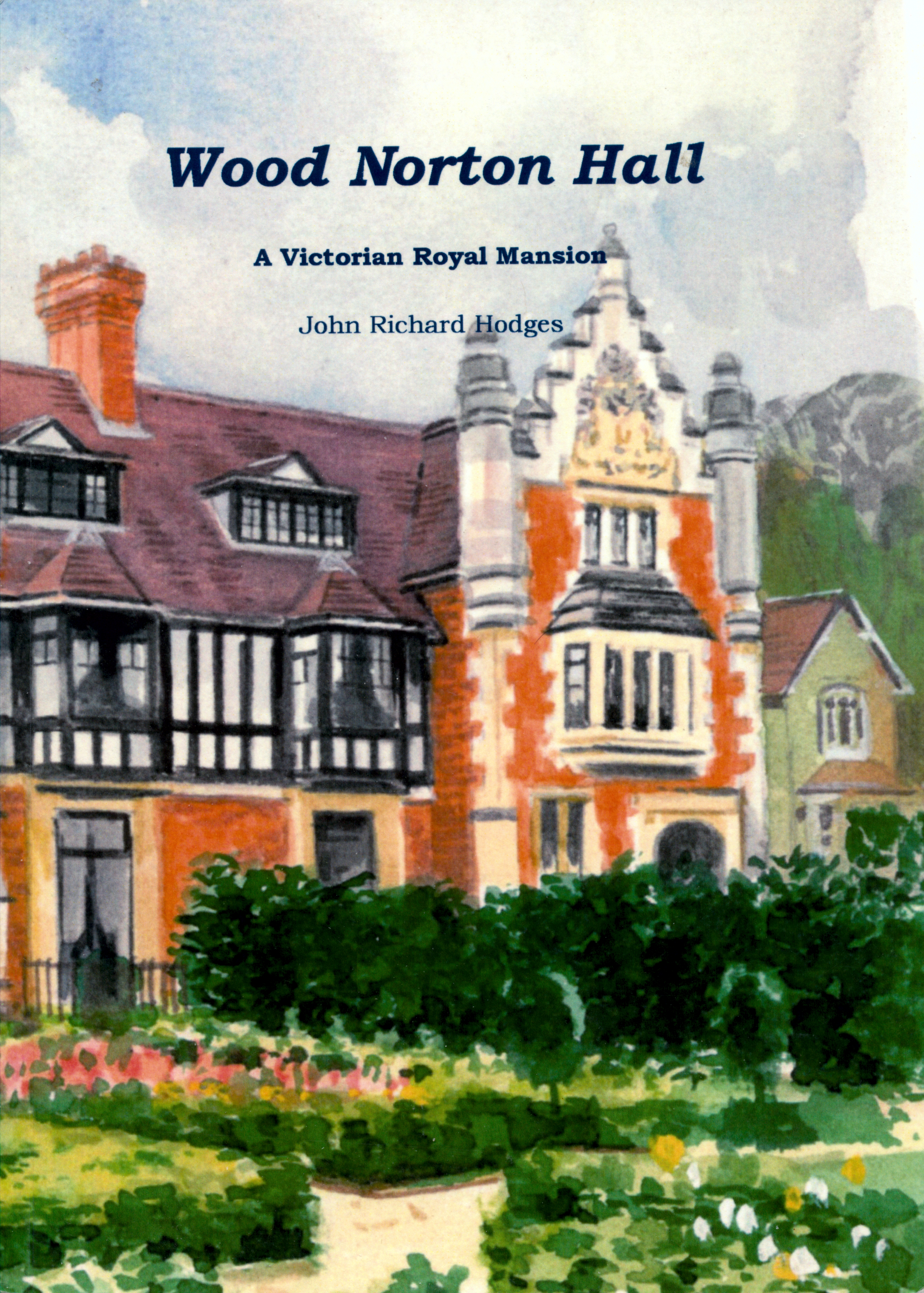
Following a few months of this tedium, I was sent along with many other new-hire engineers for the formal residential training sessions at the BBC Engineering Training School, which was located at Wood Norton Hall, in Evesham, Worcestershire (and which still exists, but is now a hotel). There is an entire book about Wood Norton Hall. It’s out-of-print, but can be obtained used, at, for example, https://www.amazon.co.uk/Wood-Norton-Hall-Victorian-Mansion/dp/0955405793/ref=sr_1_1

The cover of the book about Wood Norton Hall. Copyright © 2014 John Richard Hodges

The cover of the book about Wood Norton Hall. Copyright © 2014 John Richard Hodges

As part of that course, we were required to undergo the EP1 training specified by the Institution of Electrical Engineers (IEE). As I mentioned in a previous post, I had already spent several months completing exactly that training at Ferranti, and had a certified notebook to prove it. Why, then, should I spend time redoing exactly the same training? When I asked that question, it became apparent that I was by no means the only new BBC trainee who had already completed the EP1 training.

I pointed out to management that forcing us all through the same training again was a serious waste of money. The BBC were always sensitive to the suggestion that they were squandering licence-payers’ money, so management was eager to defend their stance, with this appalling justification: “It’s not licence-payers’ money we’re wasting. The Engineering Industry Training Board (EITB) reimburses us for the cost of EP1, so it’s the EITB’s money we’re wasting!”

Wood Norton Hall as it appeared when I worked there. The upper floors had been destroyed in a fire during World War II, and never replaced! Copyright © 2014 John Richard Hodges

Wood Norton Hall as it appeared when I worked there. The upper floors had been destroyed in a fire during World War II, and never replaced! Copyright © 2014 John Richard Hodges

Sorry; Your Degree is too Good

At around that time, it struck me that the job I’d accepted at the BBC was not the role that I’d originally had in mind. My initial application, in 1980, had been for an “Operations” job, that is, as a technician who operated or maintained broadcasting equipment. Those were the kind of roles I’d noticed when I visited Yorkshire Television, and which had stimulated my interest in working in the field in the first place.

Therefore, I asked my manager whether I could transfer from SCPD to one of the Operations Departments. His astonishing answer to me was along the lines of, “Oh no. Those jobs are for people with third-class degrees. Your degree is too good for that!”

So, apparently I’d gone from being underqualified for the BBC job in 1980, to being overqualified for it in 1984!

Having made no headway in trying to argue the problem with management, I eventually began looking for alternative employment, even if that would mean leaving the field of “video engineering”. After various interviews, I was offered an exciting position as “Technical Sales Engineer” by an electronics distributor called Swift-SASCO, who were based in Crawley, Sussex (but not in any way related to my previous employer, Swifts of Scarborough). Not only was the salary in that position comparable to what I was earning at the BBC, but they also offered an all-expenses-paid company car, plus the potential for sales bonuses. The offer was simply too good to ignore, so I accepted it and handed in my notice at SCPD, thinking sadly but mistakenly that that would be the end of my short career in video!

Retrospective: My Alternatives

Alternatively, I realize that I could perhaps have viewed my unproductive months of training at the BBC as being merely “paid education” and patiently plodded through it without complaint. I could also have spent my “enforced idleness” in exploring more of those historic buildings in which I found myself working. Perhaps I could then have moved to one of the ITV contractors? I’ll never know whether that would have worked out, but it would certainly have propelled the remainder my life in a very different direction, so in retrospect, I’m glad I did not.

In fact, I had overestimated the value of the BBC training. I’ve subsequently worked with many expatriate British engineers, quite a few of them specializing in video equipment design, yet not one of them ever underwent that BBC training! I discovered that the BBC’s engineering expertise simply was not held in high regard in the electronics or computer industries. As one former boss told me, “The BBC think they know it all, because they think they invented television. They don’t and they didn’t.”

After leaving the BBC, I stayed in contact with some of my former colleagues for a while. The word that got back to me was that, following my departure, management seems to have implicitly realized that the situation had been mishandled, and had made an effort to change their attitude. When one of my colleagues subsequently complained about some other unsatisfactory situation, his manager’s response was, “I’m glad you let us know. We don’t want anyone else to leave”!

I also discovered in the same way that, about six months after I resigned, many of my former colleagues were, in fact, made redundant from SCPD. My foreboding had been correct.

Why the Secrecy?

Nobody at the BBC ever offered me an explanation of what seemed to be the unreasonable behavior of SCPD’s management. Therefore, I can only surmise what was really happening at that time, based on descriptions and opinions I’ve received from other video engineers, inside and outside the BBC.

Here is what I was told:

Why did Studio Capital Projects have insufficient work?

As discussed in detail here, the then Prime Minister, Margaret Thatcher, and her Tory government, were engaged in a rather ridiculous ideological dispute with the BBC. The BBC (rightly) valued its independence, and its goal of providing objective, unbiased news reporting. Thatcher, on the other hand, took the view that, being funded by a licence fee, the BBC should in fact be a government propaganda arm. Unable to shut down or defund the BBC, she made petty attempts to hobble its position in other ways.

One such way was to insist that the BBC must “operate competitively”, supposedly to obtain value for money for licence-payers. Previously, whenever a BBC studio required refurbishment, the work had automatically gone to SCPD. Now, however, the BBC were forced to request bids for such work, not only from SCPD within the corporation, but also from external private companies.

The result was that external contractors always underbid, and so were awarded the contracts, leaving SCPD (which had bid according to the true costs of a project) without any work.

Logically, of course, if SCPD had no work, then the department should have closed or been repurposed. However, in that case, Thatcher would have won what was really a purely political battle, and some in the BBC were apparently determined not to concede.

Why did Studio Capital Projects hire more Engineers?

Given that SCPD had insufficient work for the engineers that it already employed, why would it nonetheless go ahead and hire even more engineers?

It was later suggested to me that this probably occurred because the BBC was “not a commercial organization”. Its annual income was essentially fixed by the licence fee collections, so the BBC’s budget was based on dividing up that fixed income among the various departments.

The primary way that a particular department could argue for a higher portion of the fixed budget was to employ more people. Hence, the goal of hiring more staff became completely detached from the question of whether such staff were actually needed!

Bad Times on the Horizon

The management issues that affected my employment at the BBC came as a great shock and disappointment to me at that time. Little did I realize back then that it would be just the start of a frustrating sequence of jobs with UK engineering employers, which would continue until I “escaped” to California (and relative sanity!) in 1987. Through no failing of my own, I worked for several employers during that 3-year period, with the management of each company being at best unstable, and at worst incompetent, as I experienced firsthand a portion of the terminal decline and failure of Britain’s electronics and computer industries. I hope to write more about some of those experiences in future posts.

It seems that the kind of mismanagement that plagued my employment experience in Britain is not a thing of the past. I was shocked by the recent news of the appalling Horizon Scandal in Britain, which seems to have stemmed from technical incompetence, and subsequent attempts by management to cover that up at any cost.

I am So Glad I Left

Let me emphasize once more that, in hindsight, I am so glad I quit that BBC job when I did! If I had not done that, but instead had listened to the discouraging comments of certain timid naysayers around me, and had clung on there, I would probably never have had the opportunity to move to California and work in “Silicon Valley”. As I have described in several earlier posts, there’s no question that the move to California changed my life immensely and permanently for the better.

I gave some thought to the wording of the title of this post. The phrase “illusory limitations” reflects both the way that I underestimated my own potential skills at that time, and the way that others attempted to impose false limitations on me. When I joined the BBC in that role, I really thought that it was the best I could do. I did not seriously imagine in those days that I could become a design engineer, and certainly not a patent-holding inventor. Fortunately, I didn’t ultimately settle for an underachieving career!

The message that I hope this tale of my experiences will convey to readers is not to be cowed by the unreasonable demands of any employer. Be confident in your own position, and don’t sacrifice your own future for the convenience of others who ultimately do not have your best interests at heart.

BBC Broadcasting House, from Portland Place

BBC Broadcasting House, from Portland Place

The Tower by the Bay

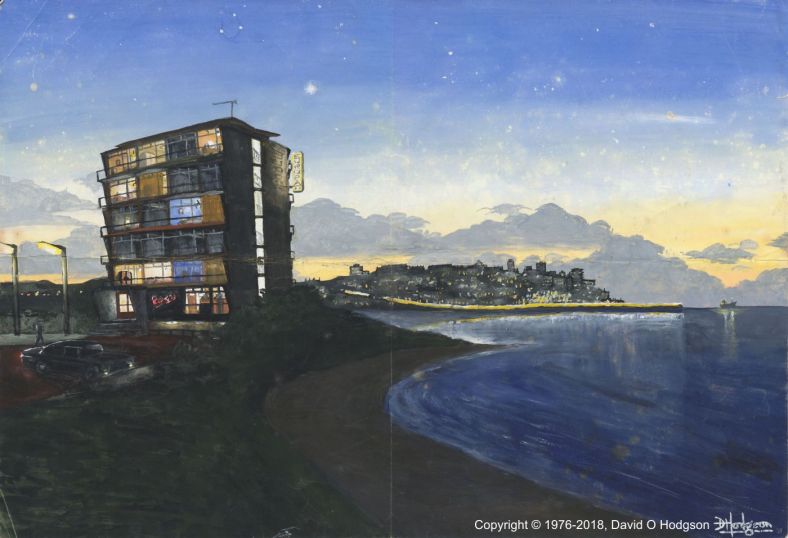
The Tower by the Bay, 1976

The Tower by the Bay, 1976

I completed the painting above during 1976, but not at school. I apologize for the poor quality; not only has the poster paint I used decayed over time, but the painting was also folded into four at some point!

The scene depicted is completely imaginary, and doesn’t attempt to represent any real place. I’m not sure why I chose to do this particular work at home; perhaps I just felt that my schoolteachers would demand to know what it was supposed to represent, and I wouldn’t be able to explain!

Today (October 25th) is International Artist Day, so I thought it appropriate to feature some of my artwork in this post, even if it’s not of “professional” standard on this occasion.

If my painting above represents anything, then I suppose that it was intended to show my “ideal location”, from my viewpoint as a teenager. Looking closely, the “tower block” in the image has a sign on the side saying “Europa”, so presumably it was supposed to be a hotel somewhere in Europe. At that age, I had no experience of independent living, so it probably seemed to me that the only alternative to living with my parents was to stay in a hotel!

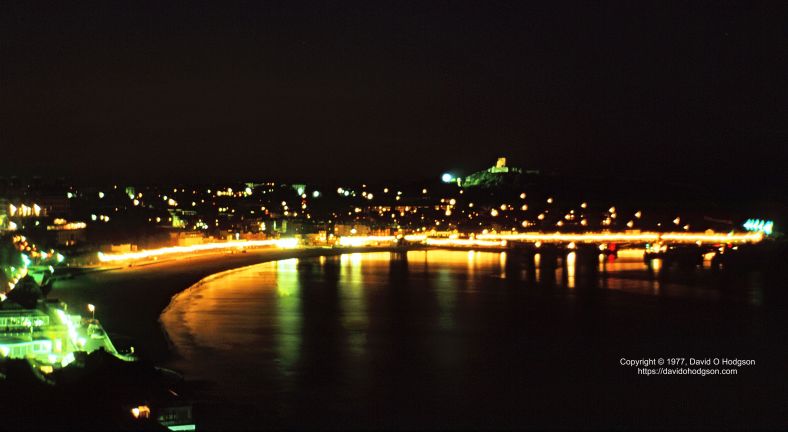
The city on the horizon, with its illuminated seaside promenade, is of course loosely based on views of my home town of Scarborough (as shown below in my 1977 photo). However, at that time, there were no modern “tower blocks” such as the one in my painting near the sea in Scarborough (although there was such a building—Ebor House—in the nearby resort of Bridlington, which was in the news just recently for the wrong reasons).

Scarborough South Bay at Night, 1977

Scarborough South Bay at Night, 1977

I seem to have spent a lot of time detailing the interiors of the rooms in the hotel, which I could have avoided simply by painting the curtains closed!

Slightly more than ten years after I painted the image above, I unexpectedly found myself in a seaside location that reminded me of that imaginary scene, although it was not anywhere in Europe.

Realizing the Dream

The photo below, which I took during my first visit to California in October 1987, shows the Metro Tower in Foster City, as seen from one of the lagoon bridges. At that time, the Metro Tower, which had only just been completed, had the distinction of being the tallest building between San Francisco and Los Angeles.

Foster City, California, in 1987

Foster City, California, in 1987

During the first evening that I arrived in California, I found myself very disoriented, because I thought that the tower and lagoon in front of it were facing westwards towards the Pacific Ocean. In fact, Foster City faces San Francisco Bay, and thus eastwards. I had to consult maps to figure out why the sea seemed to be on both sides!

I’m afraid that once again the picture quality is very poor, but I could not in fact go back and take the same photograph today, because other large buildings now surround the Metro Tower, as shown in the nearest-available Google Street View today.

As I mentioned in a previous post, after emigrating to California later in 1987, I did rent an apartment in Foster City, and lived there for about 18 months. It was a pleasant place to live, and the sheer modernity of the surroundings was a refreshing change from everywhere that I’d previously lived.

Not a Premonition

I realize that, in view of what happened to me later on, it’s possible to interpret my teenage painting as some kind of “premonition” regarding the place where I would find myself living as an adult (and someone did in fact suggest that).

However, in general I see no evidence that premonitions, in the sense of someone being able to know what will happen in the future, are possible (if only because the future of the universe is inherently not knowable). You may be able to make a very good guess as to what will happen in the future, based on the current circumstances, but it’s only ever a prediction. (This is, of course, exactly what weather forecasters do every day.)

In the case of my painting, I think the reality is just the opposite. Having unexpectedly found myself in California, Foster City particularly appealed to me because it was so reminiscent of the scene in my earlier painting. Thus, I took action to fulfill aspects of the fantasy that I’d had as a teenager, and made it real.

In fact, seeing it that way seems better than believing in some kind of premonition, because I was able to take action to change my life in the way that I wanted it to be, rather than accepting whatever situation I found myself born into.

The Tower by the Bay, 1976

The Tower by the Bay, 1976

London’s Post Office Tower: My First & Only Visit

Cover of my School Study, 1971

Cover of my School Study, 1971

At the age of eleven, I produced the illustration above for the cover of a “London Study” that we were required to write and illustrate at school. The study was created in connection with our school visit to the capital city, which had taken place in May 1971, just before I drew the cover.

As you may expect (given my interests), my cover drawing emphasized modes of transport. Additionally, I chose as the centerpiece a striking modern building to which we had paid a surprise visit during the trip, and which had substantially impressed me. Little did I know at that time that it would probably be my only opportunity ever to visit that iconic building.

The building in my drawing was the recently-built Post Office Tower (now known as the BT Tower). Even before that first visit to London, I was well aware of the existence of that structure, which was feted as a prime example of Britain’s dedication to the anticipated “White Heat of Technology”. In addition to its role as an elevated mount for microwave antennas, the Tower offered public viewing galleries providing spectacular views over Central London. There was also the famous revolving restaurant, leased to Butlin’s, the famous operator of down-market holiday camps.

The Tower and its restaurant began to feature prominently in the pop culture of the time. An early “starring” role was in the comedy movie Smashing Time, where, during a party in the revolving restaurant, the rotation mechanism supposedly goes out of control, resulting in a power blackout all over London.

In the more mundane reality of 1971, our school class arrived in London and settled into a rather seedy hotel in Russell Square. One evening, our teacher surprised us by announcing an addition to our itinerary. We would be visiting the public viewing galleries of the Post Office Tower, to watch the sun go down over London, and the lights come on! Needless to say, we were thrilled, even though we had no inkling that that would be our only-ever chance to do that.

There were actually several public viewing gallery floors, some of which featured glazing, while others were exposed to the elements, except for metal safety grilles. Fortunately, the weather during the evening that we visited was not exceptionally windy!

Concretopia

I’m currently reading the book Concretopia, by John Grindrod, which provides a fascinating history of Britain’s postwar architectural projects, both public and private.

Cover of Concretopia Book

One chapter of the book is dedicated to what was originally called the Museum Radio Tower (referring to the nearby British Museum). It provides detailed descriptions of the decisions that led to the construction of the tower, and reveals that at least one floor is still filled with the original 1960s-era communications technology.

Due to subsequent changes both in communications technology and British government policies regarding state involvement in such industries, much of the original function for which the Tower was built has now been rendered obsolete or moved elsewhere, leaving the building as something of a huge museum piece (ironically, in view of its original name).

The Once-and-Only Visit

In October 1971, a few months after my school class visit, a bomb exploded in the roof of the men’s toilets at the Top of the Tower Restaurant. Initially it was assumed that the IRA was responsible, but in fact the attack was accomplished by an anarchist group.

Fortunately, nobody was hurt in the incident, but it drew attention to the security vulnerabilities created by allowing public access to the Tower. The result was that the public viewing galleries were immediately closed down, never to be reopened, and Butlins’ Top of the Tower restaurant was informed that its lease would not be renewed after that expired in 1980.

Nonetheless, the Tower continued to appear in the media as an instantly recognizable icon. At around the same time, it was supposedly attacked by a particularly unlikely monster—Kitten Kong [link plays video]—in the British TV comedy series The Goodies.

My younger brother took the same school trip to London two years after me, but it was already too late; the Tower’s public viewing galleries were closed, so he never got to see the London twilight from that unique vantage point.

The Unexpected Technologist

On that first visit to London in 1971, I had no notion that I personally would ever be a participant in the kind of exciting technological innovation signified by the Tower. In my family’s view, such advances were just something that “people like us” observed and marveled at, from a remote state of consumer ignorance.

I never anticipated, therefore, that I would return to London as an adult only ten years later, to begin my Electronics degree studies at Imperial College, University of London. I had to visit the University’s administration buildings in Bloomsbury to obtain my ID and other information, and there was that familiar building again, still looming over the area. (The University Senate House is also famous for its architectural style, but I’ll discuss that in a future post!)

My 1982 photo below, taken during my undergraduate days, offers an ancient-and-modern architectural contrast, showing the top of the Tower from a point near the Church of Christ the King, Bloomsbury.

Post Office Tower & Bloomsbury, 1982

Post Office Tower & Bloomsbury, 1982

The Museum Tower

The photo below shows the Tower again, during a visit in 2010, now with its “BT” logo prominently on display. Externally, the tower looks little different from its appearance as built, and, given that it’s now a “listed building”, that is unlikely to change much in future.

BT Tower, 2010

BT Tower, 2010

For me, the Post Office Tower stands as a memorial to the optimistic aspirations of Britain’s forays into the “White Heat of Technology”. It seems that, unfortunately, the country’s “Natural Luddites” (which C P Snow claimed were dominant in the social and political elite) won the day after all.

Cover of my School Study, 1971

Cover of my School Study, 1971

Ruins of Yorkshire


Byland Abbey, West Front, 2010

Byland Abbey, West Front, 2010

The photo above, which I took during a visit in 2010, shows the still-impressive ruin of the West Front of Byland Abbey, in Yorkshire. Prior to its destruction, the most impressive feature of this facade would have been a huge rose window, the lower outline of which is still visible here. Apparently, that was the inspiration for a similar rose window in York Minster, which remains intact (although it narrowly escaped destruction in the 1984 fire, and required substantial renovation, as described here).

For my Yorkshire Day post this year, I wanted to draw attention once again to the remarkable assemblage of monastic ruins that exist in that county. There are, of course, also many military ruins, such as Scarborough Castle, but the religious buildings are perhaps less well-known.

Just to avoid any confusion regarding my intentions, I should make it clear again that I have no interest at all in religion. My interest in these buildings is and always has been architectural and historical.

I’ve mentioned my early experiences with these ruins in previous posts, and I must admit that I tended to take them for granted when growing up. I just assumed that there must be huge ruined churches lying around everywhere, and it was only later that I realized that this was a rare environment.

Illustrating the degree of integration of these ruins into the landscape, the photo below shows the modern remains of Byland Abbey’s gatehouse, the surviving arch of which stands over a public road.

Byland Abbey Gatehouse Ruin

Byland Abbey Gatehouse Ruin

A Long-Forgotten Social Disaster

The process by which all these huge religious institutions came to be abandoned and ruined is fairly well known, as the Dissolution of the Monasteries, which took place between 1536-40. The event occurred because King Henry VIII picked a fight with the Pope, over his desire to divorce one of his wives. The key to success, as he saw it, was to crush the power of the Catholic church in England. All the monasteries owed allegiance to the established church, so it seemed to him that abolishing them would not only be a way to reduce the church’s power, but also to grab the land and valuables owned by those institutions, and the income streams created by them.

As the extent of the remaining ruins suggest, the monasteries in Yorkshire formed a major part of the local economy and social organization, so their abolition and deliberate destruction must have been catastrophic. Although the King was able to seize the land and the monasteries’ treasures, his hoped-for income streams never materialized, because he had destroyed the organizations that were generating them! Henry sold off most of the seized land to his favored nobles, and then squandered the proceeds on his wars.

Rievaulx Abbey, also in Yorkshire, built one of the world’s first blast furnaces for iron, and it has been suggested that, if it had not been for the Dissolution of the Monasteries, the Industrial Revolution would have begun in Britain a century before it actually did.

In State Care

Following the Dissolution, the institutions’ land and buildings passed into private hands, and stayed that way for centuries.

Many abandoned religious buildings that were close to settlements gradually disappeared, as they were stripped for building stone. It was probably the relative isolation of the Yorkshire abbeys that permitted the survival of significant portions of the structures.

At the start of the Twentieth Century, the British Government began to take an interest in preserving what was left of the ruins, and eventually took most of them into state ownership, by purchasing them from the private owners.

Fountains Abbey: a Spectacular Setting

While the ruins of Byland and Rievaulx Abbeys are impressive, perhaps the Yorkshire ruin with the most ideal landscape setting is Fountains Abbey.

The photo below shows the ruin of the church at Fountains, in its breathtaking setting in Studley Royal Park. This was taken during a visit in 1977, and the individuals in the foreground are my mother and her friend.

Fountains Abbey, 1977

Fountains Abbey, 1977

In those days, the visitors’ car park was at the Studley Tea Rooms, which necessitated quite a long (but pleasant) walk alongside the River Skell to the actual ruins. The modern car park is closer to the ruin.

Fountains was somewhat unusual in that it was not purchased by the Ministry of Works at the same time as most of the other sites. It remained in private hands until 1966, when it was bought by the County Council. In 1982, the estate was transferred to the National Trust, and is now maintained by English Heritage.

If you’re visiting Yorkshire, and if the weather is reasonable, then all these ruins are well worth a visit!

Becoming American (in Oakland)

Stage of the Paramount Theatre, Oakland

Stage of the Paramount Theatre, Oakland

Last Thursday, I officially became a citizen of the United States of America, after living here for about 27 years as a legal Permanent Resident. The photo above shows the stage of the Paramount Theatre, in Oakland, which was where the swearing-in ceremony took place.

(I mentioned in a previous post that I had passed the US Citizenship test at the CIS offices in San Francisco, and was waiting to be called for this event.)

Given the number of new citizens being admitted, there was a large crowd at the event. There were 1,018 people being sworn in at that ceremony, and everyone had been invited to bring family and friends, so there were several thousand people in the theater.

Prior to the actual oath-taking, there were several speeches, videos, and even a choir! The photo below shows California Secretary of State, Alex Padilla, speaking to the audience. Padilla himself is an immigrant from Mexico.

Alex Padilla Speaking at the Ceremony

Alex Padilla Speaking at the Ceremony

At the end of the ceremony, everyone takes the Oath of Allegiance as a group, and then Certificates of Naturalization are distributed to each individual. After exiting the auditorium, we were invited to register to vote and to apply for a US passport. This turned out to be quite chaotic, so instead of trying to get a photograph of me in the theatre, we went to the coffee shop next door, where Mary took the photo below. The flag in my hand was given to me at the ceremony, but I’ve owned the tie for many years!

A New American!

A New American!

An Art Deco Masterpiece

The Paramount Theatre was built in 1931, by an affiliate of Paramount Pictures, and was constructed in an opulent Art Deco style. Thankfully, after decades of neglect, the building was saved and restored to its current condition.

The photo below shows the theater’s lobby, with soon-to-be citizens entering from the street in the background.

Lobby of the Paramount Theatre, Oakland

Lobby of the Paramount Theatre, Oakland

The exterior of the theater is equally impressive, as shown below.

Exterior of the Paramount Theatre, Oakland

Exterior of the Paramount Theatre, Oakland

Next door to the theater is another spectacular Art Deco survivor, the former I Magnin store, clad in beautiful green terracotta (and also built in 1931), now converted into offices and a coffee shop. This coffee shop was the one in which Mary took the photo of me, above.

In the photo below, the queue around the building is formed by people waiting to get into the theater for the next swearing-in ceremony, which began almost as soon as mine was over!

Former I Magnin Store, Oakland

Former I Magnin Store, Oakland

It’s a great credit to the City of Oakland that at least some of its architectural gems have been saved in this way, and their presence comes as quite a surprise in the midst of so much “urban blight”.

Hear that Lonesome Whistle Blow

The ceremony started quite early in the morning, so, to avoid the rush hour traffic, we decided to stay over in Oakland the night before. We stayed at the Z Hotel, Jack London Square. The photo below shows the hotel and its parking lot after dark.

The Z Hotel, Oakland

The Z Hotel, Oakland

As the song “Walk Like An Egyptian” goes; “If you want to find all the cops, They’re hanging out…” at this hotel, apparently. The Buttercup coffee shop at the hotel is open late, and the location is close to the Oakland Police Station, so it seems that this has become a regular meeting place. The “police presence” certainly made us feel safer while staying at the hotel!

The impressive floodlit building below is situated on the opposite side of 3rd Street from the hotel, but it took some time before I worked out what it actually is. It is the former depot of the Western Pacific railroad, whose trains stopped on street tracks in front of the depot until 1970.

Former Western Pacific Depot, Oakland

Former Western Pacific Depot, Oakland

This photo on Flickr shows a WP California Zephyr train waiting at the depot. You can see the depot building on the right, and on the left is the motel that is now the Z Hotel.

Although there are no longer any railroad tracks down 3rd Street, they are very much still in place on Embarcadero West, only about 2 blocks away from the hotel. This line is still heavily used by both passenger and freight trains. The photo below shows the tail end of a freight that had just passed the crossing on Broadway.

Freight Train on Embarcadero West, Oakland

Freight Train on Embarcadero West, Oakland

We could hear the train horns quite clearly from the hotel, although fortunately they do not sound in the middle of the night.

The Heron at the Pool

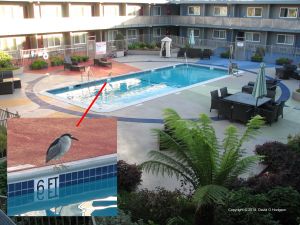
As mentioned above, the Z Hotel itself is a former motel, and still features a swimming pool. The following morning, while we were getting ready to take a shuttle bus up Broadway to the theater, the pool’s sole user was a Black-Crowned Night Heron, which was hoping in vain to catch its breakfast there! The photo below shows the pool area and a closeup of the bird.

Black-crowned Night Heron enjoying the Pool

Black-crowned Night Heron enjoying the Pool

When I open my wallet now, it seems strange not to see the Permanent Resident Card that I was required to carry for 27 years! This is due to a legal oddity; non-citizens are required to carry proof of their residency status, but citizens are not.

Return to Croydon Airport

Croydon Airport on a Rainy Day, 2001

Croydon Airport on a Rainy Day, 2001

The photo above, which I took in 2001, shows a unique building that still survives today, and was, at one time, perhaps among the most familiar structures in the world.

It is the terminal building and control tower of London Airport; the famous Croydon Airport that was the location of so much newsreel footage prior to the Second World War.

The Control Tower at Croydon, built in 1928, was the first at any airport in the world, and Air Traffic Control systems were pioneered there.

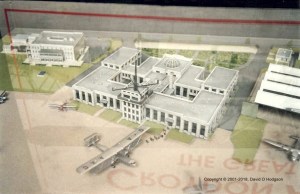
The photo below shows a model of Croydon Airport in its pre-WWII heyday, complete with passengers boarding an iconic H.P.42 Heracles class airliner.

Model of Croydon Airport during the 1930s

Model of Croydon Airport during the 1930s

Almost inevitably, the area around Croydon Airport, which had been open fields when the airfield was first opened in 1915, soon became covered with urban development. As a result, postwar expansion of the airport became impossible, so the decision was made to move operations to Heathrow instead. Heathrow replaced Croydon as London Airport in 1946, and then Croydon was gradually run down, finally closing in 1959. The runways at Croydon were all built over, and, in my ignorance, I thought that nothing was left.

Oblivious to the History around Me

During the mid-1980s, I worked for a while as a Technical Sales Engineer for an electronics distributor. An important aspect of my job was to liaise with the company’s Sales Representative for Surrey, and in order to do that, I would arrange to meet with her at a place called the “The Aerodrome” on Purley Way. The building containing the café is shown below, as it appeared during my 2001 revisit.

The Aerodrome Hotel in 2001

The Aerodrome Hotel in 2001

As I recall, my colleague’s primary reason for choosing that café was her enthusiasm for their garlic mushroom appetizer!

It wasn’t until decades later that I realized that this had been the Aerodrome Hotel, purpose-built in 1928 as prestige accommodation for London Airport. In my photo of the model above, you can see the hotel building at the top left.

As the hotel’s own web site shows, since 2001 the building has been renovated, and now proudly shows off the aviation heritage that seemed largely forgotten during the 1980s.

I Should have Looked Round the Back

Next to the building containing the café, there was what appeared to be a nondescript office block, and it never even occurred to me to take the opportunity to look around the back of that structure. Had I done so, I would have immediately recognized the famous apron of the airport.

Control Tower and Former Apron of Croydon Airport

Control Tower and Former Apron of Croydon Airport

(Since I took the photo above, replicas of the control tower’s masts have been added.)

By 2001, the terminal building had been renovated as the Airport House International Business Centre, so I was able to go inside and eat lunch at the Rayon d’Or Brasserie.

The lobby of the renovated building displayed fascinating relics of its history, as shown below. Several of the items that are visible are original features, such as the “Winged World” sculpture.

Lobby of Airport Terminal, in 2001

Lobby of Airport Terminal, in 2001

The display above included the model of the airport in its heyday, as shown in my photo. The Rayon d’Or Brasserie is in the background on the right.

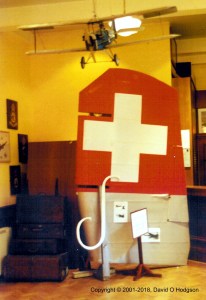
At that time, the aviation memorabilia display was still under construction, as shown by the view below of the rudder of a Swissair DC-3, a model of an SE5a hanging from the ceiling, a Sabena logo, and some period luggage (without wheels, of course).

Aviation Memorabilia in 2001

Aviation Memorabilia in 2001

Unfortunately, my visit didn’t occur on the first Sunday of the month, so I wasn’t able to avail myself of the tour of the old Control Tower. If you’re in the vicinity on the appropriate day, you may be interested in taking that tour. Full details can be found here, and this is the latest Google Streetview of the location.

[1/3/23: Updated link to the airport’s web site.]

A Modern Museum

It’s great to see that efforts are being made to preserve what is left of Croydon Airport. I hope to be able to visit the site again, next time I’m in the area.

A Short Stay in San Francisco

Embarcadero Wharves, San Francisco

Embarcadero Wharves, San Francisco

The photo above shows part of San Francisco’s famous Embarcadero, which was once a busy docklands area (with rows of wharves on the right), and was a major embarkation port during World War II, but is now mainly a tourist attraction. My wife took the photo yesterday, while we were staying for a short time in the City. When I first visited this location, about 30 years ago, there was a railroad yard on the left (which had been part of the State Belt Railroad), but all that is now gone, and the only tracks are those for Muni streetcars.

Mary and I had gone to San Francisco so that I could attend my US Naturalization interview. I’ve been a US Permanent Resident (always legally, of course) since 1991, and, following many years’ procrastination, I decided that, instead of renewing my “Green Card” again, I’d apply to become a US citizen. Part of this process involves an interview with a CIS officer, who tests you on your English language skills and your knowledge of US history and government. In addition to passing an FBI background check, you have to undergo these tests to have your citizenship application accepted.

Given that my interview was scheduled for early morning, we decided that, rather than try to rush through the morning traffic, we’d stay overnight nearby the night before. We chose the Galleria Park Hotel, partly because it was close, but also because it’s pet-friendly, and we wanted to bring our cats with us! The photo below shows the hotel building, on the corner of Sutter and Kearny streets.

Galleria Park Hotel, San Francisco

Galleria Park Hotel, San Francisco

Whenever Mary and I arrive at a hotel, we try to remember to take a “selfie” on the bed in our room. The photo below shows us just settling in at the Galleria Park.

Arrival at Galleria Park Hotel

Arrival at Galleria Park Hotel

The hotel building dates back to 1911, but has recently been renovated, while retaining many of its Art Nouveau features. All of us (Mary, the cats, and I) had a very enjoyable stay there, and can recommend that hotel if you need to stay in San Francisco’s financial district.

The photo below shows a twilight view from the window of our room. The skyscraper in the center background is the former Bank of America building at 555 California Street.

View of the Bank of America Building at Twilight

View of the Bank of America Building at Twilight

Ginger in the City

The photo below, taken by Mary, shows one of our cats, Ginger Tom, arriving in style on his first visit to San Francisco.

He was riding along Van Ness Avenue in our car, and was intensely curious about everything around him.

Ginger in the City

Ginger in the City

Return to an Old Haunt

During our stay, we took the opportunity to revisit a very long-established restaurant that we last ate together at about 30 years ago, while we were dating.

Sam's Grill, San Francisco

Sam’s Grill, San Francisco

The restaurant in question is Sam’s Grill, which has what is, by California standards, a truly ancient history, all the way back to 1867. We had a very enjoyable meal there, sitting in one of the private booths. Many of the other eateries that we frequented when dating are long gone, so it’s nice to find one that is still going strong.

Status: Approved

Fortunately, I passed my citizenship test, and my application has been recommended for approval. I anticipate that the next step in the process will be that I’ll be called to a swearing-in ceremony, where I expect to receive my Certificate of Naturalization. I’ll write about that experience when it happens.