A Californian in Manchester (or a Mancunian in California)

Manchester “Californian” type tram 765: August 1981

Manchester “Californian” type tram 765: August 1981

I took the photo above in August 1981, showing a “Californian” in Manchester, England. It’s not really Californian—of course—it’s just a “California style” tram that used to be operated by Manchester Corporation Tramways. Manchester abandoned its electric tramway system even earlier than most British cities, and this preserved car is the only surviving Manchester electric tram.

At the time of my photograph, the restoration of Car 765 had recently been completed, and it was giving rides to the public on a special track in Heaton Park. When riding that ancient tram, during a long-ago summer Sunday, I never even guessed that, within 10 years, I’d be riding modern trams (albeit called trolley cars) in the real California!

I described in a previous post how I accepted an offer of an apprenticeship in Electronic Engineering from Ferranti, in Manchester, and so moved there to start working for them in July 1981.

For all its (deserved) reputation as a grim Northern industrial city, Manchester nonetheless has a fascinating history, having been the cradle of an Industrial Revolution that massively changed the world. The city not only features many world-famous industrial landmarks, but was also the source of early reactions to the industrialization of society. For example, the German philosopher Friedrich Engels wrote his master work, The Condition of the Working Class in England, in the city in 1842-44. Engels met Karl Marx a few years later, and together they went on to promote Communism, which of course has had a substantial effect on the subsequent course of world history.

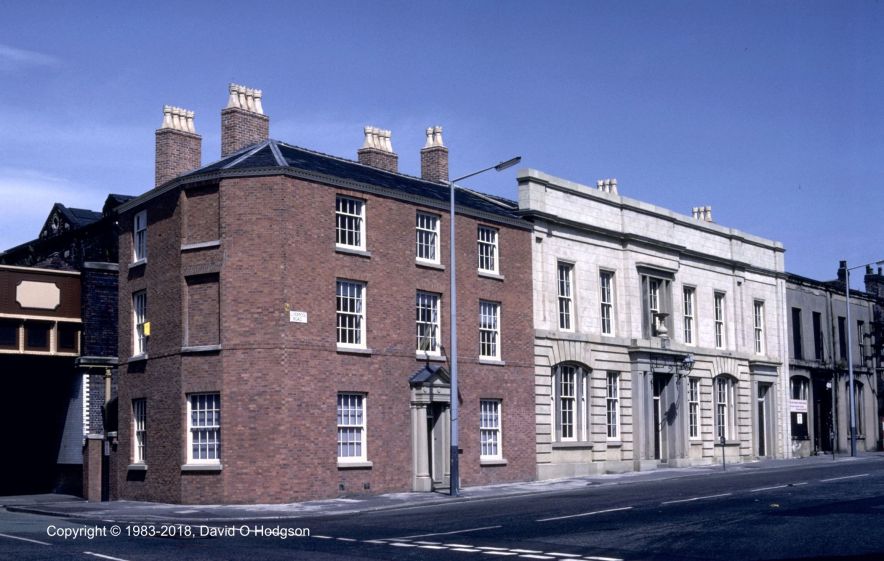
One among many “world’s firsts” located in Manchester is the oldest surviving purpose-built railway station; Liverpool Road Station, built in 1830 for the Liverpool & Manchester Railway, and shown below in my 1983 photo.

Liverpool Road Station, Manchester

Liverpool Road Station, Manchester

Things to Come

In those days, Manchester was still in the process of shedding its industrial past (as fabulized later in the TV series Life on Mars). Despite the fascination of its history, Manchester for me couldn’t compare with the opportunity to live in London (to where I moved when I began my studies at Imperial College that Autumn). I lived and worked in Manchester for three summers, and I look back on those days now as a boldly-taken but rather shaky stepping-stone on the way to everything that has happened to me since.

I admit that the title of this post is stretching the truth a little, because I’m not really “Mancunian” (someone from Manchester), but I did live there for a while, during an interesting part of my life!

Manchester “Californian” type tram 765: August 1981

Manchester “Californian” type tram 765: August 1981

Trilingualism & Beyond

Postbus & Cows, Engadin, Switzerland

Postbus & Cows, Engadin, Switzerland

I took the photo above during a 1998 visit to Switzerland. It’s a relatively typical scene in the villages of the Engadin region, with the Postbus trying to negotiate its way around a herd of cows just strolling down the street.

Visiting Switzerland is an interesting—even frustrating—experience from the linguistic viewpoint, because the country has four official languages (none of which is English). The languages are: French, German, Italian and Romansh, as shown in this map. Thus, many inhabitants of Switzerland are trilingual or more (they speak three or more languages). That’s fine for them, but for you as a visitor, it presents a difficulty. As soon as you want to speak to a stranger, the question immediately arises as to which language you should use!

In theory, the country is divided into linguistic regions, so it would be reasonable to choose the dominant language of the region in which you find yourself. (For example, in the westerly regions, French is the dominant language.) Unfortunately, as I discovered, that doesn’t always solve the problem.

Nonetheless, before arriving in Switzerland, I had naively thought that I was relatively well prepared for the experience, because I had learned two of those four languages at school…

Linguistically Prepared?

At the high school I attended in England, French was a mandatory O-level subject (along with Math, English Language and English Literature). The school was a typical British “comprehensive” and there was nothing particularly unusual about the O-level requirements. In general, pupils were expected to study at least one foreign language, and French was the usual choice.

We were also able to select 4 further O-level subjects based on our own preferences, of which one could be another language (but only one of those taught at the school: German, Russian and Latin). I chose to study German, and I passed my O-levels in both foreign languages.

At that time, I had no real idea about the direction that my future life might take, although the idea of perhaps working in Europe some day did appeal to me. Unfortunately, as things turned out, knowledge of French and German has proven to be of very limited usefulness to me, whereas knowledge of Spanish would have been very valuable!

In a Taxi in Zurich

As I mentioned above, I expected that my knowledge of French and German would be beneficial in Switzerland. The first night that we arrived in Zurich, we had to get a taxi from the airport to our hotel. I got into the taxi, and, figuring that I was in the German-speaking part of the country, I asked the driver to take us to the hotel in that language.

He returned my request with a confused look, so instead I tried English. Still no luck. Eventually I tried French, to which he smiled and nodded. It turned out that he wasn’t Swiss at all, but was in fact un colon from Morocco, where French is not an official language, but is widely taught.

Our driver seemed quite surprised that I was able to ask him in more than one language, and even accused me of being Canadian!

Arrival in Davos

Arrival in Davos Platz

Arrival in Davos Platz

We did eventually get to the hotel in Zurich, and stayed overnight before heading for Davos the following day. The photo above shows Mary and me on arrival in Davos, although we had actually traveled by Rhaetian Railway train, rather than the Postbus behind us.

Linguistically, I figured that Davos would be a “safe zone” for me, because surely now we were in the midst of the German-speaking portion of the country.

My relief turned out once again to be premature, because the version of German spoken in Switzerland was almost completely unintelligible to me. The people of that region speak Schwyzerdütsch, which is a very strong (unwritten) dialect, with substantially different pronunciation rules. Listening to a conversation between two locals, I could barely pick out more than a few words, and only then when I began to grasp the varying pronunciations.

Watch Your Gender

Nonetheless, most locals understood standard German, so I felt that at least I could ask for things in German if necessary. Unfortunately, that too turned out to have its pitfalls.

We couldn’t locate the main Post Office in Davos so, while buying gasoline, I asked the attendant for directions. I said to her, “Entschuldigen Sie mir, wo ist der Postamt?

The response was another very puzzled look (and if you speak German you’ll probably already have spotted my error). I then engaged in much hand-waving and explanations, along the lines of wanting to buy a stamp. Eventually, the attendant figured out my meaning, and, with a smile, explained that I should have said, “Wo ist das Postamt?”.

I’d got the gender wrong, which to me as an English speaker didn’t seem all that important, but clearly I was mistaken!

Don’t Learn Too Much!

At long last, just over a year ago, I decided to make the effort to begin learning (Latin American) Spanish, given that I’ve now lived for more than 30 years in California, which has a substantial Spanish-speaking population.

I called up a local tutor who was offering group lessons, and discussed whether she could help me. She asked whether I had ever learned any other foreign languages. I felt that mentioning my previous studies in French and German would be seen as beneficial, so I was surprised by the tutor’s negative response. “That’s going to confuse you”, was her claim.

I’d never before heard of the idea that it might be possible to learn too many languages! And yes, while learning Spanish I have sometimes resorted to the use of French words, but only in cases where I didn’t know the Spanish equivalent anyway! If I didn’t know French, then I’d just have had to use the English word in those cases.

I did some online research to determine whether there’s really any evidence for this odd notion that learning more than two languages is potentially confusing, or conversely, as I had believed, beneficial. I found several articles on the topic, such as here, here and here. On the whole, the consensus seems to be that, while it can lead to temporary confusion, in general knowing two languages makes it easier to learn a third.

So, yes, I still believe that I can safely say that Trilingualism is not something to be ashamed of!

Ruins of Yorkshire


Byland Abbey, West Front, 2010

Byland Abbey, West Front, 2010

The photo above, which I took during a visit in 2010, shows the still-impressive ruin of the West Front of Byland Abbey, in Yorkshire. Prior to its destruction, the most impressive feature of this facade would have been a huge rose window, the lower outline of which is still visible here. Apparently, that was the inspiration for a similar rose window in York Minster, which remains intact (although it narrowly escaped destruction in the 1984 fire, and required substantial renovation, as described here).

For my Yorkshire Day post this year, I wanted to draw attention once again to the remarkable assemblage of monastic ruins that exist in that county. There are, of course, also many military ruins, such as Scarborough Castle, but the religious buildings are perhaps less well-known.

Just to avoid any confusion regarding my intentions, I should make it clear again that I have no interest at all in religion. My interest in these buildings is and always has been architectural and historical.

I’ve mentioned my early experiences with these ruins in previous posts, and I must admit that I tended to take them for granted when growing up. I just assumed that there must be huge ruined churches lying around everywhere, and it was only later that I realized that this was a rare environment.

Illustrating the degree of integration of these ruins into the landscape, the photo below shows the modern remains of Byland Abbey’s gatehouse, the surviving arch of which stands over a public road.

Byland Abbey Gatehouse Ruin

Byland Abbey Gatehouse Ruin

A Long-Forgotten Social Disaster

The process by which all these huge religious institutions came to be abandoned and ruined is fairly well known, as the Dissolution of the Monasteries, which took place between 1536-40. The event occurred because King Henry VIII picked a fight with the Pope, over his desire to divorce one of his wives. The key to success, as he saw it, was to crush the power of the Catholic church in England. All the monasteries owed allegiance to the established church, so it seemed to him that abolishing them would not only be a way to reduce the church’s power, but also to grab the land and valuables owned by those institutions, and the income streams created by them.

As the extent of the remaining ruins suggest, the monasteries in Yorkshire formed a major part of the local economy and social organization, so their abolition and deliberate destruction must have been catastrophic. Although the King was able to seize the land and the monasteries’ treasures, his hoped-for income streams never materialized, because he had destroyed the organizations that were generating them! Henry sold off most of the seized land to his favored nobles, and then squandered the proceeds on his wars.

Rievaulx Abbey, also in Yorkshire, built one of the world’s first blast furnaces for iron, and it has been suggested that, if it had not been for the Dissolution of the Monasteries, the Industrial Revolution would have begun in Britain a century before it actually did.

In State Care

Following the Dissolution, the institutions’ land and buildings passed into private hands, and stayed that way for centuries.

Many abandoned religious buildings that were close to settlements gradually disappeared, as they were stripped for building stone. It was probably the relative isolation of the Yorkshire abbeys that permitted the survival of significant portions of the structures.

At the start of the Twentieth Century, the British Government began to take an interest in preserving what was left of the ruins, and eventually took most of them into state ownership, by purchasing them from the private owners.

Fountains Abbey: a Spectacular Setting

While the ruins of Byland and Rievaulx Abbeys are impressive, perhaps the Yorkshire ruin with the most ideal landscape setting is Fountains Abbey.

The photo below shows the ruin of the church at Fountains, in its breathtaking setting in Studley Royal Park. This was taken during a visit in 1977, and the individuals in the foreground are my mother and her friend.

Fountains Abbey, 1977

Fountains Abbey, 1977

In those days, the visitors’ car park was at the Studley Tea Rooms, which necessitated quite a long (but pleasant) walk alongside the River Skell to the actual ruins. The modern car park is closer to the ruin.

Fountains was somewhat unusual in that it was not purchased by the Ministry of Works at the same time as most of the other sites. It remained in private hands until 1966, when it was bought by the County Council. In 1982, the estate was transferred to the National Trust, and is now maintained by English Heritage.

If you’re visiting Yorkshire, and if the weather is reasonable, then all these ruins are well worth a visit!

Radio Ga Ga

My brother and I with the Radiogram, c.1965

My brother and me, with the Radiogram, c.1965

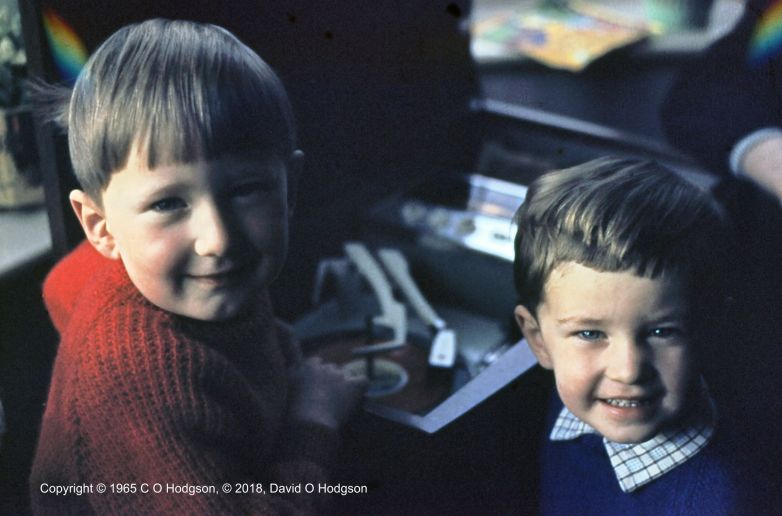
The photo above was taken by my father. It shows me at about the age of 5 (on the left), with my younger brother, apparently enthusiastically listening to a record being played on my grandfather’s radiogram.

If you’re not familiar with the term “radiogram”, that’s not surprising. It’s an obsolete British term for an item of furniture combining a record player and a radio receiver. These massive, wooden-crated units were popular until transistor electronics began to replace valve (tube) technology, after which they were replaced by smaller “hi-fi music centres”.

My grandfather’s pride-and-joy was his Bush SRG 100 model (British-made, of course). Other than the fact that it was a Bush, I’d forgotten many details of it until I found an example being offered online, in this post. The photos in the post provide a good indication of the sheer size of that device!

When the photo above was taken, I had no inkling of the role that that particular radiogram was to play in my future life. My grandfather died in 1967, and I ultimately inherited his Bush radiogram. During the 1970s, the enormous object resided in my bedroom at our house in West Street, Scarborough. I rarely played records on it, but I did spend innumerable hours listening to a wide variety of radio broadcasts.

Given that most people these days think of radio as being merely a source of music, mostly-mindless opinions, and perhaps traffic news, the quality and breadth of broadcasts in those days seems remarkable. The apparent decline in the quality of radio is appropriately lamented in Queen’s 1984 song, Radio Ga Ga.

For example, British radio comedy was a very creative field, partly because new programming ideas could be tested much more cheaply on radio than on TV. The radio comedies of the 1950s and 60s, from the Goon Show, through Round the Horne and eventually I’m Sorry I’ll Read That Again, eventually led to the TV “breakthrough” of Monty Python’s Flying Circus.

Radio Monopoly

The landscape of British radio broadcasting during the 1960s was so different that it seems in retrospect as though I must have been living in some alien nation.

Essentially the BBC had a monopoly on legal radio broadcasting. Until 1967, there were only 3 BBC radio stations: the Home Service, the Light Programme, and the imaginatively-named Third Programme. Although it’s not visible in the photo above, the VHF tuning display of the Bush radiogram showed only those 3 selections! Except for the military, “ham” operators and emergency services, nobody else was allowed to establish a broadcast radio station in the UK!

Strange as it may seem from the perspective of history, most people didn’t seem to object to the BBC’s monopoly on broadcasting. However, a problem developed during the 1960s, because the BBC refused to play rock-and-roll music on the Light Programme.

Due to tremendous demand from young people to hear pop music, various “pirate” radio stations came into being. These evaded UK law by broadcasting from foreign countries, or even from ships at sea. In a typically absurd way, although the broadcasts were legal, listening to the “pirate” broadcasts in the UK was illegal!

Our School Governor is a Pirate!

Probably the most famous of the music stations broadcasting to Britain (although not technically a “pirate” station) was Radio Luxembourg. In 1966, the owner of our local supermarket in Newby, Wilf Proudfoot, became the proprietor of a pirate station, Radio 270, which broadcast from a ship in international waters in the North Sea.

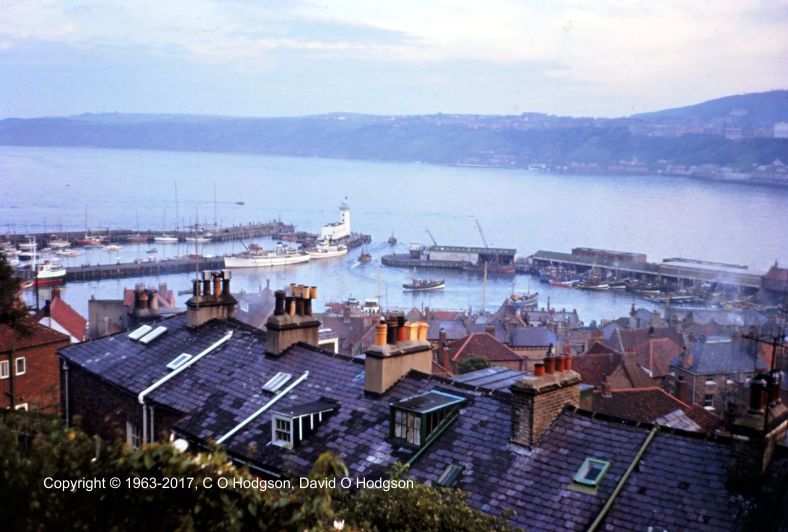
Scarborough Harbour, September 1963

Scarborough Harbour, September 1963

Proudfoot was also a governor of our school—Newby County Primary. It was hardly inspiring when our headmaster introduced him at “Assembly” time as a local businessman, who was publicly breaking the law! Of course, compared to the criminal behavior and corruption that has been unearthed in Scarborough since then, Proudfoot’s actions now seem quite benign.

In 1967, the structure of BBC radio broadcasting changed, with the introduction of Radio 1 as the official pop music station. The Light Programme, Third Programme and Home Service were rebranded as Radio 2, Radio 3 and Radio 4 respectively. At the same time, the law was changed to close various loopholes, which put Proudfoot’s Radio 270 and similar stations out of business.

Waiting for the Sky Wave

It always seemed odd to me that, during my lifetime at least, my parents never listened to the radio. They certainly watched plenty of TV, though. It was as though they’d decided that television had made radio obsolete, so that was the end of that.

As a teenager, therefore, radio became the doorway to my private world, in which my parents simply took no interest. Nowadays I suppose I’d be spending my time on the internet, but that wasn’t even imagined back then.

Typically, I’d switch on Radio 2 at 6am, to catch the start of Terry Wogan’s show, and then be listening to one or other of the BBC channels for most of the day. After twilight, things began to get more interesting, when skywave reflections allowed me to pick up (temporarily) stations from further afield. Those gave me new perspectives on the world that simply weren’t available in my small-town environment. I was also learning French and German at school, so listening to European stations gave me a study incentive.

It was a gateway to a wider world that I was eager to get out and explore, and, eventually, that was exactly what I did.

Happy Bastille Day 2018

Chemins de fer du Midi, Bordeaux

Chemins de fer du Midi, Bordeaux

Happy Bastille Day! This year, trying to avoid predictable views of Paris, I decided to post the photo above, which shows a fascinating map that still exists in the Great Hall of the main railway station in Bordeaux (Saint Jean). This huge wall plan was created by the Compagnie des Chemins de fer du Midi, presumably at the time of the station’s construction.

I took the photograph when Mary and I were passing through Bordeaux station in 2014, on our way from Paris to Saint Cyprien. We had just arrived from Paris via TGV, and we were changing trains for the TER service to our final destination.

The photo above doesn’t reveal that that afternoon was extremely hot, and only small parts of Bordeaux Station are air-conditioned (ironically, the area near the McDonalds restaurant)! Mary and I thus spent most of our time there trying to find places to keep cool, but even in those circumstances we didn’t consider the idea of eating at McDonalds.

Back to Paris

The photo below shows me in Paris Montparnasse Station, in front of the TGV that had just brought us back from Bordeaux on the return leg of our journey.

TGV and Me, Paris Montparnasse, 2014

TGV and Me, Paris Montparnasse, 2014

In fact, the train route between Paris and Bordeaux has changed since we made our journey, because the LGV Sud Europe Atlantique high-speed line has been opened all the way through (as shown here). When we made our trip in 2014, we could only use the high-speed line from Paris to Tours, and then the train used the existing route to Bordeaux.

Historic Rail Maps Survive

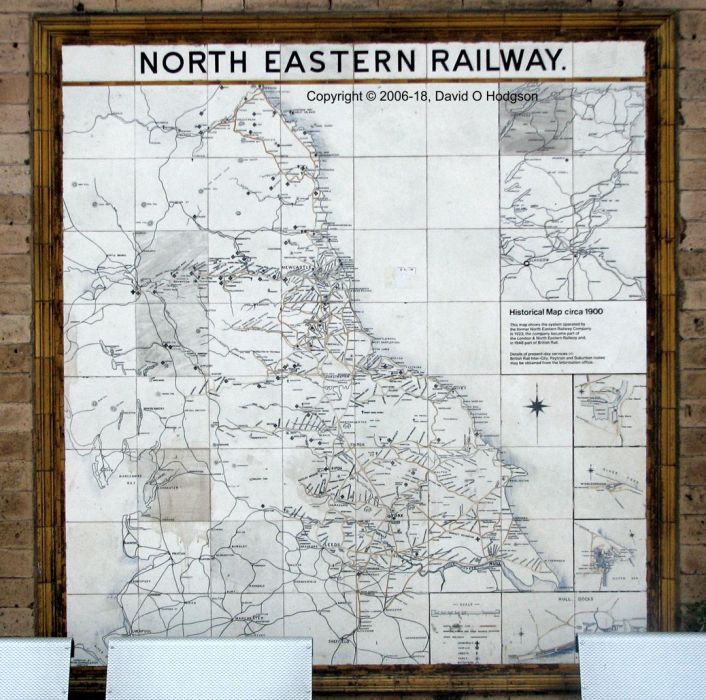
The rail map in Bordeaux station immediately reminded me of the tile maps that England’s North Eastern Railway placed at most major stations on its network, the surviving examples of which were a regular sight when I was traveling in Yorkshire as a child.

The photo below shows the map at York Station, and was taken while I was changing trains there a few years ago.

North Eastern Railway tile map, York

North Eastern Railway tile map, York

There’s an additional modern notice at the right-hand side of the map, warning potential passengers that they can’t necessarily take a train to all the locations shown on the map!

In fact, there are a few locations on the NER map that you could never get to by rail, because the lines shown were never built. On the whole, though, the maps provide an impressive record of just how extensive the European rail network was at the end of the nineteenth century.

Fireworks from the Wine Train

Wine Train Dining Car with Mary

Wine Train Dining Car with Mary

For the Fourth of July this year, Mary and I decided to have dinner on the Napa Valley Wine Train once again. The photo above shows Mary in one of the train’s dining cars, just as it was getting dark and we were preparing to watch the firework display from the train.

The “Wine Train” is a tourist meal excursion that, since 1989, has operated from Napa to St. Helena and back on the tracks of the old Napa Valley Railroad. The line originally ran from Napa Junction to Calistoga, but had been cut back to St. Helena in 1960. In 1987, when the Southern Pacific Railroad decided to abandon the remaining tracks, a local business group stepped up to buy the line and operate it as a tourist railroad.

The Yountville Stop

Generally, the dinner trains run nightly up and down the line, but it’s simply a round trip with dinner, because you usually can’t disembark in St. Helena. Once a year, however, on the Fourth of July, the train makes an extra stop outside the Yountville Veterans’ Home, which provides a public firework show. Passengers can watch the fireworks from the comfort of the train, and it is perhaps a unique way to enjoy the display without the inconveniencies of sitting outdoors at night.

The photo below shows the Yountville Veterans’ Home before dark, taken from the northbound train.

Yountville Veterans' Home from the Wine Train

Yountville Veterans’ Home from the Wine Train

The photo below shows a typical vineyard view from the train. This is the V Sattui Winery. The roses at the end of each row of vines are intended to keep aphids off the grapes.

V Sattui Winery from the Wine Train

V Sattui Winery from the Wine Train

Turnaround in St. Helena

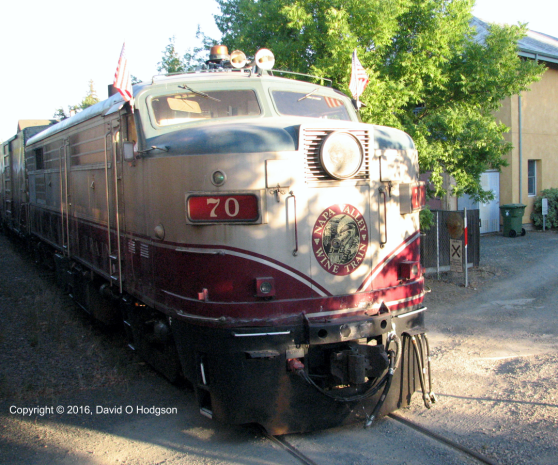
When the train reaches St. Helena, the locomotive must run around for the return journey. This year, for the first time since we’ve been taking trips on the Wine Train, our motive power was not a pair of Alco FPA-4s, but instead GP20 #48, on lease from the Sierra Railroad. Currently, the owners of the Wine Train are refurbishing much of the rolling stock, which has necessitated leasing stock from elsewhere.

Locomotive #48 is shown below as it ran past our carriage.

Sierra Railroad #48 at St. Helena

Sierra Railroad #48 at St. Helena

The photo below, taken at St. Helena during our 2016 visit, shows one of the FPA-4s more traditionally associated with the Wine Train.

Alco FPA-4 at St. Helena

Alco FPA-4 at St. Helena

Eventually we arrived back at Yountville after dark, the train halted, and we settled in to enjoy the fireworks. The photo below shows a typical scene, shot from inside the train.

Fireworks at Yountville, 2018

Fireworks at Yountville, 2018

I’d just bought a new Nikon camera, which features a “fireworks mode”, so this was an excellent opportunity to try that out. I was very pleased with the results.

An Excellent Dinner

I should add that our dinners on the train were excellent. In “special dining” situations such as this, the quality of food and service sometimes leaves something to be desired. In the early days of the Wine Train (during the 1990s), the food was not always outstanding, but our recent dinners on the trains have been perfect.

Independence Day for Kites

Juvenile White-Tailed Kite

Juvenile White-Tailed Kite

I took the photo above, showing a juvenile White-Tailed Kite, yesterday evening. I’d gone out for a short walk to take some test shots with a new Nikon superzoom camera. The results were better than I’d anticipated! Unfortunately, the only angle from which I could take the photos was against the sun, but nonetheless the results show good detail.

The White-Tailed Kite (Elanus leucurus, aka Black-Shouldered Kite) has apparently come back from the verge of extinction in California. It certainly seems to be an increasingly common bird here. When I first saw one, hovering over the old Naval airfield near our house a few years ago, I thought that it must be some kind of albino Kestrel, because that hovering behavior is very similar to that of the Eurasian and American Kestrels.

Until now, I’d only ever seen one kite at a time, but, yesterday evening, I eventually spotted no less than four kites flying around and screeching. They seemed to be fighting with each other, and sometimes with other birds of prey.

Eventually, and thanks to the detail revealed in the zoomed photographs, I realized that this must be a family of young kites, who were in the process of establishing their own territories. In the photo above, you can see brown plumage on the bird’s breast, which marks it as a juvenile.

The second photo below shows the plumage on the young kite’s back to better effect.

The same Juvenile White-Tailed Kite, showing its Black Shoulders

The same Juvenile White-Tailed Kite, showing its Black Shoulders

The birds were apparently disputing the prime rodent-hunting territory of the old airfield.

While all this was happening, nearby, perched on a power wire, was the Mourning Dove shown below. I’ve mentioned these birds, and their similarities to some species of Old World doves, in a previous article.

Mourning Dove, observing the Action

Mourning Dove, observing the Action

Normally I would expect such timid birds to go under cover when there are hawks around, but it seems that the dove had concluded that the kites were so preoccupied with each other that everyone else was safe!

I was considering what to write about for this year’s Fourth of July holiday, and it struck me that the independence battles of these young hawks made for an appropriate theme, despite being quite different from the Moggies cartoon that I posted for this holiday last year.

If you’ll be celebrating the Fourth of July, enjoy your holiday! Otherwise, have a good week anyway!

Learning the Virtue of Patience

1:72 Model of Hawker Harrier T.2 Demonstrator G-VTOL

1:72 Model of Hawker Harrier T.2 Demonstrator G-VTOL

The photo above is all that survives of a 1:72 scale model of the Hawker Siddeley Harrier T.2 demonstrator aircraft, which I made in 1976, while still a teenager. In those days, making model kits (usually of aircraft) was regarded as something of a “rite of passage” for young boys. My initial efforts were extremely clumsy, but, by the time I made the model above, I had become quite comfortable with the techniques required. I was able to adapt off-the-shelf kits to my own requirements (as here where I’d converted a single-seat Matchbox Harrier kit to the two-seat version), and even make my own decals.

When I first bought those plastic kits, however, I was too young and unskilled to construct them myself, so my parents helped out by making them for me. In retrospect, their responses to those tasks seem quite odd. I mentioned in a previous post that, like so many other children, I inadvertently learned dysfunctional attitudes from my parents, and this seems to have been another of those cases.

A Fiendish Plot to Infuriate Parents?

In Britain at that time, the two major manufacturers of plastic kits were Airfix and FROG. The strange name of the latter company, which had been the first in the world to make such kits, was actually an acronym, as I’ll explain below.

The first plastic model kit that I remember buying, when I was about 7 years old, was of a Supermarine S6B floatplane, made by FROG. Rather naively, I was planning to build it myself, but it quickly became apparent that I did not have the dexterity

Strangely, my mother agreed that she would build it for me, although she certainly had no interest in aircraft, and I assume that she had never attempted anything like that before.

Things started out quite well, but the struts holding the floats to the plane’s fuselage really were quite tricky to position and fix correctly. Attempts to complete the task threw my mother into a rage, and apparently it was my fault. She shouted at me: “You said this was easy!” I don’t think that I had actually said that, but how would a seven-year-old know anyway?

Thankfully for everyone, that was the last time that my mother ever attempted to construct one of those kits! Thereafter, my father took on the task, until I was old enough to do it myself. Nonetheless, I discovered that he also suffered from a less acute form of the same paranoid attitude towards kit manufacturers, in that he would become annoyed when some aspect of the construction was difficult, and even accuse the manufacturers of having deliberately made it so.

For example, on one occasion he was assembling the Airfix model of the AEC Matador truck (which interested him because he had learned to drive on real RAF Matador trucks during the Second World War). The Airfix kit had the rear body divided into pieces so that it could be built open or closed, but my father was sure this was a deliberate plot to frustrate him! “There’s no need to have so many pieces,” he said in disgust.

Unfortunately, I think that the lesson I learned from my parents’ responses was that the appropriate response to a lack of skill in intricate tasks was frustration and rage! It has taken me a long time to “unlearn” that unhelpful response, and even now I sometimes find myself slipping back into it.

Learning Patience

I did eventually improve my model-making skills, bought better tools, and learned the patience to persevere when tasks were intricate or unclear. As a result, I actually spent a lot of time not only building the kits, but improving them, as with the Matchbox Harrier model shown above. Most of the models are now long lost, but I did happen to take a couple of photos that have survived.

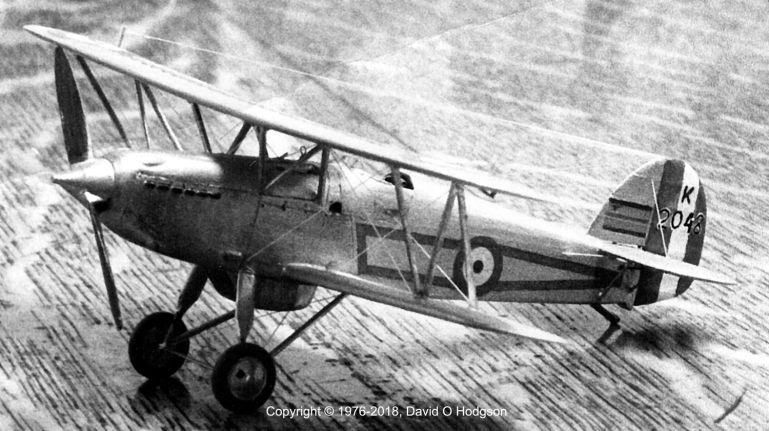
The first kit sold by Matchbox, when that company expanded away from its famous line of metal model cars in 1972, was of the RAF Hawker Fury biplane. That was another kit that I built and improved, as shown in the surviving photo below. I made my own decals for Number 1 Squadron, replaced some of the kit’s more overscale parts, and added rigging.

hawkerFury_Model1Cright

1:72 Model of Hawker Fury, based on Matchbox Kit

Unfortunately, when taking those photos, I didn’t give much thought to the selection of a suitable background, and simply posed the models on our dining room table!

FROG Models

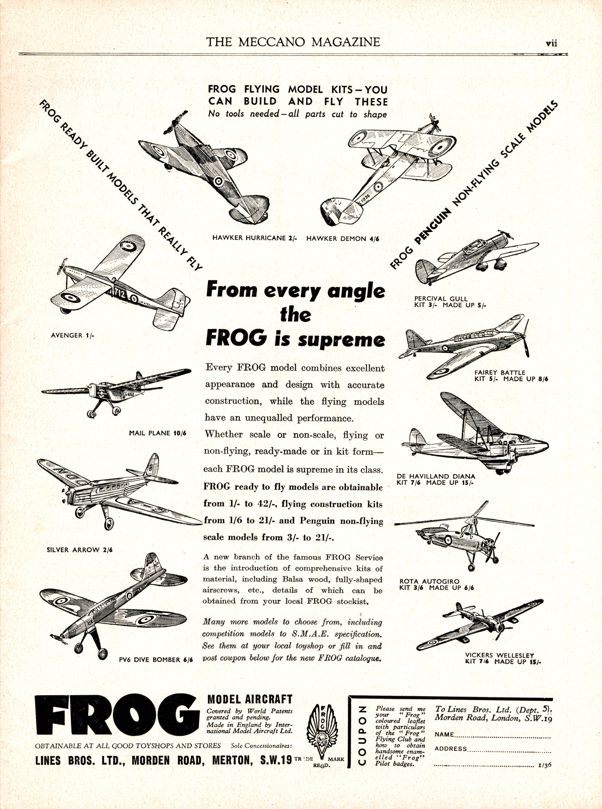
As I mentioned above, the first manufacturer in the world to create plastic model aircraft kits, during the 1930s, had been FROG. The name was an acronym for “Flies Right Off the Ground”, and actually referred to the company’s flying model aircraft. The non-flying plastic models were originally known as “FROG Penguins” because of their flightless state! (The original plastic used was cellulose acetate, rather than polystyrene.)

The image below shows an advertisement for FROG’s models, from the January 1939 issue of Meccano Magazine. It’s interesting to realize that those “non-flying scale models” shown on the right below were not museum pieces, but were all contemporary aircraft, which were in military or civil service at that time.

FROGAdMeccanoMagJan39Small

1939 Advertisement for FROG Models

A Dying Art?

In these days of innumerable TV channels, on-demand internet entertainment, and interactive games, it seems that ever fewer young people have the patience to bother building those model kits. The manufacturers and sellers of the kits have certainly noticed the change, and have tried various ways to win back their traditional buyers.

Another factor contributing to the demise of the plastic kit industry must be the advances that have been made in the detailing of ready-made models. Manufacturers such as Oxford Diecast have come onto the scene, offering fully assembled and painted models of the same subjects. Why take all that time and trouble to create your own model, when you can probably buy something similar (or even better) ready-made?

I suspect that, just as with so many other cultural developments, the days when boys spent hours making plastic models are never likely to return. I wonder whether that will have a negative effect on personal levels of patience and skill, or whether instead those virtues will be redirected to other purposes.

My Father and his Garden

My Father with his Roses, c.1960

My Father with his Roses, c.1960

For Father’s Day, I decided to post a photo of my own father alongside his “pride and joy”, which was the large garden that he cultivated at the house in Scarborough where we grew up. He lavished many of his leisure hours on that garden, growing all kinds of plants, including the rose bushes shown. The photo was taken c.1960, before he suffered his first stroke. After that, he was no longer able to do the physical work required to maintain the garden, which then gradually deteriorated (although my mother did pitch in to maintain it until we moved away in 1970).

There’s no doubt that the results he achieved while still healthy were spectacular, as shown in the photo below of the two of us sitting by the frog pond in the back garden.

My Father with Me in our Back Garden, 1963

My Father with Me in our Back Garden, 1963

Naturally, having nothing else against which to compare it, I took it for granted that everyone had a huge garden like ours, with a pond and a stream running through it, and that working on the garden was a necessary part of every adult’s life.

It was only as I grew up that I came to realize that, not only did some people not have large gardens, but that some city-dwelling types actually didn’t have their own gardens at all!

Decades later, when I moved to California, I made the further discovery that all that gardening effort is something of a British peculiarity. Some Americans do take pride in maintaining beautiful gardens, and some take an interest in cultivating roses or other specific types of plant. Nonetheless, I don’t think I’ve ever heard anyone here say that their hobby is “gardening”, which would be quite common in Britain.

Large Garden: Small House

It was also common for British suburban houses to be built with large surrounding gardens, even when the homes themselves were quite small.

Now, both the homes and the gardens are becoming small; the smallest in Europe, according to this article. Nonetheless, there are still many older houses that still have the large gardens with which they were built.

According to current aerial views, the garden of our Scarborough house has now been largely built over, so there’s nothing left to see of all my father’s hard work.

On Second Thoughts

Having grown up enjoying that immense garden, I was convinced that I, too, wanted to create and maintain something similar. It was only when we moved into a house with a garden that I realized just how much time and expense was involved! It seemed even less appealing because we were renting that house, so all that effort was going into someone else’s garden.

As a result, I dialed back my gardening ambitions very substantially! Now, I’m quite happy to have a small, well-designed, garden, and pay someone else to maintain it, even though I own the property. The photo below, showing our home’s front garden a few months ago, shows the modest level of my requirements!

The Front Garden of our Home in Santa Rosa

The Front Garden of our Home in Santa Rosa

Recapturing his Childhood

In my father’s case, I believe that he had some specific, tragic reasons for wanting to create a large and luxuriant garden. He had been born into a relatively wealthy (upper middle class) family. His father owned a textile mill in Leeds, and they lived in a large house in the suburb of Roundhay, with a complement of servants.

Unfortunately, for various reasons, the mill went bankrupt, probably in the late 1920s, and because the business was unincorporated, they lost everything. My father’s garden was probably thus a way of recapturing a lost aspect of his happy younger days.

A Liberator visits Santa Rosa

B-24 Liberator at Sonoma County Airport

B-24 Liberator at Sonoma County Airport

My photo above shows the last flying Consolidated B-24 “Liberator” bomber, which I’d hoped to be flying in earlier this week. Unfortunately, the flight had to be canceled, due to an engine problem, but nonetheless I had a rare opportunity to examine the aircraft in detail. Alongside several other vintage aircraft, the B-24 was visiting Sonoma County Airport, as part of the annual Wings of Freedom Tour, organized by the Collings Foundation.

My interest in this particular type of aircraft stems from the fact that my father flew in them, as a Wireless Operator (W/O) for the RAF, during World War II. I mentioned in a previous article that he volunteered for the RAF on the outbreak of the war, because somebody had given him a “hot tip” that, by not waiting to be conscripted, he’d be able to choose which service he joined, and where he would serve. Unfortunately, that advice turned out to be only half-right, because he definitely did not want to serve in Aden, which was where he actually spent most of the war.

The Worst Place in the World

As reported in the book Wings of Empire, RAF personnel who served in Aden during the 1920s and 1930s described it as the “most repulsive place in the world”. It was from RAF Khormaksar air base that my father flew offensive missions against Italian forces, and also operated many ferry flights of aircraft being transferred from Britain to the Far East. Most of the ferry missions involved his flying between Aden and Malta.

As the war progressed, Britain took delivery of increasing numbers of American aircraft, under the Lend-Lease program. Thus, having started out flying British types such as the Blenheim and Vincent, he later found himself operating such American types as the Liberator and Hudson. (Incidentally, all the type names of the American aircraft were conferred by the RAF; in the US all the types were officially known only by numbers.)

Inside the B-24

My photo below shows the W/O’s position, behind the flight deck, as seen from the front of the bomb bay. This is where my father would have been sitting on those long flights.

B-24 Wireless Operator Station

B-24 Wireless Operator Station

The photo below, from a slightly different angle, shows the view through to the flight deck from the W/O station.

Looking towards the B-24 Flight Deck from the Bomb Bay

Looking towards the B-24 Flight Deck from the Bomb Bay

Warbirds Together

The B-24 wasn’t the only vintage aircraft visiting Santa Rosa. As shown below, a North American TF-51 trainer (2-seat version of the P-51 Mustang fighter) was just taxying in while I was inside the B-24.

TF-51 Taxying at Sonoma County Airport

TF-51 Taxying at Sonoma County Airport

Lined up alongside the B-24 was a North American B-25 Mitchell bomber, shown below in front of Sonoma Jet Center, who were hosting the visit.

B-25 Mitchell at Sonoma Jet Center

B-25 Mitchell at Sonoma Jet Center

Perhaps the most well-known of the visiting types was the Boeing B-17 Flying Fortress, shown below.

B-17 Flying Fortress at Sonoma Jet Center

B-17 Flying Fortress at Sonoma Jet Center

Gun Crazy

The US has become notorious for having too many guns, too freely available, but fortunately the realistic-looking machine gun shown below is just a dummy! It’s the waist gunner’s position inside the B-24.

Guns at the Airport!

Guns at the Airport!

As I was leaving, work continued to repair the B-24’s engine, as shown below. The aircraft were scheduled to leave the following day, so they had to get the airplane flying again.

Working on the B-24's Engine

Working on the B-24’s Engine

He Never Went Back

As a postscript to the description of my father’s wartime experience, I should mention that he never went back to Aden again (nor anywhere near it) after his military service, and I don’t think he was sorry about that!

I’ve described in earlier posts how the lives of both my parents were blighted by war, and how fortunate I feel that mine has not (so far). I think it’s important to remind ourselves every so often of the ordeals that our ancestors endured in order to maintain our freedoms.