Derwent Valley Light Railway: the Blackberry Line

York Layerthorpe Station, 1979

York Layerthorpe Station, 1979

My photo above shows York Railway Station, as it appeared in 1979. In case you’re now feeling that there must be some mistake, I should clarify that it’s York (Layerthorpe) Station, the terminus of the Derwent Valley Light Railway (DVLR), which was still operational for freight at that time.

The DVLR acquired the nickname “The Blackberry Line” long ago, because of the trainloads of blackberries that it once carried, but the most remarkable aspect of the line was its survival as a working independent railway, from its construction in 1912 to final closure in 1981. Bear in mind that almost all other railways in Britain were grouped into the “Big Four” in 1923, then nationalized in 1948, eventually all becoming part of British Railways.

A Successful Light Railway

In 1967, S J Reading, who had been the line’s General Manager from 1926 to 1963, wrote a book describing the history to that point. Full details can be found in that book, or the 1978 revised edition.

By the end of the nineteenth century, the railway system in Britain was largely complete. There were simply no further lines to be built that would be economically viable under existing laws. To try to stimulate further growth, the government set about specifying laws that would allow so-called Light Railways to be built more cheaply.

Among many other provisions, the Light Railways Act 1896 empowered local authorities to build new lines, and the DVLR was the only instance where local authorities took advantage of those powers and actually built a line. The DVLR was promoted and developed by the Escrick and Riccall Rural District Councils.

Soldiering On

Passenger services on the DVLR were never particularly successful, and, following the end of the First World War, the growth of bus services, spurred on by the cheap availability of military-surplus trucks and buses, led to the end of all passenger service in 1926.

Nonetheless, freight services continued robustly for many decades more, peaking during and after the Second World War, when the Ministry of Food established warehouses near the line. It wasn’t until 1981 that the DVLR’s last major customer, Yorkshire Grain Driers, switched to road transport, which spelled the end of rail operations.

The Final Steam Specials

When the new National Railway Museum opened in York in 1975, the DVLR saw an opportunity to work with the NRM to offer steam train rides along its remaining tracks. This seemed like a great idea at the time, but it was soon to be overtaken by events.

Since the end of steam locomotion on BR in 1968, the nationalized railway had refused to allow operation of any steam locomotives on its tracks, so the only way to travel on a steam train was to visit one of the preserved lines that were springing up around the country. However, BR’s ban was reversed in 1971, and specials hauled by preserved steam locomotives gradually began to make a comeback.

That was bad news for the DVLR, whose small trains ambling along a few miles of rural track couldn’t compete (in the view of the public) with expresses roaring along main lines. The DVLR’s steam specials ended after the summer of 1979.

Sadly, I never took the opportunity to travel on one of those steam specials. I think we just it took it for granted that the DVLR would always be around, until suddenly it wasn’t any more.

The Bus Route to Knowledge

After returning to live in Scarborough, and beginning my first full-time job at Swifts of Scarborough, in 1979, I got into the habit of traveling to York by train almost every Saturday. There was more happening in York than in Scarborough, and York was also the closest place that had a real university!

The University of York is actually in an attractive suburb called Heslington, and during my visits I would often take a York-West-Yorkshire Joint Services bus (the number 5 service to Badger Hill, I believe) from the City Centre out to the bookstore there. In those pre-internet days, university bookstores were my only real antidote to the intellectual wasteland of Scarborough, so I was a frequent visitor.

It so happened that the bus route to the University partially paralleled the DVLR’s rail route, and the bus route crossed over the railway. I remember the overgrown rails, as the double-deck bus swayed over them, but again I never gave it much thought, because I just assumed that the DVLR would always be around.

A York-West-Yorkshire Bristol VR (right)

A York-West-Yorkshire Bristol VR (right)

Another blogger wrote a post describing how he too saw the DVLR’s tracks from his bus, on the way to York University.

The Preserved Remnant

The DVLR terminus at York (Layerthorpe) was demolished during the 1990s, and there is now no trace of the railway there. Fortunately, however, not all trace of the DVLR has disappeared. A small portion of the route has been rerailed as a preserved line.

Part of the former rail route passed through what is now the Murton Park site of the Yorkshire Museum of Farming. When the Great Yorkshire Railway Preservation Society had to move from its former home in Starbeck in 1990, the group negotiated a transfer of its collection to Murton Park. They relaid about ¾ mile of track, and even moved the former Wheldrake Station building to the site and rebuilt it there.

Where sheep may safely graze: the Preserved DVLR at Murton Park, 2008

Where sheep may safely graze: the Preserved DVLR at Murton Park, 2008

I paid a brief visit to the preserved DVLR when traveling between York and Scarborough in 2008. It was heartening to see that not only was something left of the Blackberry Line, but also that the remnant seems to have a secure future.

Delusions of Potential?

Wadham College, Oxford, during my Interview in 1980

Wadham College, Oxford, during my Interview in 1980

The photo above shows Wadham College, Oxford University, while I was staying there for an interview during 1980.

During the period 1977-81, I visited and was interviewed by quite a few universities in England, but Oxford has the unique distinction for me of being the only university that interviewed me without my having ever applied to them.

Deluding Myself?

At that period in my life, I was painfully aware that I could reasonably be accused of being a “habitual university interview attendee”. I realized that I was spending much of my free time traveling to and attending interviews at universities, with no assurance that any of that effort would lead to anything. Was I simply deluding myself, tricking myself into thinking that I had the potential to graduate from one of these institutions? Should I not instead be spending my time in looking for a better full-time job than the one I was trying to escape from?

I was nagged by doubts about what I was doing, and whether I was really just being a conceited fraud.

As I related in a previous post, having dropped out of the University of Warwick after one year, I was working full-time as an Accounts/Sales Clerk at Swifts of Scarborough. I applied for many jobs, and repeatedly received the same advice; to go back to university and obtain a degree.

By the Spring of 1980, I had essentially decided to pursue the university application route, despite knowing that, if I did so, there would be no chance of my starting a new degree course any earlier than the Autumn of 1981. That meant that I would not be able to graduate any earlier than 1984 or 1985, depending on the details of the course.

Taking a Leap of Faith

My decision seemed a particularly difficult one, because there was no guarantee that any university would consider the application of a student who’d already dropped out of another institution. Even if some university did offer me a place, how would I finance my studies? There was no guarantee that the North Yorkshire Education Authority would award me a grant (for the first year, at least), and my father had died in 1979, leaving my mother to support the household.

Having decided to study Electronic Engineering, I hoped that I might be able to obtain some kind of industrial sponsorship, whereby an employer would provide me with an apprenticeship and some kind of paid employment to complement my studies. The reality, however, was that such sponsorships were even harder to obtain than university places. In those pre-internet days, even finding sponsorships that might be available was a difficult task, requiring research at reference libraries.

I also looked at the possibility of obtaining some type of scholarship to help my finances, but that also seemed to be outside the realm of possibility. Such scholarships were intended for exceptional students who were applying from school, not for someone who had already had “one chance”.

Even if I was able to overcome those obstacles, there was still a significant risk. Unlike the case in some other countries, the award of an undergraduate university place in Britain is no guarantee that you’ll get a degree at the end of it all. What if, after all that, I went back to university but had to drop out again without a degree? What a disaster that would be, and what an immense waste of time.

The Oxford University Mystery

The Carfax Tower, Oxford, 1980

The Carfax Tower, Oxford, 1980

The City of Oxford is, of course, now internationally famous because of the Inspector Morse mysteries, written by Colin Dexter (who died in 2017). In those days, Oxford was already famous for its renowned university, but Oxford was not one the universities to which I applied, so how did I come to be interviewed there?

After I dropped out from Warwick, word eventually got back to the Scarborough Sixth Form College, where I’d taken my university entrance exams, about what had happened to me. By that time, the Sixth Form College had a new headmaster, who seemed keen to try to rectify the problems left by his predecessor. The new headmaster was a graduate of Wadham College, so he set up an interview there for me, with the idea of encouraging my efforts to return to academia.

Unfortunately, though, at that time Oxford did not have a particularly good reputation in engineering, so, weighing up the pros and cons against other institutions, in the end Oxford simply didn’t make the list of universities to which I applied!

Potential or Politics?

On the whole, I found that universities responded to my application more positively than I’d anticipated.

Chapel of Kings College, Cambridge, 1980

Chapel of Kings College, Cambridge, 1980

The University of Manchester Institute of Science & Technology (UMIST) made me an offer quite quickly after interviewing me, as did a couple of other prestigious institutions. Oddly, Cambridge University initially seemed interested, but then declined. I’ve never understood that, because I sat both the Cambridge entrance exam, and the supposedly-tougher Imperial College Scholarship exam, and obtained one of the top prizes in the Imperial College exam!

Nonetheless, I came out of the process with several offers from prestigious institutions.

An Abundance of Rewards

As I mentioned above, given my concerns about how I would support myself financially during my years of study, I had pursued several possibilities to supplement my income. In the end, amazingly, all those efforts paid off!

  • I had struggled to obtain an industrial sponsorship, and succeeded in obtaining a Student Apprenticeship with Ferranti plc, in Manchester. Ferranti would provide me with employment during the summer breaks, and also gave me a small annual bursary to help with my living costs.
  • I had sat several optional examinations in an attempt to win a scholarship, and I obtained a Royal Scholarship from Imperial College, London. The award was only for my first year there, but that was the year for which I’d been concerned about obtaining a grant.
  • In the end, the Local Education Authority was convinced of my bona fides, so they did award me a full grant for the term of my studies.

My Employer’s Misplaced Concerns

By May of 1981, everything seemed to have fallen into place. I had an apprenticeship set to start at Ferranti, and an undergraduate place at Imperial College waiting for me that October, so it was time for me to give notice to my employer, Swifts of Scarborough.

As we discussed the termination of my employment, Swifts’ Managing Director claimed to be quite concerned for my financial future. Had I considered, he asked me, that I’d be giving up a full-time income and would be forced to live on a student grant, and in London too!

Yes, of course I had considered that, I explained. I went on to explain to him that, with my full grant, my Ferranti bursary, and my Royal Scholarship, my “take home pay” would actually be higher than it had been working for him! That was the last I heard from him on the matter of my future…

You Have to Stay in it to Win it

The decision to commit to re-entering university was, at that time, the hardest and riskiest that I had had to make in my lifetime. Nonetheless, I’m really glad that I rejected the warnings of the naysayers and stuck to my own “gut instinct” that it was the right way to go.

There have been other occasions since then when I’ve had to make similar decisions, without any assurance that I’m going to be able to meet the challenge that I’m setting myself. As I see it, there is no choice but to accept the challenge and face the risks. After all, if you back down, you are absolutely guaranteeing that you will never succeed; you have to “stay in it to win it”.

Demise of the Typewriter

My Pencil Drawing of our Typewriter, 1977

My Pencil Drawing of our Typewriter, 1977

I produced the pencil drawing above in March 1977, while studying for my Advanced-Level Art qualification at Scarborough Sixth Form College. Back when I produced it, I could never have imagined that, some 40 years later, I’d be using exactly that image to illustrate an article about the demise of the typewriter!

As weekly homework, our teacher (Miss Mingay) required us to draw some object or scene in pencil, in a sketchbook. I considered the task very boring and tiresome at the time, but, fortunately, my mother hung on to the sketchbook, so some interesting drawings have survived (albeit now very smudged).

On that particular occasion, my chosen subject was a typewriter, which had originally been used mostly by my mother. (This was our second typewriter, and I think that it was an Olivetti). By that time, however, I was getting ready to use it myself, to type out the content of my A-level Art study in Architecture.

(The following year, Miss Mingay retired, and the onerous weekly homework requirement disappeared with her! That confirmed my suspicion that it was not a requirement of the A-level course.)

My Mother’s Career Plans

As I’ve mentioned in previous posts, my father was a teacher, but suffered his first stroke when I was about two years old. Given that he was the family’s sole breadwinner, my parents began to fear for their future financial security, and considered alternative plans for generating sufficient income.

One idea, which my father seemed to favor, was to buy a Guest House or Hotel, then generate income by letting out rooms. Given Scarborough’s status as a seaside resort, this was a reasonable idea, although the sheer number of such businesses in the town meant that it was highly competitive.

The other idea was for my mother to learn typing and shorthand, with a view to becoming a secretary. In those days, that was still one of the few career paths open to women without specialized qualifications.

My mother did start taking secretarial classes at Scarborough Technical College, and that was what initially prompted their purchase of a typewriter. She also decided that, to be effective in her new career, she would need to learn to drive, which she also achieved. My father’s concession on that count was that he sold his large Humber Super Snipe, and bought a smaller Austin 1100 (shown below, with me in the back seat), which my mother was more comfortable driving.

Our Austin 1100, c.1968

Our Austin 1100, c.1968

I was particularly excited about that car, because it was the first time that my father had bought a brand new car rather than a used model.

Change of Plan

Eventually, though, the Guest House plan won out, and we all moved to a suitable building on West Street in 1970. My mother seems to have abandoned her secretarial aspirations at that point, but she did continue her studies with some Open University courses, and the typewriter was useful for those.

From Typewriter to Computer

While an undergraduate student at Imperial College in the early 1980s, I decided to invest in an electric typewriter, since I was noticing that typewritten papers were better received by our tutors than handwritten ones.

That typewriter saw much use for a few years, but it was the last one that I ever bought. I brought it with me to California in 1987, but never used it again. Why bother, when a computer+printer was so much easier, more productive, and more powerful?

We Don’t Get Much Call for Those Now

I was by no means the only person who realized that the typewriter had been superseded by computer technology. In fact, should you wish to buy a typewriter now, you’ll have to find a used example, because the last new machines were manufactured in 2011, in India.

[Correction 10/18/2024: In fact, there are still two companies manufacturing typewriters: Nakajima and Royal. I can’t really imagine why anyone would prefer a typewriter to a computer these days, unless perhaps you live somewhere without access to electricity!]

Just as digital camera technology swept away film cameras, so computers and printers have swept away typewriters. I sometimes find it sobering to reflect on how different the world is now from that of only 30-40 years ago.

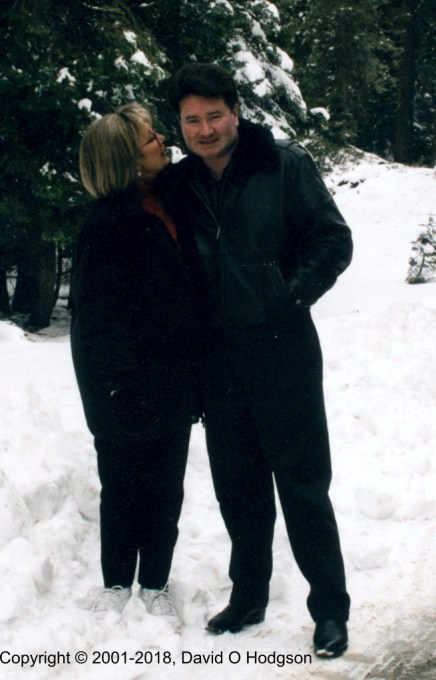
Our Twenty-Seventh Wedding Anniversary

Mary and I in Yosemite, January 2001

Mary and Me in Yosemite, January 2001

On January 9th Mary and I celebrate our Twenty-Seventh Wedding Anniversary. The photo above shows the two of us celebrating our tenth anniversary, in Yosemite, which was also where we spent our honeymoon.

Meeting Mary was undoubtedly one of the best things that ever happened to me! I love you, Mary, and I look forward to many more happy years together!

The Inheritance of Dysfunctional Thinking

A Bracing Walk on the Cliffs, Filey, 1963

A Bracing Walk on the Cliffs, Filey, 1963

The photo above was probably taken some time in 1963. It shows (from left to right) my mother’s parents, my mother, my younger brother (in the pram) and me, all apparently out for a “bracing” walk on the sea cliffs. A book that I’ve recently been reading caused me to think about how I “inherited” unhelpful ways of thinking and reacting from my parents, without even realizing it.

Based on the background details, the location of the photo definitely isn’t Scarborough, and in fact I believe it’s the nearby town of Filey. Given that he doesn’t appear in the photo, I assume that my father was behind the camera.

At that age, I could never understand the attraction of these walks, in cold and windy weather. If you must go walking on a cold day, then why not at least choose a sheltered place in which to do it? Why walk along the top of a sea cliff? I went along only because I was given no choice in the matter. Now, of course, in retrospect, I see the exercise value, and understand the fact that my parents and grandparents appreciated the clean seaside air, which must have been such a contrast compared to that of the dirty industrial city in which they’d grown up.

As is probably the case for all families, the scene of calm in the photo above hides all manner of inter-personal tensions and frustrations, many of which were never even discussed, let alone resolved. It wasn’t until I myself became an adult that I began to realize that I had unconsciously inherited some of my parents’ dysfunctional ways of interacting with the world.

The Dysfunctional Parents of H G Wells

Wells Aspects Of A Life: Cover

I’ve just been reading the book H G Wells: Aspects of a Life by Anthony West, and biographical details in that book prompted me to compare the dysfunctionality in Wells’ family with that in my own.

West, who was Wells’ illegitimate son by author Rebecca West, goes into considerable detail concerning the lives of his father’s parents. Although I knew the broad outline of their history from other biographies, it is clear from the additional details in this book that both parents not only had serious personal shortcomings, but also that their marriage was a complete failure for most of its existence.

Wells himself found it necessary to defy his mother’s wishes, knowing that, whatever direction he took, she would be unhappy with him. His mother was quite determined that he was not to “rise above his station” in life, and tried to force him to become a draper’s apprentice. She did nothing to support his efforts to forge a career in teaching, and then in writing. She remained unreasonably critical of him, even after he rose to international fame.

Our Parents Made Us in Their Image

I’ve come to realize, over the course of my life, how we all inadvertently tend to inherit both successful and dysfunctional coping mechanisms from our parents. We all grow up assuming that the way that our parents behave is the way that all adults behave (because what other reference do we have?), so we tend to adopt their approaches to problems, without even being conscious of what we’re doing.

Nobody is perfect, of course, and that’s as true of ourselves as it is of our parents. The problem here is that, by unquestioningly inheriting our parents’ ways of dealing with the world, we may unnecessarily condemn ourselves to repeat their mistakes and frustrations.

I suspect that this inheritance creates many problems that are sometimes claimed to have a genetic basis, when in fact the children simply learn the flawed responses from their parents. For example, is a tendency towards optimism or pessimism, or to “addictive” behavior, really genetic, or is it just learned behavior, based on observations of our parents?

This Be the Verse

The British poet Philip Larkin, who spent much of his adult life in the Yorkshire city of Hull, described this phenomenon very succinctly in his well-known work This Be the Verse. For the most part, the parental curse is by no means deliberate; as Larkin says, “They may not mean to but they do”.

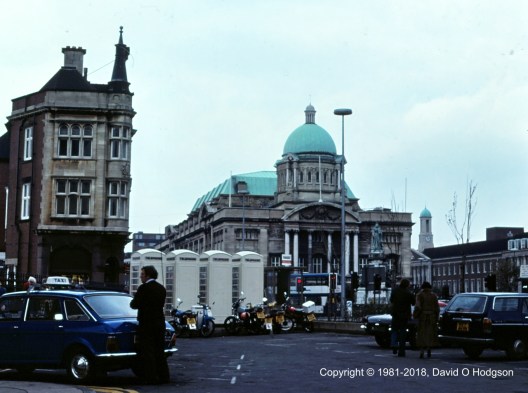
City Hall, Hull, in 1981

City Hall, Hull, in 1981

A Ray of Light

This may seem like rather a downbeat topic, suggesting that we’re all trapped by the shortcomings of our parents, but it really shouldn’t be seen that way. Surely, the key to breaking the chain of “inherited dysfunction” is first to realize that that’s what is happening.

Once you realize that you’re automatically copying your parents’ coping mechanisms, instead of considering whether there may be alternative approaches that would work better, you’ve taken the first step to escaping from this trap.

New Year’s Eve: Then & Now

New Year's Eve, 1977

New Year’s Eve, 1977

The photo above was taken exactly 40 years ago, on New Year’s Eve, 1977. The location was the War Memorial near the summit of Oliver’s Mount, in Scarborough, which as I’ve mentioned in a previous post, was a prime spot for sky and cloud photography.

According to my records, this particular photo was taken at 3.05 that afternoon, indicative of the shortness of days at that time of year. The sky that afternoon seemed to me to be heavy with a sense of foreboding, which turned out to be appropriate, because many tumultuous events were about to occur in my life during the ensuing few years. In retrospect it seems like an incredible and very scary roller-coaster ride, ending only ten years later, in 1987, when I found myself spending my first New Year on a different continent, here in California.

The Birds Just Won’t Pose

Yesterday, a flock of Robins and Waxwings appeared in the ornamental pear trees in front of our house. This is a fairly common event here during Winter, but it was the first time this year that I’d noticed the two species together in the trees.

waxwingRobinCright

Robin & Waxwing in a Pear Tree

I mentioned in an earlier post that these scenes formed the inspiration for the design of our 2017 Yuletide Card, titled Sonoma Winter Birds.

One advantage of being able to draw, and so create my own artwork, is that I can pose my subjects in whatever way results in the best composition. For the card design, I was able to position the two birds close to each other, striking exactly the poses that I wanted. For the robin, I knew the pose that I wanted, but was unable to find any reference material showing one in that position. Nonetheless, understanding something of the anatomy of birds meant that I could create a convincing pose from my imagination, aided by images of similar species, as below.

CardComp5x7Cright96dpi

Sonoma Winter Birds

Back when I was learning to draw, the usefulness of that skill in this age of photography was sometimes questioned. Why spend hours creating a realistic image, when the camera can achieve equivalent or better results in a fraction of a second? It has since become clear to me that natural history subjects are one area where drawing skill continues to offer an advantage over photography.

No matter how good their equipment, photographers do not have the luxury of being able to conjure up a scene from their imaginations. When shooting natural history subjects, they must be content with whatever poses their actors choose to adopt. My own photo above shows that, even though the birds were together in the same tree, they were never close enough to each other so that I could capture them in the same frame. Instead, I simply created a composite bitmap of 2 photos.

Even so, there’s no doubt that the abundance of photographs of any desired subject provides a treasury of reference material that was simply unavailable to earlier generations of illustrators. I’ll have more to say about this in a future post.

Happy New Year 2018!

My best wishes to all of you for a joyous and prosperous 2018!

Happy Holidays: at Home or Away

David Hodgson and Nikki, at the Cypress Inn, Christmas 1994

Me and Nikki, at the Cypress Inn, Christmas 1994

The photo above shows me spending one Christmas/Yuletide away from home, but nonetheless with all our cats! It was taken in 1994, on one of several occasions when we were staying at the Cypress Inn in Carmel, California, along with all three cats. The cat shown is our eldest, Nikki, who was hanging out with Mary and me at the hotel bar. The bartender eventually served Nikki a saucer of milk, as shown below!

Mary, Nikki & Me at the Cypress Inn bar, Christmas 1994

Mary, Nikki & Me at the Cypress Inn bar, Christmas 1994

The reason that we were able to have our cats stay with us in the hotel was because the Cypress Inn is owned by movie star Doris Day, who has been a life-long benefactor to animals. Pets are thus welcome to stay at the Cypress Inn, and, for several Christmases, Mary and I transported our three cats with us to stay at the inn for a few days.

Waxwings with Happy Holidays Message

At this time of year, I’m often asked whether I’ll be spending the holiday “at home”, or “going away”. I’ve enjoyed both alternatives in the past, but then of course that brings up the question of where “home” actually is. If my “home” is where I was born, then in fact I spend every Christmas away from it, and have done for decades.

Nonetheless, recent events have made me realize that I shouldn’t necessarily take it for granted that I’ll always have the luxury of being able to spend the holidays in my home.

My First Independent Christmas, in a Rebuilt City

As I mentioned in a previous post, the first time that I lived in any location away from my birth home in Scarborough was to attend university in Coventry, in the West Midlands of England.

Until then, I’d always been a child who was very nervous about the idea of living away from my parents, even for a short time. I was extremely distressed when it was suggested that, due to the difficulties that my mother was facing with my invalid father and grandmother, the local Social Services felt that I might need to be moved into a care home, but, later the same year, I did indeed find myself living independently for the first time.

When that day came, I quickly came to wonder what I’d been so worried about. I loved living independently, and was very excited about my new freedom and the possibilities that it seemed to offer.

Of course, I suppose that the desire of children to be close to their parents is an evolutionary adaptation. Children who preferred to wander away from their parents’ protection would be less likely to survive than those who stayed close, so an instinctive desire to remain with parents has been selected. Nonetheless, there comes a day when every well-adjusted child must make the decision to leave home and live independently.

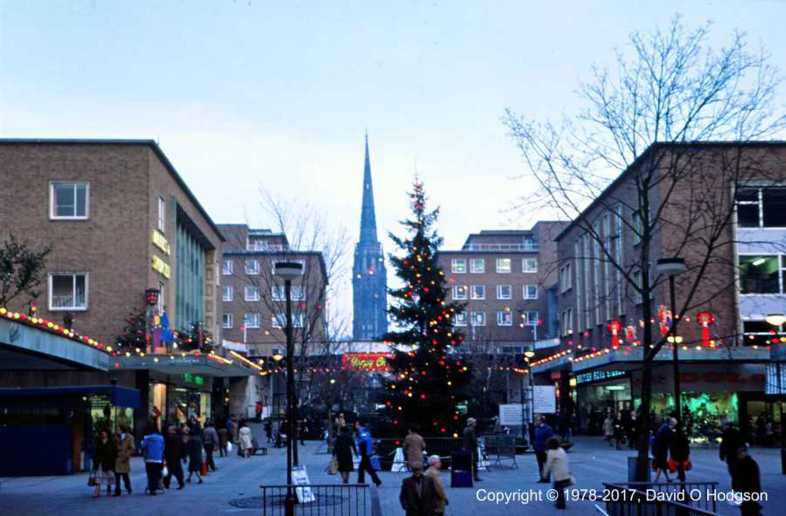
In December 1978, I found myself wandering around the streets of Coventry, doing my Christmas shopping. The photo below shows my view of the “Upper Precinct” shopping centre in Coventry, suitably decorated for the holiday.

Upper Precinct, Coventry, December 1978

Upper Precinct, Coventry, December 1978

Coventry is of course internationally famous because its city centre was almost completely destroyed during the Blitz bombing of 1940. On one night in November, 1940, some 4300 homes were destroyed in Coventry.

By the time that I lived there, most of the city had been rebuilt. The Precinct shopping centre above was part of the redevelopment, although the spire of Coventry Cathedral in the background is medieval, and survived the bombing. (The remainder of the cathedral is a ruin, with the modern replacement cathedral alongside.)

New Horizons

I lived in Coventry for only about one year, then returned to Scarborough, where I ended up working at an engineering company for nearly two years.

Nonetheless, that first taste of life “away from home” set wheels in motion for me. I finally realized that there was a whole wide world out there, beyond the limited horizons of life in a small Northern town, and I couldn’t wait to begin exploring it!

Don’t Take “Home” for Granted

I mentioned above the mass destruction of homes in Coventry many decades ago, something which I hoped I’d never have to experience during my lifetime.

However, the events in Sonoma County during the past few months have been a painful reminder that we can’t necessarily take it for granted that we will have a home in which to remain. Tragically, even now, some who lost their homes to the fires here nearly three months ago are still living in hotels, as described in an article in today’s Press Democrat newspaper. It’s a Christmas away from home for them, but not one that they wanted.

It seems appropriate that those of us who are lucky enough still to have homes to stay in should try to make the most of them this holiday season.

Whatever your reason for celebrating this season, we hope you manage to have an enjoyable time, wherever you stay.


Planning Your Career: Aim Too High or Aim Too Low?

Sunset through Freezing Fog, Coventry, 1979

Sunset through Freezing Fog, Coventry, 1979

The photo above—which could be titled “In the Bleak Midwinter”—shows the sun setting through freezing fog in University Valley, Coventry, in January 1979. The location was approximately here, although it’s now unrecognizable.

At the time, I was feeling very bleak myself, because I really wasn’t sure why I’d embarked on an Engineering Science degree course at Warwick University, with a view to becoming, of all things, a Civil Engineer. As I’ve described in a previous post, that experience didn’t go well, but, in retrospect, it actually turned out to be for the best, since a short time later I moved to a more prestigious university and obtained a better degree, in a subject that was more appropriate for my skills and interests.

It’s interesting to examine the flawed thought process that led me to make that discouraging “false start” at Warwick, and whether it would even have been possible for me to have made career decisions more wisely in those days.

What to Do with Your Life

Years ago, I heard someone say something like this (in a PBS radio item, I think):

When I was growing up, I spent a lot of time worrying about what I was going to do with my life. As I grew older, I came to realize that I should be worrying more about what life was going to do to me!

That may be all too true, but it does nothing to answer the question that occupies the time of many young people (including me, at that age), about what career to choose, and, in general, what path to take in life.

When I was growing up, it was by no means clear what career I should aim for. I seemed to have no access to knowledgeable advice, and the only thing that everyone seemed to be agreed on was that I should not follow in the footsteps of my father! (My father had become a teacher.)

My Father with Me in our Back Garden, 1963

My Father with Me in our Back Garden, 1963

What do You Want to be when You Grow Up? Are You Joking?

It has become a cliché that most children are asked at some point what they’d like to be “when they grow up”, and I was no exception. My earliest recollections of my ideas on that topic suggest that I wanted to be a train driver. However, my mother claimed that the answer I gave to that question was that I wanted to follow in my grandfather’s footsteps, and be “retired”!

In retrospect, it is now obvious that, had I tried to answer that question seriously, and had I somehow been able to give an accurate answer, nobody would have believed me.

Suppose that, in 1977 when I had to make decisions about what to do after I left school, I had made the following statement about my future:

Well, I think I’ll aim to get a degree in Electronics from one of the world’s top universities, then that should enable me to get a job with the BBC, so I can become a video engineer. Once I’ve mastered that, I’ll move to California to work on advanced video system design. Maybe I should also invent a few new video systems and techniques, to earn me some patents in the USA and Japan.

I can just imagine the kind of response that I’d have received to such a statement! There would have been much rolling of eyes, shaking of heads, and almost certainly some laughter or derision. I’d have been accused of not treating the question seriously.

But the paragraph above describes exactly what I actually did do during the ensuing quarter-century!

To realize just how impossible those predictions would have seemed, bear in mind that, during my schooldays, I’d never used any kind of computer more complex than a digital calculator (as described in a previous post), and nobody in my family had any history of working in engineering or technology. (My father had owned an electrical installation business prior to World War II, but that was really the construction industry.)

In retrospect, it’s obvious that, although my career choice at that age was an important decision, it was really much less important than I was led to believe at the time.

It Seems Easy for Some

In contrast to my indecisiveness, my best friend at school never seemed to have any doubts about what path in life he wanted to follow. He had created his own marionette act while at primary school, which he performed around the Scarborough area, and, when we were at school together, he was always certain that his future lay in show business. I was envious of his clarity of purpose and determination to achieve it.

He went on to win ATV’s New Faces show, on national television, and dropped out of school to pursue his dream, eventually becoming one of Britain’s most successful theatrical agents and managers.

Build Your Own Dream

I had to learn the hard way just how true is the following statement.

If you don’t build your dream, someone will hire you to help build theirs.

As a young man, I would certainly have found the idea of “building my own dream” impossibly daunting, but nonetheless, time expended trying to define “my dream” would have been well-spent.

This kind of advice is sometimes taken to mean that you should start your own business, but that’s not necessarily the case. You may be able to work for someone else, and yet also gain skills that will lead you towards your dream role.

Too Narrow an Education

One major problem that negatively impacted my career decisions was the insistence on over-specialization, at too early an age, that was a feature of the British educational system. The requirement to concentrate on a limited range of subjects at school, from the age of 13, effectively closed off many careers to me.

I’ll have more to say about this problem in a future post, but I want to mention it here because it has probably had such a negative effect on the lives of many.

The Luxury of Options

I realize that people of my generation and younger can perhaps consider ourselves lucky that we even have the luxury of being able to choose our goals in life. For many people—perhaps the majority—throughout history, those options were simply not available, and their paths through life were largely restricted and predetermined at birth.

For my parents, and many of their generation, their attempts to plan their lives were repeatedly interrupted by major events beyond their control, such as two World Wars in my father’s case.

Even those who managed to avoid taking overt personal risks sometimes found themselves impacted by the misfortunes of others. My mother’s first husband died of tuberculosis (contracted in a Japanese POW camp), which then almost killed my mother (her life was saved only by the development of new “wonder drugs” at the end of the 1940s).

By comparison with my parents’ battles, my own worries and concerns have always seemed trivial, but nonetheless I did have to make important decisions about my future at a young age.

Summary: how to Choose a Career

The best advice I can give to anyone trying to make a career decision now is as follows. In offering these tips, I’m well aware that it’s much easier to give this type of advice than it is to follow it!

  • Don’t fret the details. Don’t waste time trying to predict or plan exactly what you will do. As I showed above, even if your predictions were to be 100% accurate, there’s a good chance that nobody, including you, will believe them! Some people try to plan in immense detail, and are then disappointed when things don’t work out exactly that way.
  • Build Your Own Dream, by aiming to do what you enjoy doing. I realize that this is common “pop psychology” advice. It sounds trite and is usually much easier said than done! However, it has a valid basis. One way or another, you will spend a significant portion of your life doing whatever you choose to do as a career. Choosing to do something you don’t like is therefore a terrible form of self-punishment. You only get one go at life, so you will never get back all that time that you spent being miserable.
  • Don’t worry too much about relative pay or current career prospects. These conditions tend to change with time, so the job situation when you actually enter a field is likely to have changed relative to when you made your career plans. Many jobs that existed when I was trying to make my career decisions simply no longer exist at all, and vice versa. There are also more subtle pressures. For example, I chose Electronic Engineering over Computer Science for my degree, partly because, at that time, I could obtain an apprenticeship in the former but not the latter. In retrospect, though, Computer Science would have been a better fit for my skills and interests.
  • Always aim “too high”; that is, aim for the highest level that you can achieve. For example, if you can get a Ph.D., and if it’s relevant to what you want to do, be sure to do so.
  • Don’t fear failure. Again, this is easier said than done! My parents seemed to have a fatalistic view that, if you tried something but failed at it, you were somehow marked for life as an “irrevocable failure”. In fact, many successful people have experienced some failures along the way, but still their achievements outweigh their failures. They don’t “write themselves off”, nor permanently wallow in self-pity, because of a failure.
  • Treat career advice with caution. I recall many instances when someone said to me, “If I were you, I’d…”, then proceeded to offer some well-meant advice. The problem, in all cases, was that the person offering the advice was not me, and typically had completely different skills, aptitudes and interests from me. For example, an art teacher was never going to advise me to become an engineer, and a science teacher was never going to advise me to become an artist, but what I now do involves both skillsets, so I was right to insist on developing both.
  • Reject advice from “No-Talent Naysayers”. Not all career advice is well-intentioned. Unfortunately, there are many in the world who have no particular talents, and who try to compensate for their own failings by belittling the abilities of others. Such people will invariably tell you that, whatever ambitions you have, you’re sure to fail. I grew up with the British class system, where the typical claim would be that, “People like us don’t achieve things like that”. The best response to such nonsense is not only to recognize it when you hear it, but also to feel sorry for the inadequacy of the person saying it.

Christmases of Yore

Natural History Museum, London, at Christmas, 1981

Natural History Museum, London, at Christmas, 1981

This rather dark and blurry photo may look like the interior of some European cathedral, but in fact it’s the foyer of the Natural History Museum in London. I took the photo during my first Christmas in London, while a student there in 1981.

On the right, you can just see the dark outline of part of the huge Diplodocus skeleton (Dippy) that was a permanent fixture in the museum’s foyer in those days. You would be unlikely to see such a thing in any church!

Unlike most students, I didn’t go home to my family during the Christmas break from university, but instead stayed in the student dorms (paying rent, of course), and worked as a Sales Assistant at Selfridges on Oxford Street. (During Christmas of 1982, I worked at Harrods, but I found Selfridges to be the better employer.)

I knew that, if I were to go back to my home town of Scarborough for the Christmas break, my only employment opportunity was likely to be as a waiter at one of the town’s hotels. While still at Scarborough Sixth Form College, and then after returning from my first term at Warwick University, I’d worked as a waiter at the Red Lea Hotel over Christmas, and that was not pleasant work. The pay was very low and the hours were unsociable. Not only that, but, since I didn’t own a car, I had to walk there and back, or wait in the cold for infrequent buses. Working in London, at Selfridges, was considerably pleasanter, and I was able to take the relatively cozy London Underground tube between my lodgings and my work.

Piccadilly Night Ride

At that age, I really enjoyed spending the Christmas holiday in bustling London, where it felt like it was “all happening”. In retrospect, I must admit that I just remember the place as being noisy, dirty, cold, and dangerous, but I didn’t mind all that at the time.

It really was quite dangerous. There was always the threat of an IRA bomb (which did actually happen outside Harrods in December 1983). Apart from that, simply negotiating the traffic could be hazardous, as I discovered one evening when leaving Selfridges. As I was crossing Oxford Street, the heel of one of my shoes broke, causing me to fall backwards. My head landed only about six inches from the wheel of a passing taxi.

I also took the photo below during Christmas 1981, showing traffic crawling along near Piccadilly Circus.

Traffic in Piccadilly, London, Christmas 1981

Traffic in Piccadilly, London, Christmas 1981

Looking at this photo again now, I can almost hear the noise and smell the diesel fumes!

My reflections in this article should not be mistaken for nostalgia. Although I preferred Christmas in London to Christmas in Scarborough, I don’t miss those days! The Yuletide season for me now, here in California, is much happier than it ever was in Britain.

Natural History Museum, London, at Christmas, 1981

Natural History Museum, London, at Christmas, 1981

Our Yuletide Cards are On the Way


Sonoma Winter Birds

Sonoma Winter Birds

All our Yuletide cards are on the way to their recipients, as of Wednesday.

This year’s cover design is called Sonoma Winter Birds, and features a Cedar Waxwing and an American Robin. I took inspiration for the design from something that’s a common sight in our area at this time of year. Wherever there are trees with berries, we see mixed flocks of waxwings and robins descending to feast on the fruit.

The painting was produced with ink and watercolor. For the robin’s breast, I used Japanese-made vermilion sumi ink, which provides a strong festive highlight for the image (and happens to be just about the correct shade of orange-red!).

Robins for Christmas?

In a previous post, about a year ago, I discussed the popularity of Eurasian Robins in Britain, as a seasonal icon on Christmas cards and other holiday decorations. Apparently, that tradition is limited only to Britain, and doesn’t extend to other European countries.

When I was discussing the design of this year’s card with Mary, she pointed out that, in the more northerly parts of North America, some robins migrate south for Winter, and are thus less likely to be seen in the seasonal landscape. In those areas, some people even look out for the “first robin of Spring”, although the idea that there are no robins around in Winter seems to be a myth, according to this article.

Here, in more southerly climes, our resident robins not only stick around for Winter, but the numbers may actually increase, because of birds migrating from the north. Their behavior also changes, presumably because of variations in the food supply. During the warmer months, robins forage alone, or at least not in organized flocks. It’s only in Winter that they travel together with birds of their own species and other species.

QR Code Link

This year, for the first time, I included on the card a QR code that, when scanned, takes you to a landing page in this blog (https://davidohodgson.com/yuletide-letter-2017/). We’ve always included a printed copy of our letter with the cards we send, and sometimes people ask for a PDF version of that. Now, people can just navigate to the online letter, and print a version for themselves in PDF, or any other format, if they wish.

Of course, to scan the QR code, you need a scanner app for your smartphone (or similar device with a camera). There are many such apps available free, and I’m not recommending any particular one here. However, the app I use in my Android devices is the Kaspersky Labs scanner:

https://usa.kaspersky.com/qr-scanner

A nice feature of the Kaspersky app is that it warns you if a QR code is malicious, which is always a risk, because the web address to which the code points is not human-readable.

Our New Production Plan Succeeded

Following the card production problems that arose last year, Mary and I agreed on a new “division of labor” for the various tasks. I’m pleased to say that the new arrangements seem to have worked very well, with the unplanned result that we’ve been able to send out the cards earlier than ever before.

We also avoided the atmosphere of “last-minute panic” that has sometimes accompanied the task on previous occasions!