An Ancient Austin

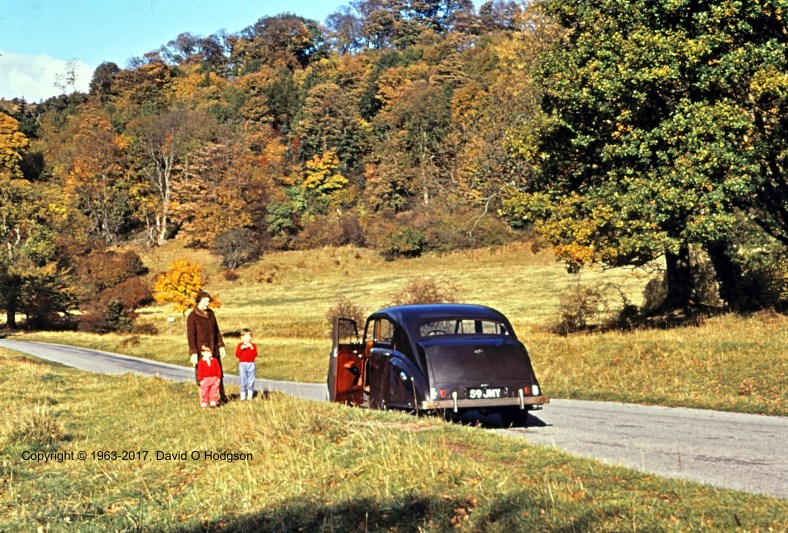
Austin Princess, Hackness 1963

Our Austin Princess, Hackness 1963

These photos include my father’s second car, which was an Austin Princess. By the standards of the day for British cars, this was a huge vehicle. This type of car was typically used for weddings, funerals and state occasions, but my father had a penchant for large cars, so, when he saw an opportunity to buy a used Princess, he jumped at the chance. These vehicles featured custom bodywork by Vanden Plas on a separate chassis, so they were very heavy. As I mentioned in a previous post, my father served in the Royal Air Force during World War II, where he learned to drive AEC Matador trucks, so the Princess probably didn’t seem especially big to him!

Perhaps the most famous Princess was one owned by John Lennon, although that had hearse bodywork. My father was no fan of the Beatles, so I’m not sure what he thought about that.

Both these views show my mother, my younger brother and me messing around near Hackness, Yorkshire, during the Autumns of 1963 and 1964.

Our Austin Princess c.1964

Our Austin Princess c.1964

This was not my father’s first Austin (although it’s the earliest that I remember riding in), since his first car had also been of that marque, and it wasn’t his last, since he subsequently owned a more modestly-sized Austin 1100.

The downsizing was at the request of my mother, who learned to drive c.1969, and didn’t want a large vehicle.

Later, during the 1970s, my father bowed to the inevitable realities and began buying non-British cars, such as Simca, Honda and, finally, a German Opel Kadett (which eventually became my first car).

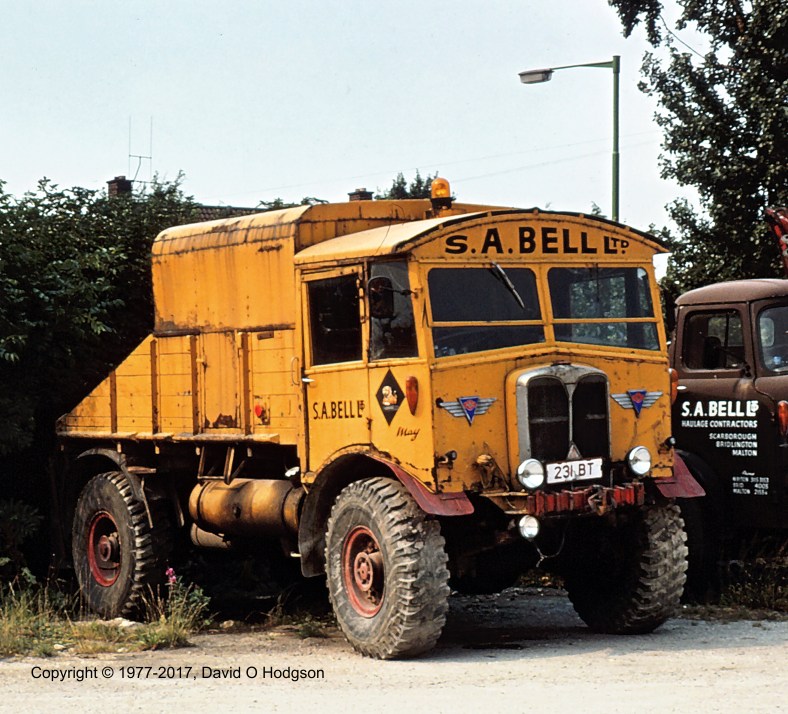
AEC Matador "May" of S A Bell, Malton, 1977

AEC Matador “May” of S A Bell, Malton, 1976

Above is an AEC Matador, similar to the vehicles on which my father learned to drive. This one, named “May” was used by haulier S A Bell Ltd., and was parked at their Malton depot in 1976.

Air Control & the Legacy of Empire

Avro Shackleton AEW.2, 8 Squadron RAF, on display in the RAF Museum

Avro Shackleton AEW.2, 8 Squadron RAF, on display in the RAF Museum, 1983

I just finished reading a fascinating book called Wings of Empire, which details the operations of the Royal Air Force in various minor conflicts between the two World Wars. It’s very detailed but also very readable, which isn’t always the case for history books. The book describes the policy of “Air Control”, which, at end of World War I, was seen by the British government as a low-cost method of policing the vast territories of the Empire.

It seems that this aspect of history is unpopular in some circles these days, due to its overtones of imperialism, or even racism. Nonetheless, for better or worse, these events did happen. In fact, even now in the twenty-first century, the Western World is still dealing with the fallout from those events. The establishment of Israel and other countries in the Middle East all stem directly from the events of those times, and conflicts resulting from that are ongoing.

Aside from their general historical interest, those events impacted my family as a result of my father’s unwilling involvement during World War II. His birthday was on March 6th–he’d have been 108 today–so this seems like an appropriate date on which to post these thoughts!

When war was declared in September 1939, my father was running an electrical business in Leeds. The issue of conscription was obviously of concern to him, but someone gave him a hot tip. They told him that, if he signed up for military service voluntarily, rather than waiting to be conscripted, it would confer two advantages:

  1. He could choose which service to join,
  2. He could choose the location where he would serve.

This seemed like great news. He decided to sign up with the RAF (which was the most glamorous service), and to specify that he wanted to serve at Church Fenton airfield (near York). That way, he’d be able to maintain his electrical business on his days off from the RAF. So, he went along and signed up.

The hot tip turned out to be half-right. He was able to enroll in the service of his choice. However, when his callup papers arrived, he discovered to his horror that he would be serving not in Church Fenton, but with 8 Squadron in… Aden.

8 Squadron had been involved in Air Control operations since the early days of the policy, and in fact continued to be associated with Aden until Britain left the area. My father made it through the war, somehow surviving threats from disease, enemy action, bad luck, and outright incompetence. Some of 8 Squadron’s exploits have been well-documented, but he had some extra details to add to some of those accounts!

The photo above shows an Avro Shackleton AEW.2 that served with 8 Squadron, and carries the squadron’s Arabian dagger (Khunjah) emblem on the nose. Of course, the Shackleton didn’t appear until after World War II, so my father never flew on that type of aircraft, but 8 Squadron is still in existence today.

Deconstructing the Future

The City of the Future (When I was Ten)

The City of the Future (As I envisaged when I was Ten)

Here’s a “throwback” to a drawing that I produced at the age of ten, to illustrate a story set in “the future”.

Last week, Mary and I went to see the documentary movie Deconstructing Sergeant Pepper, in which Scott Freiman analyzes the musical innovations that went into the creation of the Beatles’ 1967 album*. We both enjoyed the movie, because it doesn’t get bogged down in technical detail, but at the same time doesn’t shy away from technical issues when they’re relevant. The presenter even discussed the Automatic Track Doubling circuit that was used to create echo effects, although he didn’t go so far as to display a circuit diagram!

(* We saw the movie at the Rialto in Sebastopol, but it will be screened again in other theaters around the US, along with other documentaries in the same series.)

Of course, I was just a young boy of six or seven when the Beatles were creating that innovative music, so I didn’t really grasp what was going on in the world around me. In retrospect, I do recall a general mood of optimism and change during those years, but I’m not sure to what extent that was shared by the adults around me, or was simply an aspect of my youth. I’m fairly certain that any such optimistic Zeitgeist was not shared by my parents!

Seeing the “Sergeant Pepper” movie did, however, bring to mind recollections of my own youthful expectations about the future and my role in the world. In 1970, I produced the drawing above to illustrate a story that I was writing at school. My story was ambitiously set in the year 2461, but was inevitably a “product of its time”. The tower I drew was supposed to be a city, but it also happened to be a rocket. The style was clearly inspired by the claims of 1960s-era architects about future buildings, but my innovative design also incorporated the boosters from the first stage of the Saturn V spaceship!

Goldfinger or Glassfinger?

London Wall in the Rain, 1981

London Wall in the Rain, 1981

Respected architects of the post-war period, such as Le Corbusier, Walter Gropius, and Ernö Goldfinger claimed that twenty-first century cities would be “managed environments,” probably consisting of huge glass-clad skyscrapers. Many of these architects clearly saw the creation of such cities as being socially beneficial.

Goldfinger himself wrote in 1941:

Cities can become centres of civilisation where men and women can live happy lives. The technical means exist to satisfy human needs. The will to plan must be aroused. There is no obstacle but ignorance and wickedness.

Creativity & the Tyranny of Good Intentions

The fact that I was encouraged to spend time writing such a fantastic story at school seems surprising in retrospect. I do recall that, during my primary schooling, there was significant emphasis on “creativity”, in that we were encouraged or even required to write and draw every day.

If that policy was intended to turn all of us into creative adults, it seems to have been an utter failure in most cases! For me, though, it was generally enjoyable and probably beneficial, and I’m only disappointed that the emphasis of our education changed later to uncreative, rote preparation for exams.

The heart of this disconnect was, and still is, that there is a huge gulf between the kind of people that educators want to produce, and the kind of people that employers actually want schools to produce.

I’ve seen evidence that the emphasis on creativity in schools in those days was actually quite new, and stemmed from the “progressive” educational ideas that had been laid out in the Plowden Report, but the schools I attended were not notably progressive. The Church of England school that I was being forced to attend when I produced the story containing this illustration prided itself on being anything but progressive!

The book “Progressively Worse” by Robert Peal contains an interesting discussion of the history and consequences of progressive education in Britain.

Shoveling Snow

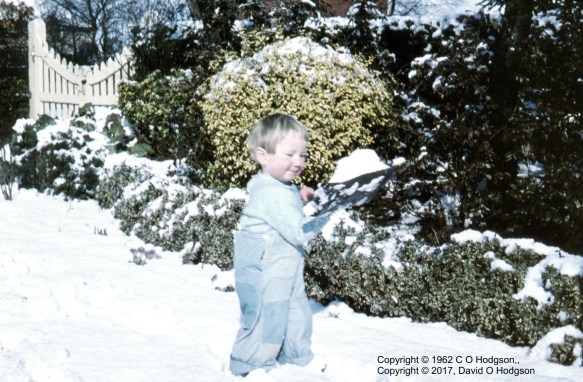
Snow in the Garden, February 1962

Snow in the Garden, February 1962

For today’s “throwback” picture, I chose an old (and rather blurry) slide that my father took in February 1962. It shows me shoveling snow in our front garden in Scarborough.

The shovel I’m using came from our coal bunkers, since we had both coal fires and coke furnaces at that time. The gate behind me led to what had been the original driveway of the house. In those days, “mobile shops” were still making the rounds, and it wasn’t unusual for those vehicles to back down that driveway, so that the driver could open the rear door safely. My favorite mobile shop was that of Woodhead’s Bakery, which sold all kinds of baked treats. I always wanted my mother to buy “iced baps” (if you don’t know what those are, click on the link), but she frequently made the excuse that they were too expensive!

There was some significant snow that year, but little did we know that the subsequent Winter (1962-63) would be the most severe for many decades. For my part, I had nothing with which to compare any of it, so I just assumed that deep snow was an annual feature of the season.

The Met Office weather report for that month is available at:

http://www.metoffice.gov.uk/binaries/content/assets/mohippo/pdf/t/2/feb1962.pdf

Today, however, the weather problem in Britain seems to be wind rather than snow, thanks to Storm Doris:

http://www.telegraph.co.uk/news/2017/02/23/Storm-Doris-uk-weather-bomb-snow-travel-distruption-batters-britain/

Revelation in Aylesbury

The Bell Hotel, Aylesbury, with the Buckinghamshire County Offices beyond, in 1980

The Bell Hotel, Aylesbury, with the Buckinghamshire County Offices beyond, in 1980

There have been some occasions in my life when I’ve attempted something that, at the time, seemed to be a failure, but eventually it became apparent that I had gained some unanticipated new insight or skill. One such instance happened at a job interview in 1980, in Aylesbury, Buckinghamshire.

I described in a previous post how, having commenced my first full-time “permanent” job at Swifts of Scarborough, I soon came to feel that I was capable of something better (and also hopefully better-paying), and began to look around for more suitable employment.

One field that was recognized as being the “white heat of technology”* in those days was “Computing”, and I wondered whether my math skills would make me a good fit for that daunting new field. Incredible though it may seem now, I’d never actually used a computer (except for a digital calculator) until I went to university. Even though I was working as an Accounts Clerk at an engineering company, there wasn’t a single computer of any kind in the business. Swifts’ accounts department used nothing more sophisticated than electric adding machines.

(* Ironically, Harold Wilson made his “white heat” speech in, of all places, my home town—Scarborough!)

My first brush with computer programming was very disheartening. During the first year engineering course, we were required to write a single computer program. However, we received no instruction in how to do this; apparently we were expected to know already, or to teach ourselves! I found this very difficult and frustrating, and I didn’t seem to achieve good results. I concluded that I probably wasn’t “cut out” for computing, and shouldn’t attempt to pursue it further.

Later, after I’d left Warwick, I discovered that quite a few of my fellow students there had actually obtained A-levels in Computing before starting at university; a subject that wasn’t even on offer in Scarborough! Thus it wasn’t at all surprising that I hadn’t been able to compete well against such students.

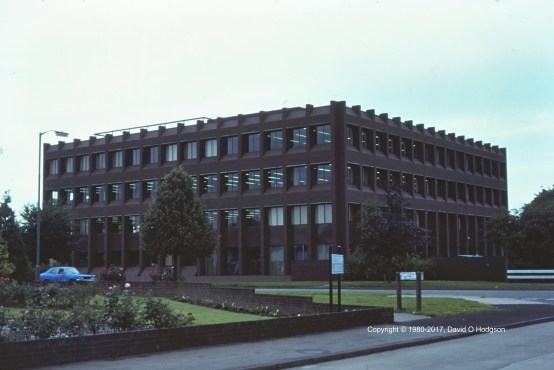
Insurance Building on Gatehouse Road, Aylesbury, in 1980

Insurance Building on Gatehouse Road, Aylesbury, in 1980

One of the potential jobs for which I somehow noticed an advertisement was for a “Computer Data Entry Clerk” at an insurance company in Aylesbury. I was warned that my interview would include a “Computer Programming Aptitude” test.

When it came time to take the test, the interviewer explained that there was no time limit. Accuracy was more important than speed. I could take as long as I needed to finish, but typically completion took about 4 hours.

I found that I’d finished and checked my work after about 3 hours, so I went over and handed my paper to the interviewer. He asked me if I was sure that I’d finished everything and done as much as I could, and repeated that there was no time limit for the test. I confirmed that I had completed everything. He gave me a skeptical look and accepted the paper, then I walked out.

I heard nothing further until weeks later, when I received a letter from the company, informing me that they were not offering me the Data Entry Clerk job. The letter went on to explain that I had done so well on the test that I “clearly” had great computer programming aptitude, and that my skills would be wasted in so lowly a position! As had happened at other interviews, I received the advice that I should instead return to university and try to obtain a technical degree.

So I didn’t get the job, but I did get some extremely valuable feedback that bolstered my self-confidence and caused me to renew my interest in a field that I had been ready to abandon.

I eventually followed the advice that I’d been given at those interviews, although I chose Electronic Engineering rather than Computer Science. In retrospect, CS may have been a better fit for my unusual skill mix, but, at the time, I hadn’t forgotten the difficulty of trying to compete with other students who had A-levels in Computing, when I had no formal qualifications in that field at all.

Old and New. Aylesbury Canal Wharf, with the County Offices building beyond

Old and New, in 1980. Aylesbury Canal Wharf, with the County Offices building beyond

Latin Names in Yorkshire

york1964-300cright

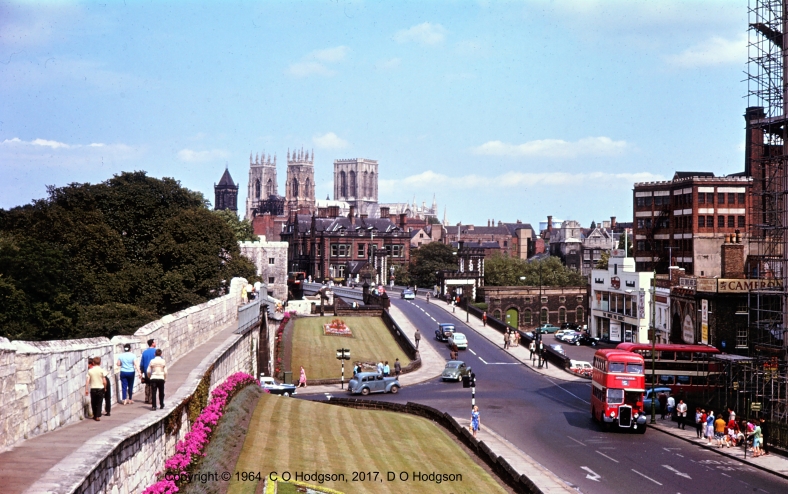
York from the City Walls, August 1964

There are many stereotypes of Yorkshire, with varying degrees of truthfulness, but I suspect that people rarely, if ever, associate Yorkshire with Latin. As a child, growing up in Yorkshire, however, I learned that there is a definite Latin influence in the county, at least as far as place names are concerned.

My father photographed the above view of York long ago, but you can still take the same view today, and little has changed there, except for the traffic.

I realize that the conjunction of the concepts “Yorkshire” and “Latin” may conjure up visions of a red-faced George Whitebread (Harry Enfield’s Yorkshireman character) declaring something like, “Latin? Don’t talk to me about Latin. I’ve been to Benidorm!”, but that’s not what I’m thinking of here.

In fact, there are many placenames in Yorkshire that are directly or indirectly derived from Latin words. Some of the “indirect” derivations stem from the Old French or Anglo-Norman languages, which were themselves descendants of Latin.

Roman Legacy

On reflection, the occurrence of Latin names anywhere in England shouldn’t really be surprising, since Yorkshire and the rest of what’s now England were a part of the Roman Empire for several hundred years.

Typically, where the Romans developed an existing settlement, they would name it by Latinizing its existing local name. In what’s now England, those names are typically of Celtic origin, and in many cases the Celtic meanings of the names remain unknown.

The Roman names of many English settlements are known, but in general those names are no longer in use, having been replaced by new names created by later settlers. However, there are a few cases where the Latin name has survived in a more or less obvious form.

As an example that’s not in Yorkshire, the name Lincoln is probably closest to the Latin original, which was Lindum Colonia. All you need to do is to cross out a few letters!

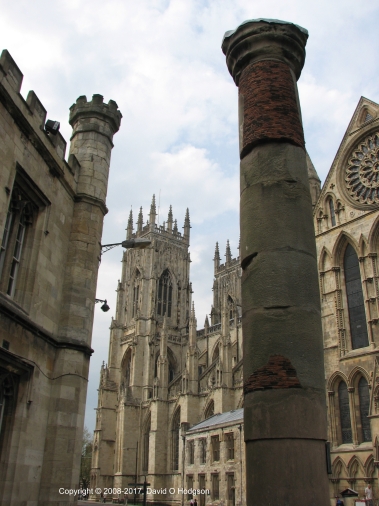
Roman Column in York, which was originally part of the Basilica. It was found under York Minster, in the background

Roman Column in York, which was originally part of the Basilica. It was found under York Minster, in the background

The name of Yorkshire’s capital city, York, is of Latin origin, but less obviously so. The Latin name was Eboracum, which was probably derived from the Celtic Caer Ebruac. The Roman name was changed to the Old English Eorforwic, and then to Jorvik by the Vikings. The current name is just a modified version of Jorvik.

As a schoolchild in Yorkshire, it was drilled into me that a person from York is not referred to as a “Yorker”, or anything like that, but as an Eborian, because of the Latin name of the city.

Religious Influence

Following the Norman Conquest, England and parts of what is now France were unified under a single king, as the Angevin Empire. As a result, cultural influences from the continent began to drift into England. At that time, religious houses such as monasteries were the repositories of much learning and tradition. The language of the Western church was still Latin, so there was a natural tendency to apply Latin names to objects.

The language of the Norman court was Anglo-Norman, which was itself a derivation of vulgar Latin. French is one of several modern European languages that are derived from Latin, and are known collectively as Romance languages.

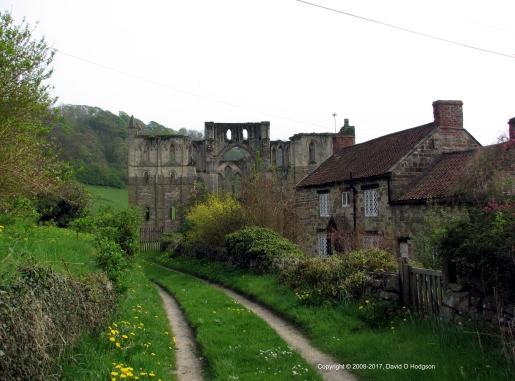
The Ruins of Rievaulx Abbey, Yorkshire, in 2008

The Ruins of Rievaulx Abbey, Yorkshire, in 2008

Usually, when a new monastery was founded, it would adopt the existing local name. However, sometimes monasteries were founded in previously-uninhabited places, so a new name had to be invented. This happened at Rievaulx, where the modern name is a corruption of the Latin Rye Vallis. The pronunciation of the name has also changed over the years; the current pronunciation is “Ree-voh”, but it seems that this was a change that occurred only after the majority of the population learned to read, and discovered how the word is spelled. Prior to that, the accepted pronunciation was apparently “Rivers”.

Latin prefixes and suffixes have also been applied to some placenames. The suffixes Magna and Parva are used in Yorkshire and in other counties. However, one Latin suffix that seems to appear only in Yorkshire applies to the neighboring villages of Low Hutton and High Hutton, which together are known as Huttons Ambo (and which was the name of their railway station). During my recent Spanish lessons, I learned that the Spanish for “both” is ambos, because of course Spanish is another of those Romance languages.

Another Old French name that appears in Yorkshire is that of the village of Grosmont. In this case, the village is named after a medieval priory that was founded at that site by a religious order based in what is now France. Scenes around Grosmont featured quite regularly in the ITV police drama Heartbeat, and the location of the fictitious town Ashfordly corresponded to that of Grosmont.

The Norman Influence: Radio Active

Writing this article reminded me of a sketch from the 1980s-vintage BBC radio comedy show Radio Active.

As part of the “God Alone Knows” show, DJ Martin Brown is interviewing church warden Clifford about the history of St. Littlebody’s Church:

Martin Brown: “This is not a new church, is it? Is it eighteenth century, Clifford?”

Clifford: “No it’s Norman in fact”

Martin Brown: “Oh I’m sorry. Erm, is it eighteenth century, Norman?”

Clifford: “The church is Norman”

Martin Brown: “Oh I’m sorry. So, Clifford, how did you come to call the church Norman?”

Clifford: “I didn’t call the church Norman”

Martin Brown: “Oh no, sorry. Silly me. It was probably called Norman hundreds of years ago, wasn’t it? Possibly by the Normans, who knows?”

You can hear this sketch in its full glory, along with the rest of the Radio Active episode “God Alone Knows”, at this site:

https://archive.org/details/RadioActiveBBC

Life Drawing Practice

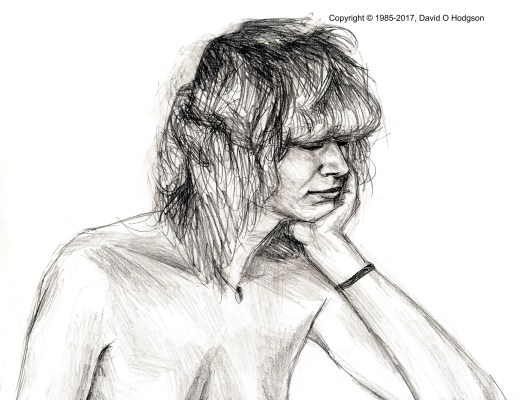
Life Drawing Sample. Cricklade College, 1985

Life Drawing Sample. Cricklade College, 1985

This article describes some of my experiences while learning to draw the human figure. I practiced my skills by attending “Life Drawing” classes in various locations.

As I mentioned in a previous post, while studying for my electronics degree at Imperial College, London, I also took time to continue practicing my artistic skills, attending a part-time class at St. Martins School of Art. I wonder whether I am the only ever Imperial College student to have done that (please comment if you know otherwise)?

After graduating, job transitions took me to various locations, but I tried to continue practicing my artistic skills wherever I went. Given that learning to draw the human figure is perhaps one of the most demanding tasks an artist can face, I frequently attended “Life Drawing” sessions, which typically involve drawing or painting a live human model.

I’ve always felt that the goal of being able to draw well (at least since the invention of photography) is to be able to conjure up convincing scenes that don’t exist in reality. However, in order to be able to do that for images that involve humans, you have to have a thorough understanding of the structure of the human body, which of course is a very complex shape. As far as I know, the only real way to obtain that understanding is to practice drawing actual humans, hence the benefit of life drawing classes.

Cricklade College

In 1985, I started working for Link Electronics, which was a company in Andover, Hampshire, that designed and manufactured television cameras for the BBC and other worldwide customers. I discovered that Life Drawing classes were being offered at Cricklade College nearby, so I began attending regularly.

During that time, we had a regular model (shown in the pencil drawing at the top of this article), who was in fact the wife of a local sheep farmer. While we were drawing her, she would sometimes regale us with tales of how she’d just been up all night, birthing lambs!

(Incidentally, the models at life drawing classes usually pose nude, and this was the case at Cricklade. Therefore, I’ve cropped the picture above so that it won’t be “NSFW”!)

Those life drawing sessions sometimes gave rise to some amusing situations. One evening, when it was almost dark, I was arriving at the college and getting out of my car when someone walked past me and said “hello”. In the dark, it took me some time to realize that she was our model, to which she responded, “Don’t tell me; you don’t recognize me with my clothes on!” If someone overheard that remark, I wonder what they made of it?

Pencil Technique

As a result of these practice sessions, I evolved a standard technique for pencil drawing. I preferred to draw in pencil because it was relatively fast, and required minimal preparation, while still allowing for some correction of errors. I mentioned in an earlier post that the idea of sketching in pencil was something I learned at school. My earliest drawings were typically laid straight down in pen, which left no chance for error correction.

Nonetheless, speed was of the essence in life drawing sessions, because live models cannot hold their poses indefinitely. Even in a very relaxing pose, most models would need a break after an hour, and most poses were held for only five to thirty minutes. Therefore, even if my technique allowed for the correction of errors, there was usually little time to do that.

My technique certainly did not follow “conventional wisdom”, and in fact I found some standard advice to be counter-productive. The details of my technique are:

  • Pencils. I found it best to use an HB “writing” pencil instead of the usually-recommended soft drawing pencil. I found that the softer pencils wore down too quickly, and that their marks had an annoying tendency to smudge. The Eagle writing pencils seemed to have smoother graphite composition than so-called “drawing” pencils, which provided a more uniform line.
  • Paper. I used thin marker paper rather than heavy Bristol board or watercolor paper. Again, the smooth surface of the marker paper allowed for more subtle shading effects, because the pencil line did not “catch” on irregularities in the paper surface.
  • Sharpening. I did not use a pencil sharpener. Instead, I sharpened my pencils by carving off the wood with a knife, leaving about 5mm of graphite projecting, then rubbing the tip to a point using sandpaper. This was a technique that I’d actually learned at school during Technical Drawing O-level classes (it was never mentioned in any art class). The benefits were that I didn’t have to sharpen the pencil so frequently, and could adjust the shape of the point to provide either a very fine line or a broader “side” stroke.

Improving with Age

Even as a child, I attempted to draw the human figure, but I was always embarrassed by the results. In fact, I would often contrive ways to tell stories without having to draw human figures, just to get around the painful limitations of my skill. I chose characters that were easier to draw, such as dinosaurs or “Daleks”, such as the page below, from a strip that I drew at the age of eight.

Part of a Daleks Adventure, drawn when I was 8 years old

Part of a Daleks Adventure, drawn with a blotchy ballpoint pen when I was 8 years old

It wasn’t until I was about 22 that I began to feel that I could draw the human figure sufficiently well that the results wouldn’t be an embarrassment. That turned out to be a useful skill, since I obtained “commissions” from fellow Imperial College students to produce posters for various university election campaigns. Typically, the student wanted to be shown in some fantastic situation that, for practical reasons, couldn’t be set up in reality, so it was necessary to synthesize a pose that did not actually exist.

Typical of this technique was the poster that I produced for Pallab Ghosh, a Physics student who was standing for the office of Student Newspaper Editor. Pallab wanted to be depicted as Superman (not my idea!), and of course it was important that the illustration would be recognizable as being Pallab. Apparently, my poster (shown below) did the job, because Pallab duly won his election! (For some of Pallab’s own recollections of his editorship, see https://www.union.ic.ac.uk/media/iscience/old/article_template_typ.php?articleid=10.)

Pallab Ghosh as

Pallab Ghosh as “Super-Editor” (Superman)

The drawing of Pallab is not pencil, but was in fact done with a black ballpoint pen (many such pens, in fact. because, as I’d learned from earlier experience, the tips would eventually become clogged with ink!). This was another benefit of attending the part-time class at Saint Martins School of Art, because I could “look over the shoulders” of practicing full-time artists, and was able to copy that technique from one such artist.

I also had a technical reason for selecting that particular technique. Although it may not be obvious in the reduced-size image shown here, there are actually no shades of grey in the drawing. All “shading” is achieved via very fine black lines. At the time, the scanning equipment that we used to produce these posters didn’t cope well with continuous shading, so I felt that this technique would lead to a better scanning result.

Back to the Bungalow: Swifts of Scarborough

In April 2007, I found myself revisiting my home town, Scarborough, and took the opportunity to return to the location of my first ever full-time “permanent” job, which was at a light engineering company called Swifts of Scarborough.

I didn’t actually work at Swifts for very long — only from September 1979 to June 1981 — but so much happened to me during that approximately eighteen-month period that, in retrospect, it seems as though I was there for much longer.

After having had to drop out of Warwick University in 1979, without a degree, I found myself back in Scarborough, where job prospects are not good at the best of times (unless perhaps you want to work in a hotel). My father had just died, and my mother was trying to support a family of three on her teacher’s widow’s pension, so there was much urgency for me to start earning a living as soon as possible.

After several dispiriting months of job-hunting, I obtained an interview at Swifts, for an Accounts Clerk position, and was hired. I had no professional accounting qualifications, but I’d always been good at math (and had 2 A-levels in it), which was presumably what impressed them.

As I was to learn, Swifts was already a long-established Scarborough business. The factory had originally been in a downtown location near William Street, but had moved out to a larger site on Cayton Low Road during the 1960s. Traditionally, the company’s main product had been aluminium milk churns, but, when demand for churns evaporated, the company switched to the manufacture of cable support systems (cable tray and cable ladder). Cable support systems are a simple and unglamorous product, but there is a steady industrial demand for those components, which the company’s successors still manufacture today.

[I haven’t been able to find any photographs of Swift’s original premises. However, the out-of-print book Scarborough in the 50s and 60s does include a couple of photographs of the William Street area. On page 69 the old Swift’s refreshment block is shown, and on page 26 you can see Swift’s sign on a wall near Hope Street.]

In 1979, the company’s accounting department was housed in a building separate from the main factory, called “The Bungalow”, which was literally that, being a former private home that sat on what was now Swift’s land. This building is shown derelict in my 2007 photo at the head of this article.

I Keep Getting the Same Advice

It soon became obvious that, although Swifts was a “solid” company, its products were “not rocket science”, and I felt that continuing there would not make good use of my abilities.

Realizing that there were few suitable jobs for me in Scarborough, I began applying for more challenging jobs in other parts of the country. I attended several promising interviews, in London, Aylesbury, and elsewhere, and a pattern soon became apparent. Every time I applied for a job, I was rejected on the grounds that I didn’t have some specialized knowledge, or was in some way overqualified, and I was told to go back to university and get a degree.

That was much easier said than done, but I did eventually reapply and was accepted by several universities. Thanks to the award of a Royal Scholarship, I ended up graduating in electronics from Imperial College, London. At that point, I recalled the advice I’d received from one potential employer who had declined to hire me pre-university—the BBC—so I reapplied and, this time, I got the job!

To Richmond At Last

Back when I worked at Swifts, the company had a satellite location at Richmond in Surrey. This had originally been the premises of a company called Walker Mainstay, which Swifts had taken over. The Richmond premises were not used for manufacturing, but only for warehousing the products that were made in Scarborough. Trucks loaded with Swift’s products left Scarborough for Richmond on an almost daily basis.

During my eighteen-month period of employment, I was never allowed to visit the Richmond premises. In 1981, finding myself now a student in London, curiosity compelled me to go to Richmond and seek out the location. The photograph below shows the Richmond premises one dull weekend afternoon. I realized that I hadn’t been missing much!

Swifts of Scarborough warehouse in Richmond, Surrey, 1981

Swifts of Scarborough warehouse in Richmond, Surrey, 1981

As I mentioned at the beginning of this article, I returned to “The Bungalow” during a visit to Scarborough in 2007, to find it still standing but derelict.

The remainder of Swifts premises on Cayton Low Road still exist. The company was taken over first by Wiremold, and then by Legrand, and continues in essentially the same business in the same location.

Leicester: Not Always the Same

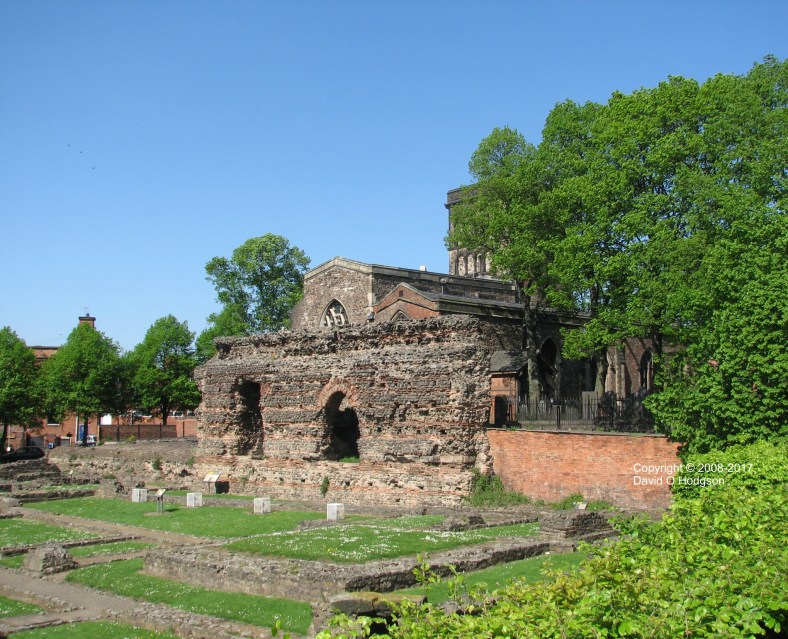
Jewry Wall & St. Nicholas' Church, Leicester, in 2008

Jewry Wall & St. Nicholas’ Church, Leicester, in 2008

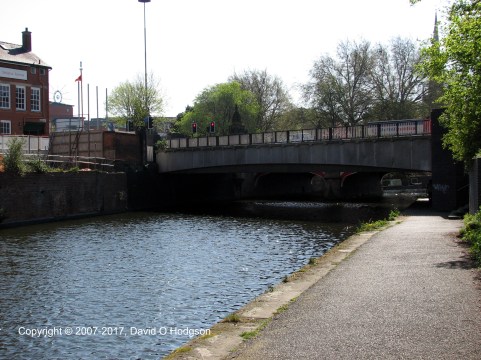
I’ve never lived in Leicester, UK, but, about 30 years ago, I found myself visiting the city quite frequently. Leicester’s city motto is Semper Eadem, which means “Always the Same“, but, when I revisited the city almost thirty years later, I discovered that the motto is not accurate!

Although superficially just another of England’s many formerly-industrial Midlands cities (and now a very multicultural city), Leicester hides some historical gems and national treasures. One such treasure is the Jewry Wall site, shown above, which is a substantial remaining relic of the city’s Roman origins, and is in fact the second-largest remaining Roman structure in Britain. Next to the ruins of the Roman baths stands St. Nicholas’ Church. The idyllic scene in the photo belies the fact that this site is actually in the middle of the city, adjacent to the busy inner ring road.

Of course, in 2012, Leicester shot to worldwide fame due to another unique treasure, when it was confirmed that the long-lost body of King Richard III had been discovered under a car park in the city center. For centuries, the accepted view had been that Richard’s remains had been thrown into the River Soar some time after he lost the Battle of Bosworth in 1485, and thus were lost for ever.

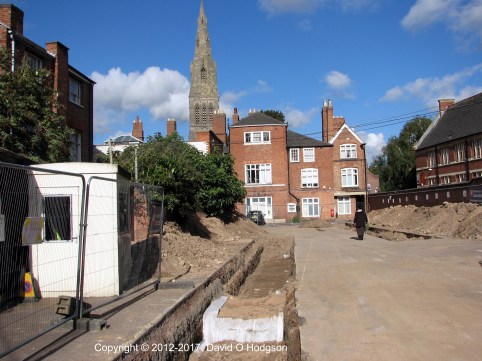
The photo below, taken during my October 2012 visit, shows the trench in the car park where Richard’s remains had been found a few months earlier. At the time that the bones were interred there (presumably in 1485), this site was part of the monastery of Greyfriars. The spire in the background is that of Leicester Cathedral.

Trench in which the remains of King Richard III were found, Leicester

Trench in which the remains of King Richard III were found, Leicester

Industrial Decay

I first visited Leicester between Autumn 1978 and Spring 1979. Thinking back to those early visits, my memories of the city conjure up a dark and grimy maze of damp streets, derelict railway lines and dilapidated businesses.

In those days, one of the most imposing industrial relics was the immense blue brick viaduct built in 1899 for the Great Central Railway, whose new main line had been pushed through the west side of the city center at huge expense. The viaduct was called the “West Bridge Viaduct”, which is not the strange name duplication that it seems, because the viaduct actually spanned not only the River Soar, but also the West Bridge itself. The West Bridge is a road bridge at the site of a river crossing, which has existed there since at least Roman times.

The Great Central line was built as part of a grand scheme to connect the manufacturing centers of Northern England with Europe via a Channel Tunnel, but of course the tunnel wasn’t built until much too late for the railway, and all those manufacturing industries. After much vacillation and ineptitude, British Rail finally closed the Great Central main line in the 1960s, making the viaduct redundant.

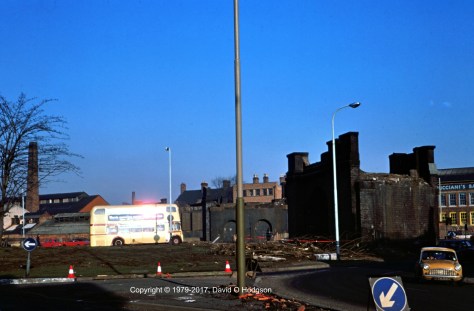
When I visited in January 1979, demolition work was underway on portions of the viaduct that had spanned the West Bridge and the River Soar.

The photo below, looking north towards the river, shows the remaining abutments, after the iron spans had been removed. A Leicester City Transport bus glints in the evening sun as it traverses the roundabout.

West Bridge Viaduct, Leicester, January 1979

West Bridge Viaduct, Leicester, January 1979

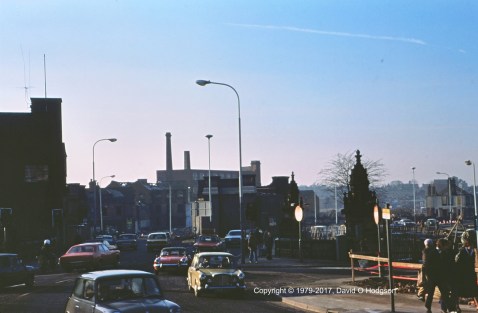
A second photo taken on the same date, from the other side of the river, shows the dome-like decorative abutment of the West Bridge, amid a clutter of half-demolished buildings and muddy roads. The isolated abutment of the former railway viaduct is in the center of the view.

West Bridge, Leicester, January 1979

West Bridge, Leicester, January 1979

And Nearly Thirty Years Later…

I didn’t return to the city until the Spring of 2007, and, when I did, I decided to try to revisit some of my “old haunts”. I headed to the West Bridge, which was easy to find, but when I tried to relocate the spots from which I’d taken the 1979 photos, I found myself completely disoriented.

I’d realized that the West Bridge Viaduct would by now have vanished completely, but in fact almost everything else seemed to have been remodeled too. There was no trace of the roundabout that had featured in my earlier photograph.

It turned out that the main source of my confusion was that a second road bridge had been built alongside the old West Bridge, so that it now forms part of a dual-carriageway system. The photo below shows the two parallel bridges from underneath, at the level of the River Soar towpath, with the old bridge beyond the new one. The weed-topped river wall on the far left formed part of the viaduct abutment.

Leicester, West Bridge from River Soar

Leicester, West Bridge from River Soar

The Grandeur That Was Ratae Corieltauvorum

The Roman name of the settlement that developed into modern Leicester was Ratae Corieltauvorum. Leicester was one of the first cities in Britain to take proactive steps to preserve its Roman heritage. The Jewry Wall ruin itself has always been obvious, but the foundations of the Roman bathhouse next to it were only discovered during the 1930s. Instead of building over them, Leicester Corporation cleared the site and opened it to the public.

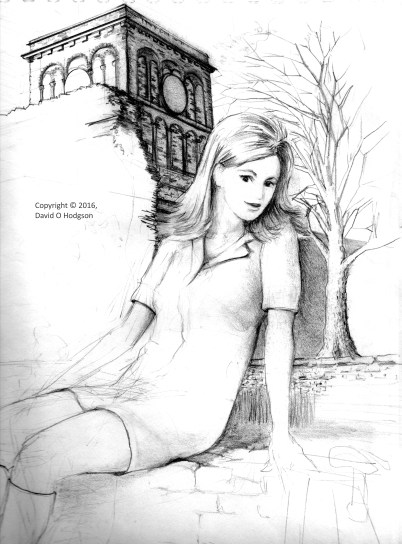
Recently, as part of the preparatory work for a fictional story about Leicester in the 1960s, I produced the pencil sketch below, showing the wife of the story’s protagonist sitting on one of the Roman walls near the Jewry Wall, with St. Nicholas’ Church in the background. The woman in the picture doesn’t exist, of course, but the structures in the background definitely do.

"Jeannie at the Jewry Wall"

“Jeannie at the Jewry Wall”

Scarborough Railway Station: A Historical Mystery Tour

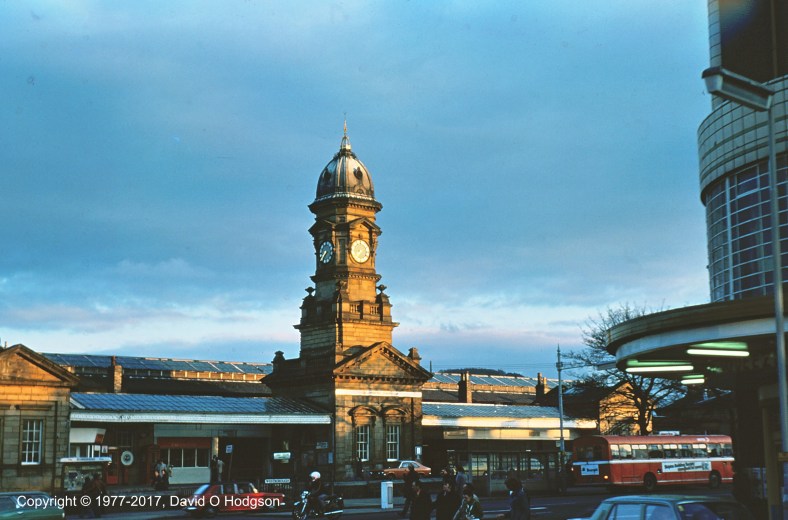
Scarborough Central Railway Station in 1977

Scarborough Central Railway Station in 1977

During my teenage years, for my A-level Art study of architecture, I did some original research on the history of Scarborough [Central] Railway Station (shown above), which led to a surprising conclusion about the building’s original appearance.

My conclusions were questioned at the time, but were verified decades later by someone else’s chance discovery.

It was always a well-known fact that Scarborough’s main railway station was built in 1845 (quite early in the history of railways), at a location that was then outside the town limits. It’s also well-known that, in 1882, a central tower was added to the frontage. Surprisingly, and despite the efforts of various developers over the decades, the station building has survived to this day in essentially its 1882 form, as shown in my 1977 photograph at the top of this article.

During my researches at Scarborough Reference Library, I discovered a copy of a catalog for an exhibition called “Marble Halls”, which had apparently taken place at the Victoria & Albert Museum in London in 1973.

Marble Halls

An 1844-dated illustration in the Marble Halls catalog showed a plan of “Scarborough Station” that, at first glance, looked nothing like the existing structure. The image below is the copy of the catalog illustration that I created for my study.

Copy of Plan of Scarborough Station, 1844

Copy of Plan of Scarborough Station, 1844

I hadn’t expected to see the central tower, of course, but where are the three small pavilions in the building’s frontage? The plan also shows a colonnaded central entrance, of which there’s no trace in the existing building.

My initial impression was that this plan did not represent the station as built, but I was puzzled that the accompanying commentary did not mention any discrepancy between the plan and the structure as-built.

I wrote to some local experts on the subject, who provided me with the limited historical references that were available. None of this provided any clear details regarding alterations to the building, except for the addition of the tower. The general opinion seemed to be that the entire frontage of Scarborough Station had probably been rebuilt in 1882 (rather than just the tower), but there was no evidence to prove that claim. One expert pointed out that the architect’s illustration in “Marble Halls” may have been nothing more than an “architect’s impression”, and that there was no guarantee that the station as-constructed had ever resembled that plan.

Some Detective Work

If in fact the building’s frontage had been substantially altered in 1882, it struck me that perhaps I could find some evidence of that (although it seemed odd that nobody would have previously noticed anything).

I walked around the outside of the building, examining its architectural details. I looked particularly at the locations that would be the junctions between the 1845 structure and what were potentially later alterations. Eventually, at the East end of the joint between the easternmost pavilion and the main trainshed (on the far left in the heading photo), I found a mismatch in the details of the pediment, as shown in my sketch below.

Scarborough Station. Detail of Trainshed Pediment stonecarving

Scarborough Station. Detail of Trainshed Pediment stonework

The mismatched joint shown above would have occurred where the new pavilion was added to the main wall of the original building, if my suspicions about the station’s original appearance were correct.

Given the immense precision of the building’s stone carving, it seemed impossible that such a noticeable mismatch would have occurred (or be allowed to remain) during the original construction. It seemed much more likely that this mismatch occurred because of some miscalculation when new stone was carved later, the intention having been to match the details of the original building.

Conclusion & Confirmation

In my study, I presented my conclusion that the 1844 architectural plan did indeed show the original appearance of Scarborough station, but that the building had been subject to greater subsequent alteration in the 1880s than most people had suspected. Not only was the central tower added, but most of the original frontage had been removed, and replaced with the three small pavilions that still exist.

At the time, I had no evidence to support my assertion, except for the architectural plan and my own illustrations of the architectural details of the actual building. Thus, my conclusion remained unproven, and nothing more than an “interesting speculation”.

In 1995, long after the completion of my Art A-level, and by which time I’d moved away from Scarborough, first to London and then to California, one of my expert correspondents from 1977, J R Lidster, published his own book on Scarborough Railway Station. In that book, he included a drawing of the station frontage from a letterhead that had recently been discovered in the attic of a property in Scarborough.

Sure enough, the letterhead showed a building that closely matched that depicted in the 1844 plan in the book “Marble Halls”, thus finally verifying the conclusion of my investigation.

[Added 12/14/24] Here is the letterhead described above, from J R Lidster’s book:
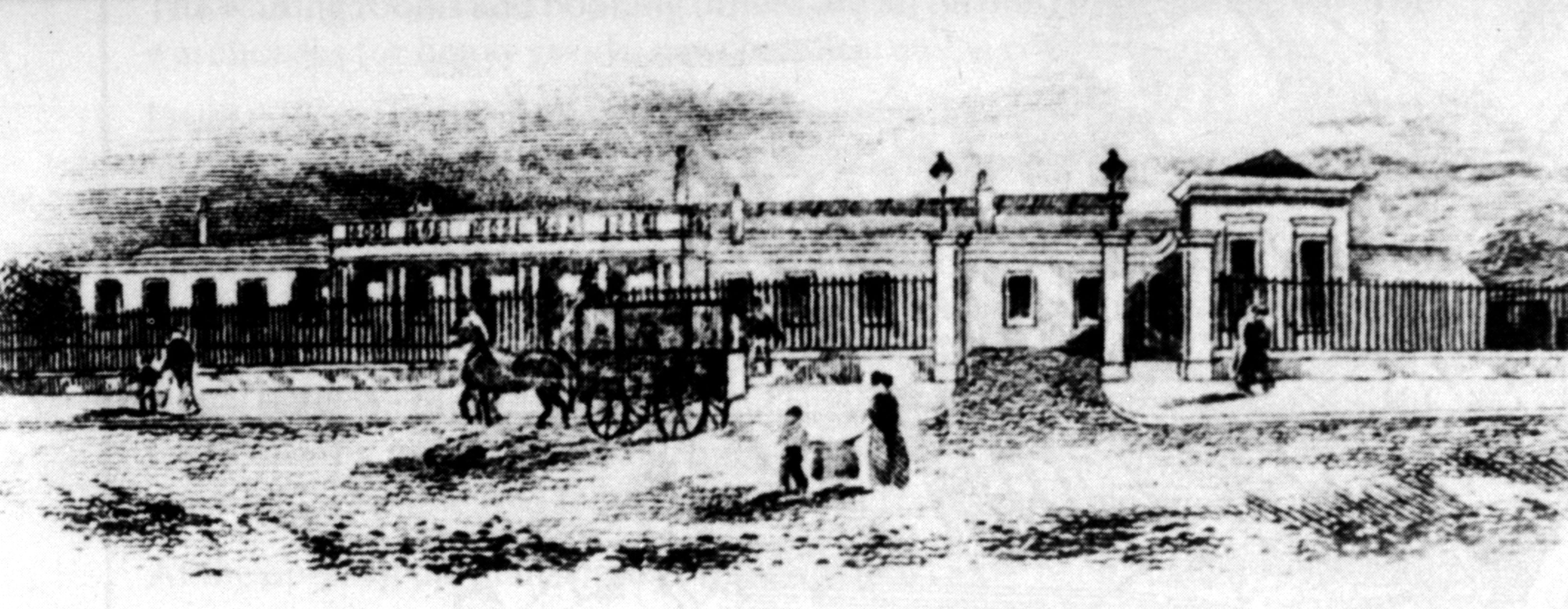
Early View of Scarborough Railway Station. Copyright J R Lidster

A Sense of History

At the age of thirteen, I was forced to select a restricted range of subjects at school for continued study, as preparation for taking “O-level” examinations. One of the subjects that I dropped was history, because my naïve belief at that time was that history was “already written down”, and thus there was nothing new to add. Even at that age, I knew that, whatever I was going to devote my life to, I wanted it to be something innovative.

The experience that I described above, where I was able to provide original insight into a historical problem, showed me that my earlier view of history had been wrong. The events under consideration were, after all, relatively recent history, dating back only about one century, and yet many details were unrecorded, and there were new contributions to be made. I was able to offer new information without even “getting my hands dirty”!

Postscript: More Marble Halls

This incident was my first encounter with the contents of the “Marble Halls” catalog. The book also contains illustrations of other Victorian buildings that featured in my later life. For example, there’s an illustration of the Imperial Institute in London, the buildings of which were subsequently incorporated into Imperial College, from where I would graduate.

The book also includes an image of Highclere Castle, in Hampshire, which was close to my home in Andover in later years. Highclere Castle is now world-famous as the fictitious Downton Abbey.