From Cloughton Station Gates to the World

HW_XingGate770319Cright

Pencil Drawing of Cloughton Station Gates, 1977

I produced the pencil drawing above in March 1977, as one of the regular weekly homework exercises for my Advanced-Level Art qualification.

The (now rather smudged) picture depicts a disused level crossing (grade crossing) gate that protected the tracks near the station at Cloughton. Cloughton was an intermediate stop on the Scarborough-Whitby line, which closed completely in 1965. The closure of that line set off a strange chain of events, which eventually led to worldwide fame for a similar station on a neighboring line.

My 1977 photo below shows a roadside view of the station building and goods shed at Cloughton, in a semi-derelict state.
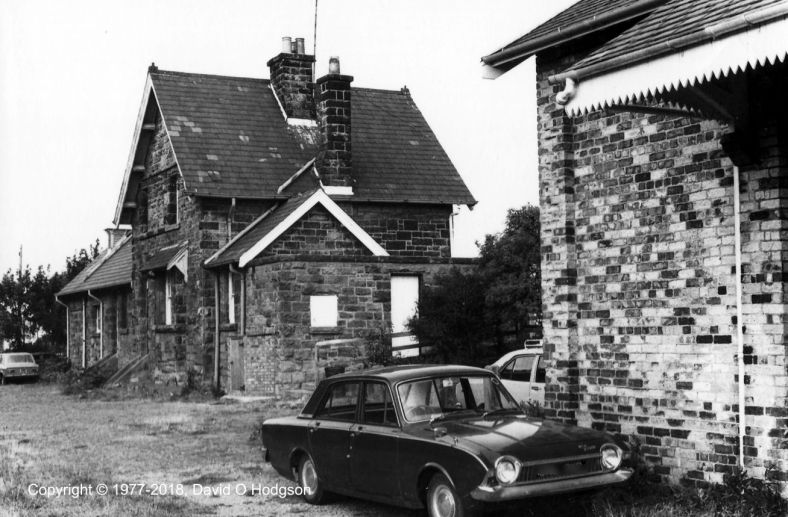
CloughtonStnCright

Cloughton Station, 1977

These days, although Cloughton Station building still exists at that location, the crossing gate is long gone (as shown in this Google Streetview). On the other hand, thankfully the surviving station premises have been substantially renovated, and are now tea rooms, presenting a much cheerier scene than they did when I took my photographs during the 1970s.

Not Quite What Was There

As I recall, the goal of that homework assignment was to draw an outdoor scene, but I felt that that was a bit too much trouble, so, instead, I based my drawing on my own photograph of that scene! (Unfortunately, I no longer have that photograph.)

However, as you might expect from my approach to such artwork, if you’ve read my earlier posts on the subject, my drawing does not accurately reflect the real scene, because I felt that the composition could be improved, relative to the reality of what was there.

For example, my drawing shows a grounded railway wagon body on the left, next to the crossing. There was no such object at that crossing, although I’d seen similar carcasses in many other railway locations.

Nonetheless, my depiction of the gate itself is accurate. The North Eastern Railway, whose design it was, adopted a rather unusual practice of using extremely wide single gates to span multiple tracks, unlike most other railways (which would have used multiple gates in these cases). For my Advanced-Level Art architectural study, I eventually created a dimensioned drawing of a smaller gate of the same design at another station on the same line, Fyling Hall, as shown below.

FylingHallGateCright

Crossing Gate at Fyling Hall Station

From Heartbeat to Harry Potter

The Scarborough-Whitby railway was one of many targeted for closure by the notorious Beeching Report. There were many local protests regarding the planned closure of this line, and, during the 1964 national election, Harold Wilson of the Labour Party ran on a platform of promising to halt the Beeching-inspired closures. Unfortunately, it turned out that Wilson was just another lying politician, and after winning the election, he actually accelerated the closure schedule, as described in this post by transport commentator Christian Wolmar.

Following the closure, which took place on 6th March 1965, a fundraising effort began to try to buy up and reopen at least part of the Scarborough-Whitby route. Unfortunately, it appeared that the cost of repairs to structures on the line would exceed any conceivable budget, so the plan came to nothing.

However, the preservation effort then focused instead on another nearby line, which had been closed to passengers on the same day. This was the Whitby-Pickering Railway, which in fact was even more historic (albeit somewhat less scenic) than the Scarborough-Whitby route. The W&PR had originally been engineered by George Stephenson in 1836, and had relied on horse-drawn locomotion until it was connected to the national network in 1845.

As a result of all this, the North Yorkshire Moors Railway was formed, and began running trains in the early 1970s. I first visited the NYMR in 1975, and returned many times after that. The photo below shows Goathland Station on the NYMR in 1976, many years before it became world-famous.

GoathlandStn1976Cright

Before the Days of Fame: Goathland Station in 1976

The preserved NYMR met with great success, and was eventually able to extend its route all the way from Grosmont (junction with BR) to Pickering. I took the photo below of an express hauled by A4 locomotive “Sir Nigel Gresley” in Pickering in 2006.

PickeringNYMR1Cright

A4 “Sir Nigel Gresley” at Pickering, NYMR, 2006

The NYMR hired out its location for filming work, and, as a result, Goathland Station began to achieve recognition far beyond Yorkshire. During the 1990s, Goathland became “Aidensfield” in the TV soap opera Heartbeat, which ran from 1992 to 2010, and was broadcast around the world. The railway station appeared in many episodes.

Then, in 2001, Goathland Station appeared all around the world in movies, as the fictitious Hogsmeade Station in the Harry Potter films.

When I reluctantly produced that pencil drawing over 40 years ago, I couldn’t possibly have imagined the worldwide fame that was to come to some of those disused and derelict Yorkshire railways!
The Uncle I Never Met

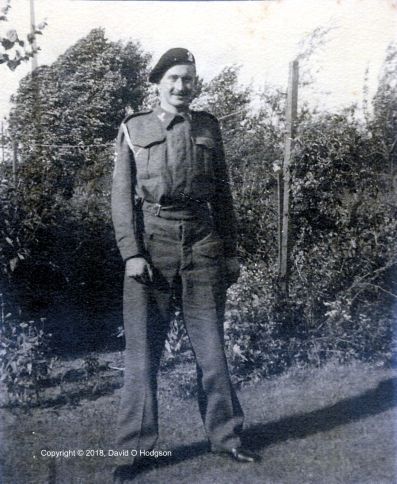
Elvyn Stephenson Martin

Elvyn Stephenson Martin

The photo above shows my uncle, Elvyn Stephenson Martin, wearing his Army uniform, while on leave, some time in 1944-45.

I never had the chance to meet Uncle Elvyn, because he was killed in action on 14th April, 1945 (about 15 years before I was born, and exactly 73 years ago today). He is buried in Becklingen War Cemetery, in Germany: full details can be found on the Commonwealth War Graves Commission web site, here.

Like so many millions of others, he was a casualty of World War II, and our family was of course by no means alone in suffering such losses (or even worse). The detail that makes Elvyn’s death seem particularly pointless was that it occurred only 3 weeks before the end of the war in Europe, and thus could not possibly have accomplished anything for anyone.

I know from the CWGC details that, at the time of his death, he was a trooper with the 15th/19th  The King’s Royal Hussars, Royal Armoured Corps. The only other details I have were those that my mother (Elvyn’s younger sister) relayed to me before she died. She told me that Elvyn had spent most of the war in England, in the Military Police, which he disliked because he found himself having to arrest his own countrymen instead of engaging with the real enemy. He was therefore delighted when he was transferred to the Tank Corps, and sent across the Channel.

In early 1945, his regiment was sweeping eastwards through Northern Germany. In April, they were involved in the liberation of a concentration camp (possibly Bergen-Belsen, but I have no confirmation), apparently in support of the 11th Armoured Division. He drove into the camp in a tank, then popped his head out of the top of the turret to look around, and was shot dead by a sniper.

Those Left Behind

Elvyn’s parents, my grandparents, were naturally devastated by his death. I’m proud to say that, during the First World War, my grandfather had been a conscientious objector, for which matter of personal principle he was imprisoned. Nonetheless, he understood that, when the Second War came, there was really something to fight for, so he didn’t object to his son’s actions.

The hand-colored photo below shows my grandmother with Elvyn, shortly after his birth in 1919.

My Grandmother with Elvyn, c.1919

My Grandmother with Elvyn, c.1919

I don’t think they ever really recovered from Elvyn’s death (which is understandable).

When my grandmother died in 1979, it fell to my mother to sort through her remaining effects, but she could find no trace of Elvyn at all. There were no documents, no medals, nothing; apparently my grandmother could not bear the memories they brought back, and had disposed of everything. These few photos are all that we now have left.

The Personal Tragedy of War & Unintended Consequences

Whatever grandiose principles any war is supposedly fought for, it always ends up being a tragedy at the personal level, as my grandparents’ experience demonstrates.

Ironically, though, the World Wars led to some improvements in the lives of the general public that were definitely unintended by the promoters of the wars. For example, the First World War led to the granting of the right to vote to women, both in the US and UK. A century later, I think that most of us would agree that a “democracy” that refused voting rights to about half its population perhaps isn’t worth fighting for.

As a result of the First and Second World Wars, in Britain, the National Health Service was founded, bringing great improvements to the standard of living for many people.

Thus, I’m in no doubt that I owe a debt of gratitude to my long-lost uncle, for the consequences of his brave actions, both intended and otherwise.

Almost a Winner

Townscape 1550, painted in school at age 14

Townscape 1550, painted in school at age 14

I painted the picture above, depicting a fictitious medieval city, in school, at the age of 14, and thought little of it at the time. It was just another one of many that I churned out during my Ordinary-level classes in Art. We were largely restricted to inventing subjects from our imaginations, because there was little reference material available and we weren’t allowed to leave the school during classes.

However, about a year later, my teacher chose this particular picture as an entry in a national art competition, where it was awarded a “runners up” certificate.

That was not the first recognition I’d won for my art skills, despite never having sought prizes for any of it. In fact, the first prize I ever won for anything was for drawing, at Newby County Primary school when I was aged 6. The award I was given for that was a copy of the book Little Grey Rabbit finds a Shoe, by Alison Uttley. Given the nature of the book, I’ve always suspected that the person responsible for obtaining the prizes had assumed that the winner would be a girl, because it didn’t seem like an ideal choice for a six-year-old boy!

Digital Salvation

Unfortunately, in the case of my 1974 painting above, and as with many of the other surviving paintings that I did at school, the cheap poster paint that we had to use is decomposing. You can see many white blotches in the blue sky, looking somewhat like aerial smoke bombs detonating! Those were not originally present, but are the result of the white paint compound separating from the tinting chemicals.

Thus, I recently took the opportunity to scan the painting before it deteriorates further, which was partly what prompted me to write this article now. The original dimensions are about 16“ x 11”, thus too large for my scanner. However, I was able to scan the paper in parts, then stitch the result together in such a way that the edges are almost invisible.

The Kellogg’s National Exhibition of Children’s Art

It seems that the American cereal company, Kellogg’s, organized a National Exhibition of Children’s Art in London every year, from the 1960s through to some time in the 1970s. The only online record of it that I’ve been able to find is a copy of an invitation to enter the “exhibition” in 1976, which apparently appeared on the back of packets of Corn Flakes. (The clichéd “happy corporate collage” artwork on the cereal packet is amusing. Of course, they couldn’t possibly promote a children’s art exhibition by using…er…actual children’s art, could they?)

As far as I recall, I was unaware of those exhibitions at the time, and my entry in the 1975 contest was entirely initiated by my teacher. I definitely didn’t fill in any back-of-a-cereal-packet entry form. The only official acknowledgement that I received was the certificate below (which isn’t even dated). Nobody invited me to attend the actual exhibition, during that or any other year.

The Undated NECA Runners-Up Certificate

The Undated NECA Runners-Up Certificate

It was certainly also the case that my parents did not encourage me to exhibit my artwork. Unfortunately, they took a pessimistic attitude to most things along the lines of, “it’s not worth trying because you’re bound to fail”. When faced with other parents who actively helped their children in such activities, they simply dismissed such behavior as being “pushy”. Nothing worse than a “pushy parent”, you know!

Competitive Art? I’d Rather Not!

While I have no objections to art exhibitions, I have become increasingly skeptical of the benefits of “art competitions”. After all, who has the competence or authority to decide which works of art are “better”? Yes; you can determine that one artwork is better-drawn or better-executed than another—that one artist is more technically competent than another—and I do that myself all the time. But does that make one artwork “better” than the other? Not necessarily. If you must turn an exhibition into a competition, wouldn’t it be better to make it a “artist contest” instead of an “art contest”?

I understand that, even in a non-competitive exhibition, there has to be someone to decide which entries will “make the cut”. Given that Kellogg’s were soliciting entries for their exhibition on the backs of cereal packets, someone would obviously need to review all entries, even if only to determine which entries met the basic conditions (e.g., to determine that they were actually produced by children). That kind of basic judgment doesn’t really turn an exhibition into a contest, unless the promoters deliberately aim to do that.

Unfortunately, we live in a culture where some people seem to want to turn every human endeavor into a contest, so when someone promotes contests in inappropriate areas, all too many people support the idea, instead of treating it with the skepticism, or possibly even contempt, that it may deserve.

It’s true that I have entered my own artworks in exhibitions that involve judging and prizegiving, such as my Moggies cartoons, which were displayed at some Sonoma County Fairs. Sometimes my entries have won, but sometimes they received no award at all. I try to maintain as detached a view as possible of those events and the responses to my entries.

Encouraging Originality

Surely, art is about the wide variety of ways in which artists see and interpret the universe, and reducing all that to a contest misses much of the value of art. The judgments that are necessary to determine contest winners will inevitably give the impression that one or two viewpoints are superior to all others, thus discouraging the very exploration and variety that is essential to art.

The Story Of Reading Evenings

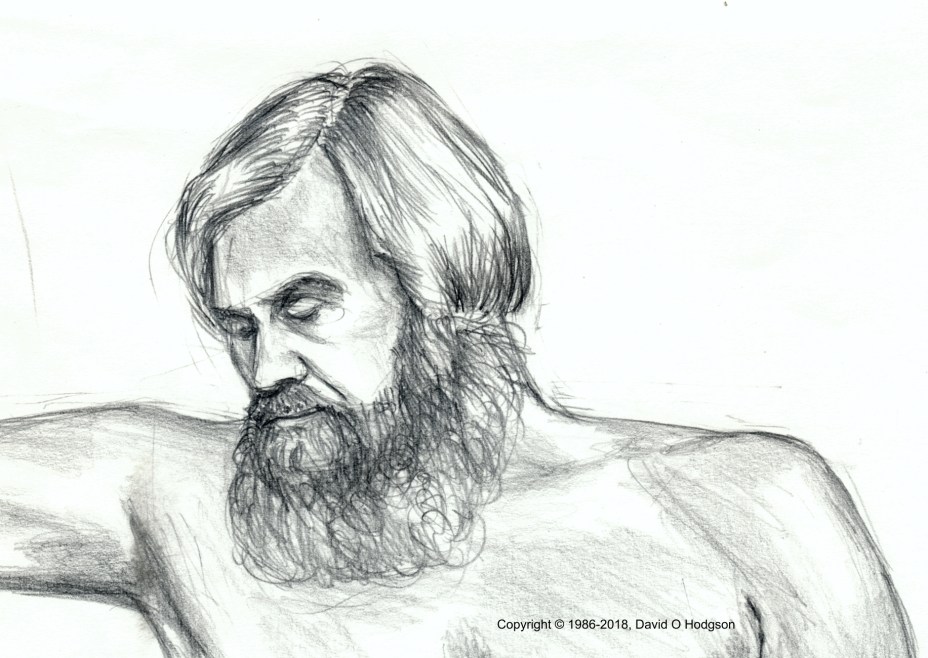
Pencil Portrait, Reading, 1986

Pencil Portrait, Reading, 1986

The pencil drawing above is a surviving sample of the life drawing work that I did at sessions in Reading during 1986-7. If you understood the word “Reading” here as referring to the reading of a book, then the title and first sentence of this post must have seemed quite meaningless.

In fact, Reading in this context is the name of a town in England, about 40 miles west of London, and it’s pronounced “Redding”. Reading forms the hub of an area known as the M4 Corridor, where huddle many of Britain’s remaining electronics technology industries. That was also true in the 1980s, when Britain had many more such industries than it does today.

Reading was perhaps first made famous during the nineteenth century by Oscar Wilde, who was imprisoned in Reading Gaol, and wrote a lengthy poem called The Ballad of Reading Gaol. In that poem, he wrote:

In Reading gaol by Reading town

There is a pit of shame…

I’m glad to be able to say that the hours I spent in Reading were definitely not in any “pit of shame” (except perhaps for certain pubs…).

More recently, of course, Reading has again achieved fame as the birthplace of comedian Ricky Gervais, who wrote a movie named after an area of the town: Cemetery Junction.

A New Venue

In an earlier article, I described how I attended Life Drawing classes in Andover during 1985-86, while I was living there and working for Link Electronics. Unfortunately, despite having created some brilliant products, Link turned out to be just one more failing British company, with the result that I was laid off in June 1985, when their management decided to shut down the design and manufacture of television cameras.

After searching for suitable alternative employment for a few weeks, I accepted a Design Engineering position with a small digital video equipment company called Questech, who were based in Wokingham, Berkshire. (As you may have guessed, because it has become such a repetitive theme, Questech is also now long out-of-business.) Although I was still living in Andover, I could no longer attend the sessions at Cricklade College, so I looked around to find something similar in the nearest large town to Wokingham, which was Reading. I eventually found a suitable class at a branch of the University of Reading, on Bath Road.

Just to demonstrate that life drawing models aren’t always female, here’s an example of one of my drawings from Reading that featured a male model.

Male Nude, Reading, 1986

Male Nude, Reading, 1986

However, those drawing sessions were not by any means the first time I’d visited Reading, because I’d had a somewhat ambivalent connection to the town since 1978.

Revisiting Reading

I had actually first traveled to Reading in 1978, while living in Coventry. While at school in Scarborough, I had had a crush on a girl who had gone on to study at the University of Reading. Had I been more mature, I would have realized that my crush was futile, but I was just another irrational teenager…

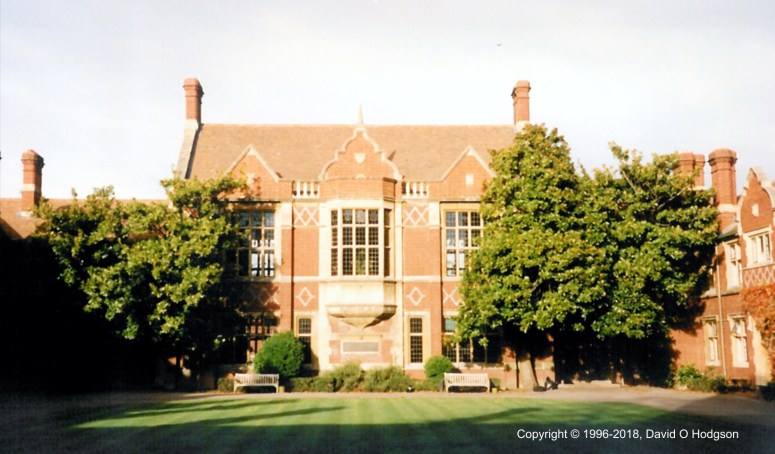
Thus one day—her birthday, in fact—I had the “bright idea” to go to Reading and seek out her room in the beautiful Wantage Hall.

Wantage Hall, University of Reading, 1996

Wantage Hall, University of Reading, 1996

I don’t think that I was really intending to try to meet up with her during that visit, but in fact I did, along with her new boyfriend! Fortunately, it all seemed to go fairly amicably, which perhaps was partly because she was still half-asleep during our unplanned meeting! It turned out to be the last time I ever saw her, which was probably just as well for all of us.

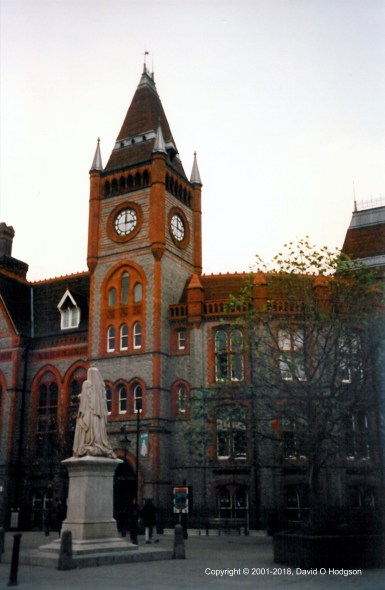
I did spend some time wandering around the town. One of the first features that struck me was the Town Hall, which, for people of my age, was very reminiscent of the building in the children’s animated series Trumpton.

Reading Town Hall, Following an External Cleaning, in 2001

Reading Town Hall, Following an External Cleaning, in 2001

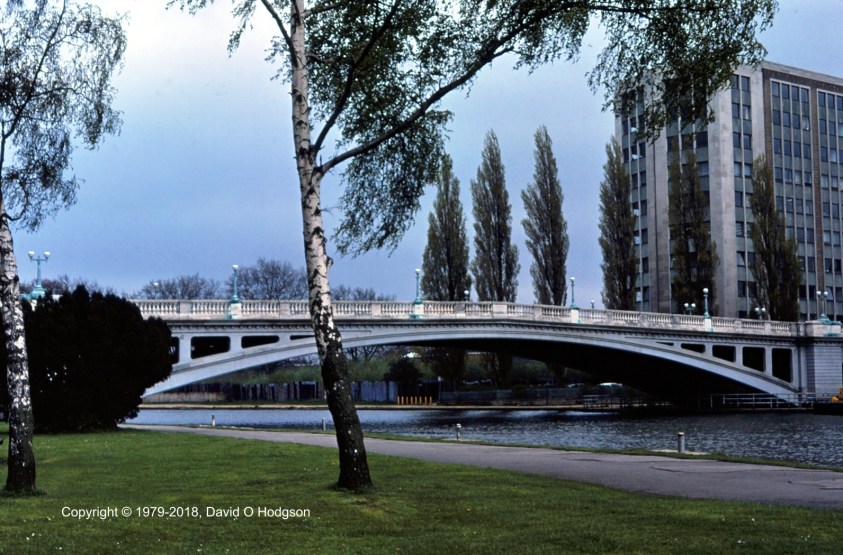
Reading has some fairly pleasant footpaths along the banks of the River Thames. I took the photo below, of Caversham Bridge, while walking alongside the river in rain.

Caversham Bridge, Reading, 1979

Caversham Bridge, Reading, 1979

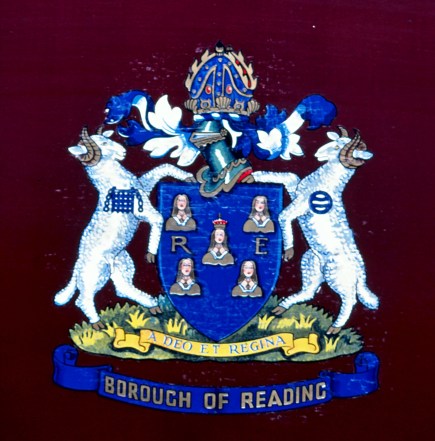
The arms below are those of the Borough of Reading, which used to appear on the sides of all Reading Transport buses.

Arms of the Borough of Reading

Arms of the Borough of Reading

The Equalizer Stops By for a Pint

When attending those 1980s drawing sessions, I rushed there straight from Wokingham, immediately after finishing work for the day. Once the drawing session was over, I was naturally hungry for dinner, so I would visit a local pub before beginning the journey home to Andover.

One pub that I frequented nearby was, and still is, called the Lyndhurst. Below is a modern Google Streetview of the location.

Google Streetview of the Lyndhurst, Reading

Google Streetview of the Lyndhurst, Reading

When I visited the pub in those days, one regular customer was a man who never offered anyone his name, but was known by the bartender as The Equalizer [warning: link plays video]. This was because he looked quite like Edward Woodward, who at the time was starring in an American TV series as the eponymous character. I still don’t know who the man in the pub was, so maybe someone will read this article and enlighten us?

As I said, the Lyndhurst is still in business today, serving good food, so probably worth a visit if you ever find yourself in Reading!

The Bizarre Demise of Ferranti

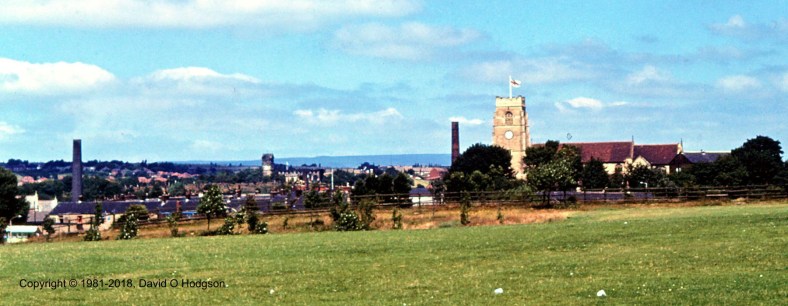
Panorama of Middleton, Manchester, 1981

Panorama of Middleton, Manchester, 1981

The photo above shows a panorama of Middleton, a suburb north of Manchester, one summer afternoon in 1981, while I was living there, and working as an apprentice at a famous British electronics company, Ferranti. For a few summers during my engineering training, I did indeed find myself working in some of the “dark satanic mills” of Manchester! I couldn’t have foreseen at the time that, within about 10 years, Ferranti would go out of business in a spectacular collapse, induced at least partially by an international fraud.

I mentioned in a previous post that, having decided during 1980 that I should try to obtain a degree in Electronics, I began searching for an employer who could sponsor me for what was called a “sandwich course”, which interleaved periods of industrial work with the academic study terms. My efforts to find such a position eventually paid off, and I was offered a Student Apprenticeship with Ferranti, commencing in July 1981, whereby I would work for the company each summer while at university. Thus, I lived and worked in Manchester for 3 summers, from 1981 to 1983, but, for reasons that I’ll explain below, I did not return there after graduating in 1984.

Live by the Sword…

In those days, Ferranti was, although not one of the largest electronics companies in Britain, certainly one of the best-regarded (the “Big Three” electronics companies were GEC, Marconi and Plessey). Ferranti had pioneered the development of computers in Britain.

When I received the offer from Ferranti, it caused some discomfort among my family and friends, because the company had a justified reputation for deriving much of its income from military contracts. However, not all of Ferranti’s work was for the military, so I was given the option to work for the company only in civilian product areas.

As things were to turn out, Ferranti did indeed “live by the sword and die by the sword”.

The Boys (& Girl) of Summer

Ferranti’s Student Apprenticeships were arranged so that we were employed by the company directly during each summer break from university. We then attended university for a normal academic year, from October through to the following June.

In July 1981, I presented myself at Ferranti’s Training Centre, at the so-called Avenue Works in Chadderton (sometimes referred to as the Hollinwood plant), to begin my apprenticeship. Most of my fellow apprentices were male, but there was (apparently not quite for the first time, but still regarded as exotic!) one female in the group.

The first summer consisted of the “EP1” practical training, which was required by the Institution of Electrical Engineers. We learned technical drawing, soldering, welding, metal fabrication, machining, and many other practical skills. This was very intensive training; for example, we spent 4 weeks learning to solder, and were required to pass precision tests.

Our fabrication, welding and machining skills were tested by an assignment to build a toolbox from steel. The diagram below, which I drew in my Ferranti log book, shows how the toolbox was constructed. I still have that toolbox, which is far stronger than similar shop-bought items.

Diagram of the Toolbox I Constructed at Ferranti, 1981

Diagram of the Toolbox I Constructed at Ferranti, 1981

[Added 6/8/25] I recently retrieved the actual toolbox from our garage. Here it is, not too much the worse for nearly 45 years of wear!

Ferranti Toolbox in 2025

The Toolbox I Constructed at Ferranti

Wafers at Gem Mill

My second summer at Ferranti involved more uncertainty about what my assignment would be. Initially, I was told that there was actually no assignment for me, and that I should return to the Training Centre. After a short time there, several of us were assigned to a photoelastic stress analysis project at the Van Carrier manufacturing division of Ferranti Engineering plc, which was situated in the front offices of what had been the Avenue Works transformer factory.

The project was quite interesting, but obviously it didn’t have anything to do with electronics. I was thus relieved when, about half-way through the summer, an opportunity arose for me to be transferred to the semiconductor manufacturing plant at Gem Mill, Chadderton, to write some software.

Description of Silicon Wafer Test Software, from my Log Book, Gem Mill 1981

Description of Silicon Wafer Test Software, from my Log Book, Gem Mill 1981

Sadly, I took no photos of the Ferranti sites at which I worked, most of which have now been demolished. Therefore, I’ve used a Wikimedia Commons image of Gem Mill below.

Chadderton,Oldham - geograph.org.uk - 1547

Thanks, But I Won’t Be Back

As I discussed previously, my goal in obtaining an electronics degree had always been to get a job with the BBC. It may seem surprising that the terms of Ferranti’s apprenticeship did not impose on us any obligation to work for Ferranti after graduation. Similarly, Ferranti were under no obligation to offer me a job. Both parties were free to terminate the arrangement at any time.

During the Spring 1984 “milk round” (when employers visited universities searching for promising new graduates), I applied to the BBC and, after several interviews, I was hired.

As a result, I had to write to the Training Officer at Ferranti, to tell him that I would be accepting the BBC’s offer and thus would not be returning to Manchester. I expressed my gratitude for the “leg up” that Ferranti had given me when starting my new career. I wasn’t really expecting a reply, but, to my surprise, he did write back, indicating that he was very happy that Ferranti had been able to help me along.

I did feel a little guilty about walking away from Ferranti at that time. I was all too aware that this was the one company that had given me a second chance, at a time when no other engineering employer was interested in me. I had also gained some valuable experience in the electronics industry, which did indeed open the door to other employment opportunities later on. It turned out to have been a “wise” decision on my part, but few could have foreseen that at the time.

Like a Bad Spy Thriller

When I worked there, Ferranti always had the “big company feel”. Everyone was expected to slot obediently into predefined roles, and there was little room for individuality or special skills. (As an engineering student with artistic skills, I was always regarded as a very odd creature!) When I made the decision not to return, however, I certainly had no forewarning that Ferranti might not even exist much longer!

I heard the astonishing news of Ferranti’s demise only after I had moved far away to California, and, in my busy new life, I had almost forgotten that I’d ever worked there.

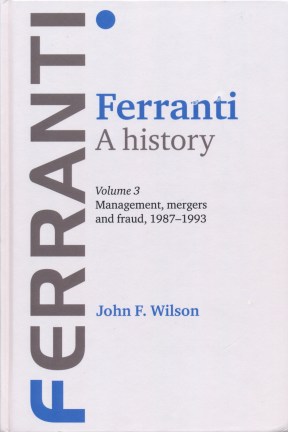
What I heard sounded so much like the plot of a bad spy thriller novel that I had to double-check the details to be sure that it was true. This story has been told in great detail elsewhere (particularly in the book Ferranti A history: Volume 3, by John F Wilson), so I will just summarize the main points here.

Cover of John Wilson's Book about the Demise of Ferranti

Cover of John Wilson’s Book about the Demise of Ferranti

It seems that, amid the Thatcherite business hubris of the 1980s, Ferranti’s management had become convinced that they needed to expand the company in the United States, and that the best way to do that would be to merge with a US defense electronics company. Unfortunately, when selecting a company, they made an appallingly bad choice. They selected a Pennsylvania-based company called International Signal & Control (ISC).

There were warning signs that ISC was a suspect operation, which Ferranti’s management and their auditors managed to miss. (For example, although nominally a US operation, ISC had chosen to register in Britain, simply to take advantage of relatively lax regulation of businesses in Britain.)

Soon after Ferranti merged with ISC, it began to become apparent that some of ISC’s major contracts actually didn’t exist at all, and that ISC’s management had engaged in elaborate deceptions to maintain their fraud. The CEO of ISC, James Guerin, was actually circulating money through front companies to give the impression that progress payments were being made on the fictitious contracts, but he couldn’t keep that up forever, so when he was no longer able to borrow more money, the whole fraud was exposed.

To be fair, though, the ISC fraud wasn’t the sole cause of Ferranti’s demise. This was the time of the end of the Cold War, when defense budgets were being slashed and contracts canceled. As Wilson mentions in his book, Ferranti had for some time been too dependent for its income on military projects, so these cutbacks exacerbated the company’s already-serious predicament, and led to its bankruptcy.

Look Back in Astonishment

It seems astonishing, and quite sad, to reflect that, that, only 35 years ago, I was working for a British company that was not only designing integrated circuits and computers, but also manufacturing them in Britain. Additionally, at that time Ferranti was designing and manufacturing many other kinds of engineering products, including some that I worked on briefly, such as telephones and van carriers. I’ll probably write more about those other products in future posts.

Whatever bad managerial decisions led to Ferranti’s demise, it still seems tragic that so much world-class innovation and effort came to so ignominious an end, and of course it was particularly disastrous for the all the highly-skilled and hard-working staff who lost their jobs when the company folded.

Return to Croydon Airport

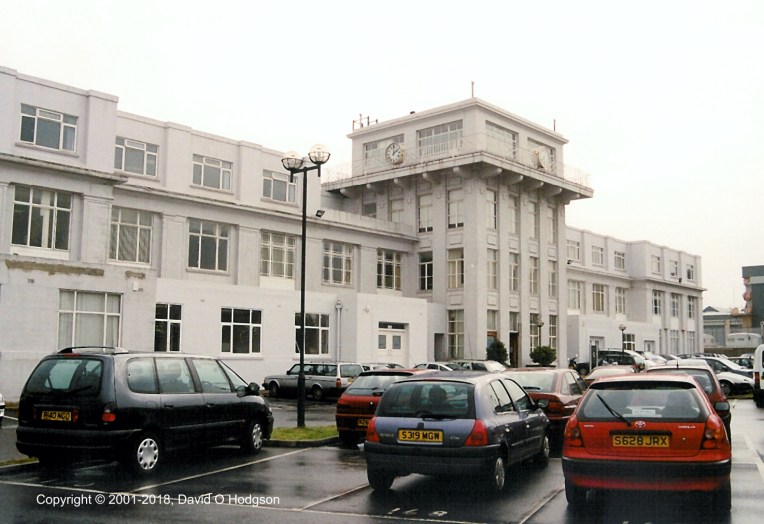
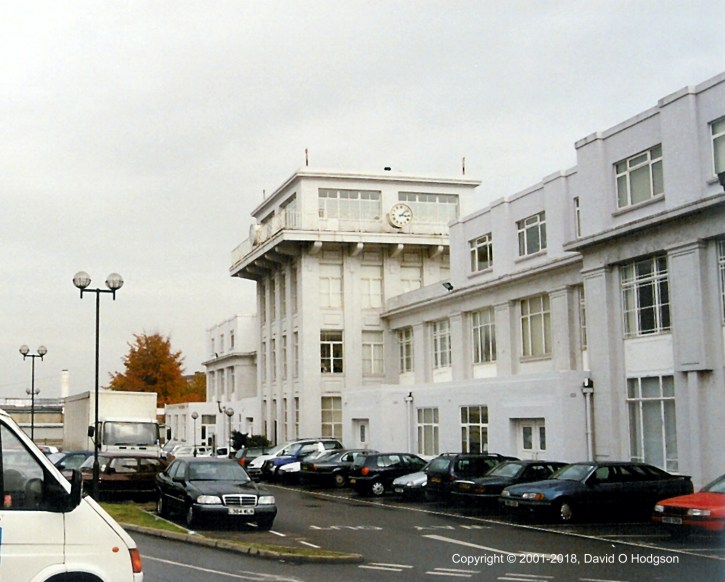
Croydon Airport on a Rainy Day, 2001

Croydon Airport on a Rainy Day, 2001

The photo above, which I took in 2001, shows a unique building that still survives today, and was, at one time, perhaps among the most familiar structures in the world.

It is the terminal building and control tower of London Airport; the famous Croydon Airport that was the location of so much newsreel footage prior to the Second World War.

The Control Tower at Croydon, built in 1928, was the first at any airport in the world, and Air Traffic Control systems were pioneered there.

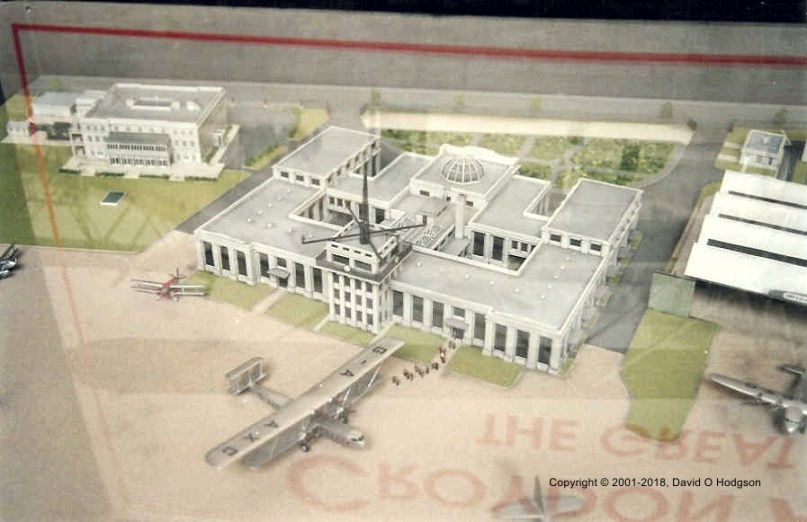
The photo below shows a model of Croydon Airport in its pre-WWII heyday, complete with passengers boarding an iconic H.P.42 Heracles class airliner.

Model of Croydon Airport during the 1930s

Model of Croydon Airport during the 1930s

Almost inevitably, the area around Croydon Airport, which had been open fields when the airfield was first opened in 1915, soon became covered with urban development. As a result, postwar expansion of the airport became impossible, so the decision was made to move operations to Heathrow instead. Heathrow replaced Croydon as London Airport in 1946, and then Croydon was gradually run down, finally closing in 1959. The runways at Croydon were all built over, and, in my ignorance, I thought that nothing was left.

Oblivious to the History around Me

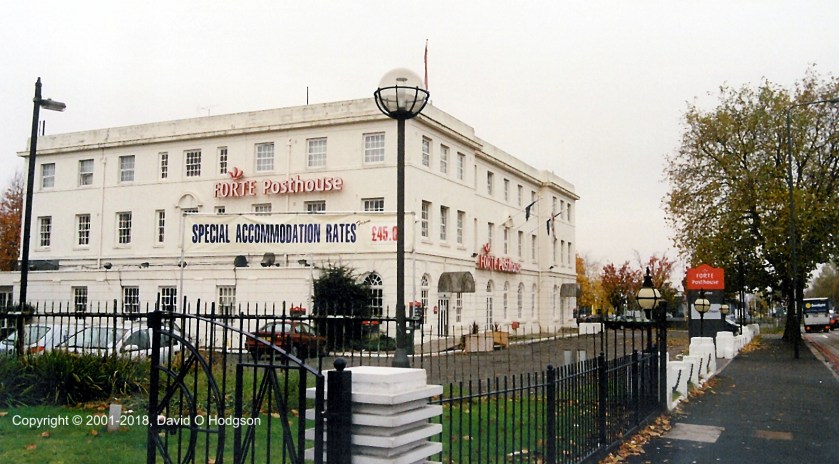
During the mid-1980s, I worked for a while as a Technical Sales Engineer for an electronics distributor. An important aspect of my job was to liaise with the company’s Sales Representative for Surrey, and in order to do that, I would arrange to meet with her at a place called the “The Aerodrome” on Purley Way. The building containing the café is shown below, as it appeared during my 2001 revisit.

The Aerodrome Hotel in 2001

The Aerodrome Hotel in 2001

As I recall, my colleague’s primary reason for choosing that café was her enthusiasm for their garlic mushroom appetizer!

It wasn’t until decades later that I realized that this had been the Aerodrome Hotel, purpose-built in 1928 as prestige accommodation for London Airport. In my photo of the model above, you can see the hotel building at the top left.

As the hotel’s own web site shows, since 2001 the building has been renovated, and now proudly shows off the aviation heritage that seemed largely forgotten during the 1980s.

I Should have Looked Round the Back

Next to the building containing the café, there was what appeared to be a nondescript office block, and it never even occurred to me to take the opportunity to look around the back of that structure. Had I done so, I would have immediately recognized the famous apron of the airport.

Control Tower and Former Apron of Croydon Airport

Control Tower and Former Apron of Croydon Airport

(Since I took the photo above, replicas of the control tower’s masts have been added.)

By 2001, the terminal building had been renovated as the Airport House International Business Centre, so I was able to go inside and eat lunch at the Rayon d’Or Brasserie.

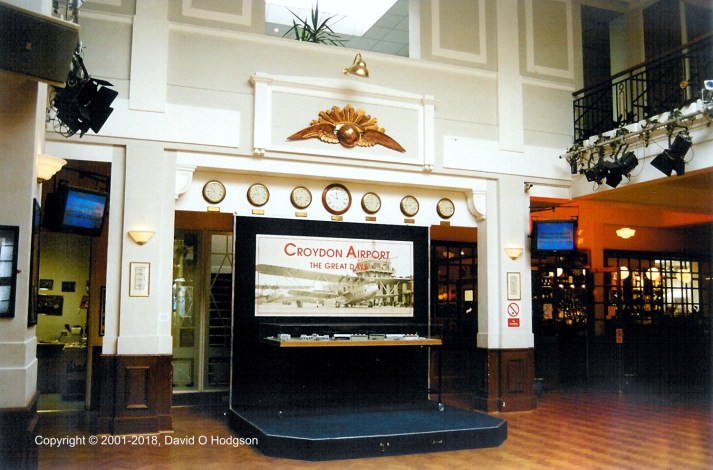
The lobby of the renovated building displayed fascinating relics of its history, as shown below. Several of the items that are visible are original features, such as the “Winged World” sculpture.

Lobby of Airport Terminal, in 2001

Lobby of Airport Terminal, in 2001

The display above included the model of the airport in its heyday, as shown in my photo. The Rayon d’Or Brasserie is in the background on the right.

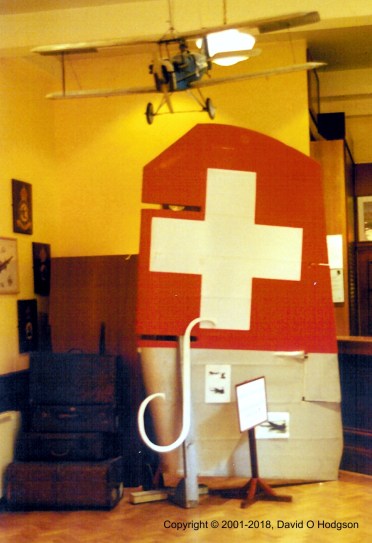
At that time, the aviation memorabilia display was still under construction, as shown by the view below of the rudder of a Swissair DC-3, a model of an SE5a hanging from the ceiling, a Sabena logo, and some period luggage (without wheels, of course).

Aviation Memorabilia in 2001

Aviation Memorabilia in 2001

Unfortunately, my visit didn’t occur on the first Sunday of the month, so I wasn’t able to avail myself of the tour of the old Control Tower. If you’re in the vicinity on the appropriate day, you may be interested in taking that tour. Full details can be found here, and this is the latest Google Streetview of the location.

[1/3/23: Updated link to the airport’s web site.]

A Modern Museum

It’s great to see that efforts are being made to preserve what is left of Croydon Airport. I hope to be able to visit the site again, next time I’m in the area.

Ally Pally

IMG0012Cright

Alexandra Palace, London, 1982

I took the photo above, of the remains of Alexandra Palace (colloquially known as “Ally Pally”), while I was a student in London in 1982. I’d seen the Palace from a distance many times before I actually visited it, but eventually I was prompted to go there, partly by a connection to my intended future career.

This immense building in North London is hardly a major tourist attraction, having had a rather unfortunate history and a wide variety of uses since it was built in 1873 (ostensibly as a counterpoint to South London’s Crystal Palace). Nonetheless, the structure remains usable to some extent, and there are currently plans for a major renovation.

The reason that I’d seen Ally Pally so many times before is because it stands prominently on a hilltop, where it can be seen from the East Coast Main (Railway) Line. When traveling between York and London by train, I frequently caught a glimpse of the structure through the carriage window.

I mentioned that the Palace has had a rather chequered past, having burned down on at least two occasions. In fact, there had been a major fire in 1980, just before the visits during which I took these photos. Despite the partial dereliction of the building itself, the grounds are still worth visiting, because of the spectacular views they offer over much of Central London.

The World’s First HDTV Transmitter

Thanks (presumably) to the building’s prominent position, it was chosen in 1935 by the BBC as the site of their first television transmitter. Studios were inserted into the building immediately below the transmitter tower. When the television service first began in 1936, there were alternate transmissions of Logie Baird’s 240-line system and the Marconi-EMI 405-line “High Definition” system.

At the time of my photograph above, the rooms below the transmitter mast were still in use for the broadcasting of Open University programs. As I’ve mentioned in earlier posts, I was studying Electronic Engineering in London because I wanted to get a job with the BBC (which I eventually did), hence my interest in the history of Ally Pally.

Public Events at the Palace

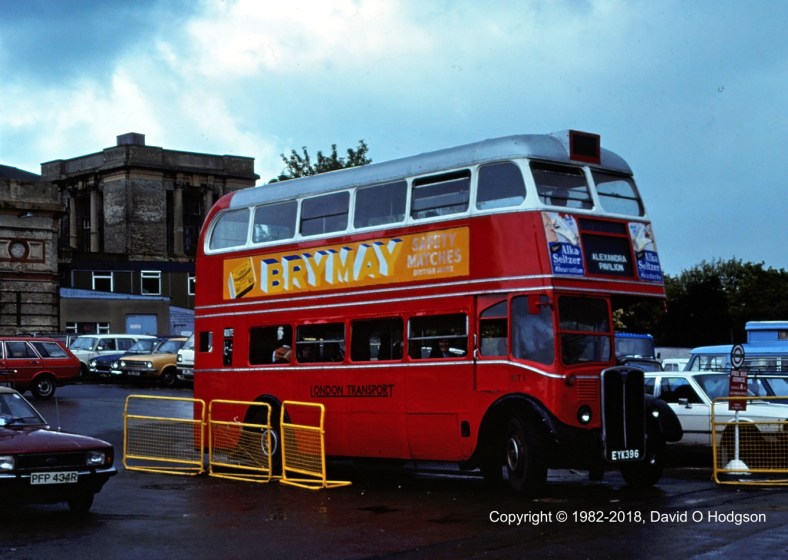
On another occasion when I visited the Palace in 1982, a public festival was underway, and several historic buses from the London Transport collection were ferrying visitors between the Palace and the nearest railway station.

London Transport RT 1 at Alexandra Palace, 1982

London Transport RT 1 at Alexandra Palace, 1982

One notable vehicle that was operating that day was RT 1 (shown above), which was the prototype of the highly-successful AEC RT class of London buses that preceded the famous Routemaster. RT 1 was built in 1939, and was the forerunner of what eventually were 4674 buses of that class, some of which continued in service until 1979.

RT 1 waiting for Custom, Alexandra Palace, 1982

RT 1 waiting for Custom, Alexandra Palace, 1982

RT 1 is seen again here, hemmed in by cars, and earning its keep by shuttling visitors to the nearest railway station. The TV transmitter and studios are visible in the background.

Rails to the Palace

In earlier days, there had been a much closer railway station. To coincide with the opening of the Palace, a railway branch was built from Highgate to the site, which terminated in a station just north of the palace building. The station building still exists today as a community centre, but should not be confused with the modern Alexandra Palace station on the main line.

The line was built by the Muswell Hill Railway, which was eventually taken over by the Great Northern Railway and finally became part of the London & North Eastern Railway group.

Tubes to the Northern Heights

During the late 1930s, London Transport developed major plans to extend its tube railway services in North London, as the so-called “Northern Heights” extensions  of the Northern Line.

Some portions of these lines were to be entirely new, while others were to be electrified sections of existing steam-operated lines. The Alexandra Palace branch became part of the plan, and work to electrify the line began in 1939.

This excerpt from the published 1937 London Underground diagram shows the planned Northern Line extensions, including the branch from Highgate to Alexandra Palace. The line from Edgware to Elstree was to be entirely new, and I mentioned my visit to the “Arches Field” that formed part of the works for that line in an earlier post.

Excerpt from 1937 London Underground map

Excerpt from 1937 London Underground map

Unfortunately, the start of World War II intervened, bringing to a halt all work on the extensions.

After the war, development priorities in Greater London had changed, and it was eventually decided not to complete some of the extensions. British Railways, which had taken over the LNER’s lines, continued to operate passenger trains from Finsbury Park to Alexandra Palace until 1954, when the service ceased.

Ghost Trains of Highgate

The London Transport station at Highgate has its own unusual history. As shown below, due to the cancellation of the Northern Heights extensions, part of Highgate Station ended up as a “ghost” which is still standing unused today.

Things to Come... But they Never Did. Abandoned Highgate Station, 1982

Things to Come… But they Never Did. Abandoned Highgate Station, 1982

The surface-level station was rebuilt in Art Deco style at the same time as the new tube station was constructed beneath it. The tube station remains in use today, which accounts for the bizarre survival of the disused platforms above it.

At the time of my visit to the “ghost” station, it was little known, and was extremely overgrown as shown in my picture, but it has now become quite famous as a “Hidden London” site.

The Invention of Wheeled Luggage


Luggage As It Was: Pencil Drawing, 1977

Luggage As It Was: Pencil Drawing, 1977

The pencil drawing above is another example of the weekly homework assignments that I completed when studying for my Advanced-Level Art qualification during the 1970s (as described in a previous post).

It’s obvious that the topic of this particular assignment was “luggage”, and the image would be extremely mundane, but notice something that none of the luggage items in the picture possess: wheels!

In retrospect, it seems incredible that the idea of adding wheels to suitcases took so long to develop. The first patent for the idea wasn’t granted until 1970. These days, most people wouldn’t consider buying a suitcase that did not have wheels and a handle, but, only 40 years ago, the lack of those features went completely unnoticed.

Learning the Hard Way

My family were anything but “seasoned travelers”, so, growing up, I had very little experience of packing and of taking luggage with me on journeys.

My parents also felt that buying new suitcases was an unnecessary extravagance, so they made do with a few decomposing leather examples, most of which probably dated from before World War II. These were typical cases of the time; strong, but with soft sides, one handle on top, and definitely no wheels or even sliders.

On the few occasions when we did pack suitcases to travel somewhere, we typically traveled by car, so loading the packed cases into the car, and unloading them at our destination, didn’t present any serious problems.

Coventry Railway Station 1979; scene of my luggage struggles

Coventry Railway Station 1979; scene of my luggage struggles

When I began attending Warwick University in 1978, therefore, it was effectively my first experience of having to transport myself and any significant amount of belongings from one location to another without benefit of a car. Naturally, we didn’t buy a new suitcase, so I inherited one of my parents’ ancient leather ones.

A few weeks after the start of the Autumn term, I decided that it would be nice to spend the weekend at home, which was only a few hours away by train. I also thought it would be a great idea to bring home with me a few of the new books that I’d purchased in Coventry. So, one Friday morning, I loaded up my suitcase and set off from my room in Coventry towards the railway station.

Needless to say, it was a disaster, because I couldn’t carry the heavy suitcase for more than a few hundred yards without having to stop and rest. Even getting from the University to the bus stop, to catch a bus to the railway station, became a Herculean task. I was saved only when a passing motorist took pity on me and offered me a ride in his car to the station.

Here was a problem that I’d never previously considered, and it became obvious that, as I acquired more possessions, the problem was only going to get worse.

Let’s Add some Wheels

As a result of my journeys, I soon noticed that more seasoned travelers had solved the problem of transporting suitcases by investing in sets of folding, add-on wheels, to which bags could be attached using bungee cords.

I quickly purchased such a set myself, which made a huge difference to the portability of my suitcases. In fact, you can still buy “luggage carts” like these, but the availability of wheeled suitcases means that they are less popular than they once were. I continued to use those wheels, and those suitcases, for many more years. I didn’t buy a suitcase with wheels until after I’d emigrated to California.

The final significant advancement in wheeled luggage, which everyone who flies now takes for granted, was the “Rollaboard”, which wasn’t invented until 1987, by a Northwest Airlines Boeing 747 pilot.

Making the Drawing More Interesting

Returning to the details of my drawing above, even at that time, I considered the subject of luggage to be extremely dull. Therefore, although the bags and cases in the drawing are themselves based on real objects, and were drawn from life, most other items in the picture came strictly from my imagination.

For example, the young woman standing behind the suitcases certainly wasn’t anyone known to me, although the clothes she’s wearing are quite typical of those worn in those days by the girls at the Scarborough Sixth Form College.

The man walking by in the background is also pure invention. I’m not sure whether my art teacher realized that I had actually invented much of the drawing, but I didn’t really care!

Derwent Valley Light Railway: the Blackberry Line

York Layerthorpe Station, 1979

York Layerthorpe Station, 1979

My photo above shows York Railway Station, as it appeared in 1979. In case you’re now feeling that there must be some mistake, I should clarify that it’s York (Layerthorpe) Station, the terminus of the Derwent Valley Light Railway (DVLR), which was still operational for freight at that time.

The DVLR acquired the nickname “The Blackberry Line” long ago, because of the trainloads of blackberries that it once carried, but the most remarkable aspect of the line was its survival as a working independent railway, from its construction in 1912 to final closure in 1981. Bear in mind that almost all other railways in Britain were grouped into the “Big Four” in 1923, then nationalized in 1948, eventually all becoming part of British Railways.

A Successful Light Railway

In 1967, S J Reading, who had been the line’s General Manager from 1926 to 1963, wrote a book describing the history to that point. Full details can be found in that book, or the 1978 revised edition.

By the end of the nineteenth century, the railway system in Britain was largely complete. There were simply no further lines to be built that would be economically viable under existing laws. To try to stimulate further growth, the government set about specifying laws that would allow so-called Light Railways to be built more cheaply.

Among many other provisions, the Light Railways Act 1896 empowered local authorities to build new lines, and the DVLR was the only instance where local authorities took advantage of those powers and actually built a line. The DVLR was promoted and developed by the Escrick and Riccall Rural District Councils.

Soldiering On

Passenger services on the DVLR were never particularly successful, and, following the end of the First World War, the growth of bus services, spurred on by the cheap availability of military-surplus trucks and buses, led to the end of all passenger service in 1926.

Nonetheless, freight services continued robustly for many decades more, peaking during and after the Second World War, when the Ministry of Food established warehouses near the line. It wasn’t until 1981 that the DVLR’s last major customer, Yorkshire Grain Driers, switched to road transport, which spelled the end of rail operations.

The Final Steam Specials

When the new National Railway Museum opened in York in 1975, the DVLR saw an opportunity to work with the NRM to offer steam train rides along its remaining tracks. This seemed like a great idea at the time, but it was soon to be overtaken by events.

Since the end of steam locomotion on BR in 1968, the nationalized railway had refused to allow operation of any steam locomotives on its tracks, so the only way to travel on a steam train was to visit one of the preserved lines that were springing up around the country. However, BR’s ban was reversed in 1971, and specials hauled by preserved steam locomotives gradually began to make a comeback.

That was bad news for the DVLR, whose small trains ambling along a few miles of rural track couldn’t compete (in the view of the public) with expresses roaring along main lines. The DVLR’s steam specials ended after the summer of 1979.

Sadly, I never took the opportunity to travel on one of those steam specials. I think we just it took it for granted that the DVLR would always be around, until suddenly it wasn’t any more.

The Bus Route to Knowledge

After returning to live in Scarborough, and beginning my first full-time job at Swifts of Scarborough, in 1979, I got into the habit of traveling to York by train almost every Saturday. There was more happening in York than in Scarborough, and York was also the closest place that had a real university!

The University of York is actually in an attractive suburb called Heslington, and during my visits I would often take a York-West-Yorkshire Joint Services bus (the number 5 service to Badger Hill, I believe) from the City Centre out to the bookstore there. In those pre-internet days, university bookstores were my only real antidote to the intellectual wasteland of Scarborough, so I was a frequent visitor.

It so happened that the bus route to the University partially paralleled the DVLR’s rail route, and the bus route crossed over the railway. I remember the overgrown rails, as the double-deck bus swayed over them, but again I never gave it much thought, because I just assumed that the DVLR would always be around.

A York-West-Yorkshire Bristol VR (right)

A York-West-Yorkshire Bristol VR (right)

Another blogger wrote a post describing how he too saw the DVLR’s tracks from his bus, on the way to York University.

The Preserved Remnant

The DVLR terminus at York (Layerthorpe) was demolished during the 1990s, and there is now no trace of the railway there. Fortunately, however, not all trace of the DVLR has disappeared. A small portion of the route has been rerailed as a preserved line.

Part of the former rail route passed through what is now the Murton Park site of the Yorkshire Museum of Farming. When the Great Yorkshire Railway Preservation Society had to move from its former home in Starbeck in 1990, the group negotiated a transfer of its collection to Murton Park. They relaid about ¾ mile of track, and even moved the former Wheldrake Station building to the site and rebuilt it there.

Where sheep may safely graze: the Preserved DVLR at Murton Park, 2008

Where sheep may safely graze: the Preserved DVLR at Murton Park, 2008

I paid a brief visit to the preserved DVLR when traveling between York and Scarborough in 2008. It was heartening to see that not only was something left of the Blackberry Line, but also that the remnant seems to have a secure future.

Delusions of Potential?

Wadham College, Oxford, during my Interview in 1980

Wadham College, Oxford, during my Interview in 1980

The photo above shows Wadham College, Oxford University, while I was staying there for an interview during 1980.

During the period 1977-81, I visited and was interviewed by quite a few universities in England, but Oxford has the unique distinction for me of being the only university that interviewed me without my having ever applied to them.

Deluding Myself?

At that period in my life, I was painfully aware that I could reasonably be accused of being a “habitual university interview attendee”. I realized that I was spending much of my free time traveling to and attending interviews at universities, with no assurance that any of that effort would lead to anything. Was I simply deluding myself, tricking myself into thinking that I had the potential to graduate from one of these institutions? Should I not instead be spending my time in looking for a better full-time job than the one I was trying to escape from?

I was nagged by doubts about what I was doing, and whether I was really just being a conceited fraud.

As I related in a previous post, having dropped out of the University of Warwick after one year, I was working full-time as an Accounts/Sales Clerk at Swifts of Scarborough. I applied for many jobs, and repeatedly received the same advice; to go back to university and obtain a degree.

By the Spring of 1980, I had essentially decided to pursue the university application route, despite knowing that, if I did so, there would be no chance of my starting a new degree course any earlier than the Autumn of 1981. That meant that I would not be able to graduate any earlier than 1984 or 1985, depending on the details of the course.

Taking a Leap of Faith

My decision seemed a particularly difficult one, because there was no guarantee that any university would consider the application of a student who’d already dropped out of another institution. Even if some university did offer me a place, how would I finance my studies? There was no guarantee that the North Yorkshire Education Authority would award me a grant (for the first year, at least), and my father had died in 1979, leaving my mother to support the household.

Having decided to study Electronic Engineering, I hoped that I might be able to obtain some kind of industrial sponsorship, whereby an employer would provide me with an apprenticeship and some kind of paid employment to complement my studies. The reality, however, was that such sponsorships were even harder to obtain than university places. In those pre-internet days, even finding sponsorships that might be available was a difficult task, requiring research at reference libraries.

I also looked at the possibility of obtaining some type of scholarship to help my finances, but that also seemed to be outside the realm of possibility. Such scholarships were intended for exceptional students who were applying from school, not for someone who had already had “one chance”.

Even if I was able to overcome those obstacles, there was still a significant risk. Unlike the case in some other countries, the award of an undergraduate university place in Britain is no guarantee that you’ll get a degree at the end of it all. What if, after all that, I went back to university but had to drop out again without a degree? What a disaster that would be, and what an immense waste of time.

The Oxford University Mystery

The Carfax Tower, Oxford, 1980

The Carfax Tower, Oxford, 1980

The City of Oxford is, of course, now internationally famous because of the Inspector Morse mysteries, written by Colin Dexter (who died in 2017). In those days, Oxford was already famous for its renowned university, but Oxford was not one the universities to which I applied, so how did I come to be interviewed there?

After I dropped out from Warwick, word eventually got back to the Scarborough Sixth Form College, where I’d taken my university entrance exams, about what had happened to me. By that time, the Sixth Form College had a new headmaster, who seemed keen to try to rectify the problems left by his predecessor. The new headmaster was a graduate of Wadham College, so he set up an interview there for me, with the idea of encouraging my efforts to return to academia.

Unfortunately, though, at that time Oxford did not have a particularly good reputation in engineering, so, weighing up the pros and cons against other institutions, in the end Oxford simply didn’t make the list of universities to which I applied!

Potential or Politics?

On the whole, I found that universities responded to my application more positively than I’d anticipated.

Chapel of Kings College, Cambridge, 1980

Chapel of Kings College, Cambridge, 1980

The University of Manchester Institute of Science & Technology (UMIST) made me an offer quite quickly after interviewing me, as did a couple of other prestigious institutions. Oddly, Cambridge University initially seemed interested, but then declined. I’ve never understood that, because I sat both the Cambridge entrance exam, and the supposedly-tougher Imperial College Scholarship exam, and obtained one of the top prizes in the Imperial College exam!

Nonetheless, I came out of the process with several offers from prestigious institutions.

An Abundance of Rewards

As I mentioned above, given my concerns about how I would support myself financially during my years of study, I had pursued several possibilities to supplement my income. In the end, amazingly, all those efforts paid off!

  • I had struggled to obtain an industrial sponsorship, and succeeded in obtaining a Student Apprenticeship with Ferranti plc, in Manchester. Ferranti would provide me with employment during the summer breaks, and also gave me a small annual bursary to help with my living costs.
  • I had sat several optional examinations in an attempt to win a scholarship, and I obtained a Royal Scholarship from Imperial College, London. The award was only for my first year there, but that was the year for which I’d been concerned about obtaining a grant.
  • In the end, the Local Education Authority was convinced of my bona fides, so they did award me a full grant for the term of my studies.

My Employer’s Misplaced Concerns

By May of 1981, everything seemed to have fallen into place. I had an apprenticeship set to start at Ferranti, and an undergraduate place at Imperial College waiting for me that October, so it was time for me to give notice to my employer, Swifts of Scarborough.

As we discussed the termination of my employment, Swifts’ Managing Director claimed to be quite concerned for my financial future. Had I considered, he asked me, that I’d be giving up a full-time income and would be forced to live on a student grant, and in London too!

Yes, of course I had considered that, I explained. I went on to explain to him that, with my full grant, my Ferranti bursary, and my Royal Scholarship, my “take home pay” would actually be higher than it had been working for him! That was the last I heard from him on the matter of my future…

You Have to Stay in it to Win it

The decision to commit to re-entering university was, at that time, the hardest and riskiest that I had had to make in my lifetime. Nonetheless, I’m really glad that I rejected the warnings of the naysayers and stuck to my own “gut instinct” that it was the right way to go.

There have been other occasions since then when I’ve had to make similar decisions, without any assurance that I’m going to be able to meet the challenge that I’m setting myself. As I see it, there is no choice but to accept the challenge and face the risks. After all, if you back down, you are absolutely guaranteeing that you will never succeed; you have to “stay in it to win it”.