The drawing above, of Thornton Dale Railway Station, (reproduced much smaller than life-size here) was the most ambitious of the architectural views that I created for my Advanced-level Art project during 1977-78. I’ve also posted this drawing on a page about the subject – Thornton Dale railway station – along with several photos that I took, and sketches that I made, at the same time.
Not Part of the Syllabus
I realize that some of the illustrations that I’ve been reproducing in this blog from my Art study (such as this and this) may give the impression that architectural drawing skills were taught as an element in the A-level course. In fact, nothing could be further from the truth. My expertise in such drawing techniques derived entirely from an O-level in Geometric Drawing that I had completed at the Graham School a few years previously. During the two years of the A-level course, I don’t recall ever having been taught anything about architectural illustration!
A few years later, when I commenced my Student Apprenticeship at Ferranti, I naturally assumed that my Geometric Drawing O-level should count towards my training, but no! We were required to learn technical drawing as part of the IEE-prescribed EP1 training, but no credit was given for prior expertise in the subject.
Of course, the fact that I’d obtained an O-level in the subject did make the Ferranti training much easier to complete, so my prior qualification was useful in that sense.
My Drawing of a Bristol Lodekka Bus; produced for the A-level Study but not used
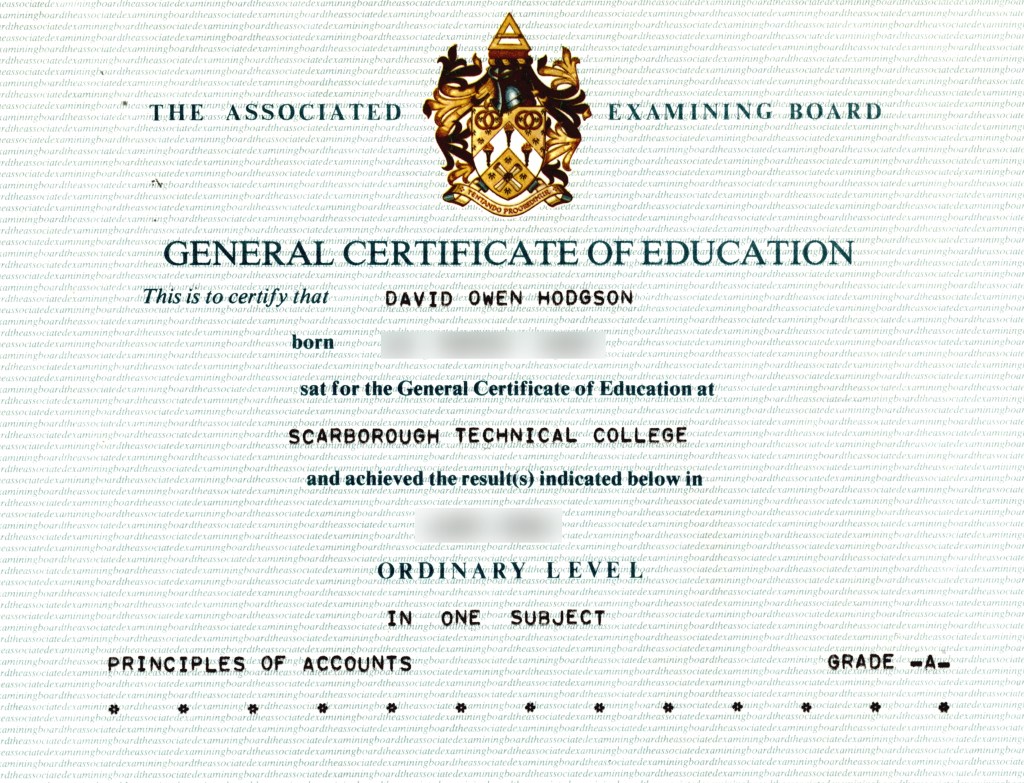
O-Level Principles of Accounting
Here is another example of a qualification that I obtained, and which was useful, but was not recognized by professional bodies. As I’ve described in another post, prior to joining Ferranti, I had worked for about 18 months as a Purchase Accounts and Sales clerk at the light engineering company Swift’s of Scarborough.
Soon after my employment commenced, my manager suggested that I might consider obtaining an Ordinary-level qualification in Accounting. It seemed as though that would help me do my job better, so I started a course at the Scarborough Technical College (now Scarborough TEC). I sat the exam and easily obtained the O-level in 1980. There was some suggestion that I should continue by taking an Advanced level qualification in the same subject, but, by that time, I had concluded that my time would better be spent studying to return to university. I already had more than sufficient O- and A-levels to qualify for university entry, so why add another one?
Part of the Certificate for my O-level in Principles of Accounts
Useful in my Job
There’s no question that what I learned from the O-level course did prove useful in the execution of my duties at Swift’s. Perhaps the most basic principle instilled into us by the course was the concept of double-entry bookkeeping; a simple idea but a powerful and necessary one. The only problem with the O-level qualification was that it was not professionally recognized in any way; had I wanted to become a Chartered Accountant, my O-level would not have been considered as a contributing qualification.
That leads to a seemingly-obvious question: Why didn’t Swifts encourage us to get recognized professional qualifications? At the time, I suspected that the cause may have been my manager’s lack of such qualifications; he had only an A-level in Accounting, and that also was not recognized professionally. Presumably, he would not have liked the idea of his subordinate becoming more qualified than he was! With the benefit of hindsight, however, I suspect that the real cause had more to do with the inherent sexism of the time and place. The underlying assumption of Swift’s management was that whoever they hired for any Accounts Clerk position would be a young woman, with a few O-levels, and perhaps a couple of A-levels. The young woman could be expected to work at Swift’s only for a few years before getting married, at which point (they assumed) she would leave employment forever to become a housewife and raise children. As such, presumably Swift’s management saw no point in expending time and money on professional training for a career that their employees would probably never have.
Of course, in a more competitive employment environment, Swift’s would probably have been forced to offer proper professional training, to attract candidates with sufficient intelligence for the job. However, the sad reality was that there were so few opportunities for intelligent young people in the Scarborough area that they didn’t need to.
Useful at University
Having left Swift’s, and embarked on my degree course in Electronics at Imperial College, London, I discovered that we were encouraged to take non-engineering courses such as Accounting & Finance, Macroeconomics, etc. Again, the fact that I’d obtained the Principles of Accounting O-level made my Imperial College studies in Accounting & Finance much easier to grasp, so the knowledge I’d gained did come in useful again, even if it was not professionally recognized. My results in the Accounting & Finance course counted towards my final degree grades.
They still don’t seem to get it
More recently, it has seemed to me that, at the very least, Ordinary-level Principles of Accounting would have been a beneficial subject for study by those who designed the Horizon software for the British Post Office!
As the forensic accountant investigating that scandalous failure reported, the software violated basic principles of double-entry bookkeeping, such that, even if the code had been well implemented (which it was not), the system was bound to fail quite quickly.
Can it be that not one of the technical contributors to the Horizon software system had even an O-level in Principles of Accounts? If so, then how could a major national institution such as the Post Office ever have believed that the resulting system would be trustworthy as a key component of their accounting systems? I don’t know the answers to those questions, but they would certainly seem to be worthy of investigation!
The photo above is, sadly, the only one that I ever took of BBC Broadcasting House, even though I worked there and walked in and out of the building regularly. With the benefit of 40 years of hindsight, I regret that, from 1984 through 1987, I took no photographs at all. At that time, it simply never occurred to me that I might one day want to describe and illustrate what was happening to me! I was only prompted to restart taking photographs when I visited California for a job interview in October, 1987. Therefore, this article, and others discussing the events of this time period, are unfortunately quite lacking in personalized images!
In a previous post, I mentioned how, during the early 1980s, my primary goal in obtaining an Electronics degree had been to obtain what I sincerely thought would be my “dream job”, as a video engineer at the British Broadcasting Corporation (BBC). I finally obtained that job in 1984, almost exactly 40 years ago, so this seems like an appropriate time to review the details of what happened then, and my reactions to it.
Having completed my degree at Imperial College, London, I interviewed for and obtained an entry-level Engineering job with BBC Studio Capital Projects Department (SCPD), which was responsible for building and renovating studios. The final interview seemed to go so well that I actually had the temerity to ask the intimidating board of three interviewers about my chances, given that I’d already received a job offer from the Philips television systems design plant in Croydon (which I did not want to lose, if the BBC turned me down again).
The interview board asked me to leave the room for a few minutes while they discussed my case. When I re-entered the room, they informed me that, subject to their receiving confirmation of my degree grade, I’d got the job! The only further thing they wanted to know from me was, “how come you know so much about television?” I explained that I’d just spent the last 2 years as a volunteer and then Chairman of Imperial College Student Television, which had given me experience in every production job, from producing through presenting to videotape editing.
Now, with the benefit of so much hindsight, I see that I should perhaps have been tipped off by that final question that something was amiss, but, after all, in those days I was just a naïve young graduate, who naturally trusted that my new employer would be acting in my best interests!
Letter from the BBC, informing me that I’d been selected
I was overjoyed at being offered the opportunity that I had sought for so long, but unfortunately I was soon to discover that the reality of my new job was not at all what I’d anticipated.
Digression: The Realities of Auntie
For readers who do not live in Britain, I should perhaps explain something about the exalted status of the BBC (nicknamed “Auntie”) in that country’s national mindset. (This reputation has been seriously damaged by recent scandals, including official cover-ups of abusive and pedophile behavior by certain BBC celebrities, but, back in those days, that was all kept firmly secret.)
It may come as a surprise to you to learn that, in a country that is supposedly a cradle of free speech, the BBC was for many decades a monopoly broadcaster in Britain. For many decades, by law, only the BBC could broadcast radio or television services. As from 1923, all British residents had to pay an annual licence fee to operate broadcast reception equipment, although since 1971, only television receivers have required a licence. Any other organization that attempted to broadcast was a “pirate”, and the British government made strenuous efforts to shut down such organizations whenever they could. Nonetheless, broadcast advertising was such a lucrative market that many pirate radio stations did operate. As I recounted in a previous post, the governor of my own school was a director of one such pirate station!
Despite its monopoly, the BBC was not officially an arm of government. It was nominally independent, and, although it usually toed the government line, its independence was sometimes the cause of friction between the Corporation and officialdom.
The BBC lost its monopoly on television broadcasting in 1955, when the Independent Television Authority began broadcasting a rival, regionally-distributed, ITV service, supported by advertising. Nonetheless, the BBC was still regarded as the “high-brow” service, and was accorded perhaps-undue respect for that.
As regards engineering training, the reality for many years was that only the BBC offered any professional training. ITV’s contractors usually simply poached trained engineers from the BBC. Therefore, it seemed to me that the only way to get into broadcasting was to undergo the BBC’s training, and the only way to obtain that was to work there.
It turned out that I was wrong, on many counts.
It’s Not Licence-Payers’ Money We’re Wasting!
I began working for the BBC on 13th August, 1984. The location of my office was the so-called “Woodlands” building, which was at 80 Wood Lane, quite close to Television Centre in White City.
I went through the expected employee induction process, but, as I settled into the job, it began to seem that there was actually very little for me to do. Having asked to be assigned some work, I was given various unnecessary tasks, such as auditing the acceptance of a new audio mixing desk, which in fact had already been accepted. I was provided with no information about the expected performance characteristics of the audio desk, so my review was mostly meaningless anyway.
As I recall, the single highlight of that period of my employment occurred one day when we got an urgent message that a radio microphone had failed at Broadcasting House, a few hours prior to a live broadcast. I rushed over there with two colleagues to investigate, only to discover that a wire had come loose within the microphone base. We obtained a soldering iron, and (thanks to my EP1 training at Ferranti), all was fixed a few minutes before the broadcast! Seriously, that was as “cutting-edge” as things got!
I complained to management about the lack of available work, but got nothing except shoulder-shrugging in response. Initially, they explained that it was because they had done me a favor by allowing me to start early, prior to the official training date at the Evesham training school. That excuse might have made sense, except for the fact that it was obvious that my fully-trained colleagues didn’t have sufficient work either!
I became disillusioned with the justifications that were being offered to me by SCPD management, and by what seemed to be a haughty refusal to engage with me. Having selected some of the best graduates from the best British universities, apparently they now expected those same people to accept seemingly illogical decisions without question! It seemed obvious to me that, despite their heads-in-the-sand attitude, they would not be able to maintain the charade indefinitely, and that the likely ultimate result was that at least some of us would be made redundant. The only remotely meaningful response that I ever got was, “Don’t rock the boat”. What “boat”? Why were my concerns about the true situation “rocking” anything?
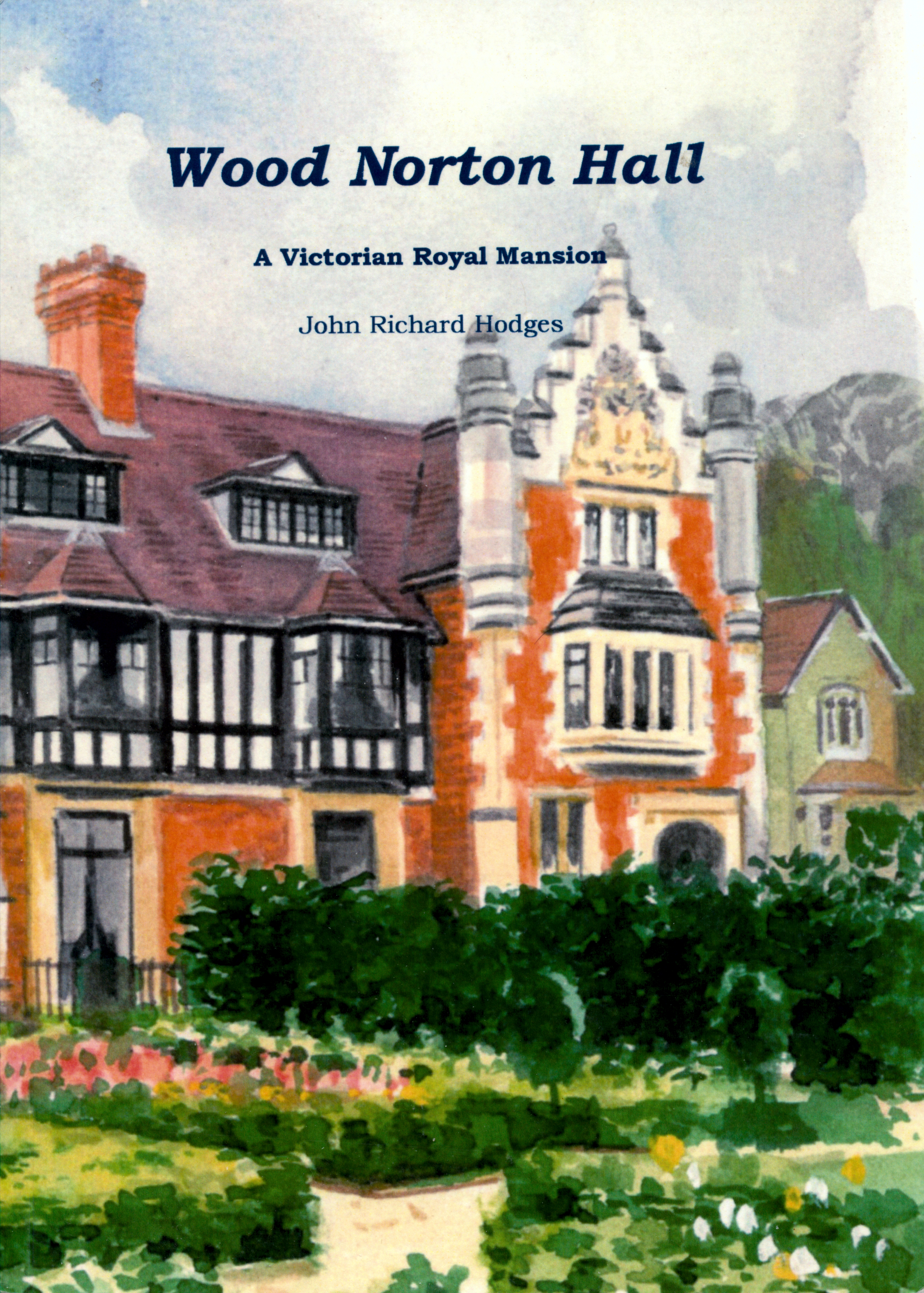
Following a few months of this tedium, I was sent along with many other new-hire engineers for the formal residential training sessions at the BBC Engineering Training School, which was located at Wood Norton Hall, in Evesham, Worcestershire (and which still exists, but is now a hotel). There is an entire book about Wood Norton Hall. It’s out-of-print, but can be obtained used, at, for example, https://www.amazon.co.uk/Wood-Norton-Hall-Victorian-Mansion/dp/0955405793/ref=sr_1_1
As part of that course, we were required to undergo the EP1 training specified by the Institution of Electrical Engineers (IEE). As I mentioned in a previous post, I had already spent several months completing exactly that training at Ferranti, and had a certified notebook to prove it. Why, then, should I spend time redoing exactly the same training? When I asked that question, it became apparent that I was by no means the only new BBC trainee who had already completed the EP1 training.
I pointed out to management that forcing us all through the same training again was a serious waste of money. The BBC were always sensitive to the suggestion that they were squandering licence-payers’ money, so management was eager to defend their stance, with this appalling justification: “It’s not licence-payers’ money we’re wasting. The Engineering Industry Training Board (EITB) reimburses us for the cost of EP1, so it’s the EITB’s money we’re wasting!”
At around that time, it struck me that the job I’d accepted at the BBC was not the role that I’d originally had in mind. My initial application, in 1980, had been for an “Operations” job, that is, as a technician who operated or maintained broadcasting equipment. Those were the kind of roles I’d noticed when I visited Yorkshire Television, and which had stimulated my interest in working in the field in the first place.
Therefore, I asked my manager whether I could transfer from SCPD to one of the Operations Departments. His astonishing answer to me was along the lines of, “Oh no. Those jobs are for people with third-class degrees. Your degree is too good for that!”
So, apparently I’d gone from being underqualified for the BBC job in 1980, to being overqualified for it in 1984!
Having made no headway in trying to argue the problem with management, I eventually began looking for alternative employment, even if that would mean leaving the field of “video engineering”. After various interviews, I was offered an exciting position as “Technical Sales Engineer” by an electronics distributor called Swift-SASCO, who were based in Crawley, Sussex (but not in any way related to my previous employer, Swifts of Scarborough). Not only was the salary in that position comparable to what I was earning at the BBC, but they also offered an all-expenses-paid company car, plus the potential for sales bonuses. The offer was simply too good to ignore, so I accepted it and handed in my notice at SCPD, thinking sadly but mistakenly that that would be the end of my short career in video!
Retrospective: My Alternatives
Alternatively, I realize that I could perhaps have viewed my unproductive months of training at the BBC as being merely “paid education” and patiently plodded through it without complaint. I could also have spent my “enforced idleness” in exploring more of those historic buildings in which I found myself working. Perhaps I could then have moved to one of the ITV contractors? I’ll never know whether that would have worked out, but it would certainly have propelled the remainder my life in a very different direction, so in retrospect, I’m glad I did not.
In fact, I had overestimated the value of the BBC training. I’ve subsequently worked with many expatriate British engineers, quite a few of them specializing in video equipment design, yet not one of them ever underwent that BBC training! I discovered that the BBC’s engineering expertise simply was not held in high regard in the electronics or computer industries. As one former boss told me, “The BBC think they know it all, because they think they invented television. They don’t and they didn’t.”
After leaving the BBC, I stayed in contact with some of my former colleagues for a while. The word that got back to me was that, following my departure, management seems to have implicitly realized that the situation had been mishandled, and had made an effort to change their attitude. When one of my colleagues subsequently complained about some other unsatisfactory situation, his manager’s response was, “I’m glad you let us know. We don’t want anyone else to leave”!
I also discovered in the same way that, about six months after I resigned, many of my former colleagues were, in fact, made redundant from SCPD. My foreboding had been correct.
Why the Secrecy?
Nobody at the BBC ever offered me an explanation of what seemed to be the unreasonable behavior of SCPD’s management. Therefore, I can only surmise what was really happening at that time, based on descriptions and opinions I’ve received from other video engineers, inside and outside the BBC.
Here is what I was told:
Why did Studio Capital Projects have insufficient work?
As discussed in detail here, the then Prime Minister, Margaret Thatcher, and her Tory government, were engaged in a rather ridiculous ideological dispute with the BBC. The BBC (rightly) valued its independence, and its goal of providing objective, unbiased news reporting. Thatcher, on the other hand, took the view that, being funded by a licence fee, the BBC should in fact be a government propaganda arm. Unable to shut down or defund the BBC, she made petty attempts to hobble its position in other ways.
One such way was to insist that the BBC must “operate competitively”, supposedly to obtain value for money for licence-payers. Previously, whenever a BBC studio required refurbishment, the work had automatically gone to SCPD. Now, however, the BBC were forced to request bids for such work, not only from SCPD within the corporation, but also from external private companies.
The result was that external contractors always underbid, and so were awarded the contracts, leaving SCPD (which had bid according to the true costs of a project) without any work.
Logically, of course, if SCPD had no work, then the department should have closed or been repurposed. However, in that case, Thatcher would have won what was really a purely political battle, and some in the BBC were apparently determined not to concede.
Why did Studio Capital Projects hire more Engineers?
Given that SCPD had insufficient work for the engineers that it already employed, why would it nonetheless go ahead and hire even more engineers?
It was later suggested to me that this probably occurred because the BBC was “not a commercial organization”. Its annual income was essentially fixed by the licence fee collections, so the BBC’s budget was based on dividing up that fixed income among the various departments.
The primary way that a particular department could argue for a higher portion of the fixed budget was to employ more people. Hence, the goal of hiring more staff became completely detached from the question of whether such staff were actually needed!
Bad Times on the Horizon
The management issues that affected my employment at the BBC came as a great shock and disappointment to me at that time. Little did I realize back then that it would be just the start of a frustrating sequence of jobs with UK engineering employers, which would continue until I “escaped” to California (and relative sanity!) in 1987. Through no failing of my own, I worked for several employers during that 3-year period, with the management of each company being at best unstable, and at worst incompetent, as I experienced firsthand a portion of the terminal decline and failure of Britain’s electronics and computer industries. I hope to write more about some of those experiences in future posts.
It seems that the kind of mismanagement that plagued my employment experience in Britain is not a thing of the past. I was shocked by the recent news of the appalling Horizon Scandal in Britain, which seems to have stemmed from technical incompetence, and subsequent attempts by management to cover that up at any cost.
I am So Glad I Left
Let me emphasize once more that, in hindsight, I am so glad I quit that BBC job when I did! If I had not done that, but instead had listened to the discouraging comments of certain timid naysayers around me, and had clung on there, I would probably never have had the opportunity to move to California and work in “Silicon Valley”. As I have described in several earlier posts, there’s no question that the move to California changed my life immensely and permanently for the better.
I gave some thought to the wording of the title of this post. The phrase “illusory limitations” reflects both the way that I underestimated my own potential skills at that time, and the way that others attempted to impose false limitations on me. When I joined the BBC in that role, I really thought that it was the best I could do. I did not seriously imagine in those days that I could become a design engineer, and certainly not a patent-holding inventor. Fortunately, I didn’t ultimately settle for an underachieving career!
The message that I hope this tale of my experiences will convey to readers is not to be cowed by the unreasonable demands of any employer. Be confident in your own position, and don’t sacrifice your own future for the convenience of others who ultimately do not have your best interests at heart.
The photo above was taken many years ago in the main railway station in Lucerne, Switzerland, just after Mary and I had arrived from Chiasso. Mary looks as though she is waiting for me to help her with our luggage! During my travels, I have rarely taken photos that included luggage, but since the topic of packing that luggage is the subject of this post, it seems appropriate here.
As I’ve mentioned before, my parents were anything but “seasoned travelers”, so I grew up with very little experience of packing suitcases. I really didn’t pack a suitcase myself until I went away to university for the first time. As I recounted in an earlier post, I quickly learned some hard lessons about what or what not to pack!
However, those lessons didn’t really solve the problem of how to remember to pack everything that I would actually need, and how to avoid forgetting some vital item.
Whatever You Do, Don’t Forget That!
To be honest, I didn’t usually “panic” about packing, but there was a low-level anxiety. Whenever I had to pack a suitcase, even for an overnight stay, there was always a nagging worry that I was forgetting something important.
Usually, my fears turned out to be unfounded, but on one occasion I did forget something vital.
During 1986, I had to fly from London to Munich, just on a one-day trip, to attend a job interview. As I was parking my car at Heathrow Airport, I suddenly realized to my horror that I had left my passport at home! There wasn’t time to drive back home to get it, so I decided that I had no choice but to go to the checkin terminal, and ask about my options.
My flight was with British Airways, and unfortunately this was to be my first experience of misleading information provided by that airline (but not the last). The checkin agent was adamant that there was no way I’d be allowed into West Germany without my passport, and that the immigration authorities there would simply send me straight back to Britain. Taking the flight would simply be a waste of time, she claimed.
Nonetheless, I couldn’t cancel my ticket at that point, so it seemed that I had nothing further to lose by taking the flight to Munich. When I arrived in Munich, it turned out that what I had been told by the British Airways representative had been completely false! When I explained my predicament, the German immigration officer laughed, and assured me that this situation occurred every day. He told me that they could simply issue me with a temporary Reisepass, which would allow me into the country just for the day, and which I would surrender on leaving.
That was what I did, and, apart from a few additional delays answering extra questions, it was really no problem at all. There wasn’t even a fee to pay!
Inspiration: Make a List
Despite the unexpectedly happy resolution of that situation, I continued to wonder whether there might be some way for me to guarantee that I would not forget some vital item when packing. As I grew older and traveled more frequently, the significance of the problem increased.
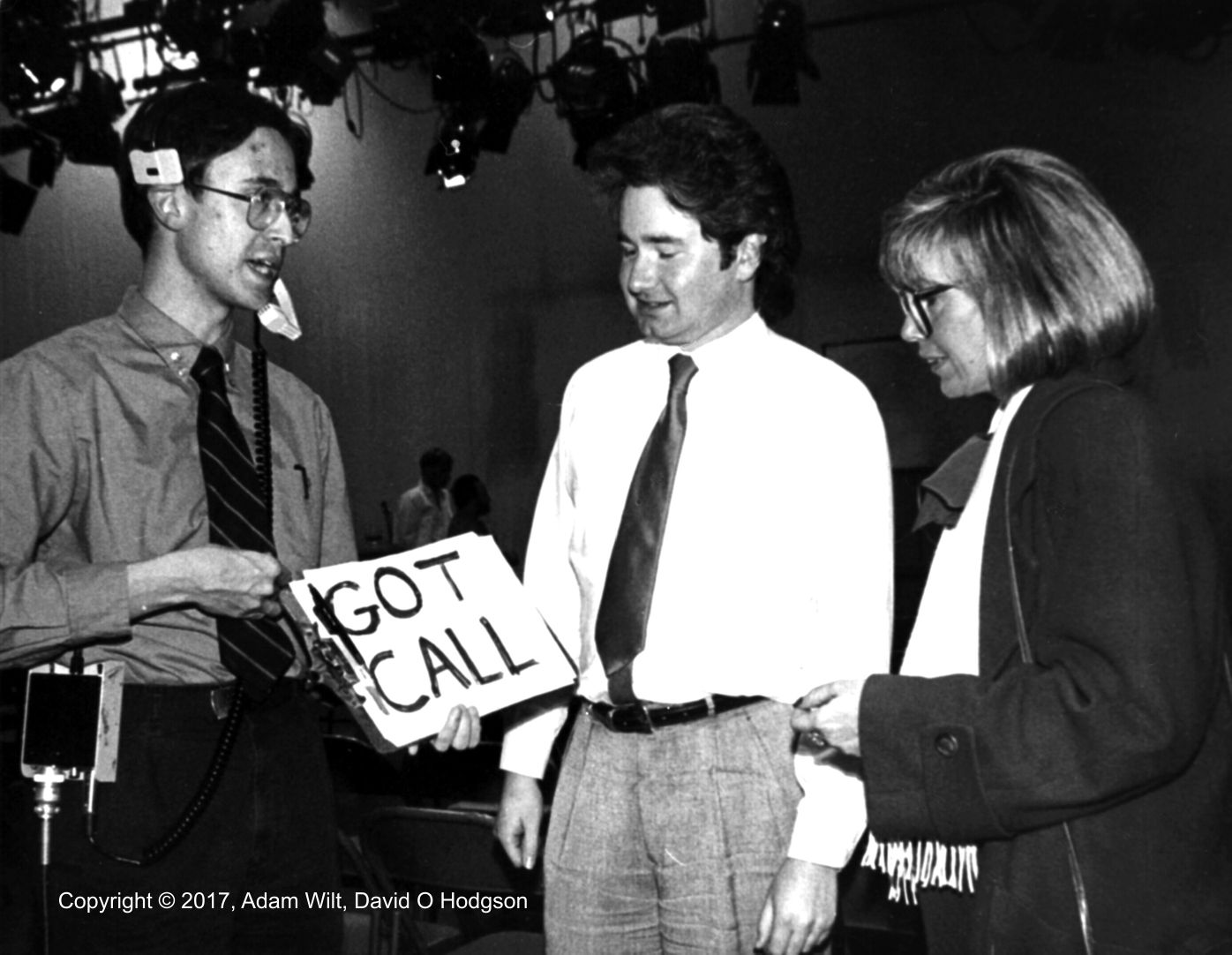
Eventually, I was inspired to find a solution by the activities of my friend Adam Wilt, who is shown below (on the left), with me and Mary, at an SMPTE video broadcast some time during the 1990s.
Broadcasting an SMPTE Meeting
Adam provided videography services at many events, and he always brought all his own equipment with him. That included a wide variety of small-but-critical items, such as cables and adapters. Obviously it was important for him to avoid leaving some item behind at the end of every shoot. I couldn’t help noticing that, when packing his kit, he created a handwritten list, ticking off every item as he packed it, and then ticking off every item again as he repacked after the event.
It immediately dawned on me that here was the solution to my packing worries! If I just made a list of everything that I needed to pack, then I wouldn’t have to worry about forgetting anything. It seemed like a great idea, but then, of course, how would I ensure that the list itself was complete?
I realized that if I created my list on a computer, as a word processor file, then not only would I avoid having to rewrite it for every journey, but I’d also be able to improve the list after each trip, adding or removing items as travel conditions changed. (For example, years ago my list included phone cables and adapters for dial-up internet connections in hotels, but none of that is necessary now!)
I created my list more than 20 years ago, and I’ve used edited versions of it for every trip since then. I sub-divided the list to make packing even easier, splitting off, for example, items needed only for international travel, and (after 9/11) items that could or could not be carried onto aircraft.
Mary traveling in style!
The photo above illustrates the pleasures of care-free travel. Mary was relaxing in an airbed seat, on a flight back to the US from London, having carefully included her crafting items in her carry-on baggage, so she could work on her projects during the flight. For my part, I could enjoy the flight, without having to worry about having forgotten some vital item.
Many thanks to Adam Wilt for the inspiration that permanently solved my problem!
The photo above, which I took in 1981, shows Bloomsbury Square, London, following a seasonal snowfall. At the time that I took the photo, I was working part-time at Selfridges, a well-known department store on nearby Oxford Street.
In previous posts, I’ve described how I moved to London in October 1981, to begin my studies for an Electronic Engineering degree at Imperial College.
In Britain, each undergraduate academic year is divided into three terms: Autumn, Spring and Summer. There’s a short Christmas break between the Autumn and Spring terms, and another Easter break between the Spring and Summer terms. Typically, during the short breaks, young students return home to their parents, and take the time off.
My family situation, however, was somewhat different. My father had died in 1979, and my mother was struggling to support herself, so I did not feel that I could just go back and expect her to support me as well. Instead, I decided that I would try to stay in London and obtain temporary work during the short breaks. I found that it was possible to stay in my student accommodations during the breaks if I paid additional rent.
Finding suitable work turned out to be relatively easy, but, in retrospect, I have come to doubt that the job choices I made were for the best.
The Scarborough Pattern
During my schooldays, I had become accustomed to seeking work in menial jobs during the school holidays. In a seaside resort like Scarborough, that usually meant working as a waiter in a hotel or café, or perhaps as a shop assistant. Even if I had had the skills to do more sophisticated work at that age, such work was probably not available in that town anyway.
Thus, when I found myself becoming a student again, this time in London, I fell into the mindset of seeking out types of temporary work that were similar to those that I’d done in Scarborough.
That was a mistake; I should have searched for jobs that would have made better use of my special skills, and would probably have paid better. I was in the very unusual situation of having just worked fulltime in accounting for 2 years prior to starting my studies. Surely, in a world financial center such as London, I could have obtained some temporary work in that field!
The only good aspect of these menial jobs was that the experiences have left me with a cache of anecdotes about the events that occurred.
Mister Selfridge
Prior to the Christmas break for my first academic year in London, I applied to Selfridges Department Store for a sales assistant position, and was accepted.
As a teenager growing up during the 1970s, I was very familiar with the popular (but low-brow) situation comedy series Are You Being Served?, which actually ran on the BBC from 1972 through 1985. The show was set in a fictitious London store called Grace Brothers, but, as I was to discover, the staff uniform of Grace Brothers was strangely similar to that of Selfridges.
More recently, Selfridges has gained worldwide fame as a result of the television series Mister Selfridge, which portrays the early history of the business. Although the TV series used specially-built sets to depict the store, many of these seemed very accurate, and reminded me of the rooms and corridors within the huge building.
The illustration below is an advertisement that Selfridges ran in a 1964 book about London boroughs.
Advertisement for Selfridges, 1964
There are many stories to tell of surprising and amusing incidents that I experienced while working at Selfridges (and also at Harrods, during one break), or in some cases heard about from other employees, but there isn’t room to tell all of them in this article. Between Christmas 1981 and Spring 1983, I worked in several different Selfridges departments, including luggage, gifts, and finally electronics.
The Electronics Department
In this article, I’ll jump ahead to what turned out to be my final stint as a part-time employee at Selfridges. During the Spring of 1983, I worked Saturdays-only in the Electronics Department in the Oxford Street store.
Now, surely, this department was ideal for me. After all, I was an undergraduate EE student, so now I would be able to bring that knowledge directly to bear in helping Selfridges’ customers. While that turned out to be true, I discovered later that my special skills were not received in a similar light by the department’s regular staff. Although the store hired many students as part-time workers, there was also a substantial staff of full-time employees, whose entire career was wrapped up in their work there.
One Saturday, I was standing at the counter in the Electronics Department when I was approached by an apparently exasperated customer. He explained to me that he wanted to power an item of equipment from a 12V car battery. He knew the maximum current that the battery could supply, but didn’t know whether the battery could supply sufficient power for the equipment.
I explained to him the simple equation relating electrical power to voltage and current (W = VI) that I’d learned during my O-level Physics classes at school. We were able to determine that his battery would be able to supply more than sufficient power for the equipment.
After we’d finished performing the calculation, the customer had a question for me:
“How come I’ve asked this question of every assistant in this department, and you’re the only one who could tell me?”
I responded, truthfully, that it was probably because I was the only undergraduate electrical engineering student working in the department.
I thought nothing more of the incident, which seemed at the time to be just another of the usual daily problems that arose, and which I had successfully handled. My Saturdays-only employment terminated by mutual consent, and as far as I was aware, there was nothing but goodwill between myself and my employer.
The Assistant Who Knew Too Much
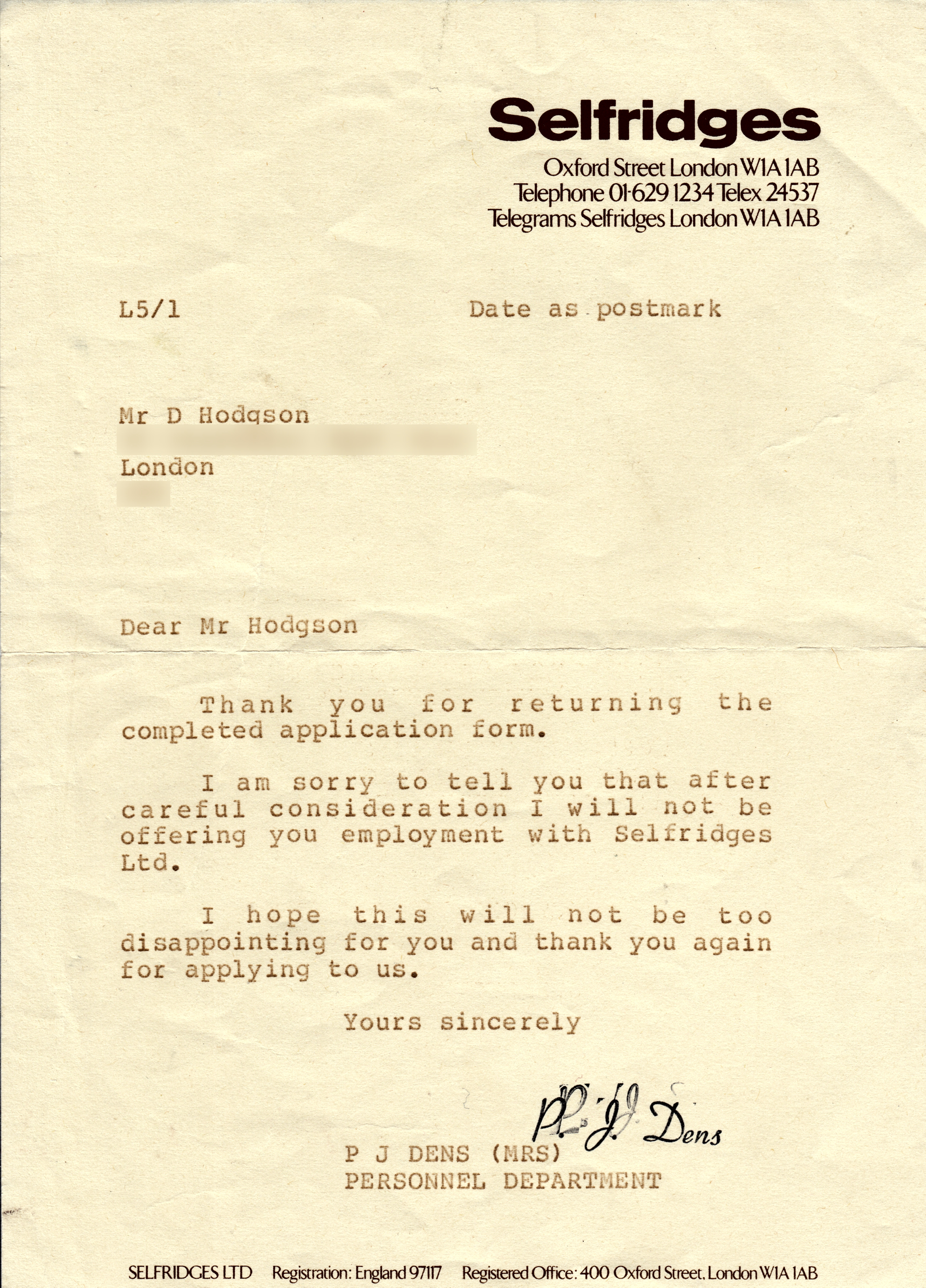
When I subsequently applied for re-employment during Christmas 1983, I received the following surprising and mystifying response:
Rejection!
I can only believe that, unbeknown to me until then, my unusual expertise in electronics had ruffled some feathers somewhere among the store’s fulltime staff. The content of the letter is strangely brusque and unhelpful; it’s obviously a form letter, personalized with my name and address, but not the date!
Unfortunately, there are no photos of me working at Selfridges (or at any of the other London locations where I did temporary work). However, the photo below was taken at about the same time that I was doing those Saturday stints at Selfridges, and just after I had produced a video interview with Sir Cliff Richard at the Imperial College TV Studio.
Me (left) following a video interview with Sir Cliff Richard, 1983
Don’t Sell Yourself Short
In retrospect, then, I have come to believe that working in those menial jobs was a mistake, and I recommend others in a similar situation to think very seriously before committing to such work.
The issue isn’t simply that you’ll be wasting your time and skills, and perhaps accepting lower compensation than necessary in return. There’s also the problem that your superior skills are likely to cause resentment among others, who in some cases may go to considerable lengths to combat what they see as your “unfair advantage”.
The pencil drawing above is a surviving sample of the life drawing work that I did at sessions in Reading during 1986-7. If you understood the word “Reading” here as referring to the reading of a book, then the title and first sentence of this post must have seemed quite meaningless.
In fact, Reading in this context is the name of a town in England, about 40 miles west of London, and it’s pronounced “Redding”. Reading forms the hub of an area known as the M4 Corridor, where huddle many of Britain’s remaining electronics technology industries. That was also true in the 1980s, when Britain had many more such industries than it does today.
Reading was perhaps first made famous during the nineteenth century by Oscar Wilde, who was imprisoned in Reading Gaol, and wrote a lengthy poem called The Ballad of Reading Gaol. In that poem, he wrote:
In Reading gaol by Reading town
There is a pit of shame…
I’m glad to be able to say that the hours I spent in Reading were definitely not in any “pit of shame” (except perhaps for certain pubs…).
More recently, of course, Reading has again achieved fame as the birthplace of comedian Ricky Gervais, who wrote a movie named after an area of the town: Cemetery Junction.
A New Venue
In an earlier article, I described how I attended Life Drawing classes in Andover during 1985-86, while I was living there and working for Link Electronics. Unfortunately, despite having created some brilliant products, Link turned out to be just one more failing British company, with the result that I was laid off in June 1985, when their management decided to shut down the design and manufacture of television cameras.
After searching for suitable alternative employment for a few weeks, I accepted a Design Engineering position with a small digital video equipment company called Questech, who were based in Wokingham, Berkshire. (As you may have guessed, because it has become such a repetitive theme, Questech is also now long out-of-business.) Although I was still living in Andover, I could no longer attend the sessions at Cricklade College, so I looked around to find something similar in the nearest large town to Wokingham, which was Reading. I eventually found a suitable class at a branch of the University of Reading, on Bath Road.
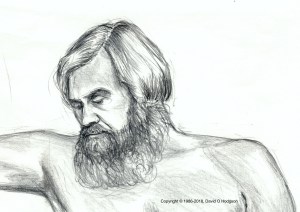
Just to demonstrate that life drawing models aren’t always female, here’s an example of one of my drawings from Reading that featured a male model.
Male Nude, Reading, 1986
However, those drawing sessions were not by any means the first time I’d visited Reading, because I’d had a somewhat ambivalent connection to the town since 1978.
Revisiting Reading
I had actually first traveled to Reading in 1978, while living in Coventry. While at school in Scarborough, I had had a crush on a girl who had gone on to study at the University of Reading. Had I been more mature, I would have realized that my crush was futile, but I was just another irrational teenager…
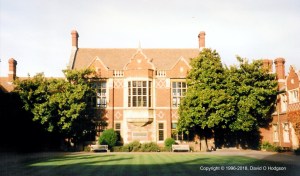
Thus one day—her birthday, in fact—I had the “bright idea” to go to Reading and seek out her room in the beautiful Wantage Hall.
Wantage Hall, University of Reading, 1996
I don’t think that I was really intending to try to meet up with her during that visit, but in fact I did, along with her new boyfriend! Fortunately, it all seemed to go fairly amicably, which perhaps was partly because she was still half-asleep during our unplanned meeting! It turned out to be the last time I ever saw her, which was probably just as well for all of us.
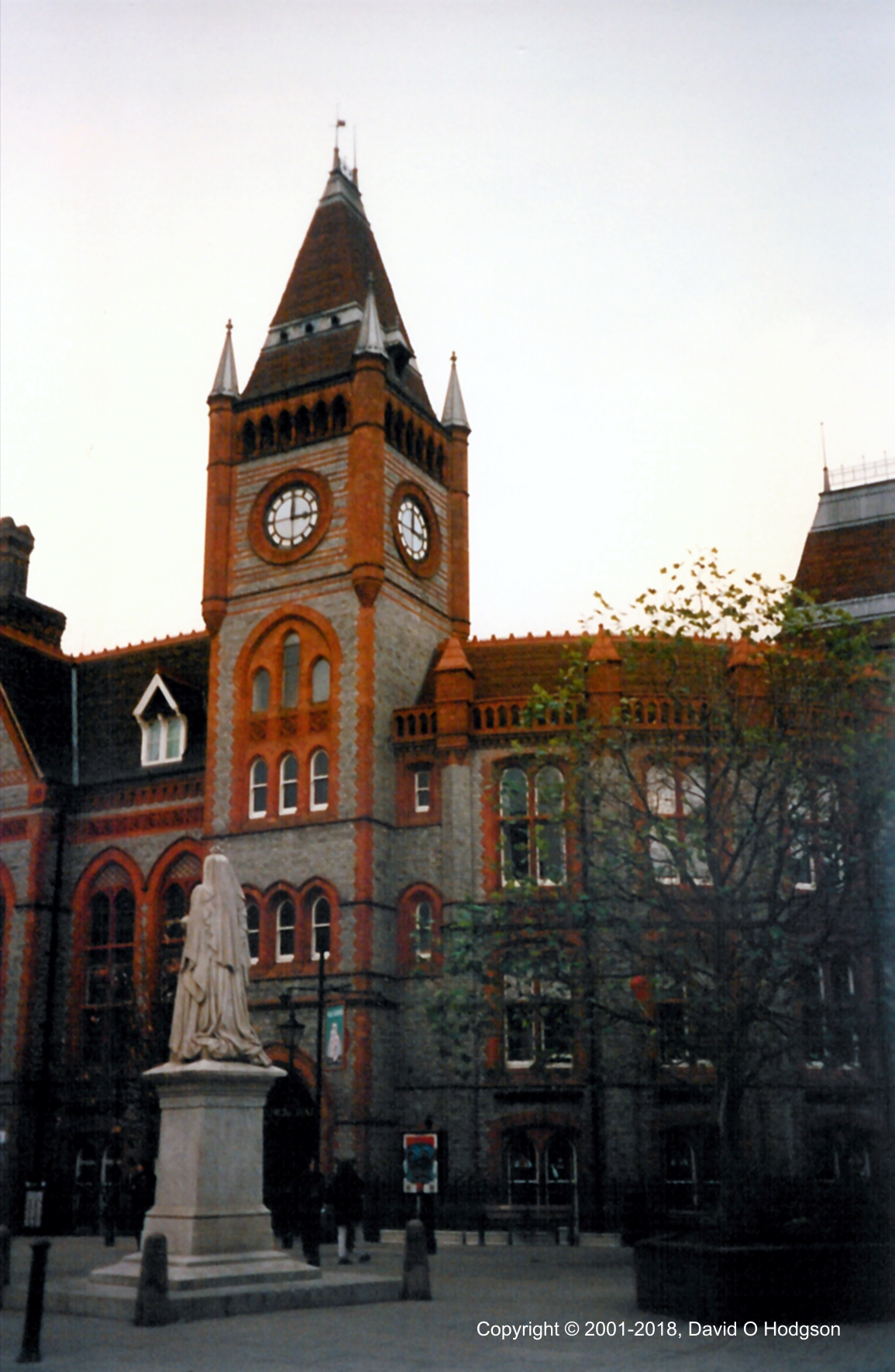
I did spend some time wandering around the town. One of the first features that struck me was the Town Hall, which, for people of my age, was very reminiscent of the building in the children’s animated series Trumpton.
Reading Town Hall, Following an External Cleaning, in 2001
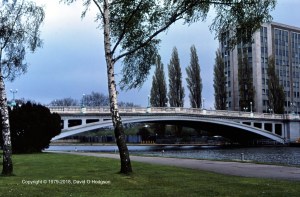
Reading has some fairly pleasant footpaths along the banks of the River Thames. I took the photo below, of Caversham Bridge, while walking alongside the river in rain.
Caversham Bridge, Reading, 1979
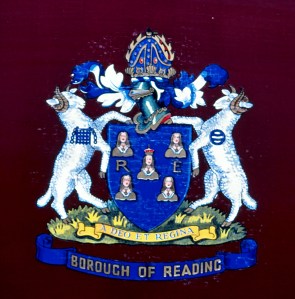
The arms below are those of the Borough of Reading, which used to appear on the sides of all Reading Transport buses.
Arms of the Borough of Reading
The Equalizer Stops By for a Pint
When attending those 1980s drawing sessions, I rushed there straight from Wokingham, immediately after finishing work for the day. Once the drawing session was over, I was naturally hungry for dinner, so I would visit a local pub before beginning the journey home to Andover.
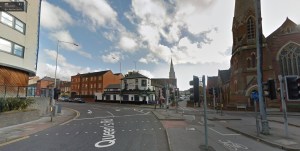
One pub that I frequented nearby was, and still is, called the Lyndhurst. Below is a modern Google Streetview of the location.
Google Streetview of the Lyndhurst, Reading
When I visited the pub in those days, one regular customer was a man who never offered anyone his name, but was known by the bartender as The Equalizer [warning: link plays video]. This was because he looked quite like Edward Woodward, who at the time was starring in an American TV series as the eponymous character. I still don’t know who the man in the pub was, so maybe someone will read this article and enlighten us?
As I said, the Lyndhurst is still in business today, serving good food, so probably worth a visit if you ever find yourself in Reading!
The photo above shows a panorama of Middleton, a suburb north of Manchester, one summer afternoon in 1981, while I was living there, and working as an apprentice at a famous British electronics company, Ferranti. For a few summers during my engineering training, I did indeed find myself working in some of the “dark satanic mills” of Manchester! I couldn’t have foreseen at the time that, within about 10 years, Ferranti would go out of business in a spectacular collapse, induced at least partially by an international fraud.
I mentioned in a previous post that, having decided during 1980 that I should try to obtain a degree in Electronics, I began searching for an employer who could sponsor me for what was called a “sandwich course”, which interleaved periods of industrial work with the academic study terms. My efforts to find such a position eventually paid off, and I was offered a Student Apprenticeship with Ferranti, commencing in July 1981, whereby I would work for the company each summer while at university. Thus, I lived and worked in Manchester for 3 summers, from 1981 to 1983, but, for reasons that I’ll explain below, I did not return there after graduating in 1984.
Live by the Sword…
In those days, Ferranti was, although not one of the largest electronics companies in Britain, certainly one of the best-regarded (the “Big Three” electronics companies were GEC, Marconi and Plessey). Ferranti had pioneered the development of computers in Britain.
When I received the offer from Ferranti, it caused some discomfort among my family and friends, because the company had a justified reputation for deriving much of its income from military contracts. However, not all of Ferranti’s work was for the military, so I was given the option to work for the company only in civilian product areas.
As things were to turn out, Ferranti did indeed “live by the sword and die by the sword”.
The Boys (& Girl) of Summer
Ferranti’s Student Apprenticeships were arranged so that we were employed by the company directly during each summer break from university. We then attended university for a normal academic year, from October through to the following June.
In July 1981, I presented myself at Ferranti’s Training Centre, at the so-called Avenue Works in Chadderton (sometimes referred to as the Hollinwood plant), to begin my apprenticeship. Most of my fellow apprentices were male, but there was (apparently not quite for the first time, but still regarded as exotic!) one female in the group.
The first summer consisted of the “EP1” practical training, which was required by the Institution of Electrical Engineers. We learned technical drawing, soldering, welding, metal fabrication, machining, and many other practical skills. This was very intensive training; for example, we spent 4 weeks learning to solder, and were required to pass precision tests.
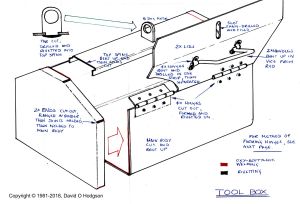
Our fabrication, welding and machining skills were tested by an assignment to build a toolbox from steel. The diagram below, which I drew in my Ferranti log book, shows how the toolbox was constructed. I still have that toolbox, which is far stronger than similar shop-bought items.
Diagram of the Toolbox I Constructed at Ferranti, 1981
[Added 6/8/25] I recently retrieved the actual toolbox from our garage. Here it is, not too much the worse for nearly 45 years of wear!
The Toolbox I Constructed at Ferranti
Wafers at Gem Mill
My second summer at Ferranti involved more uncertainty about what my assignment would be. Initially, I was told that there was actually no assignment for me, and that I should return to the Training Centre. After a short time there, several of us were assigned to a photoelastic stress analysis project at the Van Carrier manufacturing division of Ferranti Engineering plc, which was situated in the front offices of what had been the Avenue Works transformer factory.
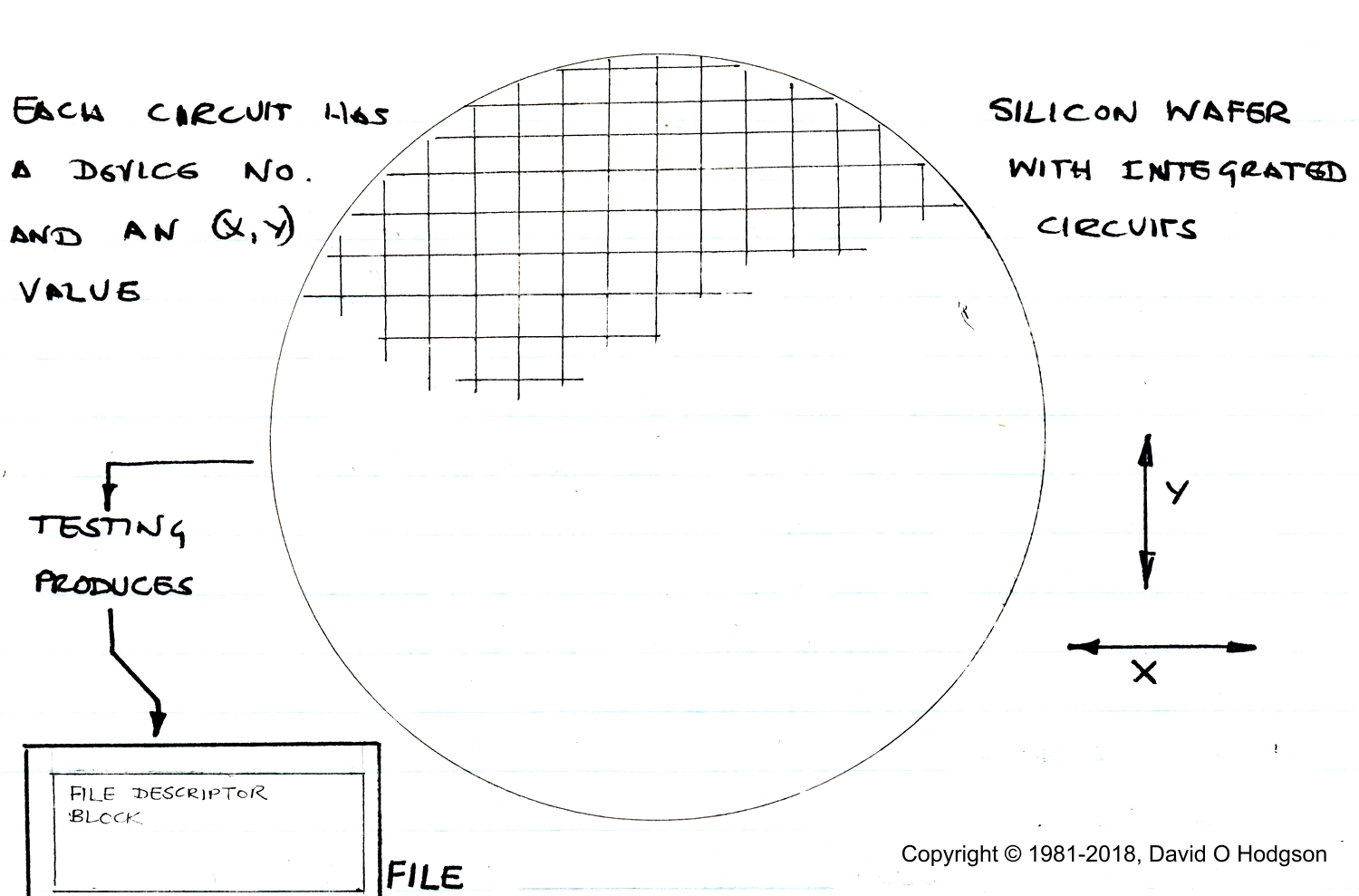
The project was quite interesting, but obviously it didn’t have anything to do with electronics. I was thus relieved when, about half-way through the summer, an opportunity arose for me to be transferred to the semiconductor manufacturing plant at Gem Mill, Chadderton, to write some software.
Description of Silicon Wafer Test Software, from my Log Book, Gem Mill 1981
Sadly, I took no photos of the Ferranti sites at which I worked, most of which have now been demolished. Therefore, I’ve used a Wikimedia Commons image of Gem Mill below.
Thanks, But I Won’t Be Back
As I discussed previously, my goal in obtaining an electronics degree had always been to get a job with the BBC. It may seem surprising that the terms of Ferranti’s apprenticeship did not impose on us any obligation to work for Ferranti after graduation. Similarly, Ferranti were under no obligation to offer me a job. Both parties were free to terminate the arrangement at any time.
During the Spring 1984 “milk round” (when employers visited universities searching for promising new graduates), I applied to the BBC and, after several interviews, I was hired.
As a result, I had to write to the Training Officer at Ferranti, to tell him that I would be accepting the BBC’s offer and thus would not be returning to Manchester. I expressed my gratitude for the “leg up” that Ferranti had given me when starting my new career. I wasn’t really expecting a reply, but, to my surprise, he did write back, indicating that he was very happy that Ferranti had been able to help me along.
I did feel a little guilty about walking away from Ferranti at that time. I was all too aware that this was the one company that had given me a second chance, at a time when no other engineering employer was interested in me. I had also gained some valuable experience in the electronics industry, which did indeed open the door to other employment opportunities later on. It turned out to have been a “wise” decision on my part, but few could have foreseen that at the time.
Like a Bad Spy Thriller
When I worked there, Ferranti always had the “big company feel”. Everyone was expected to slot obediently into predefined roles, and there was little room for individuality or special skills. (As an engineering student with artistic skills, I was always regarded as a very odd creature!) When I made the decision not to return, however, I certainly had no forewarning that Ferranti might not even exist much longer!
I heard the astonishing news of Ferranti’s demise only after I had moved far away to California, and, in my busy new life, I had almost forgotten that I’d ever worked there.
What I heard sounded so much like the plot of a bad spy thriller novel that I had to double-check the details to be sure that it was true. This story has been told in great detail elsewhere (particularly in the book Ferranti A history: Volume 3, by John F Wilson), so I will just summarize the main points here.
Cover of John Wilson’s Book about the Demise of Ferranti
It seems that, amid the Thatcherite business hubris of the 1980s, Ferranti’s management had become convinced that they needed to expand the company in the United States, and that the best way to do that would be to merge with a US defense electronics company. Unfortunately, when selecting a company, they made an appallingly bad choice. They selected a Pennsylvania-based company called International Signal & Control (ISC).
There were warning signs that ISC was a suspect operation, which Ferranti’s management and their auditors managed to miss. (For example, although nominally a US operation, ISC had chosen to register in Britain, simply to take advantage of relatively lax regulation of businesses in Britain.)
Soon after Ferranti merged with ISC, it began to become apparent that some of ISC’s major contracts actually didn’t exist at all, and that ISC’s management had engaged in elaborate deceptions to maintain their fraud. The CEO of ISC, James Guerin, was actually circulating money through front companies to give the impression that progress payments were being made on the fictitious contracts, but he couldn’t keep that up forever, so when he was no longer able to borrow more money, the whole fraud was exposed.
To be fair, though, the ISC fraud wasn’t the sole cause of Ferranti’s demise. This was the time of the end of the Cold War, when defense budgets were being slashed and contracts canceled. As Wilson mentions in his book, Ferranti had for some time been too dependent for its income on military projects, so these cutbacks exacerbated the company’s already-serious predicament, and led to its bankruptcy.
Look Back in Astonishment
It seems astonishing, and quite sad, to reflect that, that, only 35 years ago, I was working for a British company that was not only designing integrated circuits and computers, but also manufacturing them in Britain. Additionally, at that time Ferranti was designing and manufacturing many other kinds of engineering products, including some that I worked on briefly, such as telephones and van carriers. I’ll probably write more about those other products in future posts.
Whatever bad managerial decisions led to Ferranti’s demise, it still seems tragic that so much world-class innovation and effort came to so ignominious an end, and of course it was particularly disastrous for the all the highly-skilled and hard-working staff who lost their jobs when the company folded.
Wadham College, Oxford, during my Interview in 1980
The photo above shows Wadham College, Oxford University, while I was staying there for an interview during 1980.
During the period 1977-81, I visited and was interviewed by quite a few universities in England, but Oxford has the unique distinction for me of being the only university that interviewed me without my having ever applied to them.
Deluding Myself?
At that period in my life, I was painfully aware that I could reasonably be accused of being a “habitual university interview attendee”. I realized that I was spending much of my free time traveling to and attending interviews at universities, with no assurance that any of that effort would lead to anything. Was I simply deluding myself, tricking myself into thinking that I had the potential to graduate from one of these institutions? Should I not instead be spending my time in looking for a better full-time job than the one I was trying to escape from?
I was nagged by doubts about what I was doing, and whether I was really just being a conceited fraud.
As I related in a previous post, having dropped out of the University of Warwick after one year, I was working full-time as an Accounts/Sales Clerk at Swifts of Scarborough. I applied for many jobs, and repeatedly received the same advice; to go back to university and obtain a degree.
By the Spring of 1980, I had essentially decided to pursue the university application route, despite knowing that, if I did so, there would be no chance of my starting a new degree course any earlier than the Autumn of 1981. That meant that I would not be able to graduate any earlier than 1984 or 1985, depending on the details of the course.
Taking a Leap of Faith
My decision seemed a particularly difficult one, because there was no guarantee that any university would consider the application of a student who’d already dropped out of another institution. Even if some university did offer me a place, how would I finance my studies? There was no guarantee that the North Yorkshire Education Authority would award me a grant (for the first year, at least), and my father had died in 1979, leaving my mother to support the household.
Having decided to study Electronic Engineering, I hoped that I might be able to obtain some kind of industrial sponsorship, whereby an employer would provide me with an apprenticeship and some kind of paid employment to complement my studies. The reality, however, was that such sponsorships were even harder to obtain than university places. In those pre-internet days, even finding sponsorships that might be available was a difficult task, requiring research at reference libraries.
I also looked at the possibility of obtaining some type of scholarship to help my finances, but that also seemed to be outside the realm of possibility. Such scholarships were intended for exceptional students who were applying from school, not for someone who had already had “one chance”.
Even if I was able to overcome those obstacles, there was still a significant risk. Unlike the case in some other countries, the award of an undergraduate university place in Britain is no guarantee that you’ll get a degree at the end of it all. What if, after all that, I went back to university but had to drop out again without a degree? What a disaster that would be, and what an immense waste of time.
The Oxford University Mystery
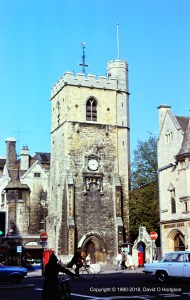
The Carfax Tower, Oxford, 1980
The City of Oxford is, of course, now internationally famous because of the Inspector Morse mysteries, written by Colin Dexter (who died in 2017). In those days, Oxford was already famous for its renowned university, but Oxford was not one the universities to which I applied, so how did I come to be interviewed there?
After I dropped out from Warwick, word eventually got back to the Scarborough Sixth Form College, where I’d taken my university entrance exams, about what had happened to me. By that time, the Sixth Form College had a new headmaster, who seemed keen to try to rectify the problems left by his predecessor. The new headmaster was a graduate of Wadham College, so he set up an interview there for me, with the idea of encouraging my efforts to return to academia.
Unfortunately, though, at that time Oxford did not have a particularly good reputation in engineering, so, weighing up the pros and cons against other institutions, in the end Oxford simply didn’t make the list of universities to which I applied!
Potential or Politics?
On the whole, I found that universities responded to my application more positively than I’d anticipated.
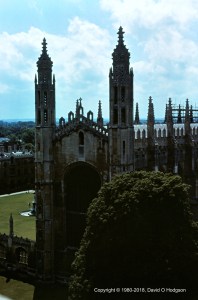
Chapel of Kings College, Cambridge, 1980
The University of Manchester Institute of Science & Technology (UMIST) made me an offer quite quickly after interviewing me, as did a couple of other prestigious institutions. Oddly, Cambridge University initially seemed interested, but then declined. I’ve never understood that, because I sat both the Cambridge entrance exam, and the supposedly-tougher Imperial College Scholarship exam, and obtained one of the top prizes in the Imperial College exam!
Nonetheless, I came out of the process with several offers from prestigious institutions.
An Abundance of Rewards
As I mentioned above, given my concerns about how I would support myself financially during my years of study, I had pursued several possibilities to supplement my income. In the end, amazingly, all those efforts paid off!
I had struggled to obtain an industrial sponsorship, and succeeded in obtaining a Student Apprenticeship with Ferranti plc, in Manchester. Ferranti would provide me with employment during the summer breaks, and also gave me a small annual bursary to help with my living costs.
I had sat several optional examinations in an attempt to win a scholarship, and I obtained a Royal Scholarship from Imperial College, London. The award was only for my first year there, but that was the year for which I’d been concerned about obtaining a grant.
In the end, the Local Education Authority was convinced of my bona fides, so they did award me a full grant for the term of my studies.
My Employer’s Misplaced Concerns
By May of 1981, everything seemed to have fallen into place. I had an apprenticeship set to start at Ferranti, and an undergraduate place at Imperial College waiting for me that October, so it was time for me to give notice to my employer, Swifts of Scarborough.
As we discussed the termination of my employment, Swifts’ Managing Director claimed to be quite concerned for my financial future. Had I considered, he asked me, that I’d be giving up a full-time income and would be forced to live on a student grant, and in London too!
Yes, of course I had considered that, I explained. I went on to explain to him that, with my full grant, my Ferranti bursary, and my Royal Scholarship, my “take home pay” would actually be higher than it had been working for him! That was the last I heard from him on the matter of my future…
You Have to Stay in it to Win it
The decision to commit to re-entering university was, at that time, the hardest and riskiest that I had had to make in my lifetime. Nonetheless, I’m really glad that I rejected the warnings of the naysayers and stuck to my own “gut instinct” that it was the right way to go.
There have been other occasions since then when I’ve had to make similar decisions, without any assurance that I’m going to be able to meet the challenge that I’m setting myself. As I see it, there is no choice but to accept the challenge and face the risks. After all, if you back down, you are absolutely guaranteeing that you will never succeed; you have to “stay in it to win it”.
It seems very strange to have to discuss both raging fires and frosty mornings in the same article, but that’s the way things are at the moment. Not only are we still recovering from the Wine Country fires here during October, but substantial new fires are burning right now in Southern California.
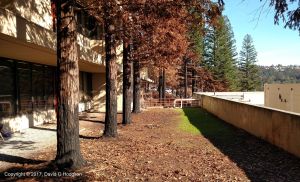
Last week, I was asked to go back the Fountaingrove site of my employer, Keysight, for the first time since the premises were closed due to the Tubbs Fire. The photo above shows how trees burned right up to the south side of Keysight’s Building 4, although the building itself was saved.
Nonetheless, all four main buildings suffered internal smoke damage, due to particles sucked in by the ventilation system from the fires outside. Therefore, we went into our former work site last week, with instructions to sort through everything and triage it as: personal items for removal, company-owned items for cleaning, or trash. Everything that will stay on the site must be cleaned before it can be reused, so eventually we will probably have one of the cleanest workplaces in the county!
The only buildings at Keysight that were completely destroyed by the fire were the two relatively small “Vista” buildings, the remains of which are shown below. Those were always relatively insubstantial structures.
Remains of the Vista Buildings at Keysight
Complete Destruction… Almost
Next to the Parker Hill Road entrance to Keysight is a residential area known as Hidden Valley Estates. As shown below, the fire destroyed almost everything in the northern part of Hidden Valley; the entire neighborhood has been wiped out. This Google Streetview shows the same location before the fire.
Devastation in Hidden Valley
There was also a satellite school next to the Keysight entrance on Parker Hill Road, but that burned down.
I say almost everything was destroyed, because, as shown in my photo below, the Jehovah’s Witnesses Hall on Parker Hill Road seems to have escaped completely unscathed.
Jehovah’s Witness Hall in Hidden Valley
It will be interesting to learn why that particular building survived while everything around it succumbed. Did it have a fireproof roof, or did its isolation in a car park help to protect it?
First Frost of the Season
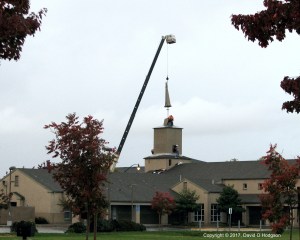
Moving on to a happier subject, I awoke this morning to the first frost of this Winter season, as shown in my photo of Village Green Park below. As you can see, nearly all the leaves have fallen now, but the church at the far corner of the park has just acquired a new spire, which is actually a covering for a cellphone antenna!
Village Green Park with Frost
My photo below shows the antenna cover being mounted on the church, in the rain about a month ago.
Mounting the Cellphone Antenna on the Church
Our thoughts go out to those in Southern California who are now having to endure what many in our area went through in October. We hope that the new fires will be brought under control very quickly.
I arrived at San Francisco Airport for the second time exactly thirty years ago today, on Monday, 16th November, 1987, but on that occasion I did not have a return air travel ticket, and I was planning to make a home in California, for a while, at least.
This is the third in the series that covers the events of that time, when, while living and working in Southern England, I was offered a job in California, decided to accept it, and moved here on what turned out to be a permanent basis. The first post in the series was It was Thirty Years Ago Today, and the second was California Confusin’.
Living in Foster City
When I arrived, my employer had obtained temporary accommodation for me at the Residence Inn in San Mateo, which was very pleasant, but too expensive to be a permanent home. My boss recommended that, for long-term accommodation, I should look in nearby Foster City, which is a modern waterfront community with many apartment complexes.
I did look there, and eventually signed up for a one-bedroom apartment in Beach Cove Apartments, a large complex on Catamaran Street. Although these units were generally regarded as barely adequate by locals, by comparison with my accommodations in Britain they seemed palatial and well-equipped. For the first time ever, I had my own phone line, and—wow!—an automatic dishwasher!
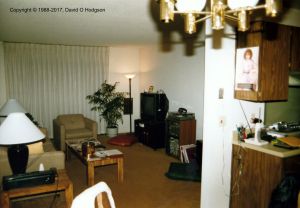
The photo below shows part of my apartment in Foster City. The only item visible in the picture that I brought with me from the UK is the hi-fi system, which I’d bought in London while a student there. Everything else was bought or rented in California. Just visible, on the right, is my new answering machine, which was to cause a completely unexpected change in the direction of my life, as described below.
My Apartment in Foster City, 1988
Driving
California officially only permits visitors to drive on an out-of-state license (so spelled!) for 10 days. After that, you’re required to apply for a California license. Thus, I began the process of applying, which required both a written and practical test. Although my prior experience of driving in Britain actually worked against me (because it made me seem too confident for the California examiner), I did eventually pass both, and had my first California license by December 1987.
What Credit History?
One significant problem that my employer had failed to warn me about was that, despite having a job and a Social Security number, I would be completely unable to obtain credit in the US on arrival. In Britain, I had already bought several cars on credit, had two credit cards, and had credit accounts with several stores, and I was oblivious to the fact that my UK credit rating would be totally meaningless in the US. My credit history outside the US simply didn’t appear on the records, so it effectively didn’t exist.
Buying a car turned out to be a significant problem, because of my lack of accessible credit history. Eventually, I was somehow able to persuade one dealer to grant me credit via General Motors Acceptance Corporation (probably only because it was a secured loan).
Once I had obtained the car loan, and began making payments, I was able to begin building a US credit history. Nonetheless, for the first year or so, I had to depend entirely on my British credit cards, sending my payments to the UK in US dollars. It seemed “so unfair”, but in fact the time passed quickly. After only 18 months, I’d built up sufficient credit history that I was able to buy a brand-new Ford Mustang, as shown below.
My 1989 Ford Mustang, in Monterey
Northern California, Where the Girls are Warm…
When deciding whether to move to California, the idea of finding romance there was definitely the last thing on my mind! As I mentioned in the previous article, I did not even have a girlfriend in Britain, and had essentially given up on dating during my undergraduate years.
I must have heard the Steve Miller Band’s song Rock’n Me on the radio in Britain many times since its release in 1976, but I had always completely ignored its lyrics! Part of the lyrics say:
I went from Phoenix, Arizona all the way to Tacoma
Philadelphia, Atlanta, L.A.
Northern California where the girls are warm
So I could be with my sweet baby, yeah
I had emigrated to California strictly for professional reasons, to get a better job. Nonetheless, something completely unexpected happened after I moved to California, which eventually led me to begin dating again. Strangely enough, it happened because I bought an answering machine!
In my British accommodations, I had never had my own phone line, and of course there were no cellphones in those days. When I rented the apartment in Foster City, it came with a dedicated phone line. Given the 8-hour time difference between California and the UK, I was concerned that people from Britain would try to call me in the middle of the night. I decided to invest in an answering machine, so that at least they could leave me a message.
After I had installed the answering machine and recorded my greeting on it, something odd began to happen. I came home from work several times to find messages from anonymous women, explaining that they had just called to hear my “cute accent”! That was something that, for obvious reasons, had never been regarded as in any way special in Britain, but now it made me begin to think that perhaps there was something about me that might be deemed “attractive”!
As I mentioned in an earlier post, I’d obtained seriously distorted preconceptions about California from American media. As such, I assumed that California women would be impressed only by bronzed “surfer dudes”, and would have no interest in pasty-faced Brits such as me!
My Sweet Baby: Mary!
I Won’t be Home for Christmas
Ever since I moved away from my parents’ home in Scarborough, it seemed to have been assumed by everyone (including me) that I would return there to spend each Christmas with the family (or what was left of it). While I was a student, those visits were very short, because I was working in Selfridges or other London stores over the Christmas period, so I had to get to Yorkshire and back during the brief period that the stores were actually closed.
My feelings about those visits were very ambivalent. On the one hand, there was little point in staying in London or Andover when my few friends there were also absent (visiting their families). That would have made for a very lonely holiday. On the other hand, I had no friends or activities left in Scarborough, so spending the time there was also quite lonely.
Of course, it would have been very unrealistic to expect my family to leave Scarborough to visit me at Christmas, because I was living in small bedsits or houseshares, which could not accommodate guests. Nonetheless, by 1987, I was becoming anxious to find a solution to the problem, whereby I could find a reason to stay in my own part of the world during the holiday period.
Union Square, San Francisco, at Christmas
Moving to California solved this problem once and for all. It simply was no longer practical for me to return to Scarborough at Christmas, so I had to spend it in California. Although that was a little lonely for my first Christmas there, my employer was accustomed to hiring engineers from Britain, and so went out of their way to ensure that we were to some extent included in the seasonal activities of other families.
Working Three-Day Weeks?
I’d also given no thought to the fact that the week after I arrived in California was Thanksgiving, which of course is not celebrated in Britain. As such, my employer treated us to Thanksgiving Lunch at work, then we had two days of the week off.
During the lunch, my employer’s CEO leaned over and mentioned to me:
We don’t do this every week, you know…
A Good Start
As I began to settle in to my new apartment and new job, I felt that I had made a good choice, and I saw little evidence of the problems and disappointments that some had predicted.
In every aspect, my new life was no worse than my previous existence in Britain, and, in many ways, it was much better.
The photo above shows one of our cats, Penny, sitting in the window alcove of our bedroom yesterday afternoon, contemplating the rain that had just begun to fall.
The rain intensified yesterday evening, having been forecast the previous week. We’d been anxiously awaiting its arrival, because, despite the extraordinary efforts of firefighters from all over the US, the wildfires were still not fully contained. Even after a fire has been quelled, it can sometimes continue to smolder and can then flare up again later. Falling rain should extinguish any remaining embers and prevent further flare-ups.
The Rain Begins
Contrast the photo above, taken yesterday afternoon looking over the park from our balcony, with the same view in my earlier post. At least this time, the gray skies are due to rain and not to smoke!
Having grown up somewhere it rains year-round (Britain), and now living where it rarely rains during the summer (California), I sometimes find that, by the end of summer here, I’m missing the rain, and look forward to the first shower of the season. Nonetheless, I’ve never welcomed the first rain as much as I did this year, because it will hopefully put an end to the local wildfires!
Smoky Sunsets
Although the smoke has gradually cleared during the past week, we’ve still been having smoky sunsets, with unusually red skies, as shown below, looking west from in front of our house.
Smoky Sunset
Oakmont Fire
Last weekend, a new wildfire erupted in the hills above Oakmont, which is a large retirement complex to the East of Santa Rosa. This led to further closure of Highway 12, and the evacuation of the Sky Hawk and Mountain Hawk neighborhoods.
I took the photo below last Saturday, looking East along Highway 12. In the distance, you can see smoke billowing from the Oakmont fire.
Smoke from the Oakmont Fire, from Highway 12
A little further along Highway 12, the road was closed. People were being let out of the evacuated zone, but not into it. The photo below shows a police roadblock across Highway 12, at the junction with Calistoga Road.
Highway 12 Closed at Calistoga Road
Fountaingrove Still Evacuated
At the time of writing, although most evacuation orders have been lifted, and people are being allowed back in to some fire-damaged areas, the Fountaingrove neighborhood remains evacuated.
The offices of my employer, Keysight, are in Fountaingrove, and are closed. Fortunately, the main buildings were not destroyed, but they were damaged by efforts to fight the surrounding fire. Details are shown in this fire damage map.
It’s also fortunate for me that I’m able to do my work from home (although I wasn’t doing that prior to the fire), and that’s what I’ve been doing since the area was evacuated. Keysight has been very supportive of us all, having made immense efforts to locate and ascertain the safety of all its employees, and to provide special assistance to those who need it. Many thanks are due to Keysight for looking after its staff.
I’m aware that many people have lost jobs or businesses as a result of the fires, and how lucky I’ve been to have avoided that.
The New Normal
The process of trying to get back to normal life is now just beginning. Even for those of us who were lucky enough to avoid any serious loss, things will never be quite the same again.
In one respect at least, I hope that things will be different, in that the lessons of the fire will be learned, leading to wiser land development and better protections in future.






![South Elevation of Broadcasting House, from the book "London Deco", by Thibaud Hérem[20]. Copyright © 2013 Nobrow Press](https://davidohodgson.com/wp-content/uploads/2024/04/broadcastinghouse-1.jpg)

























 David Hodgson Personal Blog
