
Living in Brutalist Britain

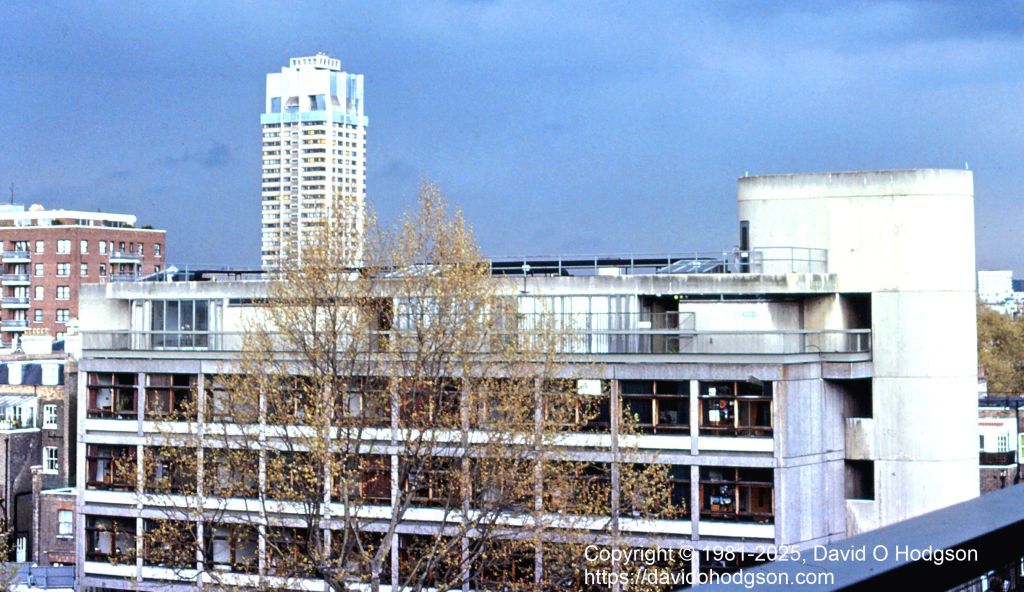
Linstead Hall, Imperial College, London, from my residence in Southside Halls

A few weeks ago, my wife and I went to see the movie The Brutalist. The extent of the hype for this movie was truly breathtaking, which may be partly why I was not surprised that it did not live up to its “promise”.

I must admit that media coverage led me to question whether those who were singing its praises even understood anything about the movie’s subject matter! For example, a fawning item about it on ABC News included paroxysms of praise for the movie’s stars and director, but never actually mentioned what the movie is about, nor was there any explanation of what the title “Brutalist” referred to! I guessed that it must have something to do with Brutalist Architecture, and it turned out that I was correct, but that was no thanks to ABC. Did the presenters really not understand it themselves, or had they decided that the explanation was too “intellectual” for their audience?

Perhaps that is, in fact, the key to the praise that the movie has received. It seems that the less a reviewer knows about its subject, the more they like the movie. Those who do understand its subject matter, professional architects, have been highly critical of its blunders and implausibility, to the extent that they are described as “hating” it in this article.

I also thought that, given its thin, questionable plot and appalling examples of ignorance, the movie was much too long at 3 hours, 35 minutes. As the Guardian reviewer states sarcastically:

“The architecture world awaits with bated breath the director’s five-hour marathons, The Postmodernist, The Deconstructivist, and The Parametricist – each to be shot with period-appropriate equipment and based on a brief skim through a coffee-table book”

Personally, the only benefit that I obtained from the movie experience was that it prompted me to think once again about the real Brutalist architecture that I grew up in and around, the history of which I find infinitely more interesting than any aspect of the movie.

Growing up, Brutalist architecture was a constant background theme in my life, and I even lived in one example of it for a while.

Brutal Aylesbury

I never actually lived in the Buckinghamshire county town of Aylesbury, but, as I recounted in a previous post, my first visit there involved a job interview and a “computer programming aptitude test” that had a profound effect on my view of my own abilities in that field.

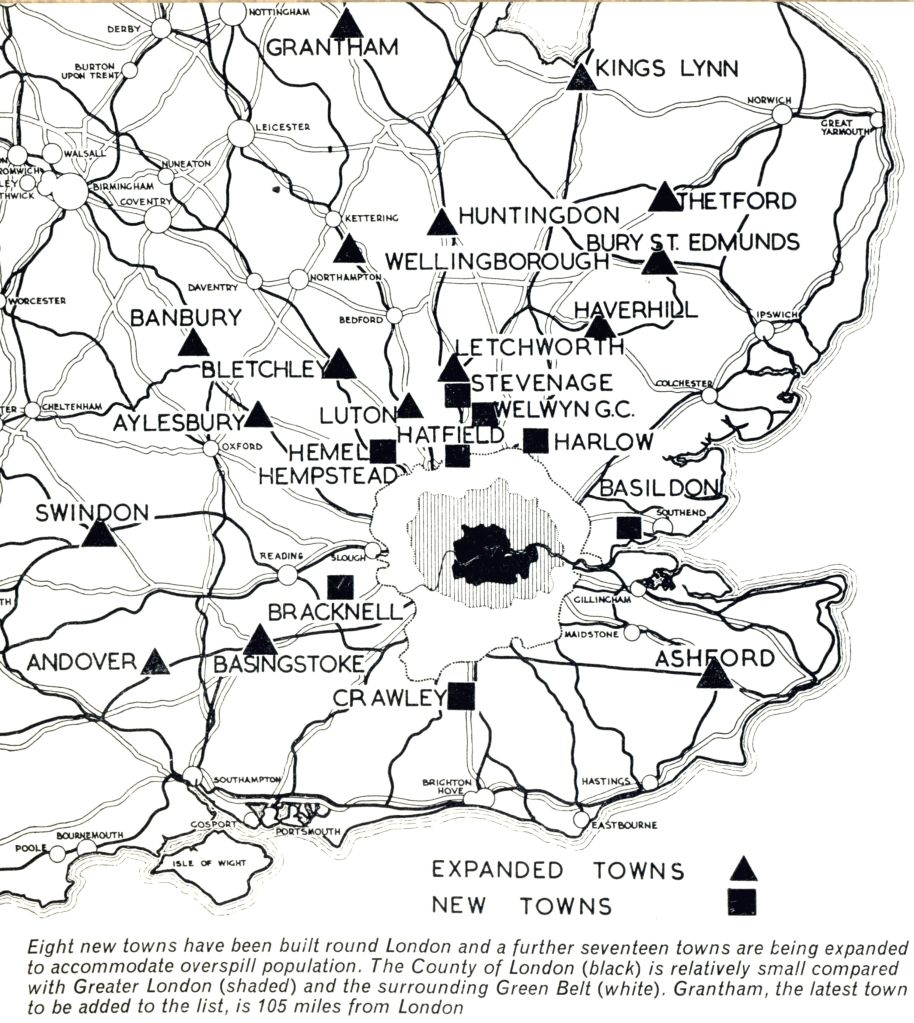
During the period from the 1930s to the 1970s, the British Government made major investments in a group of what were referred to as London Overspill Towns. There was a deliberate policy of moving population en masse out of London, to more rural locations. The goal was mainly to reduce further “ribbon development” of the London suburbs, which would eventually have spread across the entire South-East of England. There were also health implications, since prior to the 1960s, London’s air was seriously polluted, leading to increased healthcare costs.

During the 1960s, various existing towns were targeted for substantial redevelopment and expansion, and a few entirely new towns were created. Most of these were within commuting distance of London, but even Grantham in the East Midlands was included.

The map below is from the 1963 book New Architecture of London.

Map of London Expansion Towns. Copyright © 1963, British Travel and Holidays Association

As shown, one of the “expansion towns” was Aylesbury, which had until then been a quaint market town, famous mostly for its ducks.

Development plans for expansion towns invariably included the construction of new shopping centers and civic buildings, and some of these were designed along brutalist architectural lines. In 1967, Aylesbury found itself lumbered with a new shopping center, Friars Square, which quickly came to be seen as such an outstanding example of a dystopian nightmare environment that, in 1971, scenes for the movie Clockwork Orange were filmed there!

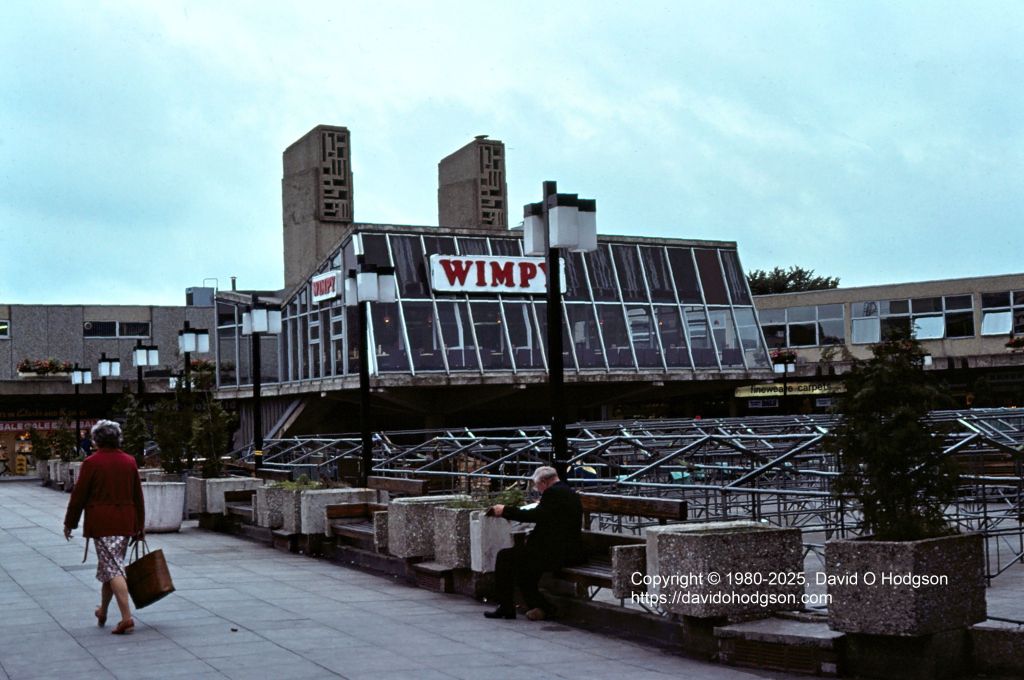
My 1980 photo below shows the centerpiece of Friars Square, the Cadena Cafe, after it had become a Wimpy Bar. As with many examples of brutalism, the building had a relatively short life, being demolished in 1993 when the shopping center was redeveloped.

Friars Square & Cadena Cafe, Aylesbury

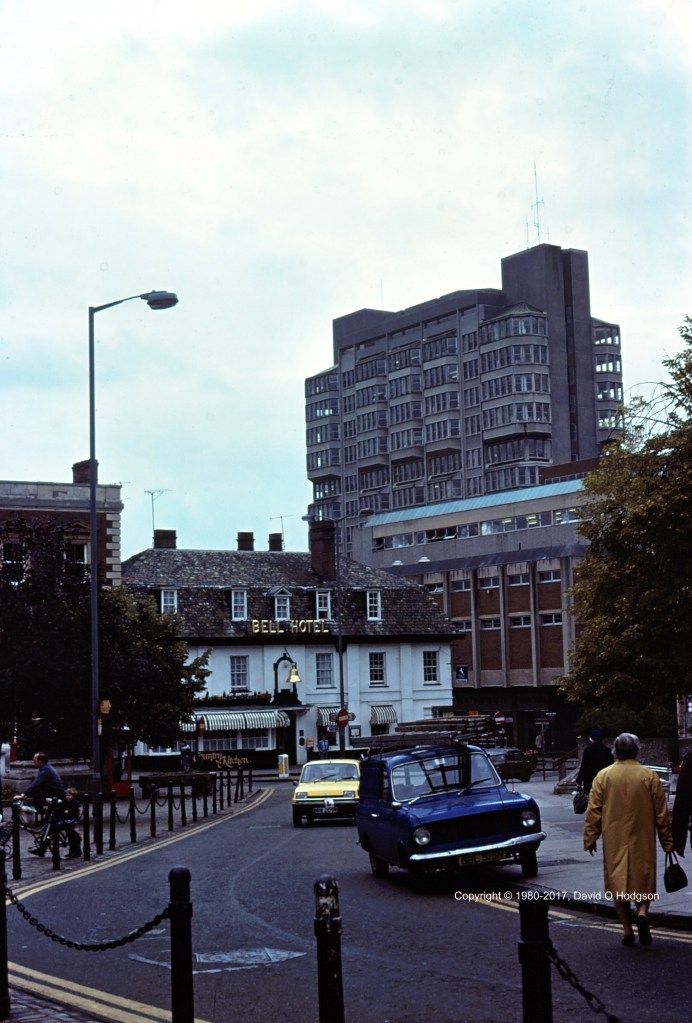
Elain Harwood’s book Brutalist Britain offers an extensive listing of brutalist architecture in the country, and describes another Aylesbury example, the Buckinghamshire County Council office tower.

The cover of Brutalist Britain, Copyright © 2023, Elain Harwood, Batsford Publishers

My 1980 photo below shows the County Council tower looming above Market Square in Aylesbury, with the Bell Hotel in the foreground.

The Bell Hotel, Aylesbury, with the Buckinghamshire County Offices beyond, in 1980

Brutal Birmingham

Birmingham New Street Signal Box, 1980

It seems perhaps most appropriate that Brutalist architecture would be chosen for the design of industrial buildings, and even British Railways constructed a few examples. One of the most famous in Britain must surely be Birmingham New Street Signal Box, which has towered above the gloomy subterranean station since 1966, and is clearly visible from street level, as shown in my 1980 photo above. Although it closed as a signal box in 2022, the building is listed, is still standing, and continues to be used by Network Rail.

Again, Birmingham was not a city in which I ever lived, but when traveling between Coventry and York, I usually had to change trains at Birmingham New Street. I also applied to, and was accepted by, Aston University in Birmingham, so I attended an interview there in 1980.

Brutal London

Approximately a year after visiting Aylesbury for that job interview, I found myself moving to London, as I began my Electronic Engineering studies at Imperial College.

Many first-year undergraduate students were accommodated in Halls of Residence, situated in South Kensington near the college campus. Generally, we were assigned to one of the halls, and were not given any option as to which hall we preferred. I was assigned a single-bed room in Selkirk Hall, which was a subdivision of the huge Southside Halls building, located, as the name indicates, on the south side of Prince’s Gardens.

The photo at the head of this article shows the view looking north from Selkirk Hall over Princes Gardens, one stormy afternoon. The building in the foreground is Linstead Hall, which was of similar architectural style to Southside. In the distance, the tower of another Brutalist edifice is visible; Hyde Park Barracks, which was and still is the home of the Horse Guards.

Cover of Lost Futures. Copyright © 2017, Owen Hopkins, Royal Academy of Arts

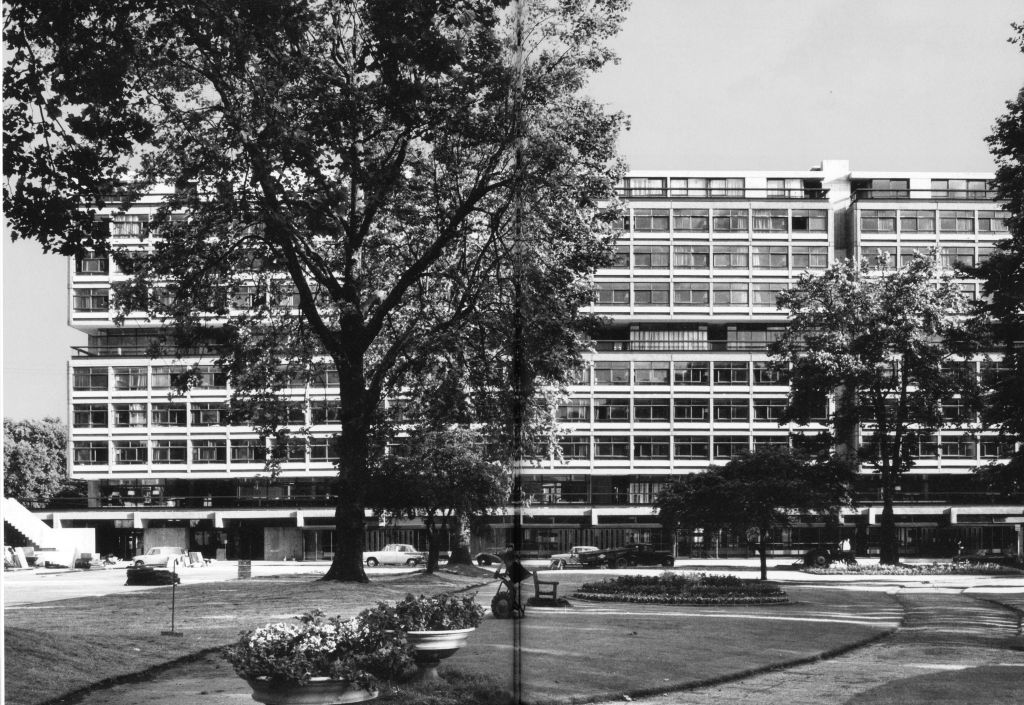
Unfortunately, while living in Selkirk Hall, I never photographed the outside of the building itself (partly because the trees in front of it obscured most of it). However, Owen Hopkins’ book Lost Futures includes an article about Southside Halls, which also mentions the smaller Weeks Hall, situated on the north side of Prince’s Gardens.

The photo below, borrowed from “Lost Futures”, shows an excellent panorama of Southside, before the trees in front of it grew too large.

Southside Halls, Imperial College. Copyright © 2017, Owen Hopkins, Royal Academy of Arts

Unfortunately (or perhaps fortunately, depending on your view of their aesthetics!), the passage of time has revealed that many Brutalist buildings were not well-constructed, and in some cases not even well-designed. I had personal experience of this while living in Selkirk Hall.

I lived in the building for only one academic year, but even during that time there were serious maintenance problems. Each bedroom had its own sink, whereas kitchen and bath facilities were shared. The sink in my room was out-of-action, and boarded off, for several weeks during my residency, due to plumbing problems. It seems that the design of the building had a major flaw, whereby pipes and other service conduits were buried directly within the concrete, instead of being placed in accessible service ducts. As a result, any plumbing maintenance work required drilling out the concrete to access the pipes! The quality of the concrete also seems to have been defective, and large chunks of it eventually began to disintegrate.

The upkeep of Southside became so problematic that, despite its being a listed building, permission was eventually granted to demolish it in 2005. That permission was granted on condition that the smaller Weeks Hall, on the north side of Prince’s Gardens, and also a listed building, be retained and refurbished. In my photo below, looking north from Southside, you can just see Weeks Hall towards the right.

Skyline from Princes Gardens, with Weeks Hall

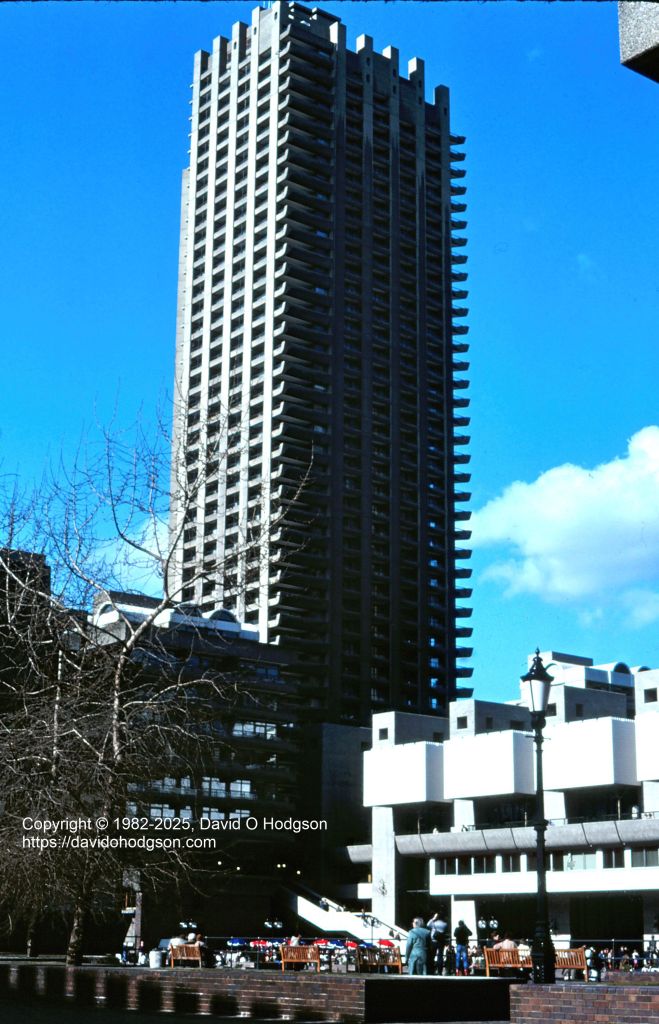
One of the more successful examples of Brutalist architecture, which still exists and is in use today, is the Barbican Centre, in the City of London. My photo below shows part of the complex shortly after its official opening in 1982. I visited the Centre many times, usually to go to the Museum of London, which was housed within it.

Despite having been voted the “Ugliest Building in London”, the Barbican apparently remains popular with apartment renters, thanks to its views and convenient location.

Barbican Centre, London

Brutal Scarborough

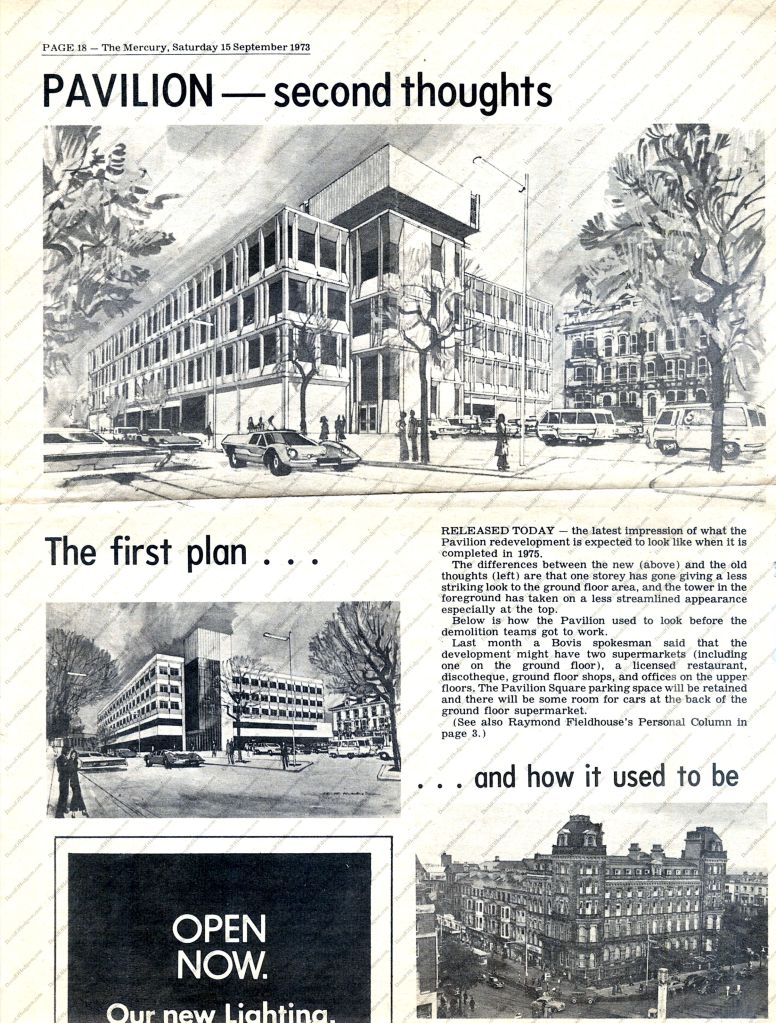
Even my home town of Scarborough suffered the attentions of architects with brutalist leanings. In 1973, the imposing Pavilion Hotel, immediately opposite the main railway station, was controversially demolished and eventually replaced by an office block that has been described as the “ugliest building in Scarborough”. I reproduce below an article from the Scarborough Mercury of 15th September 1973, showing how the new building was to look, along with hopelessly-optimistic predictions of its future uses.

Scarborough Mercury article about Pavilion House. Copyright © 1973, Scarborough News

The building did eventually gain one supermarket, on the ground floor, although, as I recall, that store managed to look run-down from the day it was opened! As regards actual other uses for the new building, I can only remember it as the home of Scarborough Job Centre, in which I spent many useless hours not finding a worthwhile job. It seems perhaps appropriate; a depressing and ugly location for a depressing and hopeless office!

There’s no question that, whatever the aesthetic qualities of those Brutalist buildings, they were and are each unique, and they formed a memorable backdrop to my life in those days.

Westwood Bus Station, Scarborough

My Scale Drawing of the Westwood Bus Station Building

When I was exploring the streets of Scarborough in 1977-78, conducting research for my A-Level Art project on architectural aspects of the local road and rail industries, it was impossible to know what the future might bring for the subjects of my study. Many of those locations and buildings have in fact survived to the present day, and some have even been renovated. Others, however, have vanished completely. In some cases, even the land on which the buildings stood has been redeveloped to the extent that it is now unrecognizable.

The subject of this article is one such example. Westwood Bus/Coach Station occupied a central site in Scarborough, right next to the main railway station. During the 1970s, the bus station was still quite heavily used, particularly during the summer months, when it was often completely filled with visiting excursion coaches. It was also still the terminus for scheduled bus services. During the 1980s, however, the station was shut down, and the entire hillside on which it stood was excavated to create a new superstore and underground car park, which still exists today. As a result, no trace remains of this bus station.

The image above is a digitized version of a gouache painting that I produced for the A-level thesis. It is to scale and shows the northerly elevation of the waiting room and ticket office building at Westwood, which was the only permanent structure on the site. If you don’t like the color scheme, please don’t complain to me! Those were the actual colors of the building at the time of my survey; very “Seventies”!

Note that the location described in this article is not the East Yorkshire bus park currently referred to as “Westwood”. The old location was on the south side of Westwood, where the Tesco store now is. At that time, the current bus park was part of Scarborough railway station.

Three Bus Stations

I’d been familiar with that place for as long as I could remember. When I was very young, Westwood was the terminus for services operated by East Yorkshire Motor Services (EYMS). At that time, there were two other regional bus companies running services into Scarborough, but each had its own station. United Automobile Services used Valley Bridge Bus Station, whereas West Yorkshire Road Car (WYRC) used a station on Northway.

During the late 1960s, after all three companies had become part of the National Bus Company, operations were merged, and the opportunity was taken to reduce costs by eliminating some of the facilities. Northway was closed in 1970, and WYRC services then operated from Valley Bridge. Similarly, EYMS ceased to use Westwood in 1970 (see letter below), and transferred its operations to Valley Bridge.

Another independent user of Northway Bus Station prior to its closure had been Hardwick’s Services, which was a company owned by the famous holiday tour operator Wallace Arnold. Following Northway’s closure, Hardwick’s began to use Westwood as the terminus for its scheduled services to Ebberston.

As such, by the time of my study, Westwood was used only for Hardwick’s Services, and to handle summer excursion traffic visiting Scarborough. I didn’t specifically take any photos of the bus station, but mostly of vehicles that happened to be parked there.

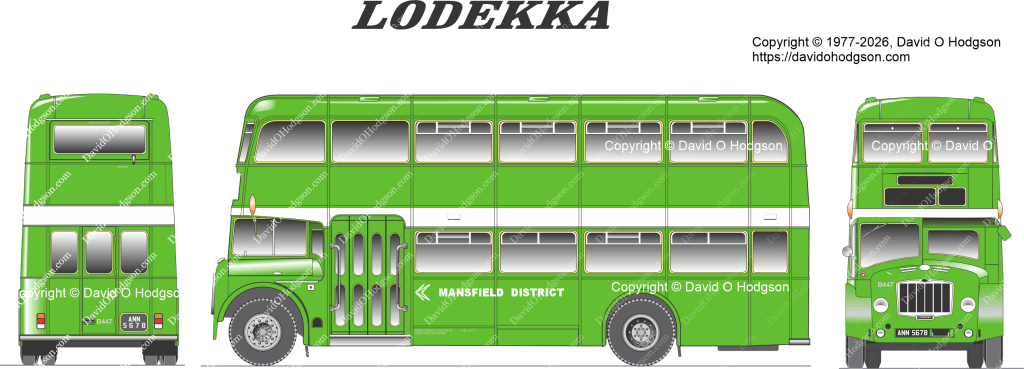
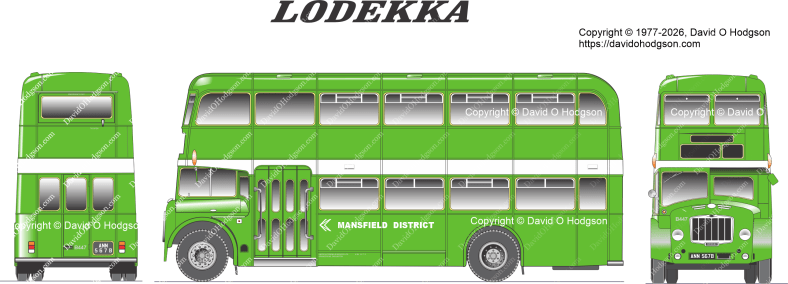
The photo below does show part of the site. The view is looking towards Valley Bridge, with Westwood on the left. The building that I drew is on the right. In the foreground is a former Mansfield District Bristol Lodekka, which was in use for driver training.

Westwood Bus Station in Summer 1977

An Undeveloped Prime Location

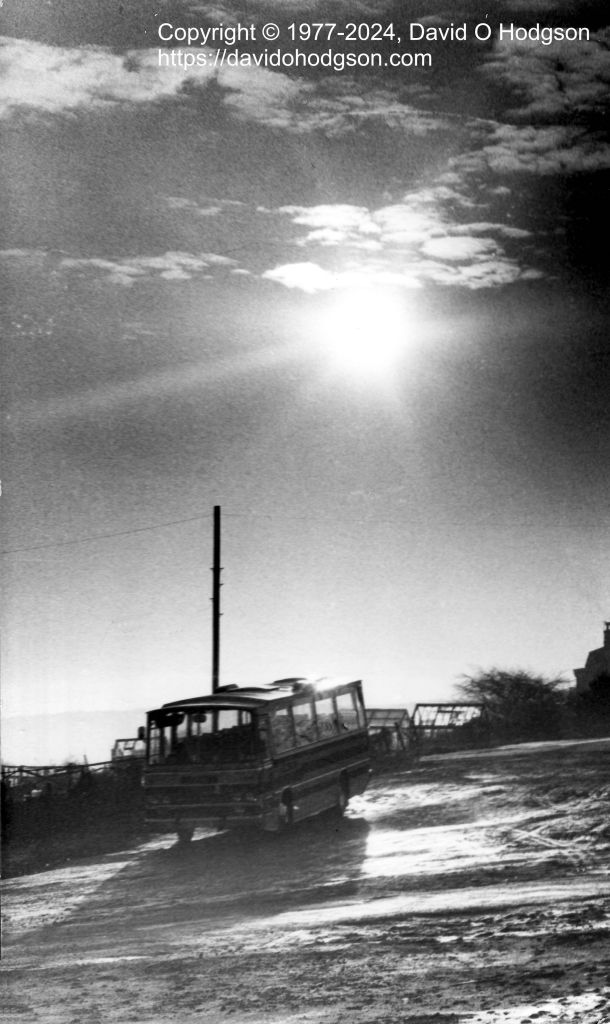
It always struck me as odd that the site of Westwood Bus Station was relatively undeveloped, given that it was in a central location right next to the railway station. There was only one building, and the concrete parking surfaces were steeply sloped, having never been leveled. Parts of the parking area were never even concreted, and were simply filled with stone rubble, as shown in my photo below.

The muddy unmetalled part of Westwood Bus Station, under a low winter sun

Surely such a site would have been snapped up by an eager developer for construction of a hotel or some similar profitable structure.

I eventually discovered that the reason for this was that the land on which Westwood stood was railway-owned. It had been bought up in the late nineteenth century by the North Eastern Railway (NER), with a view to the extension of Scarborough Central station. However, the railway’s planners soon realized that, due the existence of villas immediately west of their newly-acquired land, it would be impossible to create the necessary fan of extra lines to extend the station footprint there.

As a result, the NER dropped that plan and, instead, in 1907 constructed an entirely new station further west at Londesborough Road, on the site of a former goods depot. Additionally, a new complex of sidings was built alongside the Scarborough-Whitby running line at Northstead. This arrangement proved very effective for handling the extra excursion traffic that Scarborough experienced every summer, so the land in Westwood was no longer needed.

According to an old photograph that I’ve seen, the railway-owned land was let out for allotments until after World War II. When EYMS needed a new bus station in Scarborough during the 1950s, British Railways presumably sold the land to them (EYMS was by then part of the privately-owned British Electric Traction group).

While researching my A-level Art project, I could find very little published information about Westwood, so I wrote a letter to EYMS directly, requesting some details. The letter below is the response I received from them.

Letter from EYMS providing details of Westwood Bus Station, etc.

The book Prestige Series: East Yorkshire, by John Banks, shows color photos of Westwood on the front and back covers, and there are several monochrome photos of the location inside the book.

Front Cover of Prestige Series: East Yorkshire. Copyright © Venture Publications 1999

As I mentioned above, the entire site was excavated during the 1980s, and a Hillards supermarket with underground parking was built on the site. Hillards was taken over by Tesco in 1987. Here is the current Google Streetview of the Tesco supermarket from Westwood. Due to the redevelopment, it’s no longer possible to stand in the location from which I took the 1977 photo above.

Hardwick’s Services

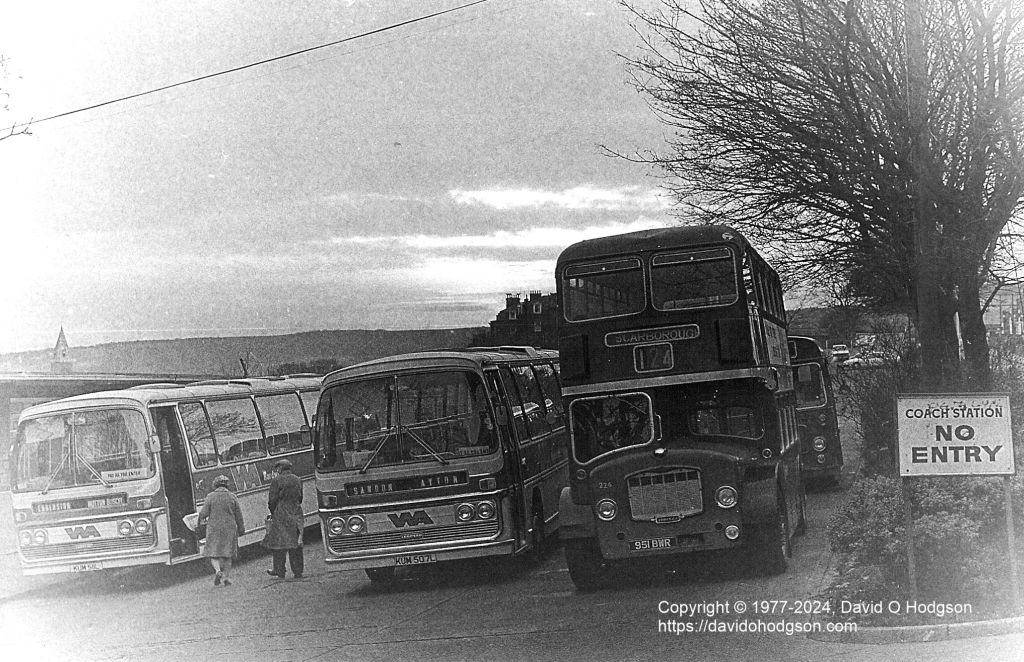
My photo below, taken in Winter 1977, shows the buses of Hardwick’s Services using Westwood as their Scarborough terminus. As you can see, Hardwick’s used vehicles with Plaxton coach bodies, but fitted with bus seats. Presumably the reason for that was for parts interchangeability with other vehicles in the Wallace Arnold fleet.

Westwood on another chilly winter’s afternoon

As is visible in the photo, NBC buses were still sometimes parked temporarily at Westwood, because there wasn’t sufficient space in the nearby Valley Bridge Bus Station, and Westwood was closer than the United depot on Vernon Road.

Incidentally, the vignetted and “frosty” look of my photo was accidental; during cold-weather development of the negatives, I failed to wash off the fixer properly! However, in this case I liked the effect, so I kept it.

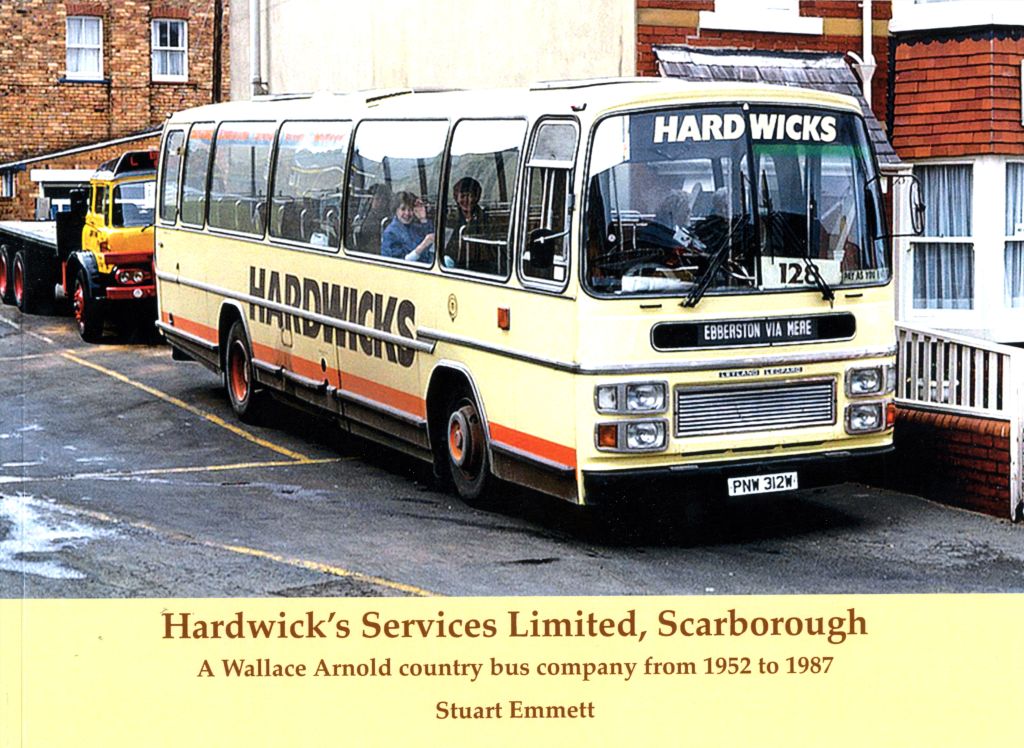
Full details and history of Hardwick’s Services can be found in this book.

Hardwick’s Services Limited, by Stuart Emmett. Copyright © 2020, Stenlake Publishing Ltd.

Scarborough Tramways Company

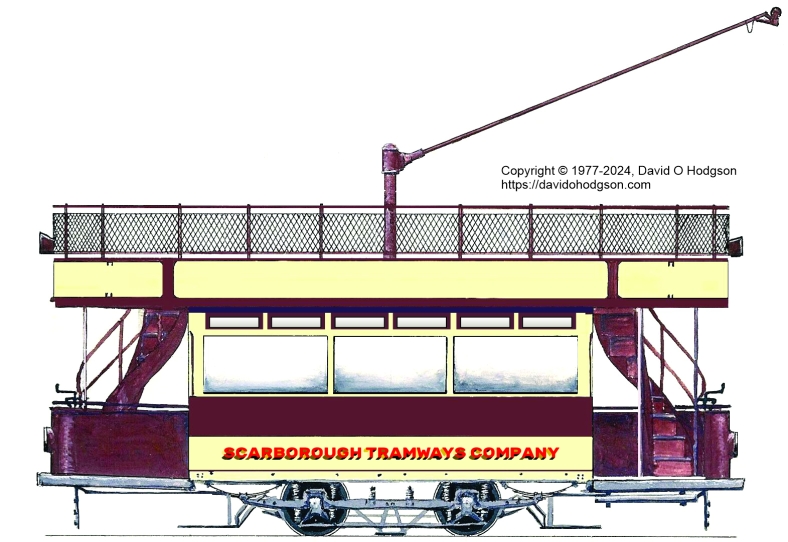
My technical illustration of a Scarborough tramcar. Based on the drawing of a Brush-manufactured tram in “Scale Model Electric Tramways

This article describes an aspect of the history of my home town that definitely does not derive from my personal memories, because the Scarborough Tramways Company ceased to exist many decades before I was born.

However, as part of my ‘A’ Level Art project, I included some details of the long-defunct system in my thesis (written during 1976-78) on “Road & Rail Transport in Scarborough”. At that time, there was very little published information available regarding the system, so my researches were based on limited resources. Since then, at least a couple of books have been published on the topic, as detailed in Published References below.

The cover of my Art project thesis also featured a somewhat distorted painting of a Scarborough tram alongside its modern equivalent, as shown below.

The Cover of my A-Level Art Project

Great Expectations

At the turn of the twentieth century, an electric tramway system was a prestigious asset for any British town. This was before the age of the motorbus, and electric trams were seen as the most modern and most efficient way to provide urban mass transport.

By 1904, following various rejected proposals, Scarborough Corporation had arranged for the construction and operation of a tramway system by Edmundson’s Electricity Corporation. The first trams ran on 6th May, 1904, but unfortunately the subsequent history of the system was marred by disputes with the town Corporation, which ultimately led to the early abandonment of the system. The last tram ran on 30th September 1931.

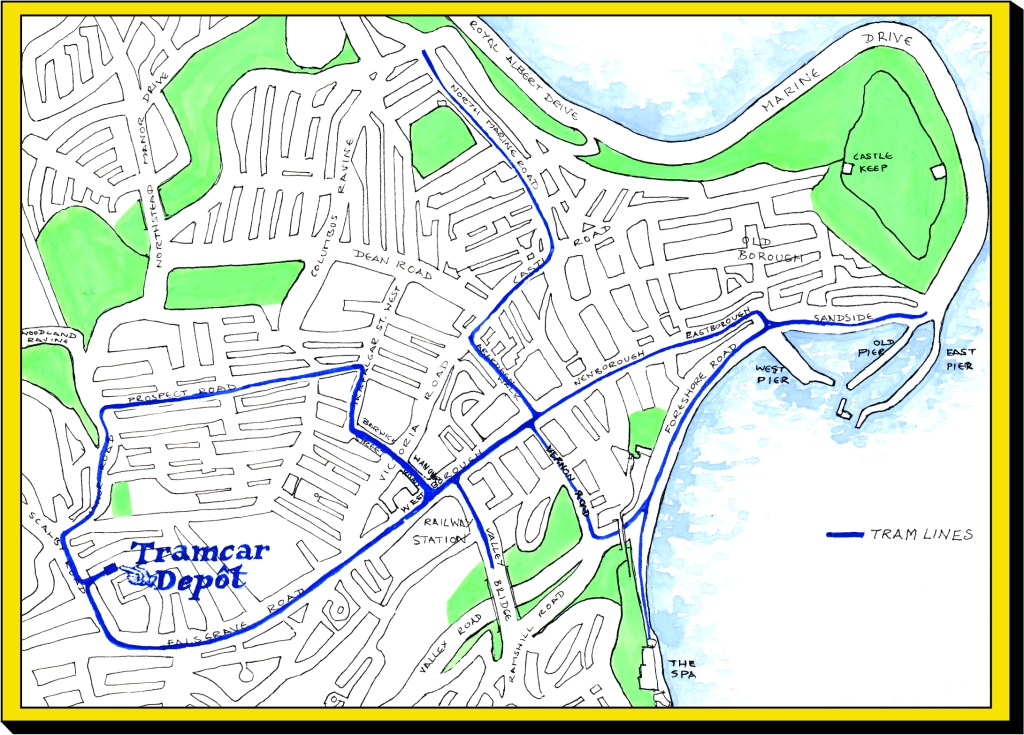
The map below shows the extent of the system as constructed, and the location of the car depot on Scalby Road. The company also had parliamentary authorization to build a line along the Marine Drive, linking the stub on Sandside to that on North Marine Road, via Peasholm Glen, but that line was never built.

My map of Scarborough Tramways System

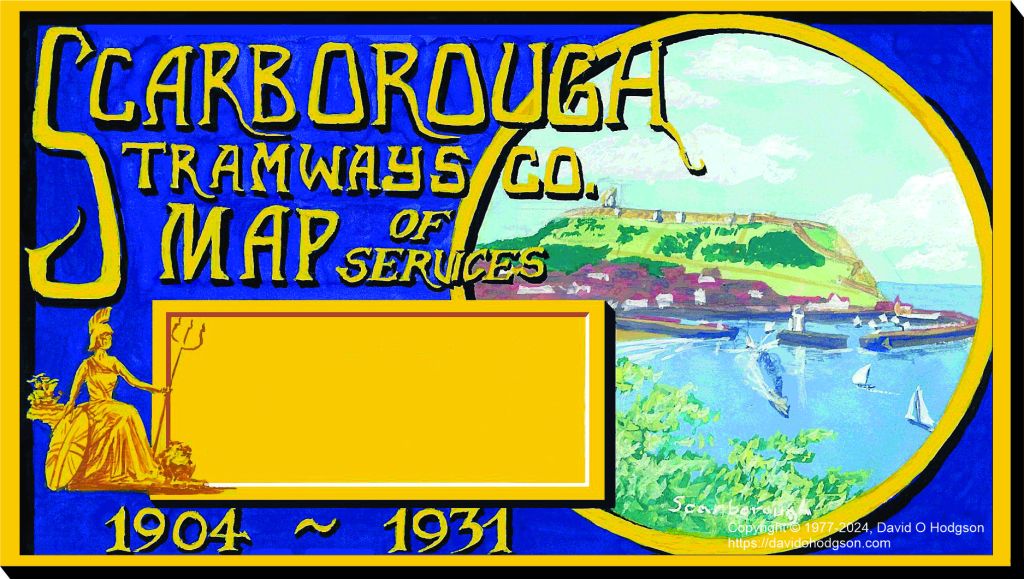
The design below is a fictitious Art Nouveau styled header that I created for the presentation of the tramway map in my Art study.

My fictitious Art Nouveau Header for the Scarborough Tramways Map

The tramway depot on Scalby Road survived until the 1960s, in derelict condition, when it was finally demolished to make way for the construction of Harley Close.

Other than that, there was generally no remaining evidence that the system had ever existed. Occasionally, however, disused tram tracks would reappear through the surface of existing roads, as shown in my photo below, which shows the truncated tracks protruding through the surface of Hanover Road in 1979.

Tram rails protruding through the surface of Hanover Road, Scarborough, in 1979

Thwarted Ambitions

One reason that has been suggested for the failure of the tramway system was that it did not expand as Scarborough grew in size. For example, the tramway system never extended to the rapidly-developing South Cliff over the Valley Bridge. However, it seems that there was a proposal to add a line across the bridge, then up West Street, terminating at Holbeck Hill. This very reasonable proposal was quashed by opposition from local residents! During 1970-78, I lived on West Street, and the photo below was taken from my bedroom window, showing a United Automobile Services bus operating the 100 service, which followed the route of the never-built tramway extension.

From my bedroom window in West Street, a United AS Bristol VR on the 100 Service. This route was a proposed extension to the Scarborough Tramways system, but was blocked by local opposition

A Premature Demise?

The troubles that beset the Scarborough Tramways Company throughout most of its existence seem to have been largely caused by an initial failure to agree on whether the system was to be run on a purely for-profit basis, or as a non-commercial public utility. As I’ve mentioned in another post, Scarborough’s population reliably swelled with visitors during the summer months, making the tramway profitable during those months. However, during the inevitable quiet months in winter, demand for tram services declined to the point where the company felt justified in suspending operations. Scarborough Corporation objected to this, even though they had failed to specify in the agreement how the service would be supported during lean times.

Needless to say, it was not only Scarborough Tramways that suffered from such hopelessly inconsistent economic expectations. British Railways notoriously suffered from conflicting demands by successive British governments; sometimes demanding that it should operate at an absolute profit, then at other times that it should provide a public utility without regard for cost.

Between the 1930s and the 1970s, all British electric tramway systems were shut down and abandoned, with only one exception (Blackpool). It wasn’t until the 1980s that the prevailing view in Britain that tramways were obsolete began to be superseded by economic realities. Subsequently, some tramways were partially reinstated, and some completely new systems have been built. At the time of writing, there are 9 operating tramway systems in Britain.

In his 1961 book “The British Tram,” author Frank E Wilson seems to have fully accepted the obsolescence of tramways. Horrifically, but thankfully inaccurately, the book’s last sentence reads:

Perhaps some of the babes in arms today will live to see the time when trains, buses, cars and probably aircraft have gone to join the tram in history—leaving them with hovercraft or rockets for earth and space travel, unless they have themselves, with the whole lot, disappeared in nuclear fission

Cover of “The British Tram” by Frank E Wilson. Copyright © 1961, Model & Allied Publications Ltd.

Scarborough Tram Week, 1981

Apparently, in October 1981, Scarborough’s local bus operator, United Automobile Services, held a “Scarborough Tram Week”, commemorating the fiftieth anniversary of the end of tram services in the town. Unfortunately for this history, and as I’ve mentioned elsewhere, I had just then left Scarborough for ever, to begin my undergraduate studies at Imperial College, London.

It seems that United AS repainted a contemporary Bristol VR bus in a fairly accurate version of the Scarborough Tramways colors, as shown in the photo below. Unfortunately, this monochrome image is the only one that I’ve ever been able to find of that vehicle. The image probably came from a book, but at present I can find no record of which. If anyone can provide copyright details, or another color image, then I will be grateful to acknowledge that!

United AS Bristol VR painted in replica Scarborough Tramways livery, 1981. Copyright © TBD

Published References

During the 1970s, when I did the research for my Art project, I could find no published books describing Scarborough’s tramway system. The only source material available was a few articles in old editions of the “Scarborough Evening News”.

Now, however, the situation is much better. Perhaps the definitive work is Barry Marsden’s “Scarborough Tramways”, published in 2007.

Copyright © 2007, Middleton Press

In 1981, which was the fiftieth anniversary of the closure of the tramway system, Scarborough’s local bus operator, United Automobile Services, self-published a small but informative booklet, titled “Trams by the Sea”.

Copyright © 1981, United Automobile Services
My technical illustration of a Scarborough tramcar. Based on the drawing of a Brush-manufactured tram in “Scale Model Electric Tramways”

Michael Palin Interview: Out-Takes

In an earlier post, I described some thought-provoking comments about the Monty Python movie “The Life of Brian” that Michael Palin made to me during my student TV video interview with him, back in 1983.

Recently, I’ve been reformatting an ancient video recording of that interview. The entire interview is over 30 minutes in length, and some of it has become quite outdated. Nonetheless, there are some sections that could still be relevant.

For this post, I decided to edit together some of the clips that did not make it into the interview. These were “out-takes”, in which something went wrong (intentionally or otherwise!) during the shot. I can’t honestly say that these have never before been broadcast, because most of them were actually included in the Student TV’s annual “bloopers” program that was screened just before Christmas. Anyway, they’re still quite funny, after all this time.

The content of the clips probably speaks for itself, but I should perhaps explain why the shots appear the way that they do. The interview was an “outside broadcast” for us, so we took along only one camera (because in those days when camcorders were new technology, we had only one portable camera). Therefore, to shoot the main interview, we locked off the camera pointing at Michael, and recorded the entire session like that. That’s why, in most of the video, you can only see him, and hear me talking to him in the background.

Once the main interview had been recorded, we moved the camera to an over-the-shoulder shot of the two of us, then recorded some video of that for cutaways, which would be edited into the main tape.

Finally, after Michael left, we moved the camera to point at me, and recorded all my questions and reactions again, with me facing an empty chair.

I must apologize again for the poor video quality, due to the number of format conversions that this recording has undergone over the years. It’s worse in this case because some of the video was recorded during setup, so the camera is shaking around and there are even color bars over some of it. Nonetheless, I think it’s still sufficiently funny to be worth viewing.

The photo below is the best-quality shot that I have remaining from that occasion, because it’s a professional publicity shot of Michael Palin.

Michael Palin Publicity Photo c.1983


Do We Need A White Christmas?

Shoveling Snow: Winter 1962-63

Shoveling Snow: Winter 1962-63

The photo above was taken by my father during the severe winter of 1962-63, and shows me using our coal shovel to “help” clear snow from our front garden in Scarborough. Today marks the Winter Solstice here, so it seems like a good moment to reflect on something that many people seem to hope for at this time of year.

As the photo above demonstrates, some of my earliest memories of this time of year were associated with snow. This was largely because the winter depicted in the image was the coldest in Britain since 1895, a record which has still not been broken in the part of the country in which I was living.

As a result of that experience, as I grew up, I tended to assume that Christmases should be snowy, and I was most disappointed in later years when there was not only no snow on Christmas Day, but it was actually even sunny!

As I grew more mature, of course, I realized that my expectation was not particularly reasonable, and that it had in fact been instilled by episodes of weather that were anomalous, coupled with myths about what Christmas was supposed to be like.

Last weekend, I attended a “Holiday Soundtracks” concert by Michael Berkowitz at the Luther Burbank Center for the Arts in Santa Rosa where we heard, once again and as we do every year, melodies proclaiming the desirability of a “White Christmas”. The photo below shows a view of the concert.

LutherBurbankCenterXmasSoundtracks1

Holiday Soundtracks, Santa Rosa

In a pre-show discussion, Berkowitz himself pointed out the irony of a “Christmas” show being presented by a Jewish conductor, and indeed several of the writers of those famous songs were also Jewish.

The origin of my own childhood views about snowy holidays are obvious to me, but the concert led me once again to consider why so many other people should also want this end-of-year festival to be “white”, that is, to have snow on the ground.

A Northern European Tradition

Presumably the source of the association of the Yuletide festival with snow was that most of its traditions originated in Northern Europe, where there was usually snow at this time of year.

Later, in North America, many of the regions that were settled earliest by European peoples also experienced snowy winters, so those traditions continued.

In the Southern Hemisphere, of course, it’s Summer at this time of year, so the idea of a “White Christmas” makes little sense in many places. However, even in Australia, there are high-altitude ski resorts where you can experience snow in mid-summer if you really want to, as described in this article.

Maintaining the Myths

Many blame the media for propagating the myth of the desirability of a snowy holiday, as in this Boston Globe article. There is also the ever-popular Santa Claus myth, which includes the idea of his living at the North Pole.

When I discovered the truth about “Father Christmas”, after my mother admitted it to me when I was about 8 years old, I was actually quite angry that she had conspired with my father to deceive me for so long!

Snow in London

After leaving my home town, I attended university in London, and lived there for several years. The climate in London is only slightly milder than that in Northern England, so of course it also snows in London during the winter.

I took the photo below, of the Albert Memorial in Kensington Gardens, during my first winter as a London student.

AlbertMemorialSnow1981Cright

Albert Memorial, London, in Snow, 1981

There’s no question that it’s a pretty scene, but getting around in the city after a snowstorm wasn’t necessarily any fun. The snow quickly turned to dirty slush, which would often then refreeze overnight, creating black ice the following morning. Travel became unusually difficult and dangerous.

As I’ve said so many times since then, it’s great to be able to look at a snowy landscape, as long as you don’t have to go anywhere in it!

Snow in California

If anyone had asked me before I came here whether it snows in California, I may well have replied “No”, but I’d have been very wrong. At the higher elevations in the state, such as the Sierra Nevada, it snows every winter. In the lowland elevations where I live, however, it almost never snows. For example, I lived on the San Francisco Peninsula for about 20 years, and during that time it only snowed once at our house (and only very lightly), although we could sometimes see snow on the surrounding peaks.

The elevation of land in California ranges from sea level to about 14,000 feet above sea level, so the state has a corresponding variety of climates. Contrast that with the highest elevation in Britain, at about 4,400 feet, which is the peak of a mountain (Ben Nevis), while the whole of Lake Tahoe in California lies at 6,225 feet.

Thus, if I were to decide now that I would like a “White Christmas”, all I have to do is to get in my car and drive up to the Sierras. It’s nice to feel that, although I don’t need snow for the holiday, I have the option of it if I choose!

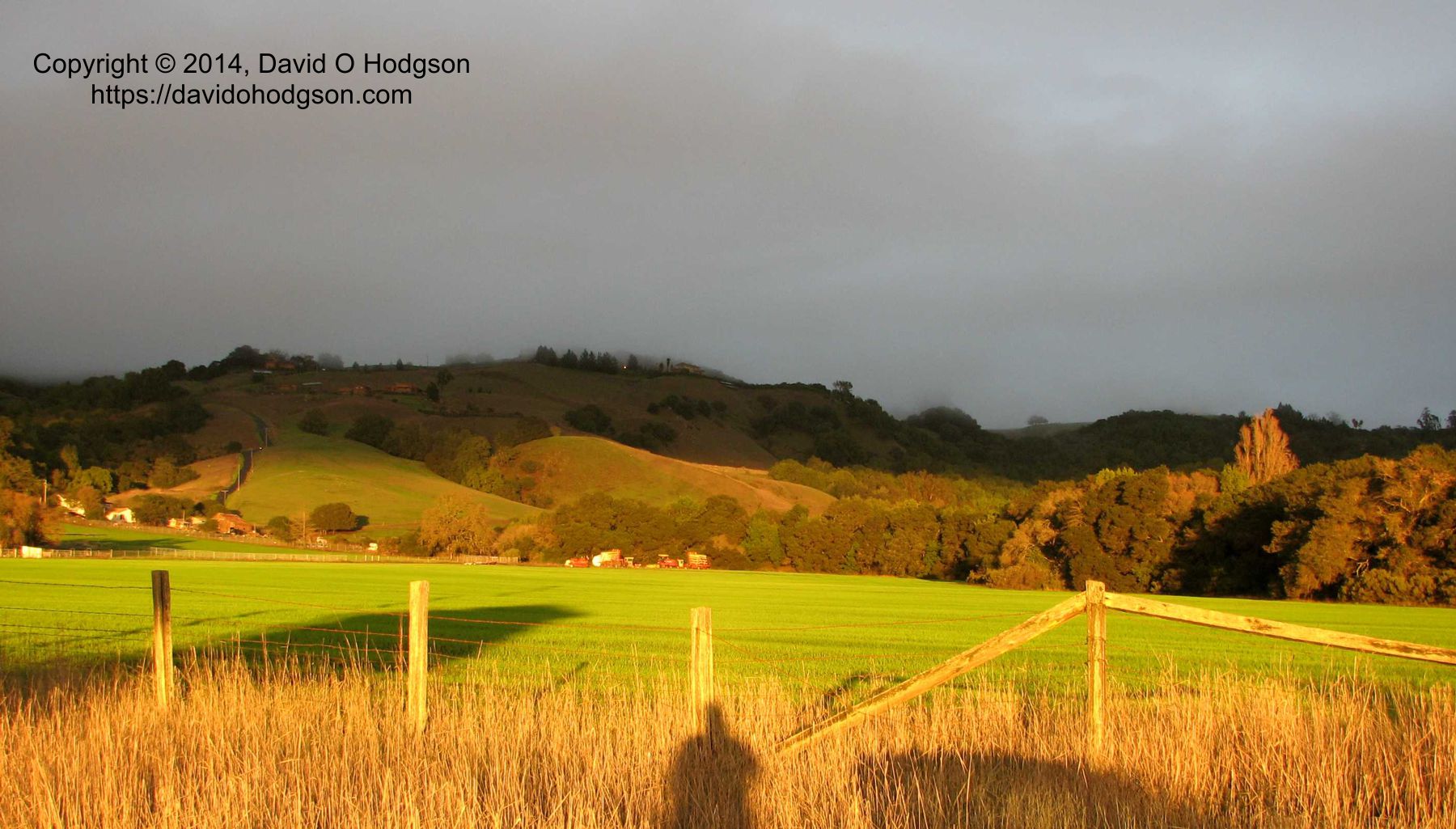
The photo below shows a typical local California view, taken near Cotati, on the occasion of the Winter Solstice in 2014. There’s mist over the hills, but no snow anywhere nearby.

Winter Solstice, Cotati, California

Winter Solstice, Cotati, California

Let It Go

If you happen to live somewhere that does not have snow at this time of year, then perhaps it will help to realize that its desirability is actually just a myth, and that there are actually definite benefits to a holiday without such weather!

Shoveling Snow: Winter 1962-63

Shoveling Snow: Winter 1962-63

Centenary of the Great War Armistice

St Clement Danes Church, London

St Clement Danes Church, London

The photo above, which I took during an early visit to London, shows the RAF memorial church of St Clement Danes. The building was completely destroyed during the Second World War, and fully restored in 1958, to act as a war memorial for the Air Force.

As most people are probably aware, today (11th November 2018) marks the centenary of the end of the First World War (known earlier as the Great War). There has been and continues to be much debate about the causes of that devastating war, and the issue will probably never be completely settled. What does seem clear is that, in those days, many European nations saw warfare as a satisfactory way to resolve disputes or gain territory, and had created detailed plans defining exactly whom they were going to attack and how. Their autocratic leaders were really just “spoiling for a fight”, and were supremely (but mistakenly) confident that they could win a swift, decisive victory.

It seems clear now that, if the conflict hadn’t been sparked by the assassination of Archduke Ferdinand by a Yugoslav nationalist, then some other equally parochial incident would have served as the trigger.

The situation was made more volatile by the nationalistic attitudes of the general populations, who tended to see war as a spectator sport. Many were quite prepared to sit happily on the sidelines and cheer as their “team” slogged it out with the opposition. Warfare had usually been conducted that way for centuries, but all that was to change as the Great War turned into “total war”, involving substantial portions of the civilian populations.

The Invasion of Leeds?

Of course, I’m not nearly old enough to have lived through the First World War, let alone remember anything about it. However, my father was 5 years old when the war began in 1914, and he did have some memories of the time.

His family lived in Leeds, Yorkshire, which is some 60 miles from the coast of the North Sea, and thus was not likely to be in any direct danger from enemy action. Nonetheless, my father’s mother was apparently certain of an immediate German invasion, and insisted upon placing sandbags around the house on the outbreak of war! Apparently, even then, not everyone believed that the war would take place on faraway fields.

Raid on Scarborough

My home town of Scarborough became a flashpoint during the First World War, after being subjected to a German naval raid during December 1914. That attack was characterized as a brazen assault on civilians (and it’s difficult to see how it could have served much other purpose), and had the presumably-unintended consequence of offering a major propaganda opportunity for the Allied nations.

During the bombardment, Scarborough’s lighthouse was one of many buildings that were hit and damaged, but it was subsequently repaired, as shown in my photo below.

Scarborough Lighthouse, 2007

Scarborough Lighthouse, 2007

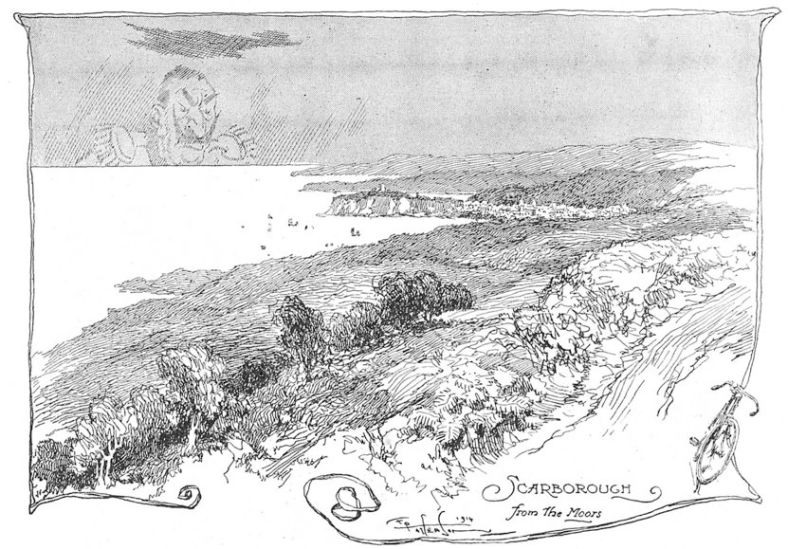
British illustrator Frank Patterson, whom I’ve mentioned in a previous post on my professional web site, normally avoided propaganda-style artwork. Apparently, however, he was so incensed by the attack on Scarborough that he produced the illustration below, showing a thunderous Kaiser glowering at the town from over the horizon.

Scarborough from the Moors, 1914. Copyright Frank Patterson

Scarborough from the Moors, 1914. Copyright Frank Patterson

A Changed World

Whatever its actual causes and motivations, there can be no doubt that the First World War changed the course of history very significantly, and not only in terms of international relations and territorial dominance.

The war essentially spelled the end of the colonial empires created by European powers during the preceding few centuries. Admittedly, some empires (such as the British and French) clung on for a few more decades, but the new order of affairs was already being set up at the end of the First War.

On the social level, agreements made during the War led to women eventually obtaining the right to vote in several countries, such as Britain. From the modern perspective, it seems astonishing that such a development took so long, and no sane, educated person would now suggest that women should not have such a right.

The First World War was undoubtedly a disaster of immense proportions, but some social good did eventually come of it.

St Clement Danes Church, London

St Clement Danes Church, London

The Tower by the Bay

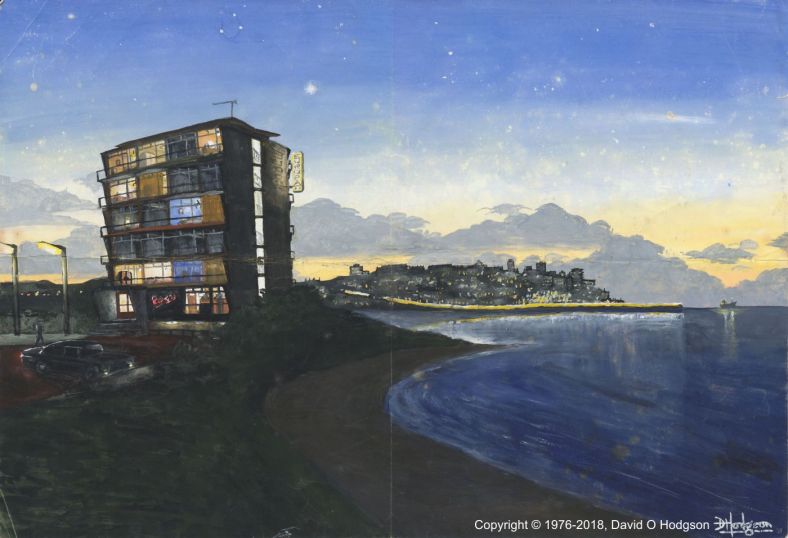
The Tower by the Bay, 1976

The Tower by the Bay, 1976

I completed the painting above during 1976, but not at school. I apologize for the poor quality; not only has the poster paint I used decayed over time, but the painting was also folded into four at some point!

The scene depicted is completely imaginary, and doesn’t attempt to represent any real place. I’m not sure why I chose to do this particular work at home; perhaps I just felt that my schoolteachers would demand to know what it was supposed to represent, and I wouldn’t be able to explain!
Today (October 25th) is International Artist Day, so I thought it appropriate to feature some of my artwork in this post, even if it’s not of “professional” standard on this occasion.

If my painting above represents anything, then I suppose that it was intended to show my “ideal location”, from my viewpoint as a teenager. Looking closely, the “tower block” in the image has a sign on the side saying “Europa”, so presumably it was supposed to be a hotel somewhere in Europe. At that age, I had no experience of independent living, so it probably seemed to me that the only alternative to living with my parents was to stay in a hotel!
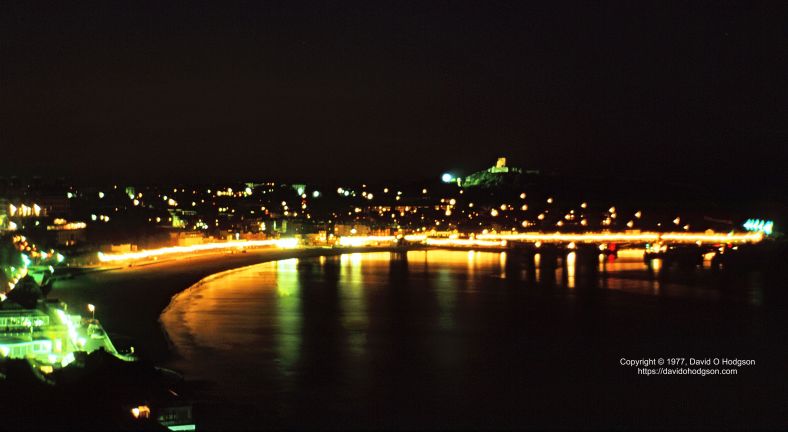
The city on the horizon, with its illuminated seaside promenade, is of course loosely based on views of my home town of Scarborough (as shown below in my 1977 photo). However, at that time, there were no modern “tower blocks” such as the one in my painting near the sea in Scarborough (although there was such a building—Ebor House—in the nearby resort of Bridlington, which was in the news just recently for the wrong reasons).

Scarborough South Bay at Night, 1977

Scarborough South Bay at Night, 1977

I seem to have spent a lot of time detailing the interiors of the rooms in the hotel, which I could have avoided simply by painting the curtains closed!

Slightly more than ten years after I painted the image above, I unexpectedly found myself in a seaside location that reminded me of that imaginary scene, although it was not anywhere in Europe.

Realizing the Dream

The photo below, which I took during my first visit to California in October 1987, shows the Metro Tower in Foster City, as seen from one of the lagoon bridges. At that time, the Metro Tower, which had only just been completed, had the distinction of being the tallest building between San Francisco and Los Angeles.

Foster City, California, in 1987

Foster City, California, in 1987

During the first evening that I arrived in California, I found myself very disoriented, because I thought that the tower and lagoon in front of it were facing westwards towards the Pacific Ocean. In fact, Foster City faces San Francisco Bay, and thus eastwards. I had to consult maps to figure out why the sea seemed to be on both sides!

I’m afraid that once again the picture quality is very poor, but I could not in fact go back and take the same photograph today, because other large buildings now surround the Metro Tower, as shown in the nearest-available Google Street View today.

As I mentioned in a previous post, after emigrating to California later in 1987, I did rent an apartment in Foster City, and lived there for about 18 months. It was a pleasant place to live, and the sheer modernity of the surroundings was a refreshing change from everywhere that I’d previously lived.

Not a Premonition

I realize that, in view of what happened to me later on, it’s possible to interpret my teenage painting as some kind of “premonition” regarding the place where I would find myself living as an adult (and someone did in fact suggest that).

However, in general I see no evidence that premonitions, in the sense of someone being able to know what will happen in the future, are possible (if only because the future of the universe is inherently not knowable). You may be able to make a very good guess as to what will happen in the future, based on the current circumstances, but it’s only ever a prediction. (This is, of course, exactly what weather forecasters do every day.)

In the case of my painting, I think the reality is just the opposite. Having unexpectedly found myself in California, Foster City particularly appealed to me because it was so reminiscent of the scene in my earlier painting. Thus, I took action to fulfill aspects of the fantasy that I’d had as a teenager, and made it real.

In fact, seeing it that way seems better than believing in some kind of premonition, because I was able to take action to change my life in the way that I wanted it to be, rather than accepting whatever situation I found myself born into.

The Tower by the Bay, 1976

The Tower by the Bay, 1976

Radio Ga Ga

My brother and I with the Radiogram, c.1965

My brother and me, with the Radiogram, c.1965

The photo above was taken by my father. It shows me at about the age of 5 (on the left), with my younger brother, apparently enthusiastically listening to a record being played on my grandfather’s radiogram.

If you’re not familiar with the term “radiogram”, that’s not surprising. It’s an obsolete British term for an item of furniture combining a record player and a radio receiver. These massive, wooden-crated units were popular until transistor electronics began to replace valve (tube) technology, after which they were replaced by smaller “hi-fi music centres”.

My grandfather’s pride-and-joy was his Bush SRG 100 model (British-made, of course). Other than the fact that it was a Bush, I’d forgotten many details of it until I found an example being offered online, in this post. The photos in the post provide a good indication of the sheer size of that device!

When the photo above was taken, I had no inkling of the role that that particular radiogram was to play in my future life. My grandfather died in 1967, and I ultimately inherited his Bush radiogram. During the 1970s, the enormous object resided in my bedroom at our house in West Street, Scarborough. I rarely played records on it, but I did spend innumerable hours listening to a wide variety of radio broadcasts.

Given that most people these days think of radio as being merely a source of music, mostly-mindless opinions, and perhaps traffic news, the quality and breadth of broadcasts in those days seems remarkable. The apparent decline in the quality of radio is appropriately lamented in Queen’s 1984 song, Radio Ga Ga.

For example, British radio comedy was a very creative field, partly because new programming ideas could be tested much more cheaply on radio than on TV. The radio comedies of the 1950s and 60s, from the Goon Show, through Round the Horne and eventually I’m Sorry I’ll Read That Again, eventually led to the TV “breakthrough” of Monty Python’s Flying Circus.

Radio Monopoly

The landscape of British radio broadcasting during the 1960s was so different that it seems in retrospect as though I must have been living in some alien nation.

Essentially the BBC had a monopoly on legal radio broadcasting. Until 1967, there were only 3 BBC radio stations: the Home Service, the Light Programme, and the imaginatively-named Third Programme. Although it’s not visible in the photo above, the VHF tuning display of the Bush radiogram showed only those 3 selections! Except for the military, “ham” operators and emergency services, nobody else was allowed to establish a broadcast radio station in the UK!

Strange as it may seem from the perspective of history, most people didn’t seem to object to the BBC’s monopoly on broadcasting. However, a problem developed during the 1960s, because the BBC refused to play rock-and-roll music on the Light Programme.

Due to tremendous demand from young people to hear pop music, various “pirate” radio stations came into being. These evaded UK law by broadcasting from foreign countries, or even from ships at sea. In a typically absurd way, although the broadcasts were legal, listening to the “pirate” broadcasts in the UK was illegal!

Our School Governor is a Pirate!

Probably the most famous of the music stations broadcasting to Britain (although not technically a “pirate” station) was Radio Luxembourg. In 1966, the owner of our local supermarket in Newby, Wilf Proudfoot, became the proprietor of a pirate station, Radio 270, which broadcast from a ship in international waters in the North Sea.

Scarborough Harbour, September 1963

Scarborough Harbour, September 1963

Proudfoot was also a governor of our school—Newby County Primary. It was hardly inspiring when our headmaster introduced him at “Assembly” time as a local businessman, who was publicly breaking the law! Of course, compared to the criminal behavior and corruption that has been unearthed in Scarborough since then, Proudfoot’s actions now seem quite benign.

In 1967, the structure of BBC radio broadcasting changed, with the introduction of Radio 1 as the official pop music station. The Light Programme, Third Programme and Home Service were rebranded as Radio 2, Radio 3 and Radio 4 respectively. At the same time, the law was changed to close various loopholes, which put Proudfoot’s Radio 270 and similar stations out of business.

Waiting for the Sky Wave

It always seemed odd to me that, during my lifetime at least, my parents never listened to the radio. They certainly watched plenty of TV, though. It was as though they’d decided that television had made radio obsolete, so that was the end of that.

As a teenager, therefore, radio became the doorway to my private world, in which my parents simply took no interest. Nowadays I suppose I’d be spending my time on the internet, but that wasn’t even imagined back then.

Typically, I’d switch on Radio 2 at 6am, to catch the start of Terry Wogan’s show, and then be listening to one or other of the BBC channels for most of the day. After twilight, things began to get more interesting, when skywave reflections allowed me to pick up (temporarily) stations from further afield. Those gave me new perspectives on the world that simply weren’t available in my small-town environment. I was also learning French and German at school, so listening to European stations gave me a study incentive.

It was a gateway to a wider world that I was eager to get out and explore, and, eventually, that was exactly what I did.

My Father and his Garden

My Father with his Roses, c.1960

My Father with his Roses, c.1960

For Father’s Day, I decided to post a photo of my own father alongside his “pride and joy”, which was the large garden that he cultivated at the house in Scarborough where we grew up. He lavished many of his leisure hours on that garden, growing all kinds of plants, including the rose bushes shown. The photo was taken c.1960, before he suffered his first stroke. After that, he was no longer able to do the physical work required to maintain the garden, which then gradually deteriorated (although my mother did pitch in to maintain it until we moved away in 1970).

There’s no doubt that the results he achieved while still healthy were spectacular, as shown in the photo below of the two of us sitting by the frog pond in the back garden.

My Father with Me in our Back Garden, 1963

My Father with Me in our Back Garden, 1963

Naturally, having nothing else against which to compare it, I took it for granted that everyone had a huge garden like ours, with a pond and a stream running through it, and that working on the garden was a necessary part of every adult’s life.

It was only as I grew up that I came to realize that, not only did some people not have large gardens, but that some city-dwelling types actually didn’t have their own gardens at all!

Decades later, when I moved to California, I made the further discovery that all that gardening effort is something of a British peculiarity. Some Americans do take pride in maintaining beautiful gardens, and some take an interest in cultivating roses or other specific types of plant. Nonetheless, I don’t think I’ve ever heard anyone here say that their hobby is “gardening”, which would be quite common in Britain.

Large Garden: Small House

It was also common for British suburban houses to be built with large surrounding gardens, even when the homes themselves were quite small.

Now, both the homes and the gardens are becoming small; the smallest in Europe, according to this article. Nonetheless, there are still many older houses that still have the large gardens with which they were built.

According to current aerial views, the garden of our Scarborough house has now been largely built over, so there’s nothing left to see of all my father’s hard work.

On Second Thoughts

Having grown up enjoying that immense garden, I was convinced that I, too, wanted to create and maintain something similar. It was only when we moved into a house with a garden that I realized just how much time and expense was involved! It seemed even less appealing because we were renting that house, so all that effort was going into someone else’s garden.

As a result, I dialed back my gardening ambitions very substantially! Now, I’m quite happy to have a small, well-designed, garden, and pay someone else to maintain it, even though I own the property. The photo below, showing our home’s front garden a few months ago, shows the modest level of my requirements!

The Front Garden of our Home in Santa Rosa

The Front Garden of our Home in Santa Rosa

Recapturing his Childhood

In my father’s case, I believe that he had some specific, tragic reasons for wanting to create a large and luxuriant garden. He had been born into a relatively wealthy (upper middle class) family. His father owned a textile mill in Leeds, and they lived in a large house in the suburb of Roundhay, with a complement of servants.

Unfortunately, for various reasons, the mill went bankrupt, probably in the late 1920s, and because the business was unincorporated, they lost everything. My father’s garden was probably thus a way of recapturing a lost aspect of his happy younger days.

Monochrome Film Photography


St. Mary's Church, Castlegate, York, in 1977I took the photo above, showing the church of St. Mary’s, Castlegate, York, during 1977. It was taken with Ilford FP4 film.

At that time, most of my photographs were taken with monochrome 35mm film, which I developed and printed myself. Most of them were taken for record purposes, without any serious attempt to produce high-quality or artistic results. Nonetheless, the photo above turned out to be one of the best, in terms of composition and tonal balance.

Thinking back now on those days, in this age of ubiquitous digital photography, the concerns and challenges of film photography seem like part of an alien world. Everything seemed more complex, and it was also quite an expensive pursuit. There was no instant feedback; you had to wait for a photograph to be developed before you could assess the quality, which led to much waste, increasing the effective cost of the photographs that ended up being usable.

The Accidental Photographer

During the 1960s my father became a keen amateur photographer. He owned several cameras, plus a complete suite of darkroom equipment, including two enlargers. He was a member of the Scarborough Camera Club, and regularly exhibited his work at their shows. He used a variety of film formats, from 35mm monochrome, through to much larger negative formats in color or monochrome. He developed and printed monochrome film images himself, and although he experimented with developing and printing color images, he found that too complex and expensive to be worthwhile.

By the mid-1970s, my father’s health had deteriorated to the point that he no longer took an active interest in photography, so I found myself “inheriting” all his equipment. At the same time, I was developing an interest in local history, and was soon to begin my Advanced-Level Art study of architecture, so I was able to make perfect use of his equipment. Nonetheless, I had to make tradeoffs regarding cost and quality.

Predicting Digital Photography

In 1983, during my final year as an undergraduate electronic engineering student at Imperial College, London, we were required to prepare a group report on a relevant topic. My group chose to write a report on possible future developments in telecommunications.

One of the future technologies that we predicted was the development of digital cameras. Our prediction wasn’t really too much of a stretch, because digital framestores already existed, and low-resolution framestores were already used in computer monitors.

It took some time for digital image technology to eclipse film, but for all practical purposes we have now reached that point. Perhaps surprisingly, given my professional contributions to digital video technology, even when digital cameras first became available, I continued to use 35mm film (albeit sometimes output to Kodak Photo CD format), on the grounds that digital images were not of comparable quality.

Eventually, however, the digital technology caught up, and the image quality now available even from some phone cameras now surpasses that possible with 35mm film. (Using 35mm film involved so many variables that the ideally-achievable quality was almost never achieved in reality.)

Return to Castlegate

Some 22 years later, in 1999, my wife and I stayed in the Stakis Hotel (now the Hilton) in York, which was constructed later on the site of the brick building in the left foreground of the 1977 photo above.

The present-day Google Streetview version of the same York location can be seen here.

“Such a Vision of the Street”

In his beautiful poem Preludes, written more than a century ago, T S Eliot masterfully evoked the dingy ambience of a rainy urban street.

I was also inspired by night-time photographs of urban settings by other photographers, and I realized that my monochrome film was fast enough to be used at night, if the camera was on a tripod.

One rainy evening, I took my father’s heavy wooden tripod with me to the Odeon roundabout in Scarborough, next to the railway station, and set it up to take some experimental shots. Not all of the photos came out well, but some were quite effective.

The photo below shows the entrance to the Odeon Cinema (now the Stephen Joseph Theatre), when passengers had just alighted from a United 101 service bus. The reflection of light from the wet road surface was particularly effective in this shot.

Scarborough Odeon at night, 1977

Scarborough Odeon at night, 1977

You can see that the Odeon was showing the movie The Pink Panther Strikes Again, which, on another night, I did actually go to see at that cinema.

In those photographs, I was trying to capture the atmosphere of that rainy evening, as eloquently described in Eliot’s poem:

The conscience of a blackened street

Impatient to assume the world.

Goodbye to All That

When I went away to university at the end of 1978, I couldn’t take my father’s processing equipment with me. I continued to take photographs for many more years using Kodachrome transparency film, but that transition marked the end of my brief “career” as a film photographer who processed his own images.