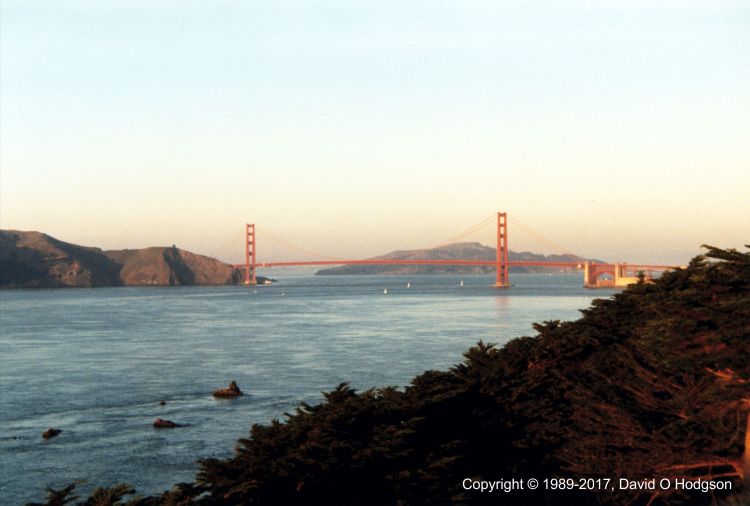
Golden Gate Bridge at Sunset
The photo above shows one of California’s most iconic views; the Golden Gate Bridge at sunset. I had a reasonably accurate preconception of this location before moving here, but I also had many other conceptions of California that were much less accurate.
In my earlier post describing the events of thirty years ago, by which I came to California, initially temporarily and then permanently, I described how I made a (literally) flying visit to my prospective new employer for interview, then returned to my job in Britain, and was eventually offered the position in California. I finally emigrated in November, 1987.
Reminiscences Interrupted
I’d planned to continue the series with this post, but was of course interrupted by the terrible wildfires that started here on October 9th. In view of that, I felt it more important to post items about my immediate experiences than to reminisce about the events of thirty years ago.
My reasons for choosing to move to California did not include the expectation of a “quiet life”, and indeed it has not been so! (If I had sought that, then staying in my birth town of Scarborough would probably have been the best option!) The fires were not even my “first disaster” in California, since I lived through the Loma Prieta Earthquake in 1989.
A Distorted View
Like most people who’ve never visited the US, and California in particular, I had formed most of my ideas about the place from American movies, TV shows and music. This provided a highly distorted view of American life, and led to considerable confusion and several misconceptions on my part.
The song California Dreamin’ was played regularly on the radio in those days, relaying the message that California was, if nothing else, warm. Of course, the song fails to distinguish Northern California from Southern California, and I was completely ignorant of any distinction between the two.
My parents’ views of the US were informed mostly by my father’s experience during World War II. His only contact with Americans had been a few servicemen that he met while on military service during the war. As a wireless officer in the Royal Air Force, he had flown a variety of British and American aircraft types, the American types being those supplied under Lend-Lease. I formed the conclusion that he admired, but was somewhat jealous of, the perceived wealth and modernity of Americans. (I recall that he had many negative things to say about some British aircraft types—particularly the Bristol Blenheim—but I never heard him say anything negative about any American aircraft type.)
Time to Live the Dream?
In October 1987, having received the offer of a job in Northern California, I quickly had to make the momentous decision as to whether to accept it, which of course would involve moving myself and all my possessions some 5,500 miles to a different continent.
It had been easy enough to dream about some day getting away from the miseries and frustrations of life in Britain, and jetting away to a great job in some far-off country, but now I was actually faced with the prospect of having to do it!
In the back of my mind, I had been assuming that my new employer wouldn’t be expecting me to start working for them before the beginning of 1988, so it was somewhat shocking when they told me that they’d like me to move and start working for them before Christmas.
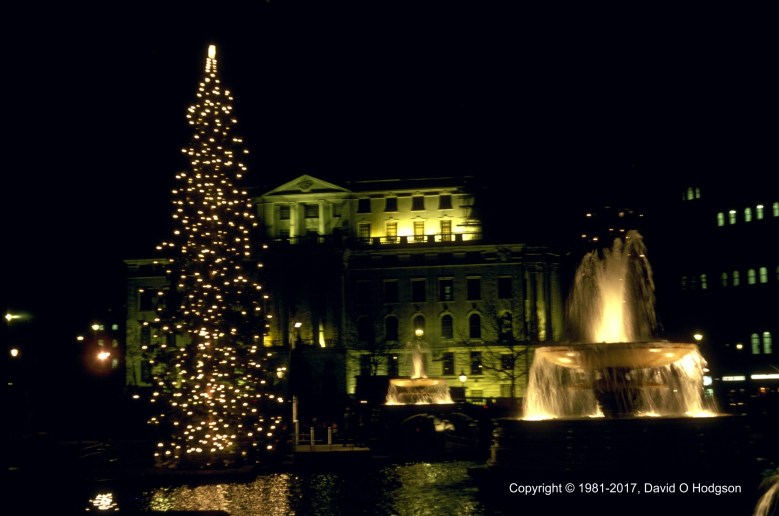
Trafalgar Square, London, at Christmas
As it turned out, 1986 was to be my last Christmas in Britain. The photo above shows Trafalgar Square in London, decorated for the holidays, while I was a student there during the early 1980s.
You’ll Live to Regret It!
I naturally couldn’t talk to my work colleagues about my situation, but I did discuss it with my mother and some non-work friends. Some people cautioned me that such a major move could be a huge mistake, which I’d live to regret. It was bound to be very expensive and disruptive (they said), and I’d find myself pining for the comforts of life in Britain soon after I left.
My response to that argument was that, if I tried it and failed, then I could always come back to Britain, and live the rest of my life wiser for my experience. On the other hand, if I passed up the opportunity, there was a real chance that I’d spend the rest of my life regretting what might have been. I could foresee that, every time something bad happened to me in Britain thereafter, I’d have been thinking: “If only I’d taken that job in the US”.
As it turned out, coming to California changed my life for the better in ways that I couldn’t even have imagined when I was making that decision, but I’ll save those details for a future post.
Footloose & Fancy-Free
It is true that, if you’re thinking of starting a new life in a foreign continent, then doing so when you’re young and relatively unencumbered is likely to be easier than making a similar move later on in life.
In my case, I was single—I didn’t even have a girlfriend—and the other surviving members of my small family already lived about 200 miles away from me. Thus there was nobody who was going to miss having me around on a day-to-day basis. I also didn’t have to worry about all the complications of moving a wife and children along with me.
I was living in furnished rented accommodation, so I didn’t have all the hassle of having to sell or rent out a home. I also didn’t have a lot of furniture to have to sell or move with me. The only large item of furniture that I owned was a bookcase, which held much of my large book collection. I discovered that all those items could be shipped to California fairly cheaply by sea.
Living in the Badlands
As I said above, I had obtained all my impressions of California from American TV shows, movies and music. As such, I was quite convinced that the whole of California was a desert, presumably irrigated artificially from somewhere further North.
While I was a student in London, French winemakers were releasing the first quality wines from their California vineyards, such as Mumm Napa. In my mind’s eye, I imagined that the Napa Valley must be an arid desert, with a few straggly vines baking in the unrelenting sun! (In reality it’s more akin to the South of France, but then in those days I’d never visited France either!)

Château of Domaine Carneros, Napa
Decision Made
There were various other differences to consider, such as the electricity supply, and learning to drive on the other side of the road, but none of those seemed to be insoluble problems.
I gave it all a great deal of thought, based on the information available to me (there being no World Wide Web in those days), and decided that there weren’t really any insurmountable obstacles that would prevent me from going.
As I mentioned above, I felt that, if it didn’t work out well, I could just come back to Britain, and at least I’d have the “experience” to look back on. On the other hand, if I didn’t try, I’d always regret it.
So, I told my prospective employer I was accepting their offer. The first task was to obtain a visa that would allow me to live and work in the country, for which I would once again have to visit the US Embassy in London. Once I’d got that, my new employer would arrange temporary accommodation for me in California, and I’d be ready to make my arrangements to move there.
I contacted Pickfords, to have the contents of my small apartment picked up and packed into a container for shipment to San Francisco. It would take about 3 months for the container to make the journey, so I had to be sure not to let them pack away anything that I would need urgently on arrival.
In the next installment of this series of blog posts, I’ll discuss the surprises that awaited me after I moved to California.





 Given my education as an engineer, you may expect that I began reading the work of H G Wells because of his science fiction writing. It’s true that, as a child, I watched several movies that were derived from Wells’ science fiction, such as “War of the Worlds”, but I never actually read any of his books.

 David Hodgson Personal Blog