Living in Brutalist Britain

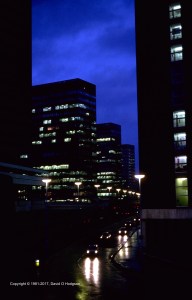
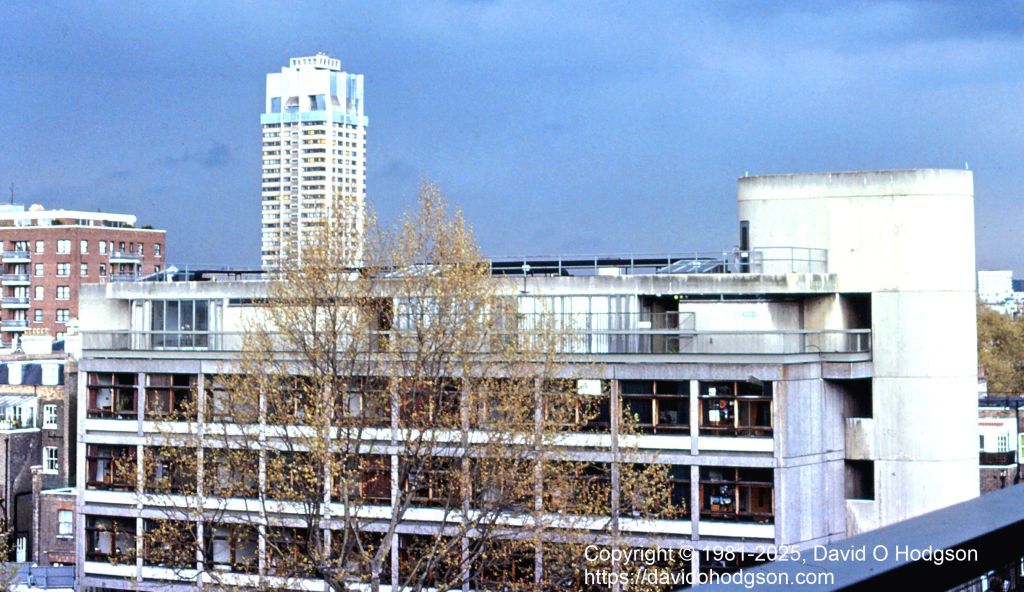
Linstead Hall, Imperial College, London, from my residence in Southside Halls

A few weeks ago, my wife and I went to see the movie The Brutalist. The extent of the hype for this movie was truly breathtaking, which may be partly why I was not surprised that it did not live up to its “promise”.

I must admit that media coverage led me to question whether those who were singing its praises even understood anything about the movie’s subject matter! For example, a fawning item about it on ABC News included paroxysms of praise for the movie’s stars and director, but never actually mentioned what the movie is about, nor was there any explanation of what the title “Brutalist” referred to! I guessed that it must have something to do with Brutalist Architecture, and it turned out that I was correct, but that was no thanks to ABC. Did the presenters really not understand it themselves, or had they decided that the explanation was too “intellectual” for their audience?

Perhaps that is, in fact, the key to the praise that the movie has received. It seems that the less a reviewer knows about its subject, the more they like the movie. Those who do understand its subject matter, professional architects, have been highly critical of its blunders and implausibility, to the extent that they are described as “hating” it in this article.

I also thought that, given its thin, questionable plot and appalling examples of ignorance, the movie was much too long at 3 hours, 35 minutes. As the Guardian reviewer states sarcastically:

“The architecture world awaits with bated breath the director’s five-hour marathons, The Postmodernist, The Deconstructivist, and The Parametricist – each to be shot with period-appropriate equipment and based on a brief skim through a coffee-table book”

Personally, the only benefit that I obtained from the movie experience was that it prompted me to think once again about the real Brutalist architecture that I grew up in and around, the history of which I find infinitely more interesting than any aspect of the movie.

Growing up, Brutalist architecture was a constant background theme in my life, and I even lived in one example of it for a while.

Brutal Aylesbury

I never actually lived in the Buckinghamshire county town of Aylesbury, but, as I recounted in a previous post, my first visit there involved a job interview and a “computer programming aptitude test” that had a profound effect on my view of my own abilities in that field.

During the period from the 1930s to the 1970s, the British Government made major investments in a group of what were referred to as London Overspill Towns. There was a deliberate policy of moving population en masse out of London, to more rural locations. The goal was mainly to reduce further “ribbon development” of the London suburbs, which would eventually have spread across the entire South-East of England. There were also health implications, since prior to the 1960s, London’s air was seriously polluted, leading to increased healthcare costs.

During the 1960s, various existing towns were targeted for substantial redevelopment and expansion, and a few entirely new towns were created. Most of these were within commuting distance of London, but even Grantham in the East Midlands was included.

The map below is from the 1963 book New Architecture of London.
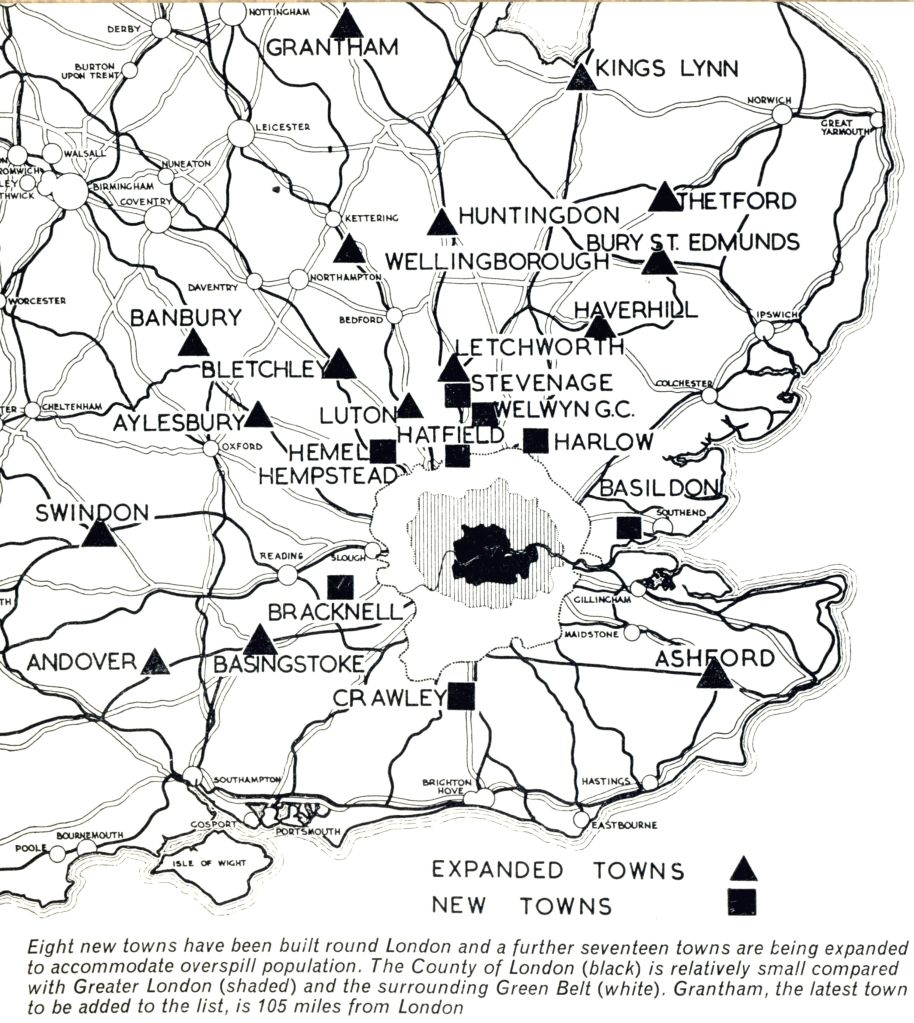
Map of London Expansion Towns. Copyright © 1963, British Travel and Holidays Association

As shown, one of the “expansion towns” was Aylesbury, which had until then been a quaint market town, famous mostly for its ducks.

Development plans for expansion towns invariably included the construction of new shopping centers and civic buildings, and some of these were designed along brutalist architectural lines. In 1967, Aylesbury found itself lumbered with a new shopping center, Friars Square, which quickly came to be seen as such an outstanding example of a dystopian nightmare environment that, in 1971, scenes for the movie Clockwork Orange were filmed there!

My 1980 photo below shows the centerpiece of Friars Square, the Cadena Cafe, after it had become a Wimpy Bar. As with many examples of brutalism, the building had a relatively short life, being demolished in 1993 when the shopping center was redeveloped.
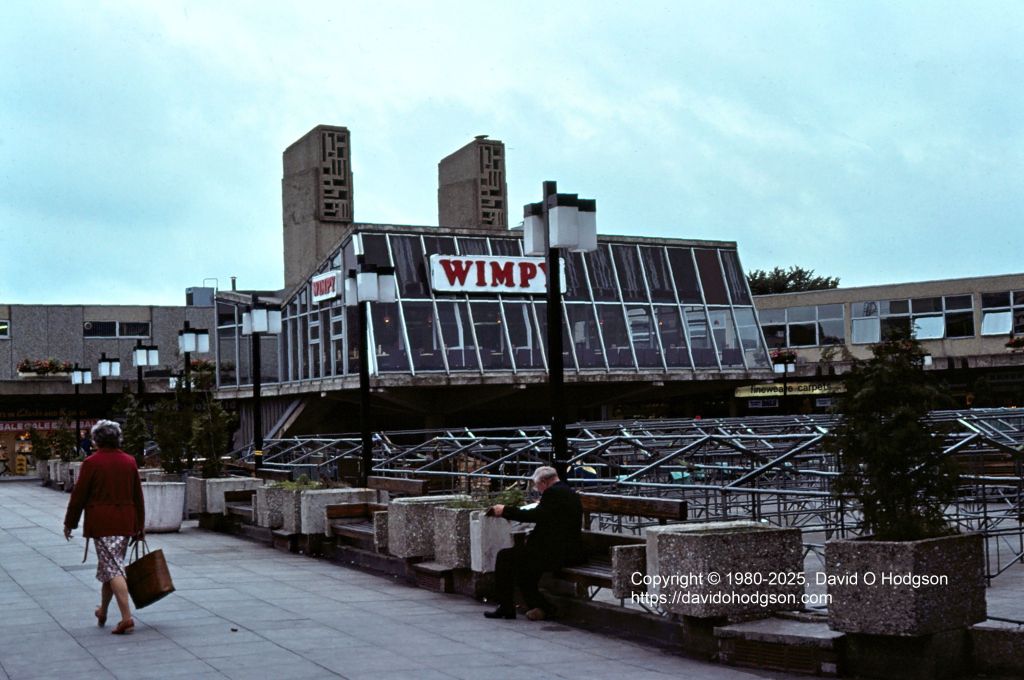
Friars Square & Cadena Cafe, Aylesbury

Elain Harwood’s book Brutalist Britain offers an extensive listing of brutalist architecture in the country, and describes another Aylesbury example, the Buckinghamshire County Council office tower.

The cover of Brutalist Britain, Copyright © 2023, Elain Harwood, Batsford Publishers

My 1980 photo below shows the County Council tower looming above Market Square in Aylesbury, with the Bell Hotel in the foreground.
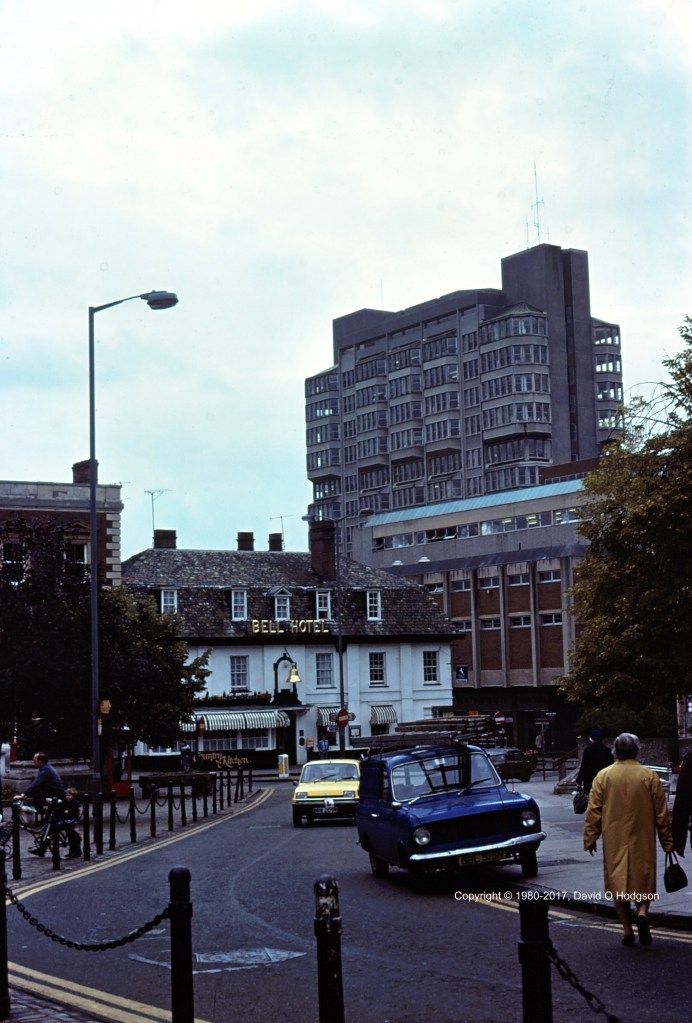
The Bell Hotel, Aylesbury, with the Buckinghamshire County Offices beyond, in 1980

Brutal Birmingham

Birmingham New Street Signal Box, 1980

It seems perhaps most appropriate that Brutalist architecture would be chosen for the design of industrial buildings, and even British Railways constructed a few examples. One of the most famous in Britain must surely be Birmingham New Street Signal Box, which has towered above the gloomy subterranean station since 1966, and is clearly visible from street level, as shown in my 1980 photo above. Although it closed as a signal box in 2022, the building is listed, is still standing, and continues to be used by Network Rail.

Again, Birmingham was not a city in which I ever lived, but when traveling between Coventry and York, I usually had to change trains at Birmingham New Street. I also applied to, and was accepted by, Aston University in Birmingham, so I attended an interview there in 1980.

Brutal London

Approximately a year after visiting Aylesbury for that job interview, I found myself moving to London, as I began my Electronic Engineering studies at Imperial College.

Many first-year undergraduate students were accommodated in Halls of Residence, situated in South Kensington near the college campus. Generally, we were assigned to one of the halls, and were not given any option as to which hall we preferred. I was assigned a single-bed room in Selkirk Hall, which was a subdivision of the huge Southside Halls building, located, as the name indicates, on the south side of Prince’s Gardens.

The photo at the head of this article shows the view looking north from Selkirk Hall over Princes Gardens, one stormy afternoon. The building in the foreground is Linstead Hall, which was of similar architectural style to Southside. In the distance, the tower of another Brutalist edifice is visible; Hyde Park Barracks, which was and still is the home of the Horse Guards.

Cover of Lost Futures. Copyright © 2017, Owen Hopkins, Royal Academy of Arts

Unfortunately, while living in Selkirk Hall, I never photographed the outside of the building itself (partly because the trees in front of it obscured most of it). However, Owen Hopkins’ book Lost Futures includes an article about Southside Halls, which also mentions the smaller Weeks Hall, situated on the north side of Prince’s Gardens.

The photo below, borrowed from “Lost Futures”, shows an excellent panorama of Southside, before the trees in front of it grew too large.
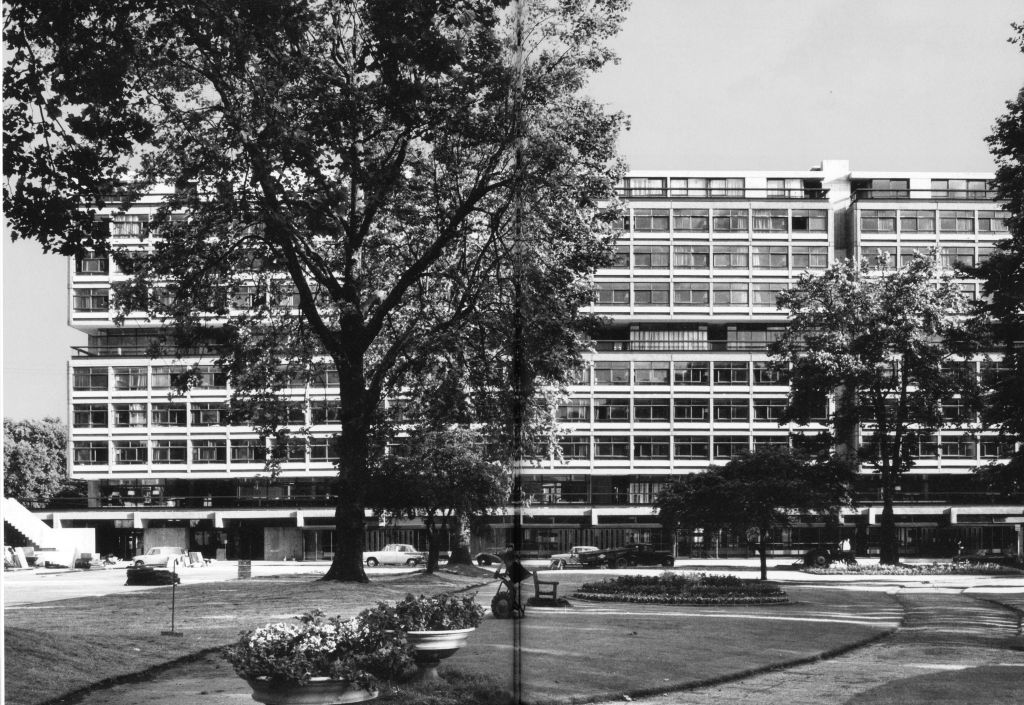
Southside Halls, Imperial College. Copyright © 2017, Owen Hopkins, Royal Academy of Arts

Unfortunately (or perhaps fortunately, depending on your view of their aesthetics!), the passage of time has revealed that many Brutalist buildings were not well-constructed, and in some cases not even well-designed. I had personal experience of this while living in Selkirk Hall.

I lived in the building for only one academic year, but even during that time there were serious maintenance problems. Each bedroom had its own sink, whereas kitchen and bath facilities were shared. The sink in my room was out-of-action, and boarded off, for several weeks during my residency, due to plumbing problems. It seems that the design of the building had a major flaw, whereby pipes and other service conduits were buried directly within the concrete, instead of being placed in accessible service ducts. As a result, any plumbing maintenance work required drilling out the concrete to access the pipes! The quality of the concrete also seems to have been defective, and large chunks of it eventually began to disintegrate.

The upkeep of Southside became so problematic that, despite its being a listed building, permission was eventually granted to demolish it in 2005. That permission was granted on condition that the smaller Weeks Hall, on the north side of Prince’s Gardens, and also a listed building, be retained and refurbished. In my photo below, looking north from Southside, you can just see Weeks Hall towards the right.

Skyline from Princes Gardens, with Weeks Hall

One of the more successful examples of Brutalist architecture, which still exists and is in use today, is the Barbican Centre, in the City of London. My photo below shows part of the complex shortly after its official opening in 1982. I visited the Centre many times, usually to go to the Museum of London, which was housed within it.

Despite having been voted the “Ugliest Building in London”, the Barbican apparently remains popular with apartment renters, thanks to its views and convenient location.
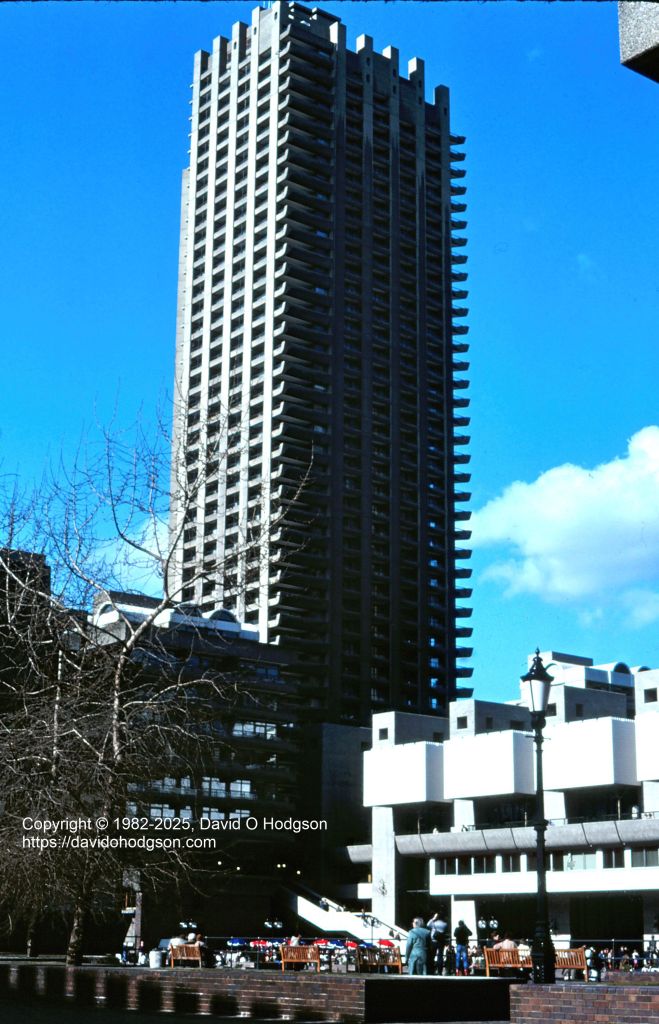
Barbican Centre, London

Brutal Scarborough

Even my home town of Scarborough suffered the attentions of architects with brutalist leanings. In 1973, the imposing Pavilion Hotel, immediately opposite the main railway station, was controversially demolished and eventually replaced by an office block that has been described as the “ugliest building in Scarborough”. I reproduce below an article from the Scarborough Mercury of 15th September 1973, showing how the new building was to look, along with hopelessly-optimistic predictions of its future uses.
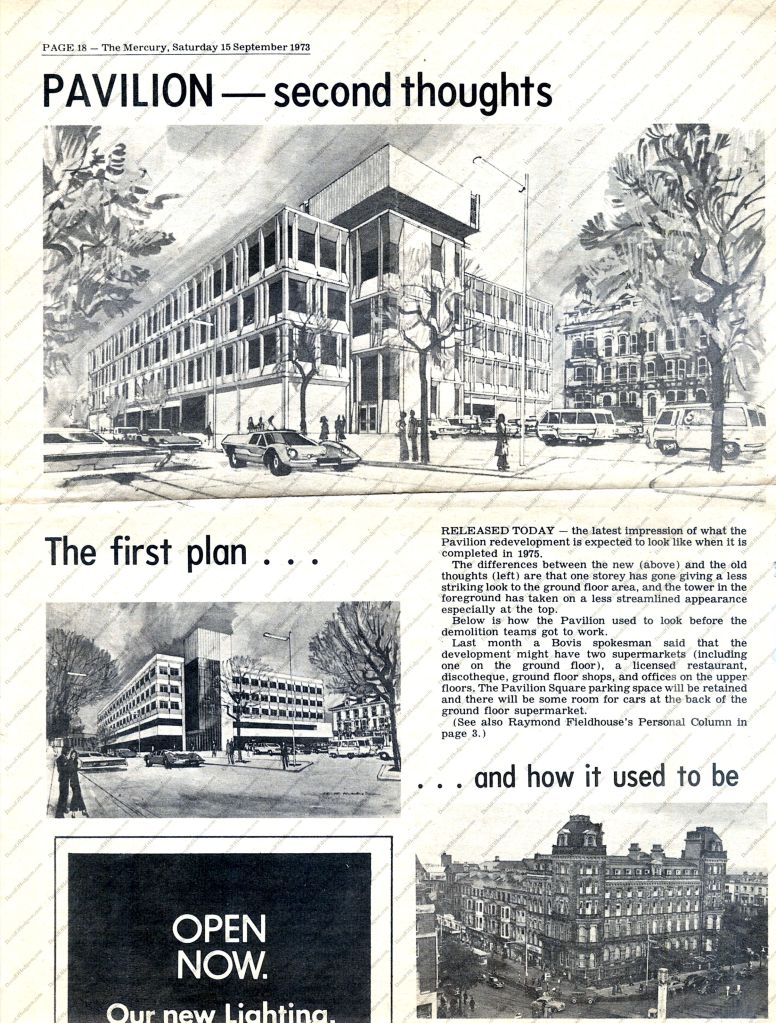
Scarborough Mercury article about Pavilion House. Copyright © 1973, Scarborough News

The building did eventually gain one supermarket, on the ground floor, although, as I recall, that store managed to look run-down from the day it was opened! As regards actual other uses for the new building, I can only remember it as the home of Scarborough Job Centre, in which I spent many useless hours not finding a worthwhile job. It seems perhaps appropriate; a depressing and ugly location for a depressing and hopeless office!

There’s no question that, whatever the aesthetic qualities of those Brutalist buildings, they were and are each unique, and they formed a memorable backdrop to my life in those days.


Dinky Cars & Modern Architecture

Playing with Dinky and Corgi Cars, 1963

Playing with Dinky and Corgi Cars, 1963

The photo above shows me (on the left), at about the age of 3, playing with model cars in my grandparents’ living room. My mother’s parents lived with us in the same house, so this kind of scene was an everyday occurrence.

The others in the photo are my grandmother (my mother’s mother) and my younger brother.

If you look very closely in the photo, you can see some small grey and blue cars lined up, as shown in the rather fuzzy close-up below.

A lineup of Ancient Dinkys

A lineup of Ancient Dinkys

Those cars are in fact Dinky Toys (the Dinky 35a “Saloon Car”), although they’re much smaller than the models that most people think of as being typical Dinkys. That model, produced in the British “OO” railway scale, was produced from 1936-40, and then again from 1946-48. The models I’m playing with were produced post-war. Examples of this model, in good condition, typically sell on eBay now for $50 or more each!

The reason that I came to be playing with Dinky toys that were much older than me was because they actually belonged to my grandfather, who literally had a bag full of them.

Draughting Years

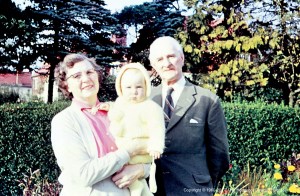
In a post on my professional blog, I mentioned that my grandfather, Allen E Martin, worked for most of his career as a draughtsman for the City of Leeds. The October 1960 photo below shows him (on the right) in our back garden, with my grandmother holding me.

My Grandparents with me, October 1960

My Grandparents with me, October 1960

As part of his work, he produced technical drawings for architectural projects, and the department sometimes created models of proposed new buildings. They used toy cars to decorate these models, and my grandfather apparently took his “bag of Dinkys” home with him when he retired in the 1950s.

Perhaps the most prominent architectural project in Leeds during the 1930s was the Quarry Hill development. This was so famous, and so well-regarded, that it featured on the cover of the 1938 Penguin book Design, as shown in a scan from my copy below.

Design, by Anthony Bertram, Penguin 1938

Design, by Anthony Bertram, Penguin 1938

My grandfather died in 1967, so I never got to ask him exactly what role he played in the Quarry Hill project, but it would certainly have been a major part of his department’s work at that time.

Unfortunately, despite the best intentions of its builders, and despite being a vast improvement on the slum dwellings that it replaced, Quarry Hill was not a success in the long term, and was eventually demolished in 1978. Some of its problems stemmed from the fact that the development was a very advanced design by the standards of the time. Had the complex survived for a few more decades, it may well have undergone a major refurbishment similar to that at St Pancras Station, and would still be with us as a major landmark.

[Update 9/21/17: see this article for details of the latest redevelopment plans for the Quarry Hill area of Leeds.]

The City of Leeds Arms

Incidentally, the arms of the City of Leeds feature rather unusual supporters, as shown below.

Leeds City Arms

Leeds City Arms

In a future post I’ll discuss the significance of those owls, and how, even though I never lived in Leeds, they seem to have become a recurring theme in my life.

Deconstructing the Future

The City of the Future (When I was Ten)

The City of the Future (As I envisaged when I was Ten)

Here’s a “throwback” to a drawing that I produced at the age of ten, to illustrate a story set in “the future”.

Last week, Mary and I went to see the documentary movie Deconstructing Sergeant Pepper, in which Scott Freiman analyzes the musical innovations that went into the creation of the Beatles’ 1967 album*. We both enjoyed the movie, because it doesn’t get bogged down in technical detail, but at the same time doesn’t shy away from technical issues when they’re relevant. The presenter even discussed the Automatic Track Doubling circuit that was used to create echo effects, although he didn’t go so far as to display a circuit diagram!

(* We saw the movie at the Rialto in Sebastopol, but it will be screened again in other theaters around the US, along with other documentaries in the same series.)

Of course, I was just a young boy of six or seven when the Beatles were creating that innovative music, so I didn’t really grasp what was going on in the world around me. In retrospect, I do recall a general mood of optimism and change during those years, but I’m not sure to what extent that was shared by the adults around me, or was simply an aspect of my youth. I’m fairly certain that any such optimistic Zeitgeist was not shared by my parents!

Seeing the “Sergeant Pepper” movie did, however, bring to mind recollections of my own youthful expectations about the future and my role in the world. In 1970, I produced the drawing above to illustrate a story that I was writing at school. My story was ambitiously set in the year 2461, but was inevitably a “product of its time”. The tower I drew was supposed to be a city, but it also happened to be a rocket. The style was clearly inspired by the claims of 1960s-era architects about future buildings, but my innovative design also incorporated the boosters from the first stage of the Saturn V spaceship!

Goldfinger or Glassfinger?

London Wall in the Rain, 1981

London Wall in the Rain, 1981

Respected architects of the post-war period, such as Le Corbusier, Walter Gropius, and Ernö Goldfinger claimed that twenty-first century cities would be “managed environments,” probably consisting of huge glass-clad skyscrapers. Many of these architects clearly saw the creation of such cities as being socially beneficial.

Goldfinger himself wrote in 1941:

Cities can become centres of civilisation where men and women can live happy lives. The technical means exist to satisfy human needs. The will to plan must be aroused. There is no obstacle but ignorance and wickedness.

Creativity & the Tyranny of Good Intentions

The fact that I was encouraged to spend time writing such a fantastic story at school seems surprising in retrospect. I do recall that, during my primary schooling, there was significant emphasis on “creativity”, in that we were encouraged or even required to write and draw every day.

If that policy was intended to turn all of us into creative adults, it seems to have been an utter failure in most cases! For me, though, it was generally enjoyable and probably beneficial, and I’m only disappointed that the emphasis of our education changed later to uncreative, rote preparation for exams.

The heart of this disconnect was, and still is, that there is a huge gulf between the kind of people that educators want to produce, and the kind of people that employers actually want schools to produce.

I’ve seen evidence that the emphasis on creativity in schools in those days was actually quite new, and stemmed from the “progressive” educational ideas that had been laid out in the Plowden Report, but the schools I attended were not notably progressive. The Church of England school that I was being forced to attend when I produced the story containing this illustration prided itself on being anything but progressive!

The book “Progressively Worse” by Robert Peal contains an interesting discussion of the history and consequences of progressive education in Britain.

Scarborough Railway Station: A Historical Mystery Tour

Scarborough Central Railway Station in 1977

Scarborough Central Railway Station in 1977

During my teenage years, for my A-level Art study of architecture, I did some original research on the history of Scarborough [Central] Railway Station (shown above), which led to a surprising conclusion about the building’s original appearance.

My conclusions were questioned at the time, but were verified decades later by someone else’s chance discovery.

It was always a well-known fact that Scarborough’s main railway station was built in 1845 (quite early in the history of railways), at a location that was then outside the town limits. It’s also well-known that, in 1882, a central tower was added to the frontage. Surprisingly, and despite the efforts of various developers over the decades, the station building has survived to this day in essentially its 1882 form, as shown in my 1977 photograph at the top of this article.

During my researches at Scarborough Reference Library, I discovered a copy of a catalog for an exhibition called “Marble Halls”, which had apparently taken place at the Victoria & Albert Museum in London in 1973.

Marble Halls

An 1844-dated illustration in the Marble Halls catalog showed a plan of “Scarborough Station” that, at first glance, looked nothing like the existing structure. The image below is the copy of the catalog illustration that I created for my study.

Copy of Plan of Scarborough Station, 1844

Copy of Plan of Scarborough Station, 1844

I hadn’t expected to see the central tower, of course, but where are the three small pavilions in the building’s frontage? The plan also shows a colonnaded central entrance, of which there’s no trace in the existing building.

My initial impression was that this plan did not represent the station as built, but I was puzzled that the accompanying commentary did not mention any discrepancy between the plan and the structure as-built.

I wrote to some local experts on the subject, who provided me with the limited historical references that were available. None of this provided any clear details regarding alterations to the building, except for the addition of the tower. The general opinion seemed to be that the entire frontage of Scarborough Station had probably been rebuilt in 1882 (rather than just the tower), but there was no evidence to prove that claim. One expert pointed out that the architect’s illustration in “Marble Halls” may have been nothing more than an “architect’s impression”, and that there was no guarantee that the station as-constructed had ever resembled that plan.

Some Detective Work

If in fact the building’s frontage had been substantially altered in 1882, it struck me that perhaps I could find some evidence of that (although it seemed odd that nobody would have previously noticed anything).

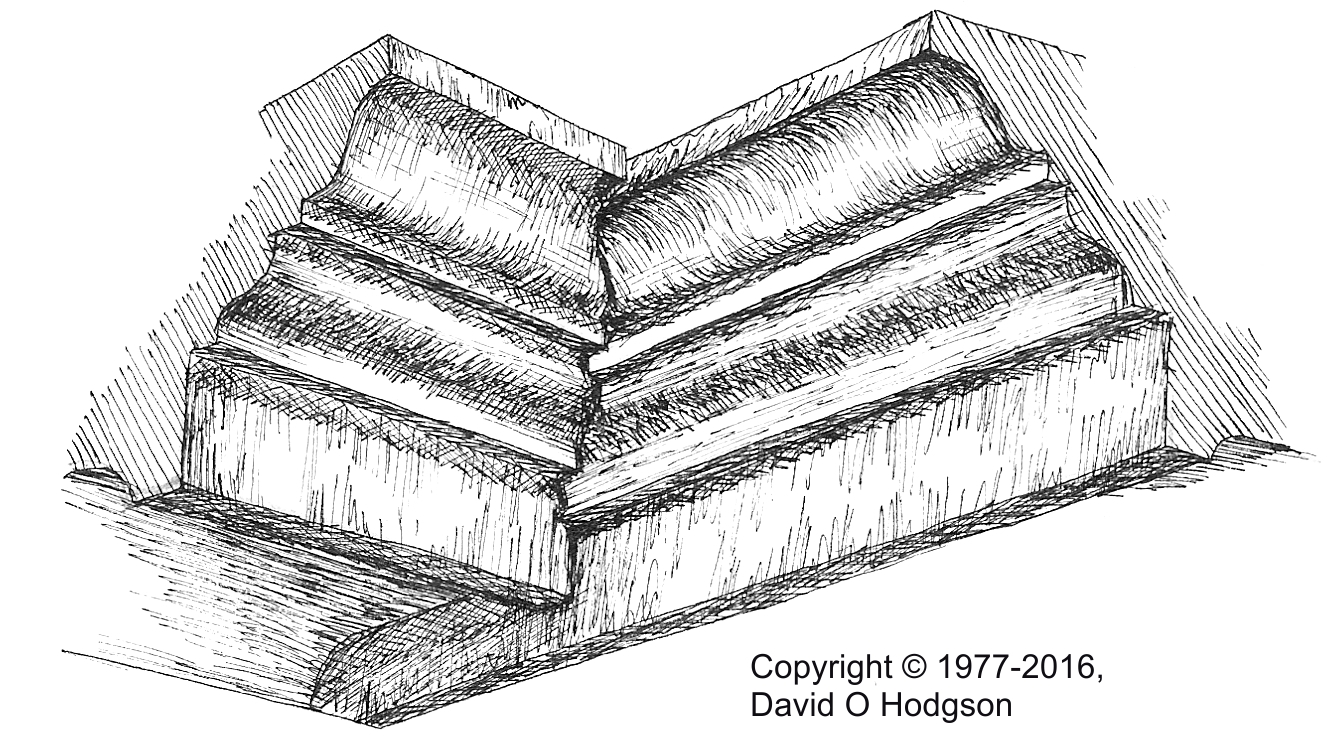
I walked around the outside of the building, examining its architectural details. I looked particularly at the locations that would be the junctions between the 1845 structure and what were potentially later alterations. Eventually, at the East end of the joint between the easternmost pavilion and the main trainshed (on the far left in the heading photo), I found a mismatch in the details of the pediment, as shown in my sketch below.

Scarborough Station. Detail of Trainshed Pediment stonecarving

Scarborough Station. Detail of Trainshed Pediment stonework

The mismatched joint shown above would have occurred where the new pavilion was added to the main wall of the original building, if my suspicions about the station’s original appearance were correct.

Given the immense precision of the building’s stone carving, it seemed impossible that such a noticeable mismatch would have occurred (or be allowed to remain) during the original construction. It seemed much more likely that this mismatch occurred because of some miscalculation when new stone was carved later, the intention having been to match the details of the original building.

Conclusion & Confirmation

In my study, I presented my conclusion that the 1844 architectural plan did indeed show the original appearance of Scarborough station, but that the building had been subject to greater subsequent alteration in the 1880s than most people had suspected. Not only was the central tower added, but most of the original frontage had been removed, and replaced with the three small pavilions that still exist.

At the time, I had no evidence to support my assertion, except for the architectural plan and my own illustrations of the architectural details of the actual building. Thus, my conclusion remained unproven, and nothing more than an “interesting speculation”.

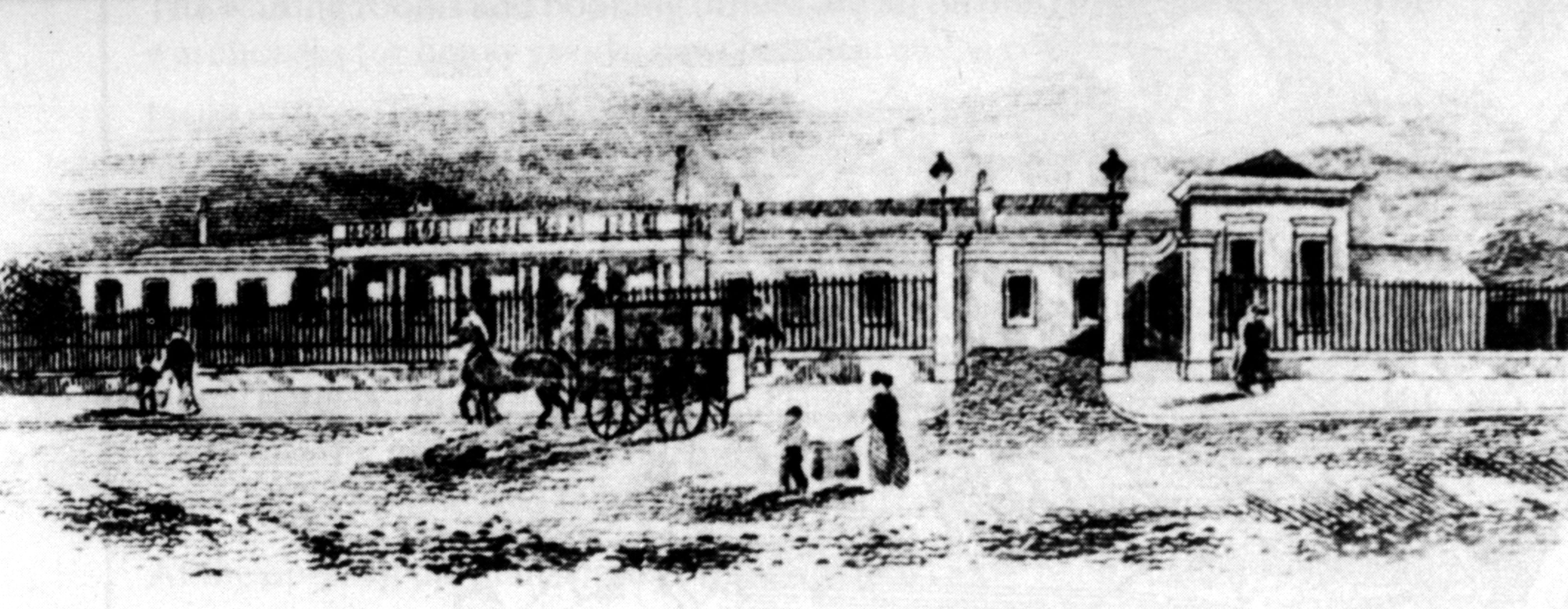
In 1995, long after the completion of my Art A-level, and by which time I’d moved away from Scarborough, first to London and then to California, one of my expert correspondents from 1977, J R Lidster, published his own book on Scarborough Railway Station. In that book, he included a drawing of the station frontage from a letterhead that had recently been discovered in the attic of a property in Scarborough.

Sure enough, the letterhead showed a building that closely matched that depicted in the 1844 plan in the book “Marble Halls”, thus finally verifying the conclusion of my investigation.

[Added 12/14/24] Here is the letterhead described above, from J R Lidster’s book:

Early View of Scarborough Railway Station. Copyright J R Lidster

A Sense of History

At the age of thirteen, I was forced to select a restricted range of subjects at school for continued study, as preparation for taking “O-level” examinations. One of the subjects that I dropped was history, because my naïve belief at that time was that history was “already written down”, and thus there was nothing new to add. Even at that age, I knew that, whatever I was going to devote my life to, I wanted it to be something innovative.

The experience that I described above, where I was able to provide original insight into a historical problem, showed me that my earlier view of history had been wrong. The events under consideration were, after all, relatively recent history, dating back only about one century, and yet many details were unrecorded, and there were new contributions to be made. I was able to offer new information without even “getting my hands dirty”!

Postscript: More Marble Halls

This incident was my first encounter with the contents of the “Marble Halls” catalog. The book also contains illustrations of other Victorian buildings that featured in my later life. For example, there’s an illustration of the Imperial Institute in London, the buildings of which were subsequently incorporated into Imperial College, from where I would graduate.

The book also includes an image of Highclere Castle, in Hampshire, which was close to my home in Andover in later years. Highclere Castle is now world-famous as the fictitious Downton Abbey.

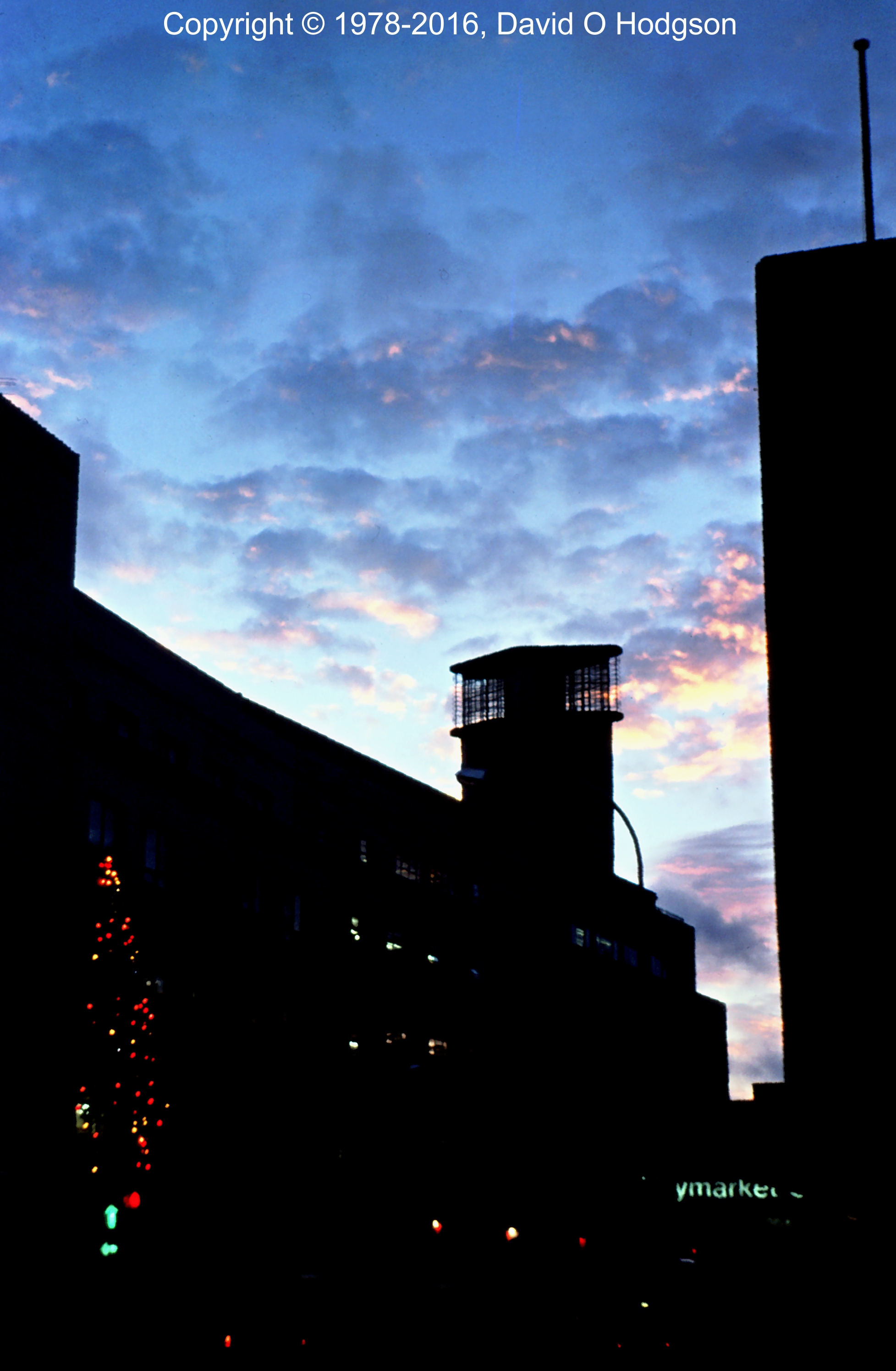
Lewis’s Store, Leicester, in 1978

tr7-14-2400shrot_781118crightThe picture above shows the tower of the Art Deco styled Lewis’s store in Leicester, UK, on the cold afternoon of 18th November 1978. In those days, there was no “Sunday Trading” (except for newsagents), so Saturday was the main shopping day of the week. There’s no Thanksgiving Holiday in Britain, of course, but the holiday decorations were already in place on the store!

Unfortunately, during the 1990s this distinctive building was demolished, except for the tower, which was preserved among the replacement architecture, seemingly as some kind of afterthought. As shown below in my 2008 photo, the Art Deco tower now seems completely incongruous with the style of the surrounding buildings.

leicester_lewistower2

Update 2022: I’ve been informed that the store was owned by Lewis’s, not John Lewis. It makes little difference to the point of my post, but I’ve corrected the text anyway. Here is a link to an article about the closure of the store:

https://www.leicestermercury.co.uk/news/history/fond-memories-lewiss-25th-anniversary-2454555