The Colored Pencil Craze


Portrait in Colored Pencil

Portrait in Colored Pencil

I’ve been puzzled and amused by the recent fad for “Adult Coloring Books”. Apparently, the popularity of these books has led to a shortage of colored pencils to buy! (See for example this article.) As a result of using them at school, it took me many years to realize that colored pencils were not “just for kids”.

My school experiences with colored pencils led me to rather a cynical view of the results that could be obtained, because our teachers required us to use them, but didn’t teach us how to use them. From the teachers’ viewpoint, pencils were naturally preferable to paint, because they didn’t produce so much mess. The problem was that, because we were never taught appropriate techniques, most of the results were very poor.

My experiences with coloring books were also not positive! Relatives would sometimes buy me coloring books as presents when I was young, but I don’t recall ever using one. My view (which apparently went unconsidered) was, “Why would I want to color in someone else’s drawings, when I’m churning out my own drawings every day?”

Nonetheless, later on, in the 1980s, when I was studying Illustration at St. Martins School of Art in London, I invested a sizable sum in a set of 72 Derwent colored pencils (my “life savings”, as my instructor described it). Despite that, the only finished work that I ever produced solely with colored pencil was the portrait at the top of this post. I was quite pleased with the results, but found the technique very time-consuming.

Since then, I have sometimes used colored pencils for concept sketches, such as that below for a fictitious piece of jewelry.

Sketch of Fictitious Jewelry

Sketch of Fictitious Jewelry

I’ve also used pencils in “mixed-media” illustrations, but never as the only medium for a finished work.

There are some excellent artists who specialize in producing photo-realistic colored pencil art. I’m left in no doubt that colored pencil can produce excellent-quality art, but only very slowly!


Covent Garden: Then & Now

Covent Garden after the Rain, 1982

Covent Garden after the Rain, 1982

I took the color transparency above in Covent Garden, London, one afternoon in 1982, just after a short rain shower. Even though the buildings were against the sun and mostly in darkness, the wet cobbles reflected the sunset and created a fantastic lighting effect. It really was a case of being in the right place at the right time, and with the right equipment.

I’d actually been inside the London Transport Museum, which was immediately behind me in the photograph. While in the museum, I heard the rain on the roof, but couldn’t see it because of the building’s high windows. Soon after the rain stopped, I noticed a brilliant orange glow reflecting onto the ceiling. Thinking that this might be a great opportunity, I rushed outside, and I wasn’t disappointed. Ever since then, I’ve been glad that I impetuously cut short my visit to the museum that afternoon!

Yesterday’s pointless atrocity in London brought to mind this photo, and the terrorist threats that always hung over us, even back when I lived there in the 1980s. In those days, most of the threats came from the IRA (or people claiming to represent them), but only a very small number were real.

As a student, I worked as a Sales Assistant at Selfridges store in Oxford Street during some of the university breaks, and sometimes on Saturdays. As part of our training, we received specific instructions as to what to do if we were notified of a bomb threat, because the store received such threats almost every day! Fortunately, while I lived in London, all the threats at Selfridges were hoaxes, but there was a car bomb at Harrods during Christmas 1983, and I had worked at Harrods only the previous Christmas.

Covent Garden in 2001

Covent Garden in 2001

In 2001, I returned to Covent Garden, and took the photo above from almost the same position as the 1982 photograph, but in obviously different weather conditions. (It’s true that a further 16 years have passed since I took the “Now” photograph!)

At first, everything seemed to be just the same as it had been in 1982, and it wasn’t until I compared the two photographs that I realized what had changed.

The building that was originally Covent Garden market hall is still visible on the right, and it’s as popular a destination now as it was then.

In the earlier photograph, there’s a multi-storey building on the left with many rooms obviously lit by fluorescent strip lights. By the time of the later photograph, this building had been completely replaced. Had that happened a couple of decades earlier, it’s likely that the entire street would have been razed and replaced with examples of “modern architecture”, but fortunately lessons have been learned since then. Many modern redevelopments at least attempt to blend with the surrounding architecture.

An Ancient Austin

Austin Princess, Hackness 1963

Our Austin Princess, Hackness 1963

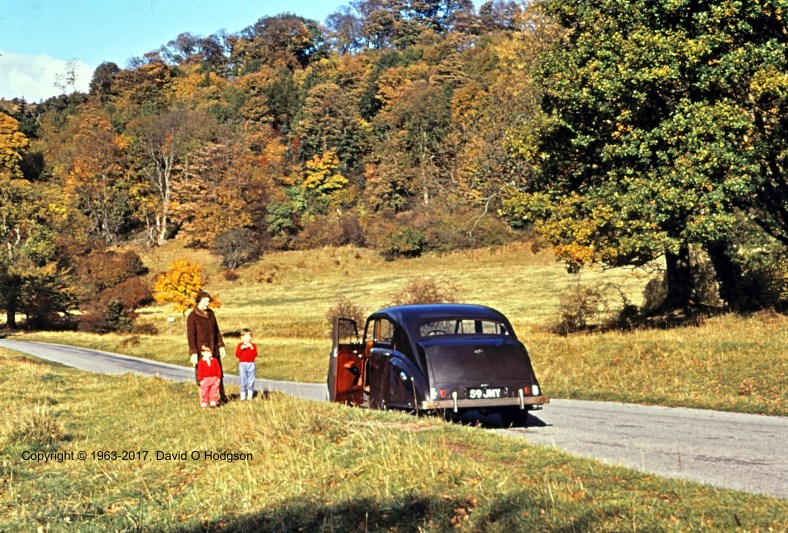
These photos include my father’s second car, which was an Austin Princess. By the standards of the day for British cars, this was a huge vehicle. This type of car was typically used for weddings, funerals and state occasions, but my father had a penchant for large cars, so, when he saw an opportunity to buy a used Princess, he jumped at the chance. These vehicles featured custom bodywork by Vanden Plas on a separate chassis, so they were very heavy. As I mentioned in a previous post, my father served in the Royal Air Force during World War II, where he learned to drive AEC Matador trucks, so the Princess probably didn’t seem especially big to him!

Perhaps the most famous Princess was one owned by John Lennon, although that had hearse bodywork. My father was no fan of the Beatles, so I’m not sure what he thought about that.

Both these views show my mother, my younger brother and me messing around near Hackness, Yorkshire, during the Autumns of 1963 and 1964.

Our Austin Princess c.1964

Our Austin Princess c.1964

This was not my father’s first Austin (although it’s the earliest that I remember riding in), since his first car had also been of that marque, and it wasn’t his last, since he subsequently owned a more modestly-sized Austin 1100.

The downsizing was at the request of my mother, who learned to drive c.1969, and didn’t want a large vehicle.

Later, during the 1970s, my father bowed to the inevitable realities and began buying non-British cars, such as Simca, Honda and, finally, a German Opel Kadett (which eventually became my first car).

AEC Matador "May" of S A Bell, Malton, 1977

AEC Matador “May” of S A Bell, Malton, 1976

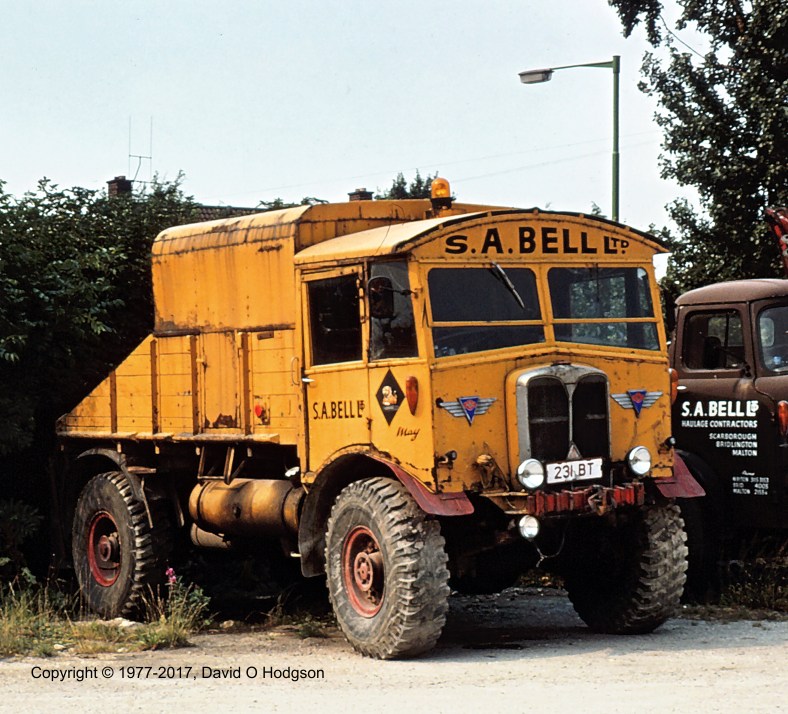
Above is an AEC Matador, similar to the vehicles on which my father learned to drive. This one, named “May” was used by haulier S A Bell Ltd., and was parked at their Malton depot in 1976.

Evening in the Valley of the Moon

Sonoma Mission with Full Moon

Sonoma Mission with Full Moon

We had an excellent dinner this evening at the Depot Hotel Restaurant in Sonoma. After all the rain in California during the past few months, this weekend’s weather was perfect.

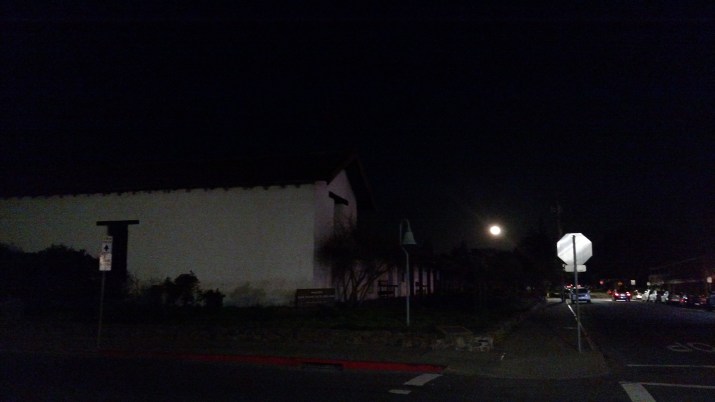
The night-time view above was snapped with my phone, but it does just show Sonoma Mission on the left, with the full moon visible as a bright dot! (The word “Sonoma” was thought to mean “Valley of the Moon” in the language of the local natives.)

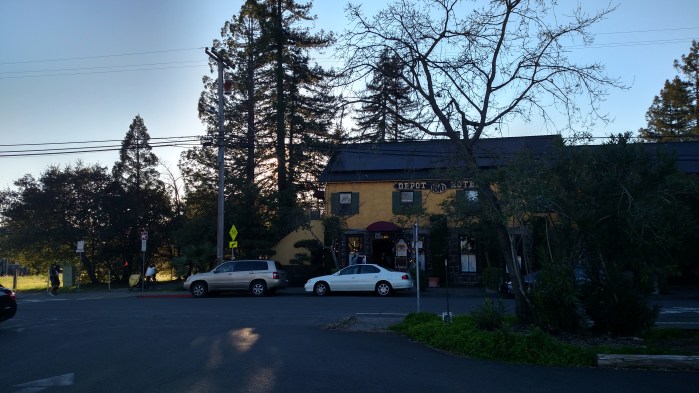
The photo below shows the Depot Hotel from First Street. As its name suggests, the hotel was adjacent to Sonoma’s railroad depot when that was in use. To the left of the hotel, you can see where the tracks crossed the road. The trackbed has now been converted into a cycle trail, and the depot itself still exists in replica form.

Depot Hotel, Sonoma

Depot Hotel, Sonoma

Given the beautiful weather, we sat outside for our meal, in the pool area at the back of the hotel. Here’s the view from our table.

Depot Hotel, Garden Area

Depot Hotel, Garden Area

Thank you,  Mary, for a fantastic birthday dinner!

Indiana Jones & the Treasure Island

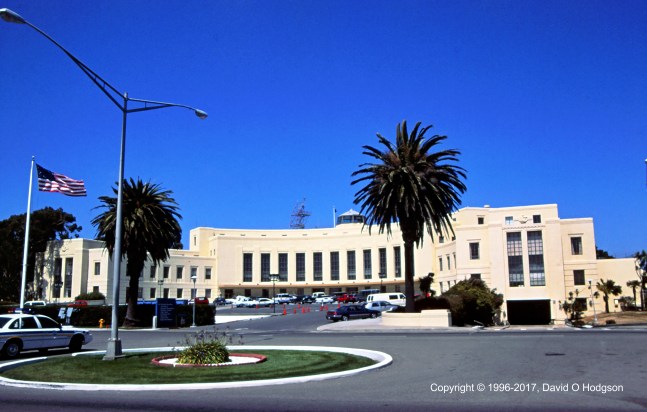
Administration Building, Treasure Island

Administration Building, Treasure Island

There are many islands in San Francisco Bay, and most of them are natural. There is however one artificial island that has a short but intriguing history. It’s called Treasure Island, and it was built during the 1930s as the intended location of San Francisco Airport.

The Administration Building on Treasure Island enjoyed its “fifteen minutes of fame” (or less) in the movie Indiana Jones and the Last Crusade, when the airport terminal building was dressed up to portray “Berlin Airport”. The remainder of its existence has mostly been quiet, but its fascinating Art Deco architecture remains on public view to this day.

The first use of the new island was not as an airport, but to host the 1939 Golden Gate International Exposition. The island’s airport facilities were used by PanAm’s Clipper flying boats, which moored at Clipper Cove (aka the Lagoon of the Trade Winds), between Treasure Island and Yerba Buena Island. This information is missing from the Wikipedia article, but I have a copy of a 1939 color movie titled Trans-Pacific, which shows PanAm passengers arriving at the terminal and boarding a Boeing 314 clipper, which then leaves from Clipper Cove.

After the start of World War II, the US Navy took over the island as a base, swapping the land for its existing base at Mills Field on the Peninsula. As a result, after the War the new San Francisco Airport was developed at Mills Field (which was just as well, because Treasure Island would have been impossibly small). The surviving Boeing 314s actually flew from the shoreline at Mills Field for a short time in 1945-46.

During the 1990s, I was a member of the Treasure Island Museum Association, and was involved with efforts to maintain the museum that was located in the Administration Building, so I visited the island quite frequently, and took the photographs shown in this post. Unfortunately, the museum closed in 1997, due to lack of financial support, but, now that the City of San Francisco owns the building, there are plans to reopen it.

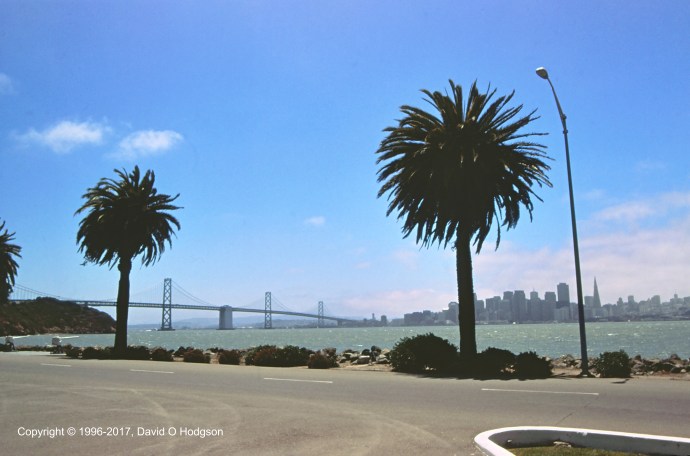
View of Bay Bridge and San Francisco from Treasure Island

View of Bay Bridge and San Francisco from Treasure Island

The spectacular view from the Administration Building towards San Francisco and the Bay Bridge.

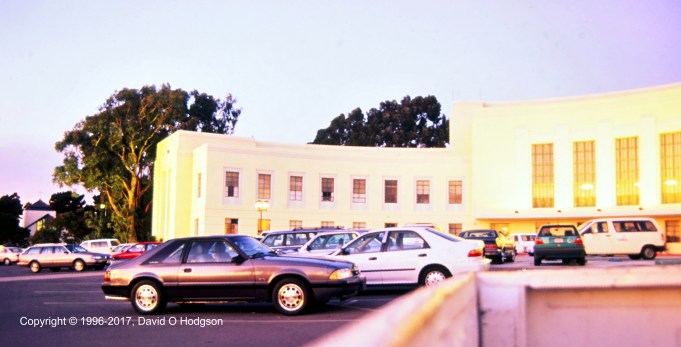
Treasure Island with Mustang

Treasure Island with Mustang

The Administration Building one summer evening, with my Mustang parked in front.

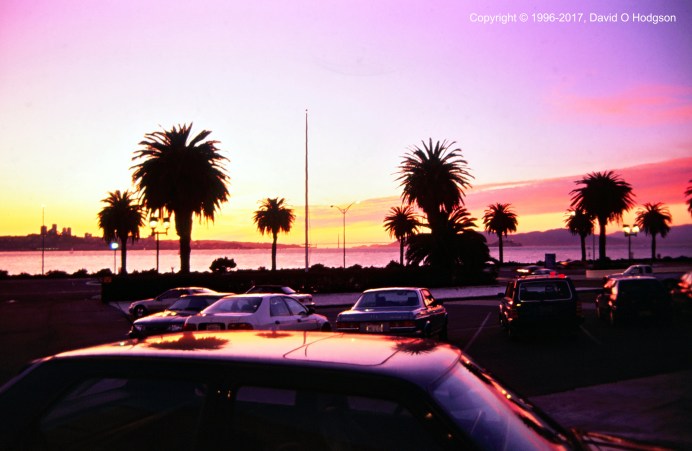
Sunset over the Golden Gate from Treasure Island

Sunset over the Golden Gate from Treasure Island

Goodnight from Treasure Island! Sunset over the Golden Gate, from the car park in front of the Administration Building.

Air Control & the Legacy of Empire

Avro Shackleton AEW.2, 8 Squadron RAF, on display in the RAF Museum

Avro Shackleton AEW.2, 8 Squadron RAF, on display in the RAF Museum, 1983

I just finished reading a fascinating book called Wings of Empire, which details the operations of the Royal Air Force in various minor conflicts between the two World Wars. It’s very detailed but also very readable, which isn’t always the case for history books. The book describes the policy of “Air Control”, which, at end of World War I, was seen by the British government as a low-cost method of policing the vast territories of the Empire.

It seems that this aspect of history is unpopular in some circles these days, due to its overtones of imperialism, or even racism. Nonetheless, for better or worse, these events did happen. In fact, even now in the twenty-first century, the Western World is still dealing with the fallout from those events. The establishment of Israel and other countries in the Middle East all stem directly from the events of those times, and conflicts resulting from that are ongoing.

Aside from their general historical interest, those events impacted my family as a result of my father’s unwilling involvement during World War II. His birthday was on March 6th–he’d have been 108 today–so this seems like an appropriate date on which to post these thoughts!

When war was declared in September 1939, my father was running an electrical business in Leeds. The issue of conscription was obviously of concern to him, but someone gave him a hot tip. They told him that, if he signed up for military service voluntarily, rather than waiting to be conscripted, it would confer two advantages:

  1. He could choose which service to join,
  2. He could choose the location where he would serve.

This seemed like great news. He decided to sign up with the RAF (which was the most glamorous service), and to specify that he wanted to serve at Church Fenton airfield (near York). That way, he’d be able to maintain his electrical business on his days off from the RAF. So, he went along and signed up.

The hot tip turned out to be half-right. He was able to enroll in the service of his choice. However, when his callup papers arrived, he discovered to his horror that he would be serving not in Church Fenton, but with 8 Squadron in… Aden.

8 Squadron had been involved in Air Control operations since the early days of the policy, and in fact continued to be associated with Aden until Britain left the area. My father made it through the war, somehow surviving threats from disease, enemy action, bad luck, and outright incompetence. Some of 8 Squadron’s exploits have been well-documented, but he had some extra details to add to some of those accounts!

The photo above shows an Avro Shackleton AEW.2 that served with 8 Squadron, and carries the squadron’s Arabian dagger (Khunjah) emblem on the nose. Of course, the Shackleton didn’t appear until after World War II, so my father never flew on that type of aircraft, but 8 Squadron is still in existence today.

Deconstructing the Future

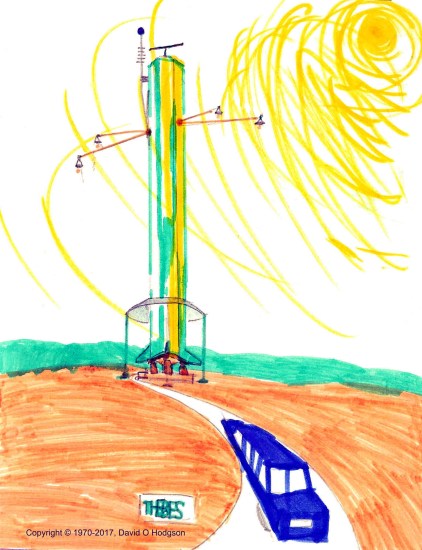
The City of the Future (When I was Ten)

The City of the Future (As I envisaged when I was Ten)

Here’s a “throwback” to a drawing that I produced at the age of ten, to illustrate a story set in “the future”.

Last week, Mary and I went to see the documentary movie Deconstructing Sergeant Pepper, in which Scott Freiman analyzes the musical innovations that went into the creation of the Beatles’ 1967 album*. We both enjoyed the movie, because it doesn’t get bogged down in technical detail, but at the same time doesn’t shy away from technical issues when they’re relevant. The presenter even discussed the Automatic Track Doubling circuit that was used to create echo effects, although he didn’t go so far as to display a circuit diagram!

(* We saw the movie at the Rialto in Sebastopol, but it will be screened again in other theaters around the US, along with other documentaries in the same series.)

Of course, I was just a young boy of six or seven when the Beatles were creating that innovative music, so I didn’t really grasp what was going on in the world around me. In retrospect, I do recall a general mood of optimism and change during those years, but I’m not sure to what extent that was shared by the adults around me, or was simply an aspect of my youth. I’m fairly certain that any such optimistic Zeitgeist was not shared by my parents!

Seeing the “Sergeant Pepper” movie did, however, bring to mind recollections of my own youthful expectations about the future and my role in the world. In 1970, I produced the drawing above to illustrate a story that I was writing at school. My story was ambitiously set in the year 2461, but was inevitably a “product of its time”. The tower I drew was supposed to be a city, but it also happened to be a rocket. The style was clearly inspired by the claims of 1960s-era architects about future buildings, but my innovative design also incorporated the boosters from the first stage of the Saturn V spaceship!

Goldfinger or Glassfinger?

London Wall in the Rain, 1981

London Wall in the Rain, 1981

Respected architects of the post-war period, such as Le Corbusier, Walter Gropius, and Ernö Goldfinger claimed that twenty-first century cities would be “managed environments,” probably consisting of huge glass-clad skyscrapers. Many of these architects clearly saw the creation of such cities as being socially beneficial.

Goldfinger himself wrote in 1941:

Cities can become centres of civilisation where men and women can live happy lives. The technical means exist to satisfy human needs. The will to plan must be aroused. There is no obstacle but ignorance and wickedness.

Creativity & the Tyranny of Good Intentions

The fact that I was encouraged to spend time writing such a fantastic story at school seems surprising in retrospect. I do recall that, during my primary schooling, there was significant emphasis on “creativity”, in that we were encouraged or even required to write and draw every day.

If that policy was intended to turn all of us into creative adults, it seems to have been an utter failure in most cases! For me, though, it was generally enjoyable and probably beneficial, and I’m only disappointed that the emphasis of our education changed later to uncreative, rote preparation for exams.

The heart of this disconnect was, and still is, that there is a huge gulf between the kind of people that educators want to produce, and the kind of people that employers actually want schools to produce.

I’ve seen evidence that the emphasis on creativity in schools in those days was actually quite new, and stemmed from the “progressive” educational ideas that had been laid out in the Plowden Report, but the schools I attended were not notably progressive. The Church of England school that I was being forced to attend when I produced the story containing this illustration prided itself on being anything but progressive!

The book “Progressively Worse” by Robert Peal contains an interesting discussion of the history and consequences of progressive education in Britain.

Signs of Spring

Daffodils and Tulips on Fresno Avenue

Daffodils and Tulips on Fresno Avenue

While out walking on Fresno Avenue on Friday evening, I noticed these daffodils and tulips blooming underneath one of the small ginkgo trees there.

In England, the appearance of crocuses and daffodils (or “daffs” as my mother called them) heralded the approach of Spring. Here in California, the flowers bloom earlier, and of course there’s not such a marked change of seasons.

The tall cypress tree in the background of the photo used to stand against the stockyard building, until that was demolished last year. In fact, there were two such trees, but one blew down in windy weather a few weeks ago. The fallen tree can still be seen lying behind the standing one.