Scarborough Tramways Company

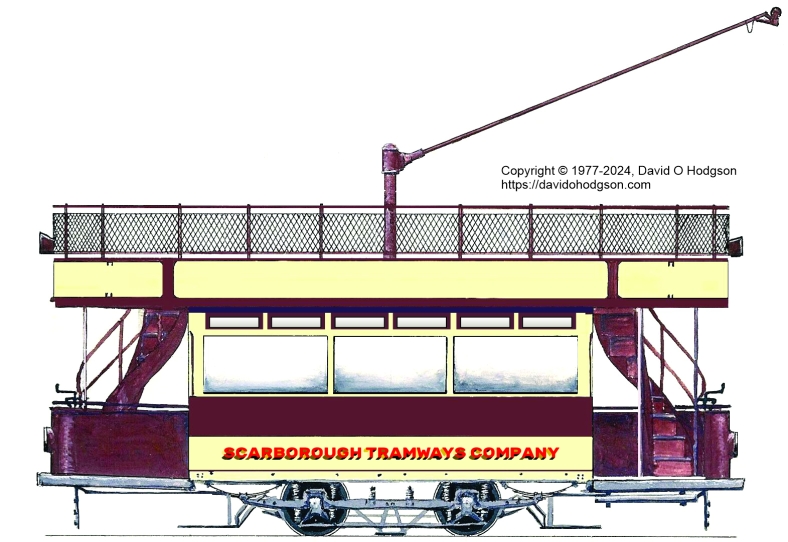
My technical illustration of a Scarborough tramcar. Based on the drawing of a Brush-manufactured tram in “Scale Model Electric Tramways

This article describes an aspect of the history of my home town that definitely does not derive from my personal memories, because the Scarborough Tramways Company ceased to exist many decades before I was born.

However, as part of my ‘A’ Level Art project, I included some details of the long-defunct system in my thesis (written during 1976-78) on “Road & Rail Transport in Scarborough”. At that time, there was very little published information available regarding the system, so my researches were based on limited resources. Since then, at least a couple of books have been published on the topic, as detailed in Published References below.

The cover of my Art project thesis also featured a somewhat distorted painting of a Scarborough tram alongside its modern equivalent, as shown below.

The Cover of my A-Level Art Project

Great Expectations

At the turn of the twentieth century, an electric tramway system was a prestigious asset for any British town. This was before the age of the motorbus, and electric trams were seen as the most modern and most efficient way to provide urban mass transport.

By 1904, following various rejected proposals, Scarborough Corporation had arranged for the construction and operation of a tramway system by Edmundson’s Electricity Corporation. The first trams ran on 6th May, 1904, but unfortunately the subsequent history of the system was marred by disputes with the town Corporation, which ultimately led to the early abandonment of the system. The last tram ran on 30th September 1931.

The map below shows the extent of the system as constructed, and the location of the car depot on Scalby Road. The company also had parliamentary authorization to build a line along the Marine Drive, linking the stub on Sandside to that on North Marine Road, via Peasholm Glen, but that line was never built.
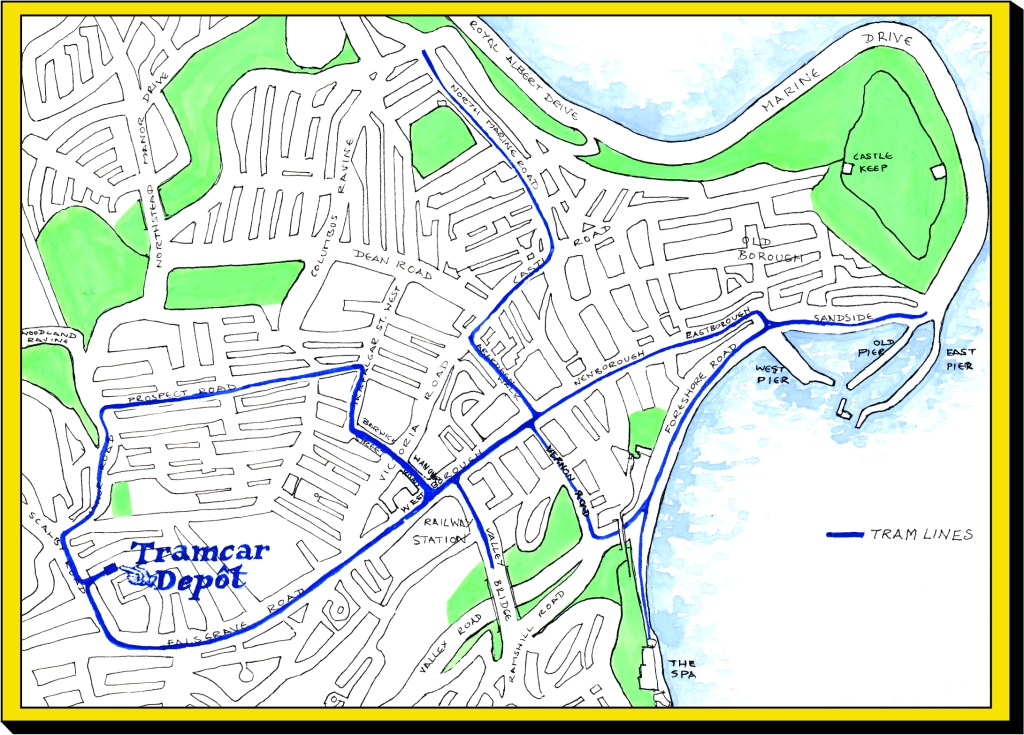
My map of Scarborough Tramways System

The design below is a fictitious Art Nouveau styled header that I created for the presentation of the tramway map in my Art study.
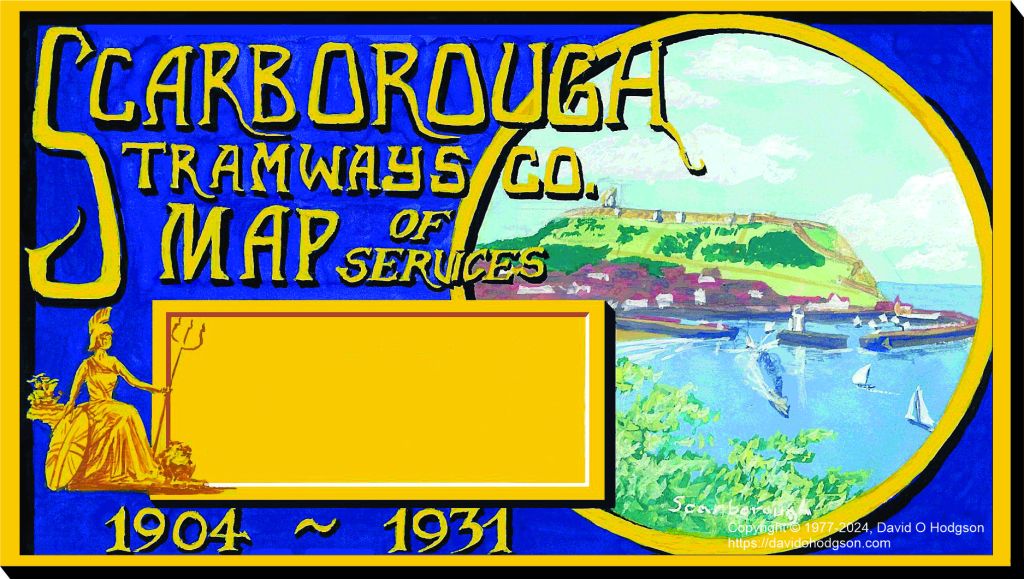
My fictitious Art Nouveau Header for the Scarborough Tramways Map

The tramway depot on Scalby Road survived until the 1960s, in derelict condition, when it was finally demolished to make way for the construction of Harley Close.

Other than that, there was generally no remaining evidence that the system had ever existed. Occasionally, however, disused tram tracks would reappear through the surface of existing roads, as shown in my photo below, which shows the truncated tracks protruding through the surface of Hanover Road in 1979.

Tram rails protruding through the surface of Hanover Road, Scarborough, in 1979

Thwarted Ambitions

One reason that has been suggested for the failure of the tramway system was that it did not expand as Scarborough grew in size. For example, the tramway system never extended to the rapidly-developing South Cliff over the Valley Bridge. However, it seems that there was a proposal to add a line across the bridge, then up West Street, terminating at Holbeck Hill. This very reasonable proposal was quashed by opposition from local residents! During 1970-78, I lived on West Street, and the photo below was taken from my bedroom window, showing a United Automobile Services bus operating the 100 service, which followed the route of the never-built tramway extension.

From my bedroom window in West Street, a United AS Bristol VR on the 100 Service. This route was a proposed extension to the Scarborough Tramways system, but was blocked by local opposition

A Premature Demise?

The troubles that beset the Scarborough Tramways Company throughout most of its existence seem to have been largely caused by an initial failure to agree on whether the system was to be run on a purely for-profit basis, or as a non-commercial public utility. As I’ve mentioned in another post, Scarborough’s population reliably swelled with visitors during the summer months, making the tramway profitable during those months. However, during the inevitable quiet months in winter, demand for tram services declined to the point where the company felt justified in suspending operations. Scarborough Corporation objected to this, even though they had failed to specify in the agreement how the service would be supported during lean times.

Needless to say, it was not only Scarborough Tramways that suffered from such hopelessly inconsistent economic expectations. British Railways notoriously suffered from conflicting demands by successive British governments; sometimes demanding that it should operate at an absolute profit, then at other times that it should provide a public utility without regard for cost.

Between the 1930s and the 1970s, all British electric tramway systems were shut down and abandoned, with only one exception (Blackpool). It wasn’t until the 1980s that the prevailing view in Britain that tramways were obsolete began to be superseded by economic realities. Subsequently, some tramways were partially reinstated, and some completely new systems have been built. At the time of writing, there are 9 operating tramway systems in Britain.

In his 1961 book “The British Tram,” author Frank E Wilson seems to have fully accepted the obsolescence of tramways. Horrifically, but thankfully inaccurately, the book’s last sentence reads:

Perhaps some of the babes in arms today will live to see the time when trains, buses, cars and probably aircraft have gone to join the tram in history—leaving them with hovercraft or rockets for earth and space travel, unless they have themselves, with the whole lot, disappeared in nuclear fission

Cover of “The British Tram” by Frank E Wilson. Copyright © 1961, Model & Allied Publications Ltd.

Scarborough Tram Week, 1981

Apparently, in October 1981, Scarborough’s local bus operator, United Automobile Services, held a “Scarborough Tram Week”, commemorating the fiftieth anniversary of the end of tram services in the town. Unfortunately for this history, and as I’ve mentioned elsewhere, I had just then left Scarborough for ever, to begin my undergraduate studies at Imperial College, London.

It seems that United AS repainted a contemporary Bristol VR bus in a fairly accurate version of the Scarborough Tramways colors, as shown in the photo below. Unfortunately, this monochrome image is the only one that I’ve ever been able to find of that vehicle. The image probably came from a book, but at present I can find no record of which. If anyone can provide copyright details, or another color image, then I will be grateful to acknowledge that!

United AS Bristol VR painted in replica Scarborough Tramways livery, 1981. Copyright © TBD

Published References

During the 1970s, when I did the research for my Art project, I could find no published books describing Scarborough’s tramway system. The only source material available was a few articles in old editions of the “Scarborough Evening News”.

Now, however, the situation is much better. Perhaps the definitive work is Barry Marsden’s “Scarborough Tramways”, published in 2007.

Copyright © 2007, Middleton Press

In 1981, which was the fiftieth anniversary of the closure of the tramway system, Scarborough’s local bus operator, United Automobile Services, self-published a small but informative booklet, titled “Trams by the Sea”.

Copyright © 1981, United Automobile Services
My technical illustration of a Scarborough tramcar. Based on the drawing of a Brush-manufactured tram in “Scale Model Electric Tramways”

Packing Without Panicking

Mary with the Luggage, Luzern Bahnhof

Mary with the Luggage, Luzern Bahnhof

The photo above was taken many years ago in the main railway station in Lucerne, Switzerland, just after Mary and I had arrived from Chiasso. Mary looks as though she is waiting for me to help her with our luggage! During my travels, I have rarely taken photos that included luggage, but since the topic of packing that luggage is the subject of this post, it seems appropriate here.

As I’ve mentioned before, my parents were anything but “seasoned travelers”, so I grew up with very little experience of packing suitcases. I really didn’t pack a suitcase myself until I went away to university for the first time. As I recounted in an earlier post, I quickly learned some hard lessons about what or what not to pack!

However, those lessons didn’t really solve the problem of how to remember to pack everything that I would actually need, and how to avoid forgetting some vital item.

Whatever You Do, Don’t Forget That!

To be honest, I didn’t usually “panic” about packing, but there was a low-level anxiety. Whenever I had to pack a suitcase, even for an overnight stay, there was always a nagging worry that I was forgetting something important.

Usually, my fears turned out to be unfounded, but on one occasion I did forget something vital.

During 1986, I had to fly from London to Munich, just on a one-day trip, to attend a job interview. As I was parking my car at Heathrow Airport, I suddenly realized to my horror that I had left my passport at home! There wasn’t time to drive back home to get it, so I decided that I had no choice but to go to the checkin terminal, and ask about my options.

My flight was with British Airways, and unfortunately this was to be my first experience of misleading information provided by that airline (but not the last). The checkin agent was adamant that there was no way I’d be allowed into West Germany without my passport, and that the immigration authorities there would simply send me straight back to Britain. Taking the flight would simply be a waste of time, she claimed.

Nonetheless, I couldn’t cancel my ticket at that point, so it seemed that I had nothing further to lose by taking the flight to Munich. When I arrived in Munich, it turned out that what I had been told by the British Airways representative had been completely false! When I explained my predicament, the German immigration officer laughed, and assured me that this situation occurred every day. He told me that they could simply issue me with a temporary Reisepass, which would allow me into the country just for the day, and which I would surrender on leaving.

That was what I did, and, apart from a few additional delays answering extra questions, it was really no problem at all. There wasn’t even a fee to pay!

Inspiration: Make a List

Despite the unexpectedly happy resolution of that situation, I continued to wonder whether there might be some way for me to guarantee that I would not forget some vital item when packing. As I grew older and traveled more frequently, the significance of the problem increased.

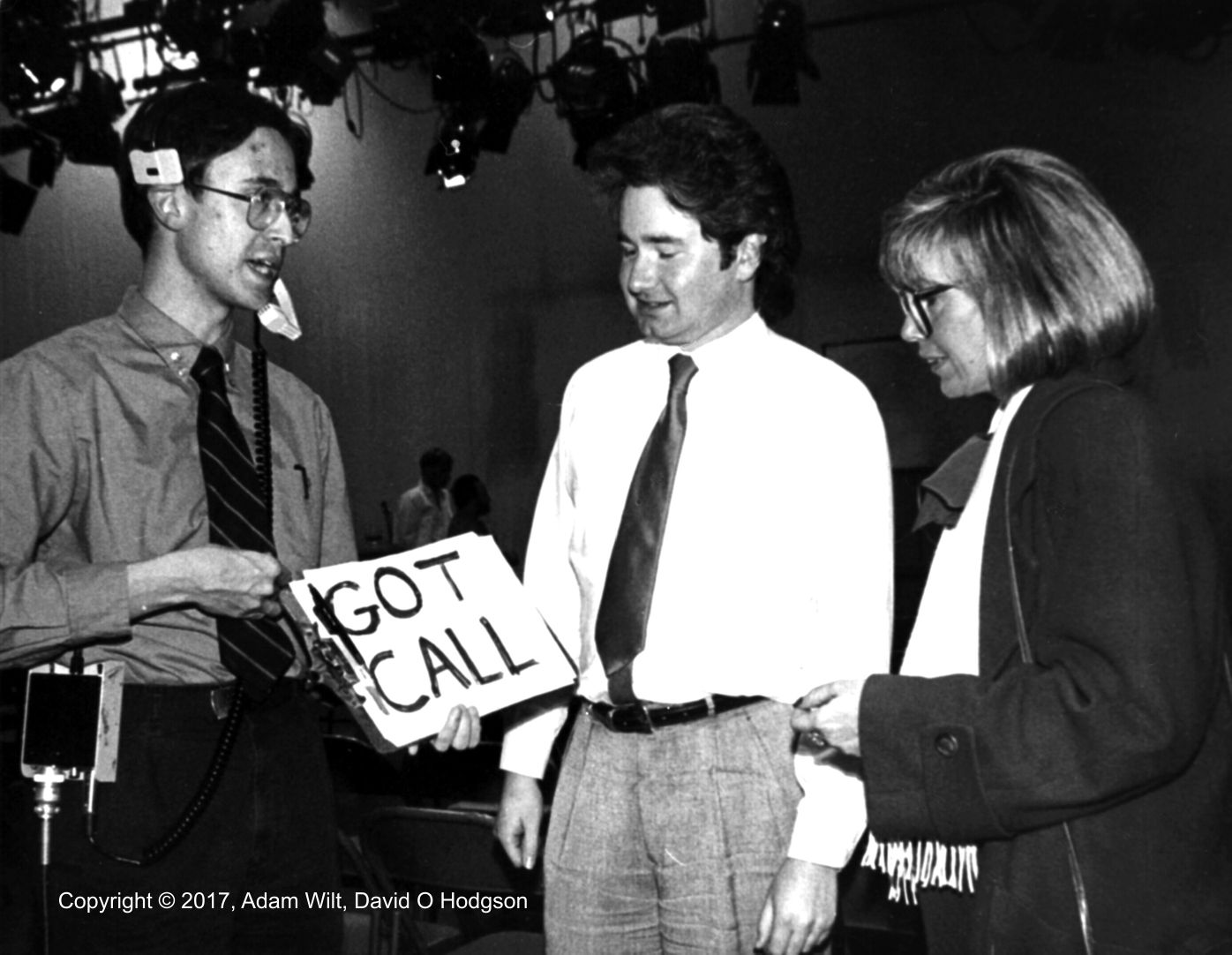
Eventually, I was inspired to find a solution by the activities of my friend Adam Wilt, who is shown below (on the left), with me and Mary, at an SMPTE video broadcast some time during the 1990s.

Broadcasting an SMPTE Meeting

Broadcasting an SMPTE Meeting

Adam provided videography services at many events, and he always brought all his own equipment with him. That included a wide variety of small-but-critical items, such as cables and adapters. Obviously it was important for him to avoid leaving some item behind at the end of every shoot. I couldn’t help noticing that, when packing his kit, he created a handwritten list, ticking off every item as he packed it, and then ticking off every item again as he repacked after the event.

It immediately dawned on me that here was the solution to my packing worries! If I just made a list of everything that I needed to pack, then I wouldn’t have to worry about forgetting anything. It seemed like a great idea, but then, of course, how would I ensure that the list itself was complete?

I realized that if I created my list on a computer, as a word processor file, then not only would I avoid having to rewrite it for every journey, but I’d also be able to improve the list after each trip, adding or removing items as travel conditions changed. (For example, years ago my list included phone cables and adapters for dial-up internet connections in hotels, but none of that is necessary now!)

I created my list more than 20 years ago, and I’ve used edited versions of it for every trip since then. I sub-divided the list to make packing even easier, splitting off, for example, items needed only for international travel, and (after 9/11) items that could or could not be carried onto aircraft.

Mary traveling in style!

Mary traveling in style!

The photo above illustrates the pleasures of care-free travel. Mary was relaxing in an airbed seat, on a flight back to the US from London, having carefully included her crafting items in her carry-on baggage, so she could work on her projects during the flight. For my part, I could enjoy the flight, without having to worry about having forgotten some vital item.

Many thanks to Adam Wilt for the inspiration that permanently solved my problem!

Mary with the Luggage, Luzern Bahnhof

Mary with the Luggage, Luzern Bahnhof

Mount Fuji: The Right Place at the Right Moment

Sunset on Mount Fuji, Japan, November 2007

Sunset on Mount Fuji, Japan, November 2007

I took this photograph of the sun setting on Mount Fuji as we were flying towards Osaka, in November 2007.

Looking back on my life, there have been several occasions where something happened to me that was simply the result of being “in the right place at the right time”. These occurrences were not the result of any great skill or prescience on my part. This photograph was one such instance.

As a Flight Attendant, my wife Mary typically worked flights to Japan, and occasionally I was able to accompany her on those flights. For me, it was a short vacation to a fascinating place.

Mary elected to work a flight to Osaka over the Thanksgiving holiday in 2007, and I went with her. We spent an enjoyable few days there and avoided all the travel hassles in the USA.

As we were approaching Osaka to land, the sun was setting. I happened to look out of the airplane window, and saw the view in the photograph above. It was hazy, but the low rays of the sun were just breaking through and catching the top of the volcano. I’ve never seen Mount Fuji like that again!

Toji Temple, Kyoto, 2007

Toji Temple, Kyoto, 2007

During our stay in Osaka on that occasion, we made a special journey to the grounds of Toji Temple, Kyoto, to visit a flea market. Mary wanted to buy a bead from Japanese beadmaker Akiko Isono, who had a regular stall at the market, and that was exactly what she did.