
 My previous post explained “How I Became a London Student and (Almost) Went Astray”. As I mentioned, moving to London and taking up studies there led me to many experiences that I had never anticipated.
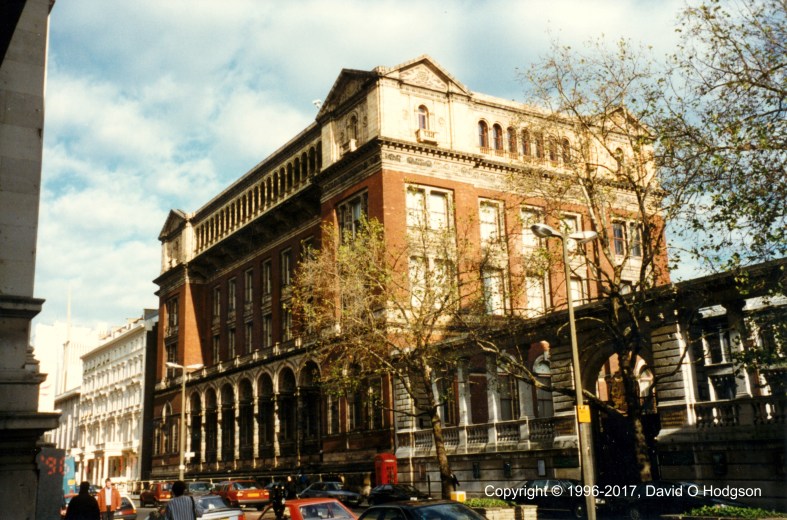
Imperial College in London is just across Exhibition Road from the Victoria & Albert Museum. In 1981, when I moved to the Student Halls of Residence in South Kensington, the “V&A” had just added a new exhibition building, which they named the “Henry Cole Wing”. Ironically, this building had been the original location of Imperial College, when it was known as the “Normal School of Science”.
One of the first exhibitions to be held in the Henry Cole Wing featured (mostly) monochrome artwork produced for one of Britain’s best-known publications: Radio Times.
Here’s the cover of the exhibition guide:

I visited the exhibition several times, and was intrigued by the inkwork techniques of the artists, which were very apparent in the original works displayed. Even the “whiting out” of mistakes in the artwork was obvious!
I hadn’t done any serious artwork myself for a few years, but, looking at these works, I must have begun to feel that “maybe I could do this”. At the same time, I had volunteered to be the Publicity Officer of Imperial College’s H G Wells Society. I decided that perhaps I could produce some monochrome artwork for use as posters for the H G Wells Society.
The H G Wells Society presented lectures on a wide variety of subjects. One of the first on the schedule was to be titled “The Psychology of Gambling”. Thus, I set to work with ink and brush to produce what I hoped would be an eye-catching illustration.
The result was the image at the head of this post, and thus it came about that, even though I’d moved to London to study Electrical Engineering, I found myself once again using my artistic skills.
 Given my education as an engineer, you may expect that I began reading the work of H G Wells because of his science fiction writing. It’s true that, as a child, I watched several movies that were derived from Wells’ science fiction, such as “War of the Worlds”, but I never actually read any of his books.
 I visited Switzerland in 1998, and, while walking in the Alps, stumbled across the eerie ruins of the Hotel Monte Generoso. I later wrote a (partially fictitious) poem about it:
 I just finished reading this excellent book:
 David Hodgson Personal Blog