A Frosty Sunday Morning

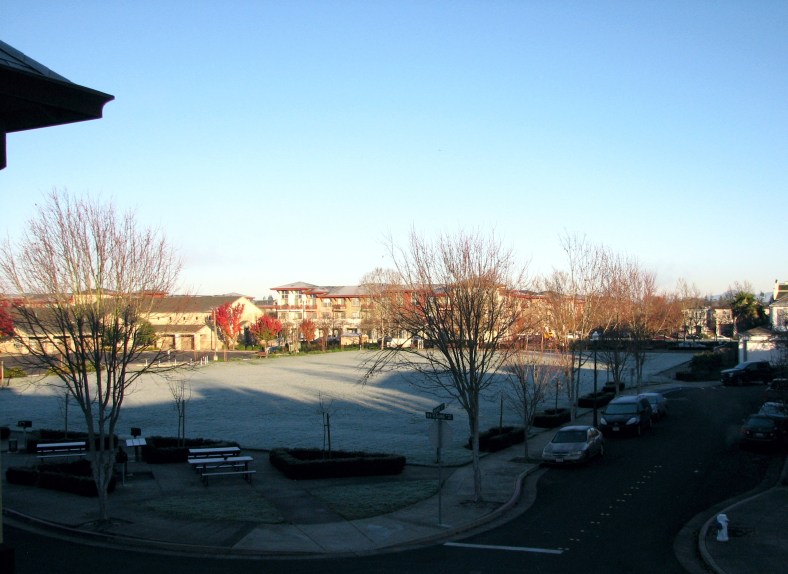
Village Green Park, Santa Rosa, on a frosty morning

Village Green Park, Santa Rosa, on a frosty morning

I took the photo above at 8 a.m. today, when the Park in front of our house was frostier than I’ve seen it since we moved here over 3 years ago. The frost was perhaps more intense because of the rain we had last week, which left everything damp.

Only a few weeks ago, at Thanksgiving, we were enjoying the sight of autumn leaves from the same vantage point, as below.

leaves161125

Autumn Leaves in Village Green Park, Thanksgiving 2016

The street running across both photos at the far end of the park is Sebastopol Road. From 1904 to 1946, the P&SR railroad ran along the center of the street here.

It seems that the last-ever passenger train on those tracks was an “Enthusiast Special” that ran on 6th April 1941. There are some interesting photos of that train in the book Petaluma & Santa Rosa Railway.

A Long-Forgotten Detail Rediscovered

david_xmastreerailway_croppedcrightFor the holiday season, here’s a slightly different “throwback” article.

When I was two years old, my parents bought me my first (clockwork) train set. The photo above, from Christmas 1963, shows me with everything set up under the Christmas tree, in the living room of our house in Scarborough.

Much later, the original train set developed into a “model railway” layout, which was permanently set up in the conservatory of our house. Although I was perhaps lucky that we had space for such a layout at all, a conservatory certainly wasn’t the ideal environment for it, since it was cold and very damp in winter, and exposed to direct sunlight in summer. As a result, the layout deteriorated to the point of unusability after a few years.

One summer evening, probably in 1973, I discovered that my father was taking photographs of the layout. At the time, I wished that he had let me know his plans beforehand, so that I’d have had a chance to “tidy up” the details as best I could. As it turned out, the photographs also left something to be desired! Nonetheless, two of those photos have survived in monochrome print form, and are now the only remaining record of my efforts. The photo below shows a closeup of part of the layout.

A portion of my falling-apart model railway, in 1973

A portion of my disintegrating model railway, in 1973

Most of the buildings shown were plastic or cardboard kits produced by Tri-ang, Playcraft, Superquick and other manufacturers.

One prominent item in the photo is the rather wonky-looking water tower (towards the bottom right), which was one of my earliest attempts at “scratch-building”. I used thin cardboard and Superquick “brick paper”, but I had no plans and just created the building’s walls “on the fly”. The initial result wasn’t too bad, but the flimsy cardboard construction couldn’t survive the climatic extremes in our conservatory, so, by the time the photos were taken, the structure was warped and was falling apart.

The posters for Beefex and Kelloggs on the sides of the water tank were hand-drawn by me. Both were real products, of course, except that I misspelled Kelloggs with only one “g”! I’d also decided to depict one of the posters peeling off the wall, which was a detail I knew I’d seen in real life somewhere years before.

I couldn’t remember where I’d seen the peeling poster, and I certainly never expected to see that real-life example again.

I was astonished therefore when, decades later, I was thumbing through a recently-published book on the Hull & Scarborough railway, and there in the book was a photo of the old water tank at Bridlington Station, with a Martini poster on the side, one corner of which is peeling! The image below is a partial scan, showing the relevant detail.

Railway Water Tank at Bridlington Station, c.1965

Railway Water Tank at Bridlington Station, c.1965

The photo in the book isn’t dated, but the Martini slogan in the poster was in use around 1964, so I probably saw it a few years after that. The only other mistake I’d made was to have the corner of the poster defying gravity, by peeling up from the bottom corner, instead of down from the top!

Our Yuletide Cards are On the Way

cropped-rooster1copyright.pngAll our Yuletide cards are on the way to their recipients, as of this morning.
I usually refer to these as “Christmas cards”, but, before there are any accusations of hypocrisy, let me point out that people were celebrating a Winter festival long before anyone had heard of Christianity. The Christians merely hijacked the existing festival because they had nothing similar to offer.

It doesn’t matter to me whether they are called “Christmas cards”, “Saturnalia cards”, “Yuletide cards” or anything else. We send them because it’s a great way of keeping in touch with family and friends whom we otherwise may rarely see.

(Insisting that the name “Christmas” can only be used by Christians seems just as ridiculous as insisting that the name “Wednesday” can only be used by those who worship Woden!)

This year, neither Mary nor I had produced any artwork for a card in time, so Mary found a suitable design by another artist on Zazzle. I must say that I’m impressed with the quality of the Zazzle card, and we will look into using Zazzle ourselves for future print-on-demand projects.

It has also become a tradition with us to create a return address label featuring the Asian (Lunar) New Year animal for the forthcoming year. This year, I produced the artwork above for 2017, which will be the “Year of the Rooster”. Again, there are no superstitious intentions; it’s just a decoration relating to the name and doesn’t imply any beliefs about the year.

I’m aware that the “Year of the Rooster” doesn’t start until January 28th, 2017, but I don’t see that as a problem. Even in Britain, “New Year’s Day” didn’t actually fall on January 1st until it was moved to that date, in 1752.

Lewis’s Store, Leicester, in 1978

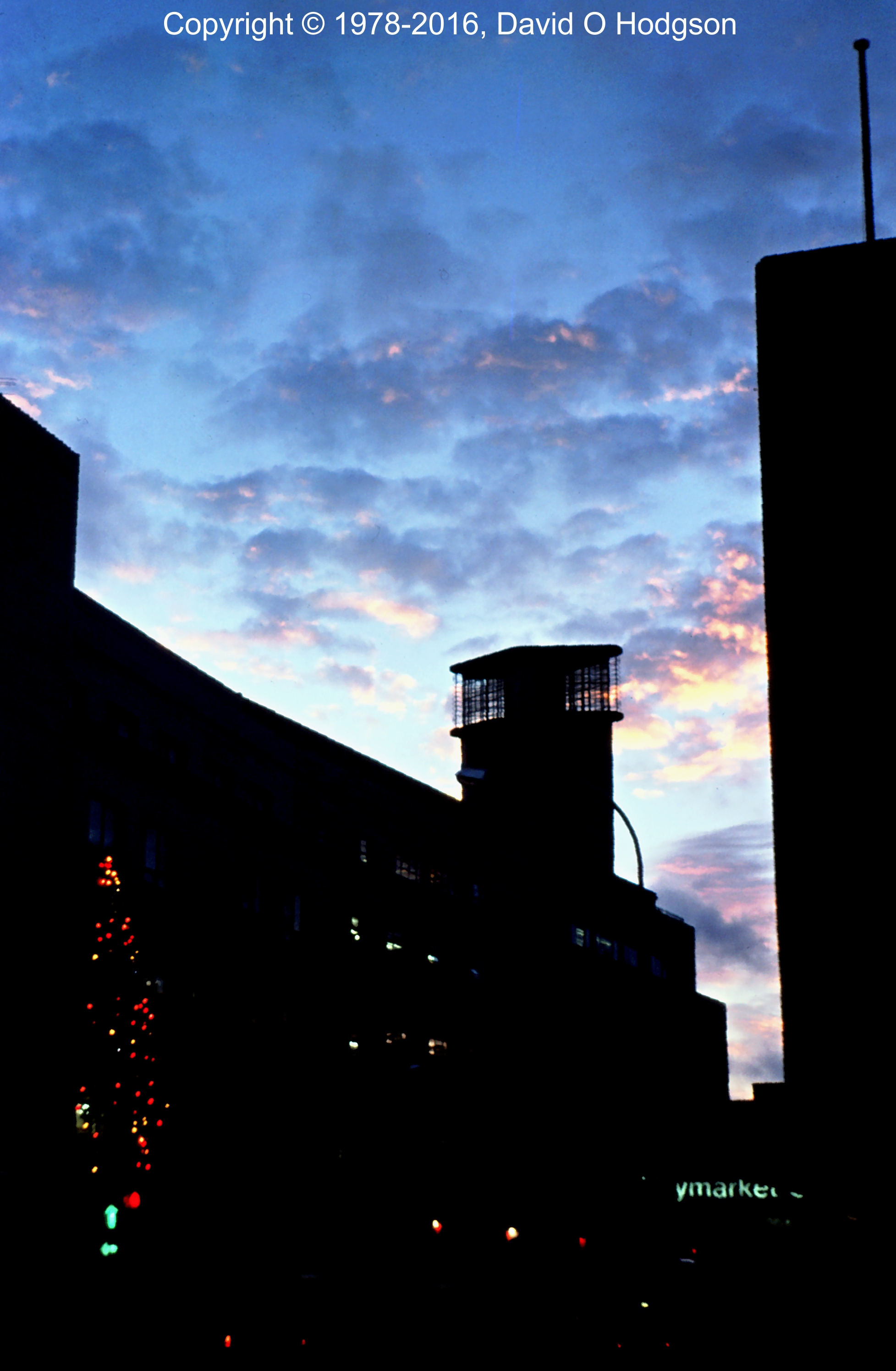
tr7-14-2400shrot_781118crightThe picture above shows the tower of the Art Deco styled Lewis’s store in Leicester, UK, on the cold afternoon of 18th November 1978. In those days, there was no “Sunday Trading” (except for newsagents), so Saturday was the main shopping day of the week. There’s no Thanksgiving Holiday in Britain, of course, but the holiday decorations were already in place on the store!
Unfortunately, during the 1990s this distinctive building was demolished, except for the tower, which was preserved among the replacement architecture, seemingly as some kind of afterthought. As shown below in my 2008 photo, the Art Deco tower now seems completely incongruous with the style of the surrounding buildings.

leicester_lewistower2

Update 2022: I’ve been informed that the store was owned by Lewis’s, not John Lewis. It makes little difference to the point of my post, but I’ve corrected the text anyway. Here is a link to an article about the closure of the store:

https://www.leicestermercury.co.uk/news/history/fond-memories-lewiss-25th-anniversary-2454555

The Salesman and the Programmer: Poem

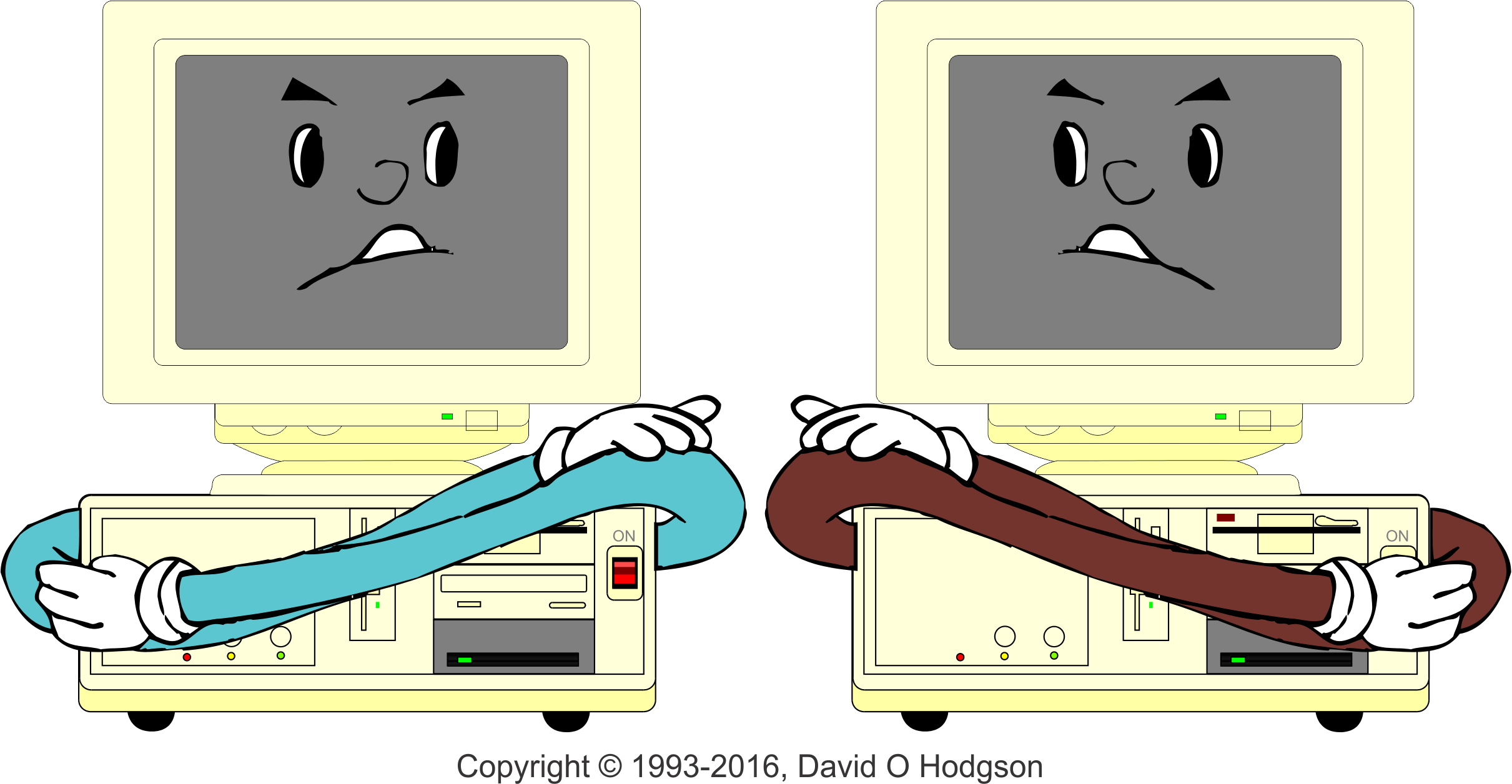
incompatiblepcsnewMore than twenty years ago now, I had to upgrade one of my PCs from Windows 3.1 to Windows 95. What I’d been promised would be a painless improvement turned out to be a very frustrating experience. However, rather than simmering about it, I was inspired to write the humorous poem below.
I must make it clear that this is intended as a satirical parody. I am not suggesting that the introduction of Windows 95 (or any other operating system) was really a deliberate plot to break anyone’s computer, and I have no evidence to support such a notion!

For product sales, the problem was
Computers were too cheap:
The software was reliable;
The learning curve not steep;
And Windows Three was so well known
Folk used it in their sleep!

The Salesman and the Programmer
Were walking hand in hand.
They were trying to make a new program
To sell throughout the land.
“If we could find a killer app,”
The Salesman said, “That would be grand.”

“We used to make a lot of cash,”
The Salesman said with glee,
“When software was such complex stuff
And our knowledge was the key.
But now it’s all such bug-free fluff,
And Tech Support is free!”

“If we could make them change their files,”
The Programmer began,
“They’d have to learn a new OS —
Oh, what a marv’lous plan!
If we could make it look the same
But so a diff’rent program ran.”

The Programmer, he saw a catch
They’d have to overcome.
“But how could we convince them all?
Who’d ever be so dumb?”
The Salesman smiled, and quietly said,
“Oh — almost everyone.”

And so they built a new OS:
Another type of GUI.
They called it “Windows 95”
And began to spout the hooey.
But who would risk this untried scheme?
Who would be so screwy?

So they showed it off as something great,
To make society better.
They claimed it was a vital tool
For every young go-getter.
They asked us “Where we’d go today”
In papers and newsletters.

For those that were more cautious,
Those that weren’t such mugs,
They told us that it worked just fine,
Between the product plugs.
One million beta testers had been set
To find those minor bugs.

They spent a mound of money
On publicity and display,
And people rushed out lemming-like
To buy it that first day.
What we really should have listened to
Was what they failed to say.

They told us that they’d tested it,
On every kind of system.
They’d questioned all the User Groups
(They’d made a vow to listen.)
Those beta testers found the bugs,
But they didn’t say they’d fixed ‘em!

I didn’t want to buy the thing —
I wasn’t taken in.
My own machine had worked just fine —
It was my main linchpin.
With Windows Three-Point-One, NT,
And lots of RAM therein.

But my client wanted me to try
To change their new software.
“It must be Windows 95!”
They called me to declare.
So I went and bought the CD-ROM,
Which was the start of my nightmare!

And so I ran the setup files,
To install Ninety-five.
My system paused, and beeped, and stopped:
It wouldn’t come alive!
I couldn’t get the thing to run,
No matter how I’d strive.

So I called —

The Salesman and the Programmer:
I asked them what was wrong.
They told me that they’d find a fix —
It wouldn’t take too long.
And until then, I’d work around:
That’s how I got along.

And so, at length, they called me back,
Which brightened my demean’.
The Programmer had checked their code:
He claimed it was pristine —
“There’s nothing wrong with our software:
It must be your machine.”

I told them it had worked for years,
And never had “gone down”,
With every other program known
And all the gear around.
“Well there’s something there that we can’t fix,”
He said, “You break it down.”

The Salesman and the Programmer,
Were happy with their game.
Saw new computers selling fast,
And that had been their aim.
“We’ve stopped your system working now,
And you can take the blame!”

My poem is, of course, a parody of Lewis Carroll’s “The Walrus and the Carpenter”, but in fact Carroll’s poem was itself an adaptation of an earlier work; “The Dream of Eugene Aram” by Thomas Hood.

Tweedle Don

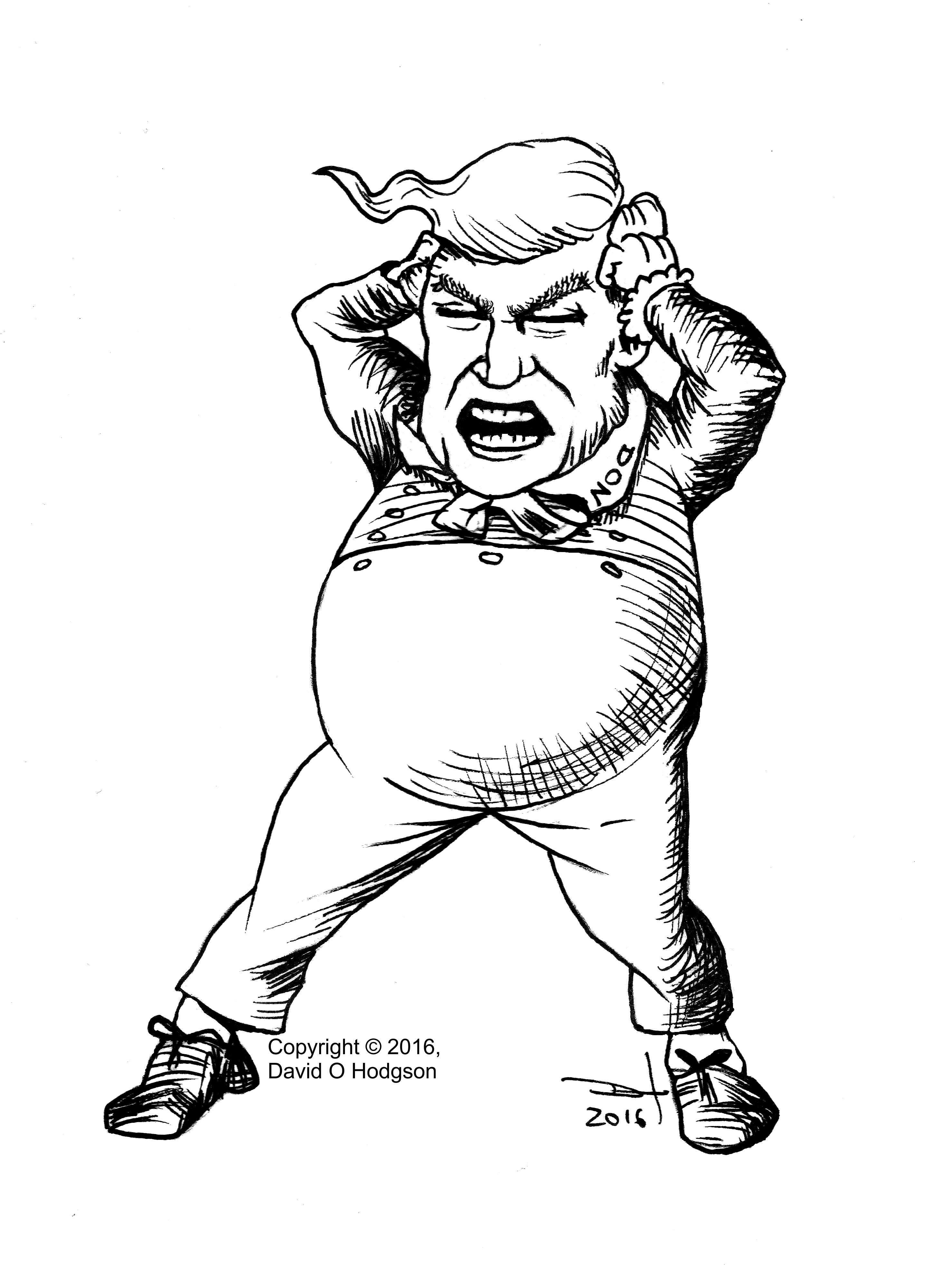
tweedledon2Tweedle Don throws his daily tantrum…

I don’t normally draw “political cartoons”, but the astonishing fact that we’re facing an election where one of the major candidates (Donald Trump, of course) has the maturity of a ten-year-old prompted me to take some inspiration from Sir John Tenniel!

I was told that some people may be unfamiliar with the original illustrations. For details, please see: https://en.wikipedia.org/wiki/Tweedledum_and_Tweedledee

Michael Palin & the Life of Brian: Insights from my Interview

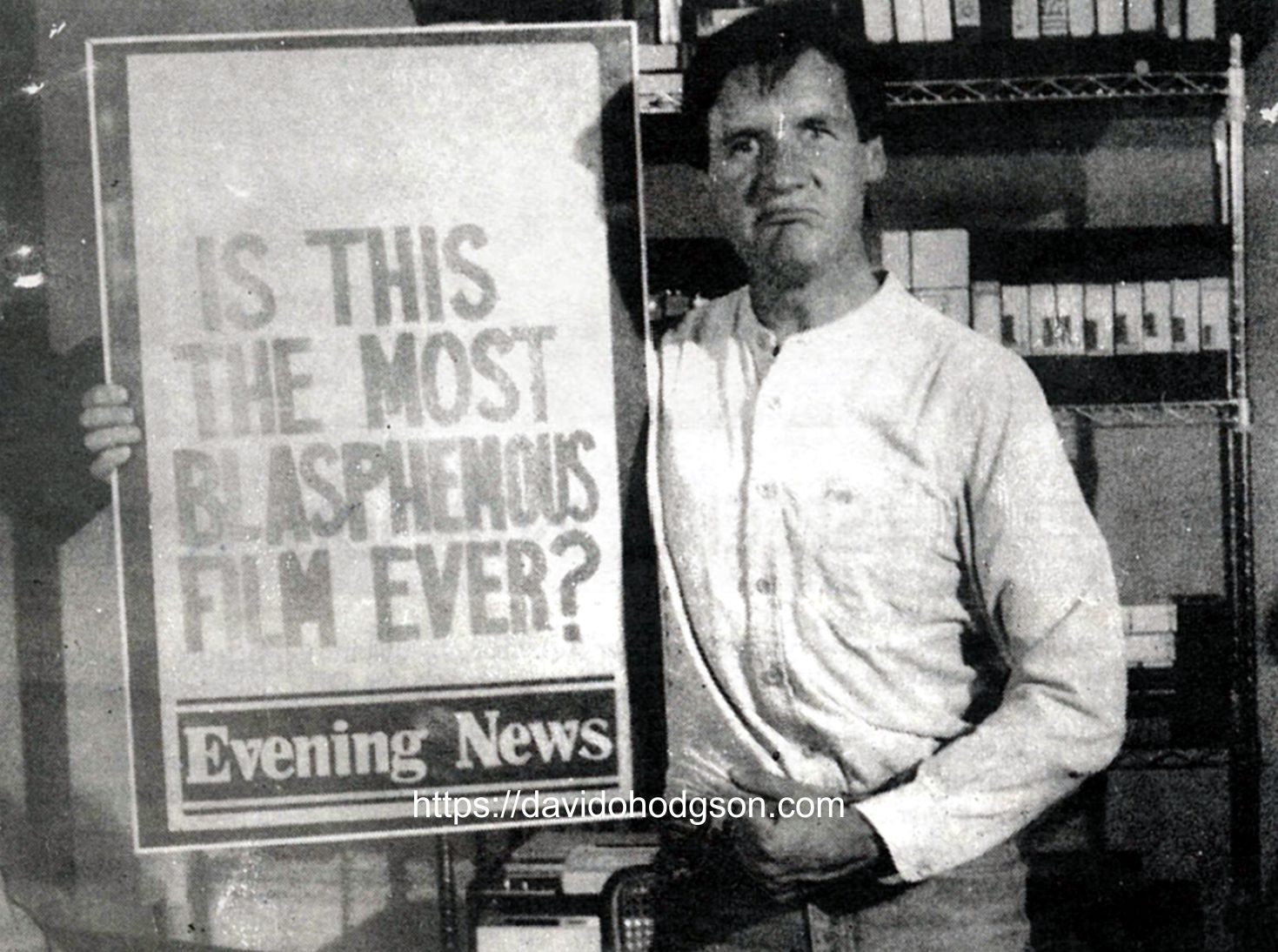
A Defiant Stance!

A Defiant Stance!

In 1983, while a student at Imperial College, I taped a video interview with Michael Palin, of “Monty Python” fame. At that time, the Monty Python team’s most famous—if not notorious—movie to date had been “The Life of Brian”, which had been released in 1979. Controversial at the time, the movie is perhaps even more famous now, having regularly been cited as the “greatest comedy film of all time”. If you can remember back to that time, you may recall that “The Life of Brian” was vociferously denounced in some quarters as being “blasphemous”.

As our interview progressed, I broached the topic by mentioning to Michael* that there had been controversy about the movie “where I was living”. His immediate response was, “You’re not from Harrogate, are you?” I laughed, but had to admit that I was in fact from nearby Scarborough (both towns being in North Yorkshire, England). He replied along the lines of, “Well, Harrogate seemed to be the worst when it came to the intellectual level of debate”.

Michael acknowledged that the team had anticipated some controversy when planning the movie: “We realized that some people would claim that Brian was supposed to be Jesus, so we deliberately included Jesus alongside Brian, to make it clear that he wasn’t.”

As it turned out, the reality was that all too many were willing to denounce the movie without even having seen it. In fact, as is surely obvious to anyone who takes the trouble to watch it through, the plot pokes satirical fun at religions, organizations, and many other topics that you’d expect the Monty Python team to address. The petulant reaction simply provided extra publicity for the movie, and discredited those who complained about non-existent offences.

Perhaps among the most insightful aspects of the movie is the lampooning of the way in which, having committed themselves to a particular belief, some people will go to extremes to avoid having to accept any evidence that the belief is wrong. Instead of reaching the logical conclusion, believers go out of their way to create and justify the most implausible rationalizations, redefining words and concepts as necessary to avoid admitting error.

I found Michael Palin’s comments during our interview interesting and personally thought-provoking, since he was correct that there had been much sanctimonious hand-wringing about the movie in my home town (and in many other places too). The end result of all that, in my case, was to make me realize that even some supposedly-intelligent people whom I knew couldn’t necessarily be trusted to behave rationally when it came to the “big issues”. That was a lesson that I’ve carried with me ever since.

(* Just in case it seems presumptuous of me to refer to my guest simply as “Michael”, I should mention that he gave me explicit permission to do that! He told me, “Only my parents call me Mr. Palin”…)

Digital Bayeux

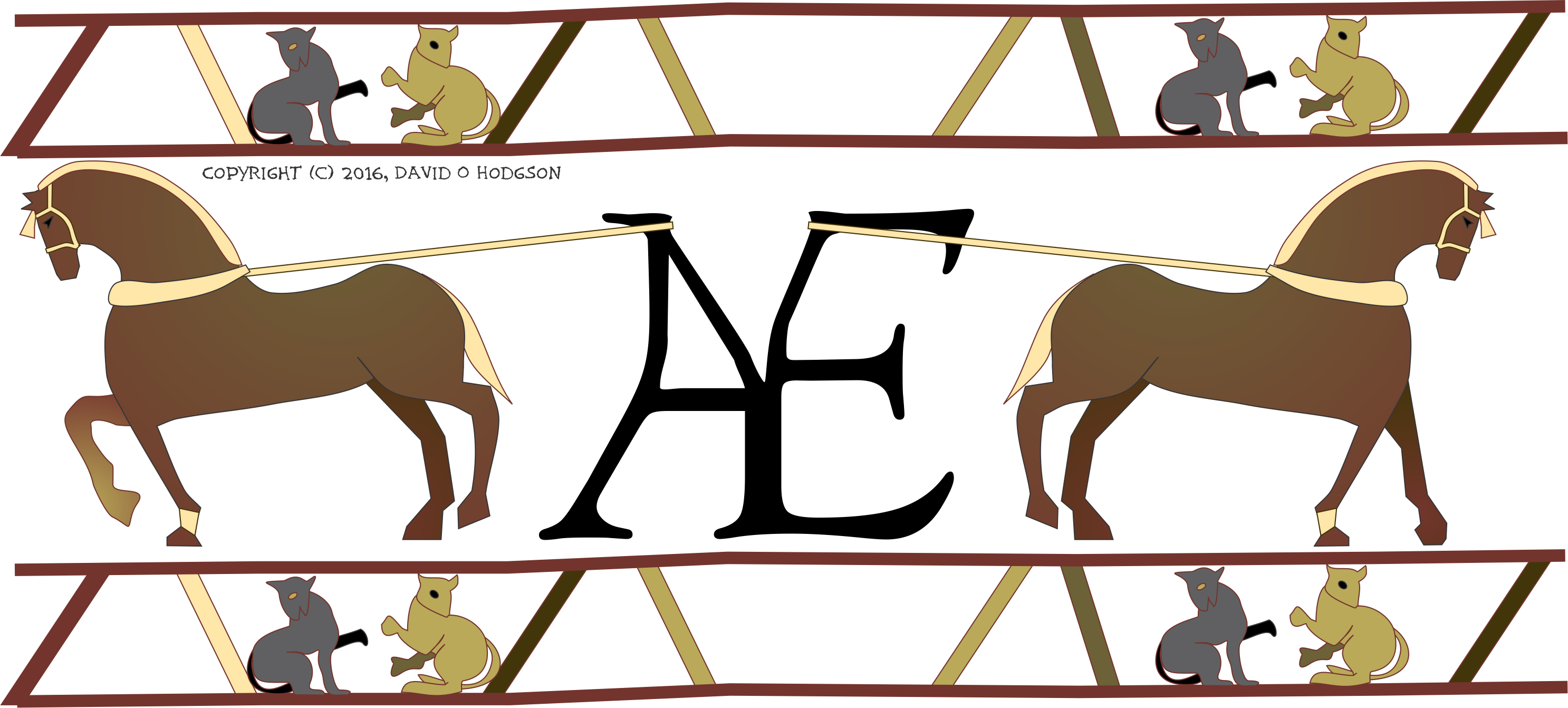
ligatures_bayeux1I just completed some artwork to illustrate a forthcoming article for my professional blog, www.teklibri.com. The article discusses the use of linguistic ligatures in English, which immediately put in me in mind of the impressive artwork of the Bayeux Tapestry.

The Bayeux Tapestry has once again been in the news recently, because the events that it depicts took place exactly 950 years ago, in 1066. I was first introduced to that remarkable work of art when I was six years old, in 1966, that being the 900th anniversary of the events.

My graphic is loosely based on the Bayeux style, but in a considerably simplified manner. Again inspired by details in the real tapestry, I took the opportunity to include in the border a representation of two cats fighting, just like our own Ignatz and Ginger Tom!

Having analyzed the design of the illustrations in the tapestry, I now have a much finer appreciation of the quality of the original work.

The typeface used for the copyright notice in my artwork is called “King Harold”, which was itself inspired by text that appears in the tapestry. The typeface can be downloaded free in TrueType format from:

http://haroldsfonts.com/portfolio/king-harold

How Radio Times Reintroduced Me to Art

pysch_gambling2My previous post explained “How I Became a London Student and (Almost) Went Astray”. As I mentioned, moving to London and taking up studies there led me to many experiences that I had never anticipated.

Imperial College in London is just across Exhibition Road from the Victoria & Albert Museum. In 1981, when I moved to the Student Halls of Residence in South Kensington, the “V&A” had just added a new exhibition building, which they named the “Henry Cole Wing”. Ironically, this building had been the original location of Imperial College, when it was known as the “Normal School of Science”.

One of the first exhibitions to be held in the Henry Cole Wing featured (mostly) monochrome artwork produced for one of Britain’s best-known publications: Radio Times.

Here’s the cover of the exhibition guide:

artofradiotimescover

I visited the exhibition several times, and was intrigued by the inkwork techniques of the artists, which were very apparent in the original works displayed. Even the “whiting out” of mistakes in the artwork was obvious!

I hadn’t done any serious artwork myself for a few years, but, looking at these works, I must have begun to feel that “maybe I could do this”. At the same time, I had volunteered to be the Publicity Officer of Imperial College’s H G Wells Society. I decided that perhaps I could produce some monochrome artwork for use as posters for the H G Wells Society.

The H G Wells Society presented lectures on a wide variety of subjects. One of the first on the schedule was to be titled “The Psychology of Gambling”. Thus, I set to work with ink and brush to produce what I hoped would be an eye-catching illustration.

The result was the image at the head of this post, and thus it came about that, even though I’d moved to London to study Electrical Engineering, I found myself once again using my artistic skills.