The image above was my design for our greeting cards this year. It depicts our two cats supposedly sharing a cracker (which of course they would never do in reality!). It’s not a painting, of course, but at least this year I was able to create something original, instead of sending out commercial cards, as we did last year.
I also published our seasonal letter, which you can read here if you wish:
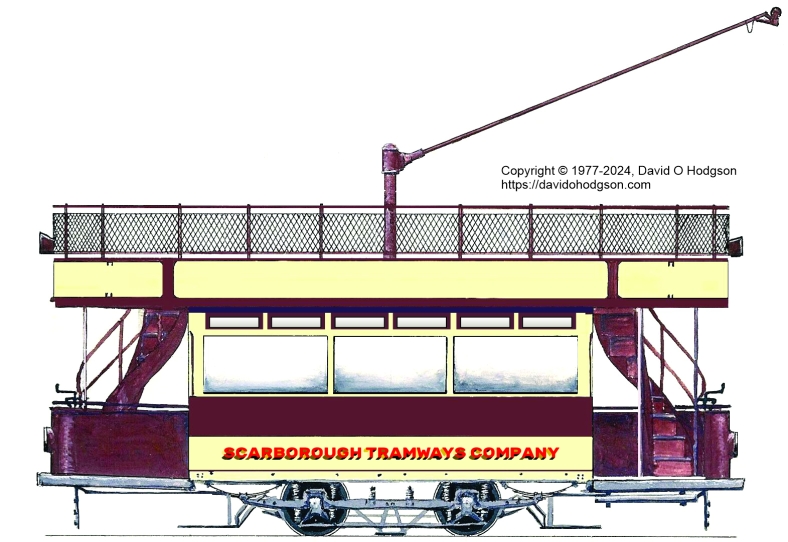
My technical illustration of a Scarborough tramcar. Based on the drawing of a Brush-manufactured tram in “Scale Model Electric Tramways“
This article describes an aspect of the history of my home town that definitely does not derive from my personal memories, because the Scarborough Tramways Company ceased to exist many decades before I was born.
However, as part of my ‘A’ Level Art project, I included some details of the long-defunct system in my thesis (written during 1976-78) on “Road & Rail Transport in Scarborough”. At that time, there was very little published information available regarding the system, so my researches were based on limited resources. Since then, at least a couple of books have been published on the topic, as detailed in Published References below.
The cover of my Art project thesis also featured a somewhat distorted painting of a Scarborough tram alongside its modern equivalent, as shown below.
The Cover of my A-Level Art Project
Great Expectations
At the turn of the twentieth century, an electric tramway system was a prestigious asset for any British town. This was before the age of the motorbus, and electric trams were seen as the most modern and most efficient way to provide urban mass transport.
By 1904, following various rejected proposals, Scarborough Corporation had arranged for the construction and operation of a tramway system by Edmundson’s Electricity Corporation. The first trams ran on 6th May, 1904, but unfortunately the subsequent history of the system was marred by disputes with the town Corporation, which ultimately led to the early abandonment of the system. The last tram ran on 30th September 1931.
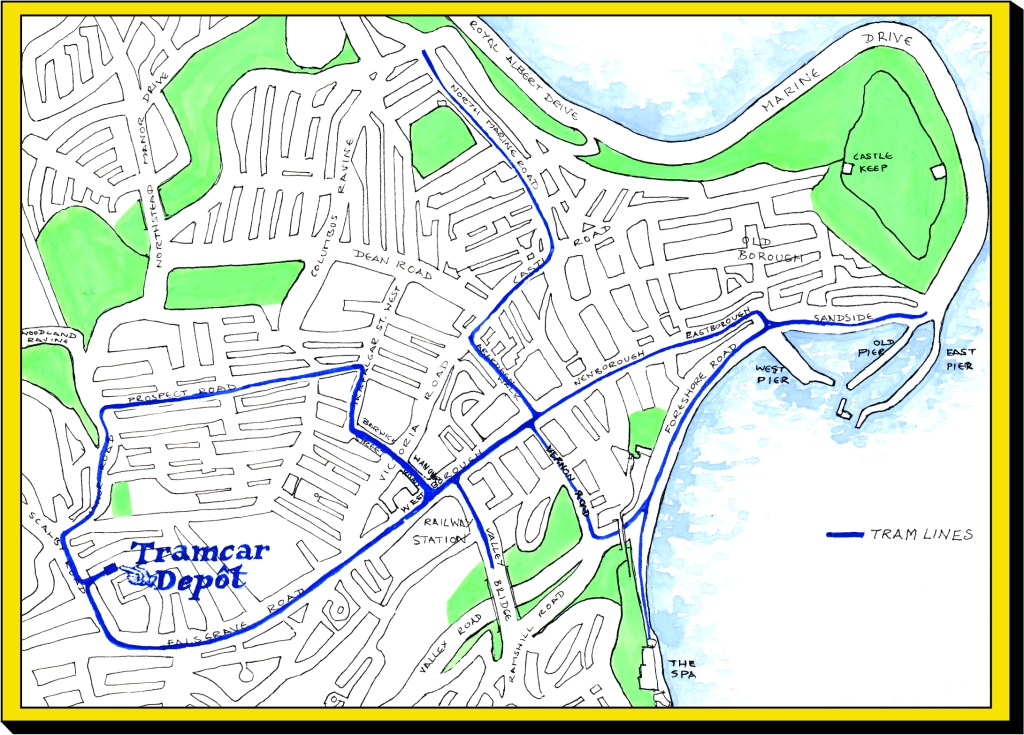
The map below shows the extent of the system as constructed, and the location of the car depot on Scalby Road. The company also had parliamentary authorization to build a line along the Marine Drive, linking the stub on Sandside to that on North Marine Road, via Peasholm Glen, but that line was never built.
My map of Scarborough Tramways System
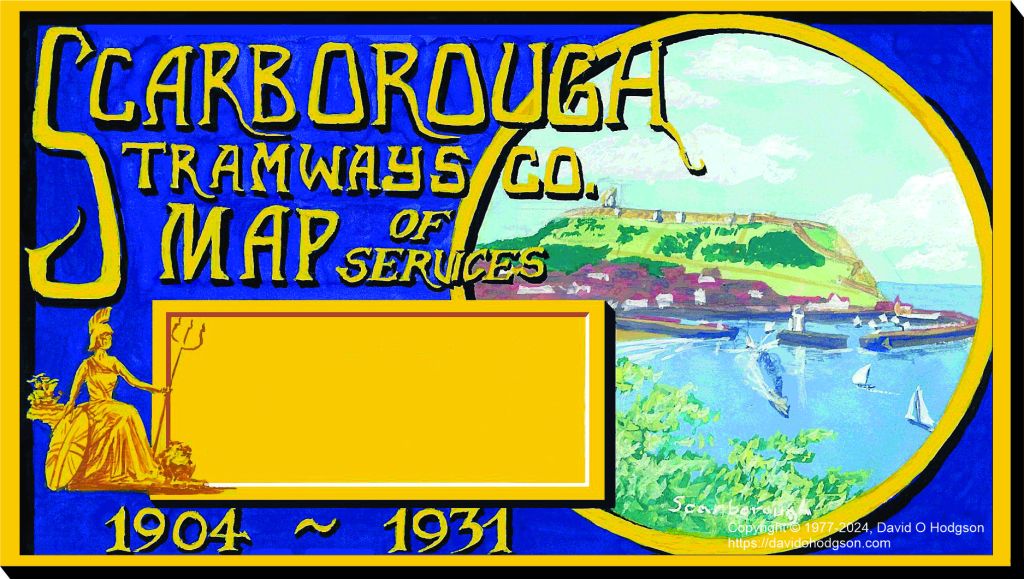
The design below is a fictitious Art Nouveau styled header that I created for the presentation of the tramway map in my Art study.
My fictitious Art Nouveau Header for the Scarborough Tramways Map
The tramway depot on Scalby Road survived until the 1960s, in derelict condition, when it was finally demolished to make way for the construction of Harley Close.
Other than that, there was generally no remaining evidence that the system had ever existed. Occasionally, however, disused tram tracks would reappear through the surface of existing roads, as shown in my photo below, which shows the truncated tracks protruding through the surface of Hanover Road in 1979.
Tram rails protruding through the surface of Hanover Road, Scarborough, in 1979
Thwarted Ambitions
One reason that has been suggested for the failure of the tramway system was that it did not expand as Scarborough grew in size. For example, the tramway system never extended to the rapidly-developing South Cliff over the Valley Bridge. However, it seems that there was a proposal to add a line across the bridge, then up West Street, terminating at Holbeck Hill. This very reasonable proposal was quashed by opposition from local residents! During 1970-78, I lived on West Street, and the photo below was taken from my bedroom window, showing a United Automobile Services bus operating the 100 service, which followed the route of the never-built tramway extension.
From my bedroom window in West Street, a United AS Bristol VR on the 100 Service. This route was a proposed extension to the Scarborough Tramways system, but was blocked by local opposition
A Premature Demise?
The troubles that beset the Scarborough Tramways Company throughout most of its existence seem to have been largely caused by an initial failure to agree on whether the system was to be run on a purely for-profit basis, or as a non-commercial public utility. As I’ve mentioned in another post, Scarborough’s population reliably swelled with visitors during the summer months, making the tramway profitable during those months. However, during the inevitable quiet months in winter, demand for tram services declined to the point where the company felt justified in suspending operations. Scarborough Corporation objected to this, even though they had failed to specify in the agreement how the service would be supported during lean times.
Needless to say, it was not only Scarborough Tramways that suffered from such hopelessly inconsistent economic expectations. British Railways notoriously suffered from conflicting demands by successive British governments; sometimes demanding that it should operate at an absolute profit, then at other times that it should provide a public utility without regard for cost.
Between the 1930s and the 1970s, all British electric tramway systems were shut down and abandoned, with only one exception (Blackpool). It wasn’t until the 1980s that the prevailing view in Britain that tramways were obsolete began to be superseded by economic realities. Subsequently, some tramways were partially reinstated, and some completely new systems have been built. At the time of writing, there are 9 operating tramway systems in Britain.
In his 1961 book “The British Tram,” author Frank E Wilson seems to have fully accepted the obsolescence of tramways. Horrifically, but thankfully inaccurately, the book’s last sentence reads:
Perhaps some of the babes in arms today will live to see the time when trains, buses, cars and probably aircraft have gone to join the tram in history—leaving them with hovercraft or rockets for earth and space travel, unless they have themselves, with the whole lot, disappeared in nuclear fission
Apparently, in October 1981, Scarborough’s local bus operator, United Automobile Services, held a “Scarborough Tram Week”, commemorating the fiftieth anniversary of the end of tram services in the town. Unfortunately for this history, and as I’ve mentioned elsewhere, I had just then left Scarborough for ever, to begin my undergraduate studies at Imperial College, London.
It seems that United AS repainted a contemporary Bristol VR bus in a fairly accurate version of the Scarborough Tramways colors, as shown in the photo below. Unfortunately, this monochrome image is the only one that I’ve ever been able to find of that vehicle. The image probably came from a book, but at present I can find no record of which. If anyone can provide copyright details, or another color image, then I will be grateful to acknowledge that!
During the 1970s, when I did the research for my Art project, I could find no published books describing Scarborough’s tramway system. The only source material available was a few articles in old editions of the “Scarborough Evening News”.
Now, however, the situation is much better. Perhaps the definitive work is Barry Marsden’s “Scarborough Tramways”, published in 2007.
In 1981, which was the fiftieth anniversary of the closure of the tramway system, Scarborough’s local bus operator, United Automobile Services, self-published a small but informative booklet, titled “Trams by the Sea”.
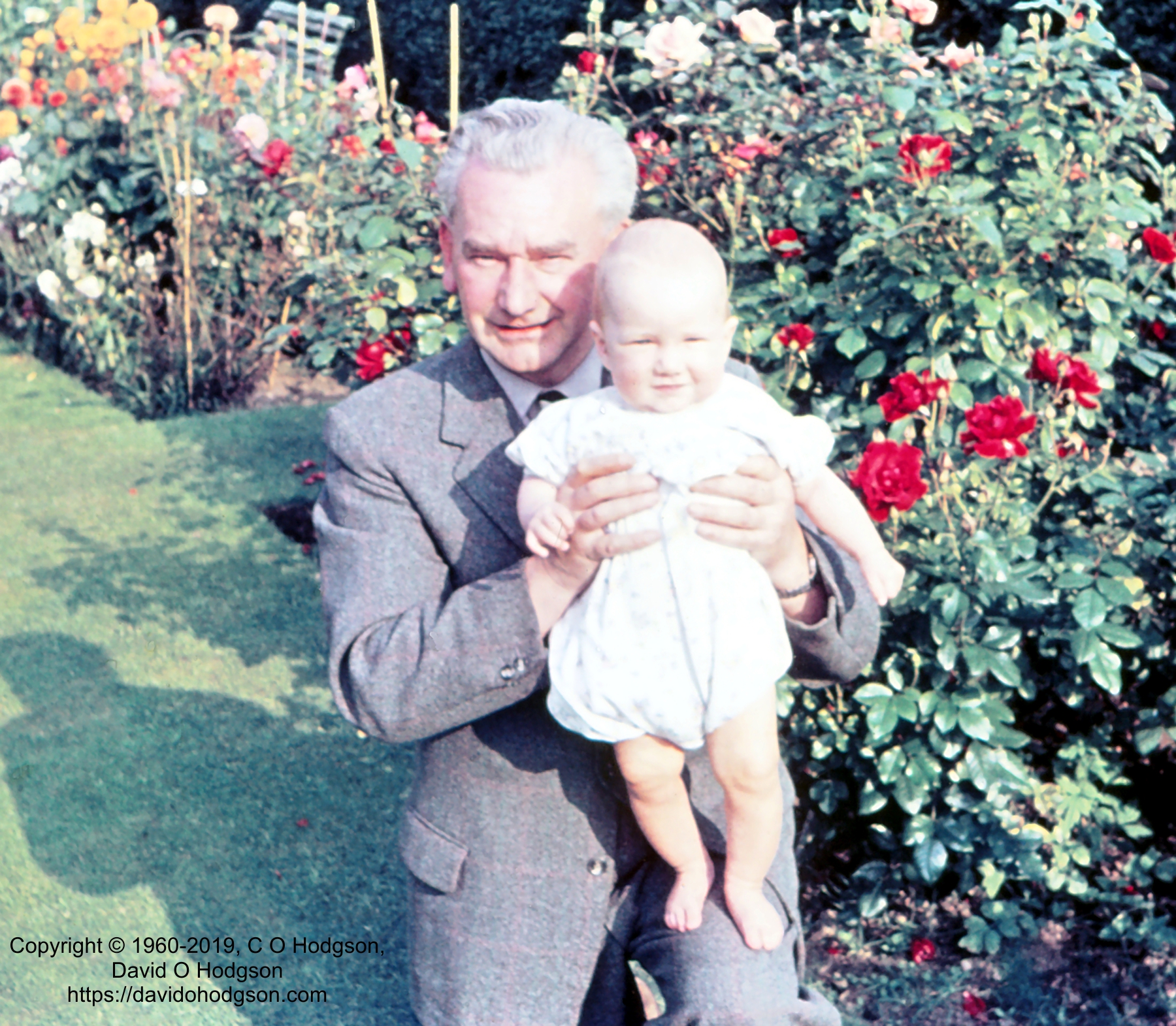
Today—6th March—would have been my father’s 110th birthday. The photo above is the earliest of the two of us together that has survived. I was about 6 months old at the time, so it shouldn’t be difficult to guess which of us is which! It was taken in my father’s beloved rose garden, at the back of our house. Unfortunately, it is somewhat over-exposed, but it has survived because most of our photos in those days were taken by my father, so he appears in very few of them.
Of course, my father is not alive today to celebrate this occasion; he died shortly after his 70th birthday, in 1979.
As I’ve mentioned in earlier posts, my father suffered his first stroke when I was about 2 years old. Given that he was the family’s sole breadwinner, that was obviously a catastrophic event, although I was much too young to appreciate what was happening at the time.
He never recovered fully from the effects of the first stroke, although he was able to continue working as a teacher until the early 1970s. As I described elsewhere, our family then operated a guest house to generate income for a few years, until my brother and I grew up.
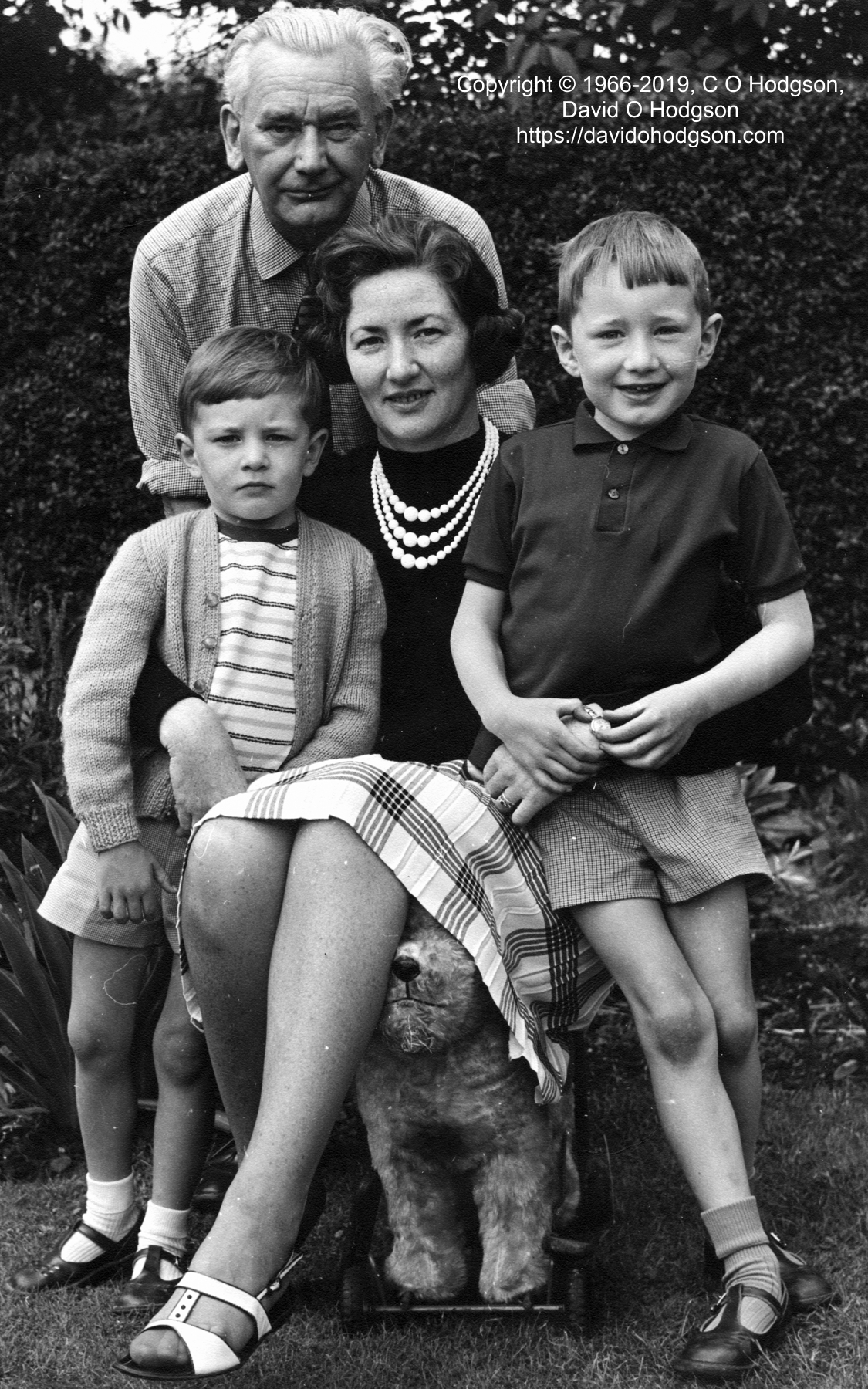
The family group photo below was taken in about 1966, also in our back garden, but this time with the camera on a tripod, and using the auto-timer, so that my father could run around and include himself in the image. In the front row are my younger brother, my mother and me. My mother is sitting on a well-used push-around stuffed dog, called “Woofy”.
The Family with Woofy, 1966
You can see that my father’s smile here is somewhat lopsided, which was one of the noticeable effects of his stroke.
I mentioned in an earlier post that my father was quite a talented amateur artist, and it has always puzzled me that he never seemed to have made any attempt to earn a living using those skills. That seemed to be an unfortunate theme in our family in those days; enviable talent that largely went ignored.
I think that he suffered many frustrations in his life. His own father (my grandfather) owned a woolen factory in Leeds, and refused to pay for my father to go to university and get a degree, on the grounds that he was going to inherit the business. There were no student grants or loans in those days, so, if his parents would not finance his studies, my father could not go to college.
Unfortunately, by the time that my father became an adult, my grandfather had so mismanaged the business that it was bankrupt, leaving my father not only with no degree, but also with no business to inherit. He then established an electrical contracting business, which was successful for several years, until World War II intervened.
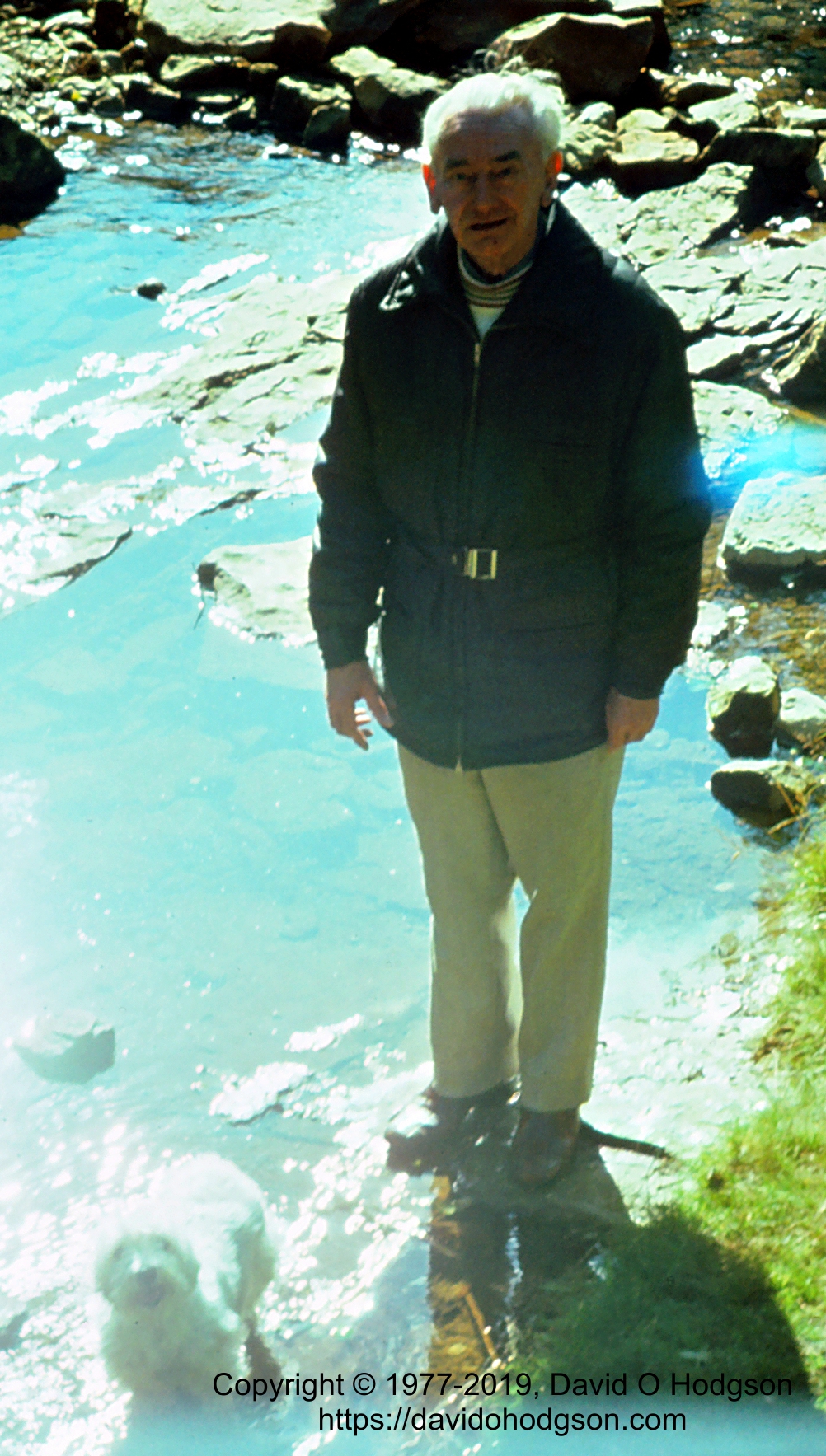
The last photo of my father is below, taken in October 1977, at May Beck on the North Yorkshire Moors. He was exploring the moors with our West Highland terrier, Meg.
At May Beck with Meg, 1977
The gift that I gave my father on what turned out to be his last birthday, in March 1979, was a book—Colour Photography: the First Hundred Years—which contains some fascinating examples of early color film technologies. Given the color photos of him that are left to me, that seems appropriate. I hope he enjoyed reading that book during the short time that he had left.





 David Hodgson Personal Blog