

Unrecognized Qualifications, Missing Expertise & Horizon

One part of my drawing of Thornton Dale Station

The drawing above, of Thorton Dale Railway Station, (reproduced much smaller than life-size here) was the most ambitious of the architectural views that I created for my Advanced-level Art project during 1977-78. I’ve also posted this drawing on a page about the subject – Thornton Dale railway station – along with several photos that I took, and sketches that I made, at the same time.

Not Part of the Syllabus

I realize that some of the illustrations that I’ve been reproducing in this blog from my Art study (such as this and this) may give the impression that architectural drawing skills were taught as an element in the A-level course. In fact, nothing could be further from the truth. My expertise in such drawing techniques derived entirely from an O-level in Geometric Drawing that I had completed at the Graham School a few years previously. During the two years of the A-level course, I don’t recall ever having been taught anything about architectural illustration!

A few years later, when I commenced my Student Apprenticeship at Ferranti, I naturally assumed that my Geometric Drawing O-level should count towards my training, but no! We were required to learn technical drawing as part of the IEE-prescribed EP1 training, but no credit was given for prior expertise in the subject.

Of course, the fact that I’d obtained an O-level in the subject did make the Ferranti training much easier to complete, so my prior qualification was useful in that sense.

My Drawing of a Bristol Lodekka Bus; produced for the A-level Study but not used

O-Level Principles of Accounting

Here is another example of a qualification that I obtained, and which was useful, but was not recognized by professional bodies. As I’ve described in another post, prior to joining Ferranti, I had worked for about 18 months as a Purchase Accounts and Sales clerk at the light engineering company Swift’s of Scarborough.

Soon after my employment commenced, my manager suggested that I might consider obtaining an Ordinary-level qualification in Accounting. It seemed as though that would help me do my job better, so I started a course at the Scarborough Technical College (now Scarborough TEC). I sat the exam and easily obtained the O-level in 1980. There was some suggestion that I should continue by taking an Advanced level qualification in the same subject, but, by that time, I had concluded that my time would better be spent studying to return to university. I already had more than sufficient O- and A-levels to qualify for university entry, so why add another one?

Part of the Certificate for my O-level in Principles of Accounts

Useful in my Job

There’s no question that what I learned from the O-level course did prove useful in the execution of my duties at Swift’s. Perhaps the most basic principle instilled into us by the course was the concept of double-entry bookkeeping; a simple idea but a powerful and necessary one. The only problem with the O-level qualification was that it was not professionally recognized in any way; had I wanted to become a Chartered Accountant, my O-level would not have been considered as a contributing qualification.

That leads to a seemingly-obvious question: Why didn’t Swifts encourage us to get recognized professional qualifications? At the time, I suspected that the cause may have been my manager’s lack of such qualifications; he had only an A-level in Accounting, and that also was not recognized professionally. Presumably, he would not have liked the idea of his subordinate becoming more qualified than he was! With the benefit of hindsight, however, I suspect that the real cause had more to do with the inherent sexism of the time and place. The underlying assumption of Swift’s management was that whoever they hired for any Accounts Clerk position would be a young woman, with a few O-levels, and perhaps a couple of A-levels. The young woman could be expected to work at Swift’s only for a few years before getting married, at which point (they assumed) she would leave employment forever to become a housewife and raise children. As such, presumably Swift’s management saw no point in expending time and money on professional training for a career that their employees would probably never have.

Of course, in a more competitive employment environment, Swift’s would probably have been forced to offer proper professional training, to attract candidates with sufficient intelligence for the job. However, the sad reality was that there were so few opportunities for intelligent young people in the Scarborough area that they didn’t need to.

Useful at University

Having left Swift’s, and embarked on my degree course in Electronics at Imperial College, London, I discovered that we were encouraged to take non-engineering courses such as Accounting & Finance, Macroeconomics, etc. Again, the fact that I’d obtained the Principles of Accounting O-level made my Imperial College studies in Accounting & Finance much easier to grasp, so the knowledge I’d gained did come in useful again, even if it was not professionally recognized. My results in the Accounting & Finance course counted towards my final degree grades.

They still don’t seem to get it

More recently, it has seemed to me that, at the very least, Ordinary-level Principles of Accounting would have been a beneficial subject for study by those who designed the Horizon software for the British Post Office!

As the forensic accountant investigating that scandalous failure reported, the software violated basic principles of double-entry bookkeeping, such that, even if the code had been well implemented (which it was not), the system was bound to fail quite quickly.

Can it be that not one of the technical contributors to the Horizon software system had even an O-level in Principles of Accounts? If so, then how could a major national institution such as the Post Office ever have believed that the resulting system would be trustworthy as a key component of their accounting systems? I don’t know the answers to those questions, but they would certainly seem to be worthy of investigation!

Yuletide “Backup” Artwork for 2017


Waxwings & Berries

Waxwings & Berries

The picture above is not the artwork for our 2017 Yuletide card, although our cards just arrived back from the printer yesterday, and I’ll be sharing the actual artwork for that as soon as we send out the cards (which I hope will be during this week).

When I began working on a painting for this year’s card, I was painfully aware that the possibilities for messing it up were rife. (In fact, that’s one major advantage of creating artwork digitally instead of via conventional methods; with digital artwork you can always hit Undo!) When working on a conventional painting, it only takes one slip of the brush, or perhaps one drop of spilled coffee, and the whole project is ruined.

Therefore, I decided to create a simpler piece of “backup artwork”, which I could use for the card if some disaster befell the main painting. Thus I created the vaguely “Charley Harper” style design shown above, using Corel Draw.

Fortunately, I didn’t mess up the main watercolor artwork, so I didn’t need to substitute this design. Nonetheless, I realized that I could easily adapt it for use as a decoration for our return address labels, so that’s what I did.

I mentioned on another page that I had decided to stop producing “Asian New Year” designs for the return address labels of our cards, because the time taken to do that detracted from the creation of the card itself. Thus, things worked out well for me this year!

Reinventing Myself: From Hardware to Software


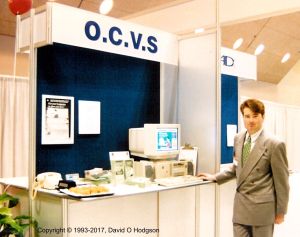
OCVS Booth, Windows Solutions Conference 1993

OCVS Booth, Windows Solutions Conference 1993

The 1993 photo above shows me effectively embarking on a new career, and not quite sure what I’d started! I was at my business’s own booth, during the first trade show where I was promoting my own product.

Of course, I’d attended, and even worked at, many trade shows prior to that, but I’d always been there as a representative of someone else’s company or organization.

Short-Sighted Employers

The series of events that led to my first attempt to develop and sell my own software provided a thought-provoking lesson in the tragic short-sightedness of many employers and businesses. Until then, I had implicitly but naively assumed that, as technology changed, my employers would “keep their eyes on the ball” and change their products (and my role in the organization) accordingly.

Far from it, in reality! Most employers seemed to think of their employees as fitting into neat, predefined boxes, and their view was that the box (and the employee within it) should stay the same for ever more. Their attitude seemed to be that, if they had once hired an oil-lamp lighter, then that person should continue to light the oil lamps for ever more, even if oil lamps had in the meantime become obsolete!

As a result of my education and industry experience, I felt that I could discern something about the way computer technology would evolve in the future, and it seemed obvious that I should attempt to evolve in the same direction. Unfortunately, as explained below, not only were my attempts to redefine my role not supported by my employer, but they even actively resisted my attempts to change!

Going with the Flow (or Trying to)

As I’ve mentioned in previous posts, my goal in obtaining an electronics degree had been to get a job working “in video”. I’d come to consider that as a desirable career as a result of one day’s teenage experience, when my friend Graham Roberts took me along with him to his shift as a Continuity Announcer for Yorkshire Television.

I really hadn’t considered electronics for any other reason. Unlike some other boys, I was not an electronics hobbyist, and I didn’t even have a “microcomputer” to tinker with.

When I started my video engineering career, the reality was that real-time digital video processing required special hardware. General-purpose computers simply weren’t even fast enough to stream video in real time, let alone modify the pixels.

However, as processing speeds increased, computers became able to handle digital video in real time. As a result, it became possible to write software to process video in ways that would previously have required specialized hardware.

I wanted to move over to some type of software development, but my employer at the time (Media Vision) seemed to be trying to restrict me to hardware development only. My manager apparently decided (without consulting me) that I should become an integrated circuit design engineer, and bought development equipment for me to do that!

Frustrated by their short-sightedness, I quit my job and started my own business, initially with the intention of producing video in some form.

(As things turned out, Media Vision collapsed quite spectacularly some time after I left, so my decision to quit seemed very smart in retrospect!)

No Video Available

Oddly enough, despite my prior programming experience, when I started my own business I did not set out to develop a software product! My initial project was to develop an instructional video, which would be distributed on standard VHS tapes.

I’d created a “treatment” for my video, but I did not myself possess video cameras and editing equipment. It seemed fortunate that a friend of mine had simultaneously started his own video editing business, so we agreed to co-operate on the production. Unfortunately, as the months went by, it seemed that he was never quite ready to begin shooting, and I reluctantly realized that I was going to have to find another way to deliver my product.

My job at Media Vision had had me designing PC hardware for the new “multimedia” technology (which basically involved adding audio and video capabilities to PCs). It struck me, therefore, that perhaps I could create some kind of “multimedia computer tutorial” as a substitute for the planned video.

I had learned to program while at college, and as I related in a previous post, even before that, I had undergone an aptitude test that indicated that I would make a good programmer. Nonetheless, the only complete programs I’d written at that point were small utilities for my own use, or that of my colleagues, when processing data as part of our hardware design jobs. I had also written “embedded” software for custom hardware, but I had never tried to create what is called a “shrink-wrap” software application. Shrink-wrap software is a standalone product that can be sold to consumers, who then install it on their own computers and expect it to run with little or no further involvement from me.

Creating a shrink-wrap software application seemed like a significant challenge, and I wasn’t sure that I could actually do it. Nonetheless, there seemed to be little alternative, so I sat down to learn a multimedia software creation tool called Asymetrix Toolbook.

My First App

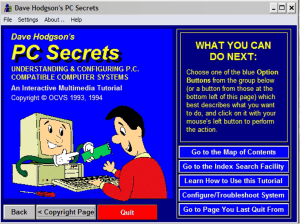
The eventual result was “Dave Hodgson’s PC Secrets”, which was a software application for Windows computers (what would now be called an “app”). The initial screen looked like this:

PC Secrets Software Title

PC Secrets Software Title

Unfortunately, sales of the product were not great, which led me to seek consulting work. Although I did accept a couple of hardware design consulting projects, it was obvious that much more work was available for software consultants.

Fortunately, I discovered that the fact that I’d just created my first software “app” qualified me for consideration as a Windows software consultant! That led to many years of work for me as a consulting software developer.

Do Anything You Want to Do, But Don’t Expect Our Support!

That was how I learned that I couldn’t rely on my employer to have my best interests at heart, nor even to be concerned about my career development. It had been clear to me that the future of video (for me, at least) lay in software, but my employer would not support my ambitions.

While I think that most self-help advice along the lines of “do what you want” is simply naïve, I did find that, in order to achieve my goals, I had to define those goals myself, then actually invest considerable time and effort of my own to achieve the results I desired.