Poem: The Ruin

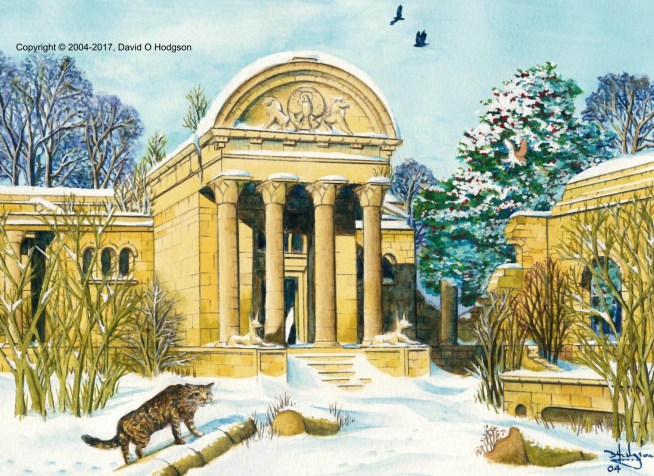
Fictitious Temple in Silchester, c.500 CE

Fictitious Temple in Silchester, c.500 CE

In previous posts, I’ve published some of my own efforts at poetry. This time, I’m publishing a poem by someone else, called “The Ruin”. However, I’m not worried about copyright infringement issues, because not only is the work very long out of copyright, but in fact nobody knows who wrote it!

My watercolor painting above, showing the ruins of a fictitious Roman temple in what’s now England, was partially inspired by the poem. However, the poem I’m discussing here is thought to refer to the city of Bath, while, for various reasons, my ruin was supposed to be in Silchester.

Before discussing the history of the poem, and some thoughts on Roman ruins in Britain, here is the poem itself in the original Old English. (In a previous post on my professional blog, I discussed some of the letters used in Old English, and which appear here.)

Of course, English has changed so much during the past thousand years that no speaker of Modern English can read this without treating it as a foreign language. Nonetheless, the original poem has a beautiful flow and structure, which can be appreciated even if you don’t understand what it actually says.

Unfortunately, the surviving manuscript of the poem is damaged, such that some of the text is either unreadable or missing. In the rendering below, the ellipses show where text is illegible. The punctuation is modern.

The Ruin (Old English)

Wrætlic is þes wealstan, wyrde gebræcon;

burgstede burston, brosnað enta geweorc.

Hrofas sind gehrorene, hreorge torras,

hrungeat berofen, hrim on lime,


scearde scurbeorge scorene, gedrorene,

ældo undereotone. Eorðgrap hafað

waldend wyrhtan forweorone, geleorene,

heardgripe hrusan, oþ hund cnea

werþeoda gewitan. Oft þæs wag gebad


ræghar ond readfah rice æfter oþrum,

ofstonden under stormum; steap geap gedreas.

Wonað giet se …num geheapen,

fel on …

grimme gegrunden …


scan heo…

…g orþonc ærsceaft

…g lamrindum beag

mod mo… …yne swiftne gebrægd

hwætred in hringas, hygerof gebond


weallwalan wirum wundrum togædre.

Beorht wæron burgræced, burnsele monige,

heah horngestreon, heresweg micel,

meodoheall monig mondreama full,

oþþæt þæt onwende wyrd seo swiþe.


Crungon walo wide, cwoman woldagas,

swylt eall fornom secgrofra wera;

wurdon hyra wigsteal westen staþolas,

brosnade burgsteall. Betend crungon

hergas to hrusan. Forþon þas hofu dreorgiað,


ond þæs teaforgeapa tigelum sceadeð

hrostbeages hrof. Hryre wong gecrong

gebrocen to beorgum, þær iu beorn monig

glædmod ond goldbeorht gleoma gefrætwed,

wlonc ond wingal wighyrstum scan;


seah on sinc, on sylfor, on searogimmas,

on ead, on æht, on eorcanstan,

on þas beorhtan burg bradan rices.

Stanhofu stodan, stream hate wearp

widan wylme; weal eall befeng


beorhtan bosme, þær þa baþu wæron,

hat on hreþre. þæt wæs hyðelic.

Leton þonne geotan …

ofer harne stan hate streamas

un…


…þþæt hringmere hate

…þær þa baþu wæron.

þonne is …

…re; þæt is cynelic þing,

huse… burg…

The Waters of Sul

As I mentioned above, it is frequently suggested that the poem describes the remains of the City of Aquae Sulis (“the Waters of Sul”) — the modern City of Bathbut that’s simply an educated guess. The manuscript provides no helpful footnotes nor explanatory detail, so the actual subject of the poem will probably never be known for sure.

Aquae Sulis probably succumbed to a similar fate to that of other conurbations, falling into disrepair some time soon after the empire’s legions were withdrawn from Britannia in 410 CE. After the Roman engineers departed, their Anglo-Saxon replacements were either unable or unwilling to maintain the complex stone buildings, and so either left them to disintegrate, or else removed the materials for other uses. Very little is known regarding the process of this decay, during the period called (for that very reason) the “Dark Ages”, so the existence of this poem offers a rare insight into the conditions of that time.

The Exeter Book

The book containing the only surviving manuscript of the poem is so-called, not because it was written in or about the City of Exeter, but because it forms part of the collection of Exeter Cathedral. The book consists of a sequence of unrelated literary works, including everything from epic poetry to risqué riddles. Its contents appear to have been copied out, by a single scribe, in about 975 CE, although most, if not all, the works contained in the book seem to have been created at earlier dates.

It is known that the book was owned by Bishop Leofric of Exeter until 1070, when he donated it to the cathedral’s library. However, there’s no evidence that the book was held in particularly high regard. Indeed, there is evidence that its front cover was used, at various times, as a cutting board and a beer mat! Some folios are missing, and the fourteen surviving pages nearest to the back have been burned.

The folio containing the poem itself is damaged, which has rendered portions of the middle and end of the poem illegible. Nonetheless, the remaining text provides an extraordinary description of the awe in which the Anglo-Saxon community must have held the crumbling remains of the Roman cities around them.

The Structure of the Poem

The poem exhibits characteristics typical of Old English verse, which distinguish such works from later poetry.

Perhaps the most obvious feature is the caesura in the center of each line (marked by commas or periods above), which imposes a syntactical structure leading to the enjambment of many of the lines.

Another typical feature is the lack of the use of rhyme, which is ironic when one considers that, due to its inflected nature, it was much easier to find rhyming pairs in Old English than in its modern equivalent.

Conversely, very heavy use was made of alliteration (e.g., “weallwalan wīrum” for “iron bonds”), although it is almost impossible to retain this feature in any modern translation.

It’s a real stroke of luck that this remarkable example of historic literary description has survived for us to read, although it makes you wonder how much similarly wonderful literature must have been lost.

Modern English Translation

Although there are no copyright concerns regarding the original Old English version of the poem, most modern translations of it are, of course, subject to copyright restrictions. However, the Wikipedia article about the poem offers one translation:

https://en.wikipedia.org/wiki/The_Ruin

Stumbling on Silchester

At the time that I first learned about this poem, I was living in Andover, UK, and commuted to my job in Wokingham, about 40 miles away. I took several circuitous rural routes between the two locations, depending on traffic and weather conditions. One such route took me past what is now a tiny hamlet called Silchester.

Unlike Bath, Silchester was never repopulated as a city after the post-Roman abandonment. At Silchester, the only remains above ground are portions of the huge city walls, which now surround an empty field. I plan to say more about Silchester in future posts.

Dinky Cars & Modern Architecture

Playing with Dinky and Corgi Cars, 1963

Playing with Dinky and Corgi Cars, 1963

The photo above shows me (on the left), at about the age of 3, playing with model cars in my grandparents’ living room. My mother’s parents lived with us in the same house, so this kind of scene was an everyday occurrence.

The others in the photo are my grandmother (my mother’s mother) and my younger brother.

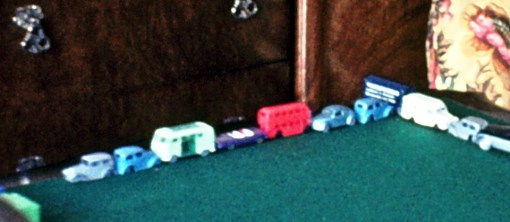
If you look very closely in the photo, you can see some small grey and blue cars lined up, as shown in the rather fuzzy close-up below.

A lineup of Ancient Dinkys

A lineup of Ancient Dinkys

Those cars are in fact Dinky Toys (the Dinky 35a “Saloon Car”), although they’re much smaller than the models that most people think of as being typical Dinkys. That model, produced in the British “OO” railway scale, was produced from 1936-40, and then again from 1946-48. The models I’m playing with were produced post-war. Examples of this model, in good condition, typically sell on eBay now for $50 or more each!

The reason that I came to be playing with Dinky toys that were much older than me was because they actually belonged to my grandfather, who literally had a bag full of them.

Draughting Years

In a post on my professional blog, I mentioned that my grandfather, Allen E Martin, worked for most of his career as a draughtsman for the City of Leeds. The October 1960 photo below shows him (on the right) in our back garden, with my grandmother holding me.

My Grandparents with me, October 1960

My Grandparents with me, October 1960

As part of his work, he produced technical drawings for architectural projects, and the department sometimes created models of proposed new buildings. They used toy cars to decorate these models, and my grandfather apparently took his “bag of Dinkys” home with him when he retired in the 1950s.

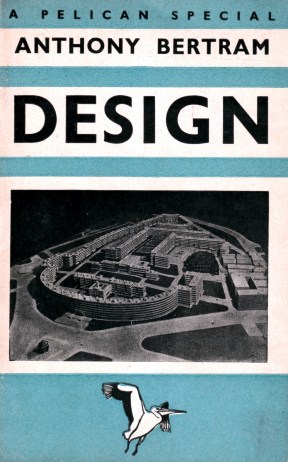
Perhaps the most prominent architectural project in Leeds during the 1930s was the Quarry Hill development. This was so famous, and so well-regarded, that it featured on the cover of the 1938 Penguin book Design, as shown in a scan from my copy below.

Design, by Anthony Bertram, Penguin 1938

Design, by Anthony Bertram, Penguin 1938

My grandfather died in 1967, so I never got to ask him exactly what role he played in the Quarry Hill project, but it would certainly have been a major part of his department’s work at that time.

Unfortunately, despite the best intentions of its builders, and despite being a vast improvement on the slum dwellings that it replaced, Quarry Hill was not a success in the long term, and was eventually demolished in 1978. Some of its problems stemmed from the fact that the development was a very advanced design by the standards of the time. Had the complex survived for a few more decades, it may well have undergone a major refurbishment similar to that at St Pancras Station, and would still be with us as a major landmark.

[Update 9/21/17: see this article for details of the latest redevelopment plans for the Quarry Hill area of Leeds.]

The City of Leeds Arms

Incidentally, the arms of the City of Leeds feature rather unusual supporters, as shown below.

Leeds City Arms

Leeds City Arms

In a future post I’ll discuss the significance of those owls, and how, even though I never lived in Leeds, they seem to have become a recurring theme in my life.

Sunsets & Air Pollution


Sunset from Oliver's Mount, Scarborough, July 1977

Sunset from Oliver’s Mount, Scarborough, July 1977

I took the sunset photograph above from the summit of Oliver’s Mount, Scarborough, at 8.45pm on Saturday, 16th July 1977. I know those details because they happen to be in a notebook that I still have. The image now forms the header for my professional blog.

The photograph has an unusual “oil painting like” appearance, with muted and brownish tones. This has led some to suggest that perhaps I “photoshopped” the original image to achieve that effect. That’s not the case; this is a scan of the color transparency exactly as it came out of the camera. As I’ll explain below, I believe that some of the extraordinary weather effects that I photographed in those days were actually caused by air pollution.

Wine Country Sunsets

I was prompted to think once again about my old sunset photographs by last night’s sunset here in Santa Rosa. We had had a very hot day, but there was a breeze, and sufficient clouds around to provide some spectacular effects at sunset, as shown below.

Sunset Clouds, Santa Rosa, June 2017

Sunset Clouds, Santa Rosa, June 2017

While nobody would dispute the claim that California’s weather is generally pleasanter than Britain’s, one problem with that is the lack of visual weather effects in California. As someone once put it, “We don’t have weather in California”.

I suspect also that another problem is that the air in California now is much cleaner than it was in Britain in the 1970s, and dirty air makes for spectacular sunsets! The fact that I was able to photograph so many interesting sunsets from Oliver’s Mount was thanks to a combination of Britain’s weather and the mount’s location.

Pilgrimages to Oliver’s Mount

Oliver’s Mount is so called because of a legend that, during the English Civil War in the 1640s, Oliver Cromwell situated cannon on the mount to bombard Scarborough Castle, which was in Royalist hands. This seems highly unlikely, because the cannon of the time did not have sufficient range to fire over such distances, and were far too inaccurate to have hit the castle with any certainty. In any case, there’s no evidence that Cromwell ever visited Scarborough during the Civil War.

When we lived in West Street, Scarborough, during the 1970s, Oliver’s Mount was only about a mile from our house. Although there’s a road to the top of the mount, I discovered that I could reach the summit much more quickly by climbing up directly through the woodland on the hillside. As a result, I visited the war memorial on the summit quite regularly, particularly during the summer. Any air pollution outdoors was definitely healthier than the level indoors, created by my chain-smoking father!

The view to the North-East from the top of the mount looks over Scarborough’s South Bay and Castle headland, and my father and I both photographed that view several times over the years. The image below shows the lights having just come on at sunset, in August 1977.

Scarborough Sunset, August 1977

Scarborough Sunset from Oliver’s Mount, August 1977

The view westwards from the same spot looked inland, towards the Pennines, and the conurbations of West Yorkshire and Manchester. The air in those industrial areas was of poor quality at the time, with much coal burning still occurring, and many chemical works still belching out their waste. I suspect that the low sun shining through all that dirty air was what created some of the spectacular refraction effects that I saw during those sunsets some 40 years ago.

I’ll be exhibiting some of the other “Oliver’s Mount Sunset” photos in future blog posts.

London Terror Attack: Don’t Surrender our Freedoms

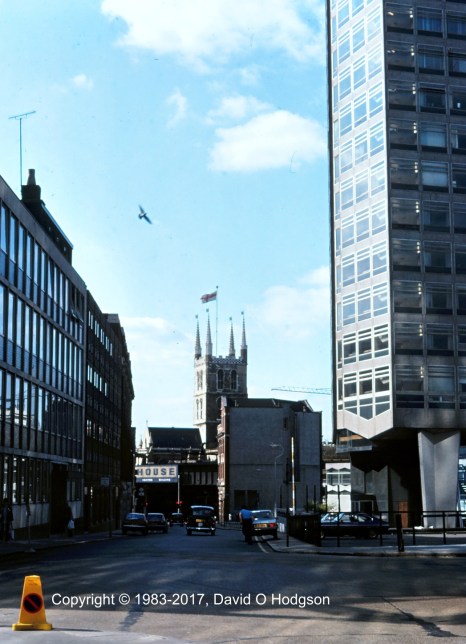
London Bridge Station & Southwark Cathedral, 1983

London Bridge Station & Southwark Cathedral, 1983

I was very saddened to hear the news yesterday of the latest pointless terror attack in London. Naturally, my best wishes and thoughts go out to all those affected by the incident.

This latest incident reminded me of the ever-present terrorist threat that existed when I lived in London during the 1980s. In those days, almost all the threats (real or hoax) came from the IRA, and there were several actual bombings in London while I was there.

As a result of living in London for a few years, I was forced to think about the delicate balance of opportunities and dangers presented by living in a free society.

Bag Searches

In response to the IRA bombings, every building in London that admitted the public adopted a policy of searching the bags of visitors entering the premises. This naturally included the museums near Imperial College on Exhibition Road, such as the Victoria & Albert Museum. Nonetheless, it seemed clear to me that there was really nothing that could be done to prevent all such threats, and that it was inevitable that some attacks would succeed.

I became quite accustomed to the bag searches when going into a building, but, on one occasion, the guard searching my bag admitted that these efforts wouldn’t really deter a serious threat. He said to me, “This is really just to reassure the public. You could put a bomb in a cigarette packet and walk in with it in your pocket, and we’d never spot it.” Sad but true.

While I was a student, I also worked as a Sales Assistant at Selfridges Store in Oxford Street, London. In that job, bomb threats were a daily nuisance, although, while I was there, all of them fortunately turned out to be hoaxes.

The point I want to make here is that, during all the years that I lived in London, I was never personally involved in an actual attack of any kind. The press coverage naturally given to such events makes it seem that they are more widespread than they really are. The attacks of the IRA were a real danger and a constant worry during those years, but they failed in their aims, and they never prevented Londoners from going about their lives.

Unfortunately, it suits the purposes of some politicians to exploit this kind of event to whip up fears and con the public into signing away their own freedoms. We’ve just seen a particularly transparent attempt to do that, with the irrelevant and unhelpful tweeting of Tweedle Don, trying to link the London atrocity in the UK to his unconstitutional travel ban in the US.

Don’t be Intimidated into Surrendering our Freedom!

Given the possibilities for committing terrorist attacks in large conurbations such as London, it’s actually a relief that so few actually succeed. I realize that this is no consolation for those whose lives are affected by these atrocities, but, for the remainder of the population, it’s important not to blow these events out of proportion.

The only way to guarantee that such attacks could not happen would be to implement a surveillance police state, which would entail giving up many of our existing freedoms. However, most of us value our freedom, and wouldn’t want to live in such a state. The price of living in a free society is the risk that a few such horrific events will occur.

Of course, that realization makes it no less shocking when these things do happen.

Days of Coal and Flowers


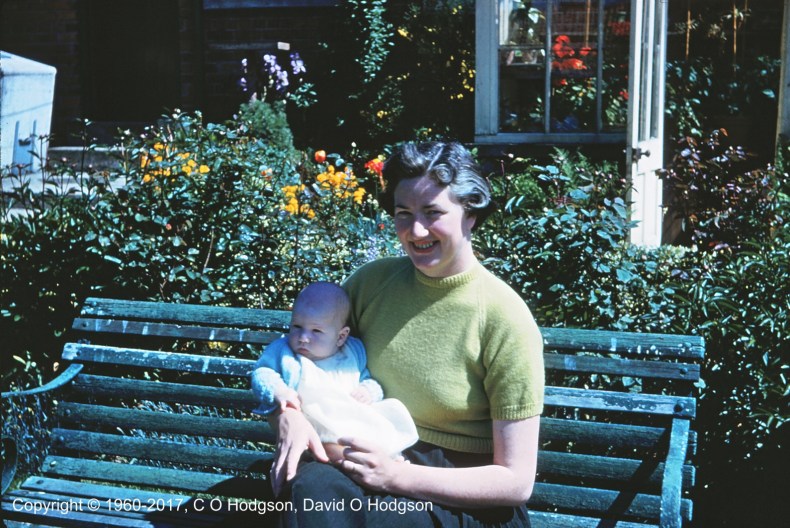
My Mother and Me, June 1960

My Mother with me, June 1960

Today is June 1st, so the photograph above seems like an appropriate flashback selection. This is probably one of the earliest surviving photographs of me, in the arms of my mother, in June 1960.

My mother is sitting on an ancient bench in the back garden of our house in Scalby Road, Scarborough. Behind her is part of our large and verdant garden, on which my father lavished tremendous amounts of time and effort. In the greenhouse that’s visible in the picture, he grew geraniums and tomatoes.

My memories of that garden led me to want something similar of my own when I grew up, and I pushed for that, until I actually got one, and realized just how much work it is! Nowadays, although I still appreciate gardens, I must admit that Mary does much more work in the garden than I do!

All Our Bunkers

Also visible at the far left of the picture above is our coke bunker. In those days, we had both coal fires and coke furnaces in the house, so we had regular deliveries of both. There were large coal bunkers in a yard at the side of the house, but my parents added this extra bunker for coke at the back.

The problem was that it was important not to mix up coal and coke, because one would not burn properly in fires designed for the other. Having the coke bunker in a completely separate location reduced the risk that the delivery person would make a mistake.

During the 1960s, Airfix made a scale model kit of a bungalow that included a coal bunker of this design, among other period features such as a VHF television antenna! The same model is still available now, from Dapol.

With the arrival of North Sea Gas later in the 1960s, my parents took the opportunity to replace all our coal fires with gas, which made life much simpler and cleaner for us. Nonetheless, we still had a coke-burning furnace in the kitchen, which also supplied all our hot water. I can remember my father cleaning out the ashes onto a newspaper every night, then bringing in a scuttle of coke, ready to relight the furnace the following morning.

The Calm before the Storm

The photo above depicts an idyllic moment, perhaps giving the false impression that all was perfect in our lives. In reality, storm clouds were already gathering for our family.

My father had his first stroke within two years of my birth, which meant that he was never again able to maintain the garden to his own high standards.

Concerns about the family’s future income led us to move out of that house in 1970, when my parents bought a guest house on the other side of town (the exterior of which is shown in this article).

The photo below, taken thirteen years later in June 1973, in the much more modest back garden of the guest house, shows (from left to right) my mother, our West Highland terrier Meg, my brother, and me.

Tea in the Garden, West Street, Scarborough, June 1973

Tea in the Garden, West Street, Scarborough, June 1973

Santa Rosa: Shadow of a Courthouse

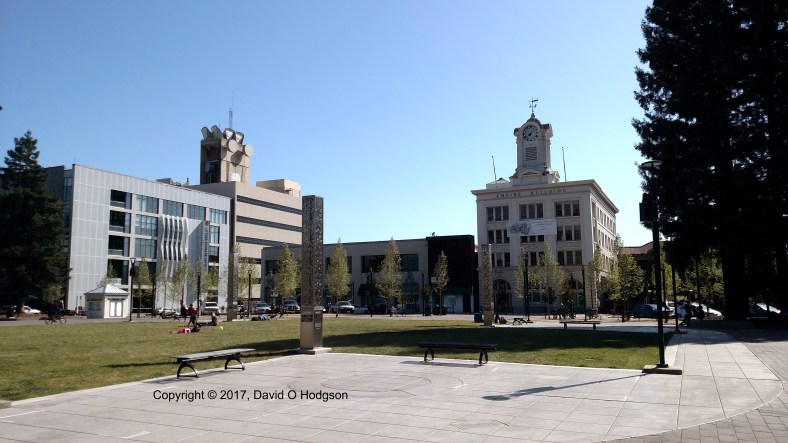
The Reunified Old Courthouse Square, Santa Rosa

The Reunified Old Courthouse Square, Santa Rosa

Yesterday, I was in downtown Santa Rosa, and visited Old Courthouse Square, for the first time since the completion of its “reunification”. Despite controversy over the cost of the project, the result seems to have been successful, as shown above. The new space seems much more open and welcoming than the previous divided “parks”, and more effectively isolates pedestrians and other park users from the traffic. Santa Rosa has had an unfortunate history of short-sighted town planning decisions, so let’s hope that this turns out to be one of the better ones.

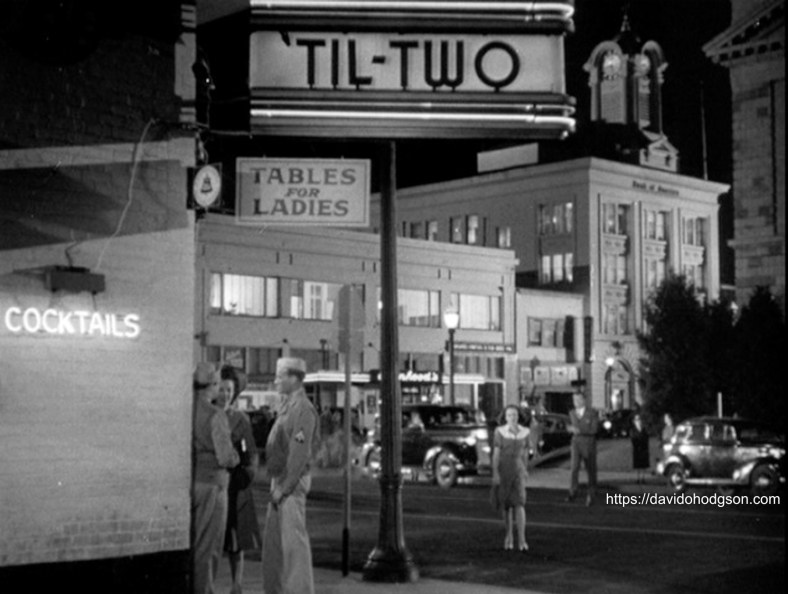
This part of Santa Rosa is perhaps most famous for having featured prominently in Alfred Hitchcock’s 1943 movie Shadow of a Doubt. Thanks to its restricted wartime budget, the movie made extensive use of real locations in Santa Rosa instead of studio sets. The result is a unique glimpse into day-to-day life in the city all that time ago.

The still below from the movie shows the exterior of the Til Two Bar, which would have been on the far left in my photo above.

Shadow of a Doubt: The Til-Two Bar

Shadow of a Doubt: The Til-Two Bar

In the background of the movie still, you can see the Empire Building (then known as the Bank of America Building), which exists today and is prominent in my photo.

The central courthouse building that appeared in the movie was demolished during the 1960s, but in my heading photo above, the cruciform area of grass marks the plan of its predecessor, the original City courthouse, which collapsed in the 1906 earthquake. After the replacement courthouse was demolished, the square was split by a road driven through to connect Sonoma Avenue to Mendocino Avenue, but which turned out not to have been a wise decision.

My next photo, below, shows a close-up of one of the monuments that have just been placed around the grassed area in the square. They look great at the moment, but I wonder how well they will withstand the weather and the vandals?

Luther Burbank Monument, Old Courthouse Square, Santa Rosa

Luther Burbank Monument, Old Courthouse Square, Santa Rosa

From the north side of the square, looking down Mendocino Avenue, the Rosenberg Building is still prominent, as shown below. This used to be the location of Santa Rosa’s Woolworths store, and is still a retail location now.

OldCourthouseSq3-20170527

The Rosenberg Building, Mendocino Avenue, Santa Rosa

Finally, wandering a bit farther down Fourth Street, the former Rosenberg’s Department Store is occupied by Barnes & Noble, as shown below. Santa Rosa made another bad town planning decision when they approved the building’s demolition in 1994, but, fortunately, instead of demolishing it, the bookseller did an amazing job of restoring this Streamline Moderne (Art Deco) building.

OldCourthouseSq4-20170527

Rosenberg’s Department Store, now Barnes & Noble, Santa Rosa

P.S. June 7th: this new article in the Bohemian provides more details of the square.

Fishbourne Palace: Roman Mosaics & Matrices

Fishbourne Palace Floors, Sussex, UK

Fishbourne Palace Mosaic Floors, Sussex, UK

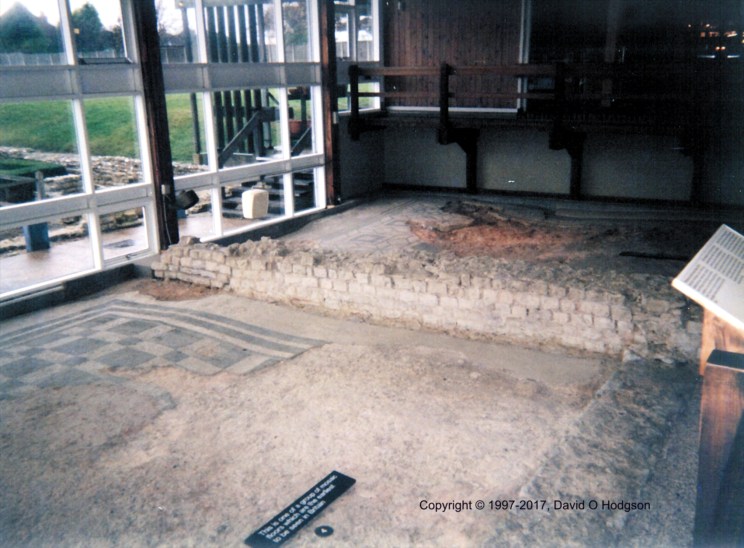
Since ceasing to live in the UK in 1987, I have returned many times for visits. On one occasion in 1997, I visited the amazing Roman remains at Fishbourne Palace, near Chichester. This is the largest known Roman residence north of the Alps.

There’s nothing left of this vast palace above ground, and in fact, until work began on a planned housing estate in 1960, nobody knew that it was there at all. Under the surface, however, excavations revealed large numbers of mosaic floors in various states of preservation. The photo above shows some of the mosaics and remaining foundations, which are now housed within a museum that was built over them. Outside the museum, part of the palace’s Roman garden has been recreated.

Cupid on a Dolphin Mosaic, Fishbourne Palace

Cupid on a Dolphin Mosaic, Fishbourne Palace

The photo above shows the famous “Cupid on a Dolphin” mosaic at Fishbourne Palace. By an incredible stroke of luck, the mosaic is perfectly preserved, except for some subsidence of the ground underneath, as is visible above.

Much later, in 2012, I visited another Roman site, Verulamium, near the modern city of St. Albans. This site also features impressive mosaics, and even some surviving decorated plaster walls.

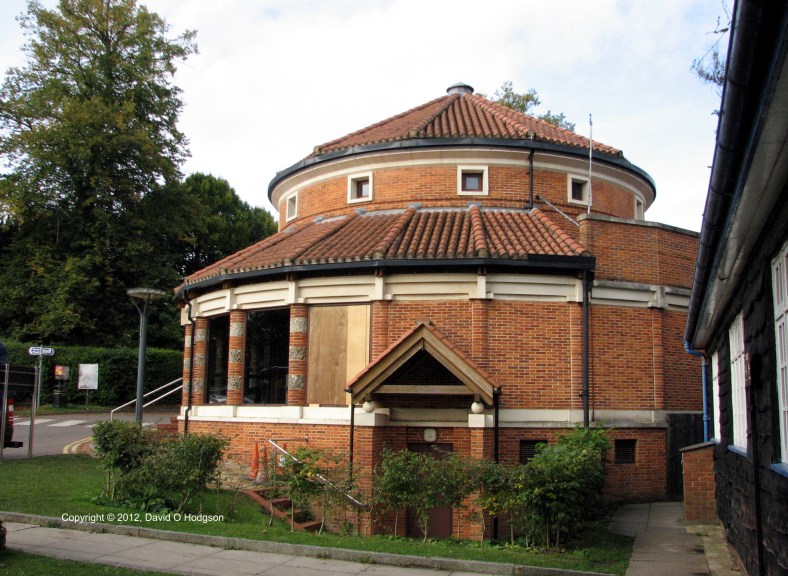
For various reasons, Britain has relatively few surviving Roman structures above ground, but the Verulamium Museum, shown below, is an impressive modern building based on Roman designs.

Verulamium Museum

Verulamium Museum

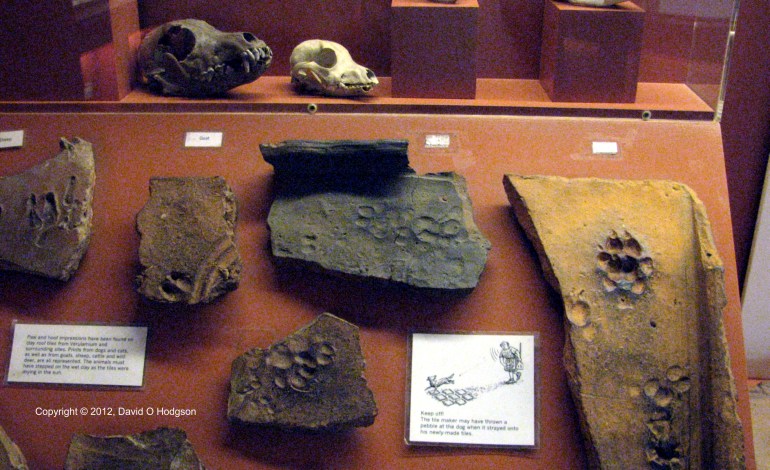
Inside the Verulamium Museum are a wide variety of artefacts discovered during the excavation of the city, including several building tiles that contain paw prints from cats and other animals that walked across them around 2000 years ago.

Animal Paw Prints on Roman Tiles, Verulamium

Animal Paw Prints on Roman Tiles, Verulamium

A cat paw print was also found on a Roman roof tile in Gloucestershire a couple of years ago, as described here.

During my visit to Verulamium, I bought a small but interesting book called Geometric Patterns from Roman Mosaics.

I’ve referred to this little book from time to time since then, whenever I’ve needed some explanation of the construction of Roman mosaics. It only struck me recently, however, that (as described in the book) most Roman mosaics are laid out in a rectangular matrix.

Over on my professional blog, I’ve written several articles about Bitmap Graphics, which are themselves based on rectangular matrices.

It really is an astonishing connection between ancient art and modern technology!

Tragedy in Manchester

Piccadilly Square, Manchester, Summer 1981

Piccadilly Gardens, Manchester, Summer 1981

I heard the tragic news about the bombing in Manchester this evening. Unfortunately, it was far from being the first terror attack in Manchester.

I lived in Manchester during the Summers of 1981-83, during my apprenticeship at Ferranti. At the time, I had mixed feelings, both about the place and the apprenticeship, but now I look back on it as an interesting if challenging part of my life.

Fortunately, there were no terrorist attacks in Manchester while I lived there, but there were other forms of severe violence. For example, in July 1981, there were major riots in parts of the city, and I almost found myself dragged into a follow-up disturbance one Saturday in Piccadilly Gardens.

During 1996, long after I’d left Manchester and Britain, there was an IRA bomb attack at the Arndale Centre, which housed a bus station that I’d used regularly when traveling between my digs in Middleton and the City Centre.

My thoughts and best wishes go out to those affected by the bombing in Manchester today.

And There’s Always the Rain…

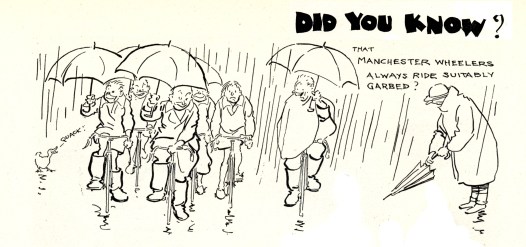
On a much lighter note, Britain is a damp country, but Manchester has a reputation (apparently undeserved) for the being the wettest place in Britain, and there are many tales about that. Here’s a 1938 cartoon by the talented line artist and cycling enthusiast, Frank Patterson.

Frank Patterson: Manchester Wheelers

Frank Patterson: Manchester Wheelers


Sketching the Great Comedian

The Great Comedian, 1986

The Great Comedian, 1986

Back in the days when I used public transport to get to work, I found myself with a substantial amount of “down time”, spent waiting for transport or traveling on transport. I wanted to do something useful with that time, so, one summer, I decided to try to teach myself Classical Greek.

I had learned French (which was mandatory) and German (optional) at high school, but Greek wasn’t even offered at my school. I was inspired to try to learn the language by having read some of the surviving works of classical authors (in English). Unfortunately, many people seem to assume that all those works are heavy tomes of philosophy, or else harrowing tragedies, because that is frequently the false impression given in pop culture. In fact the range of surviving work is much greater.

They Really Are Old Jokes

I was most impressed by the surviving comedies of Aristophanes, who wrote his plays at around the time of the fall of Athens. Naturally, the theme of many of his plays involves the Peloponnesian War, and possible ways to bring it to an honorable end. Nonetheless, many aspects of his plays seem astonishingly modern, and even include the first recorded instances of what would now elicit groans as “old jokes”.

Isn’t it a Whimsical Francis?

Living in Britain in those days, the plays of Aristophanes naturally reminded me of the recent bawdy television comedy series, Up Pompeii, starring Frankie Howerd.

The basic premise of Up Pompeii, that of a cheeky Roman slave who managed the intrigues of his masters, had been inspired by an earlier stage play (which was later made into a movie), A Funny Thing Happened on the Way to the Forum. That play in its turn was derived from the Roman plays of Plautus.

My knowledge of Classical Greek never quite rose to the level of being able to read Aristophanes in the original, but it did inspire me to draw a sketch that was intended for eventual reworking as a painting. The sketch was titled “The Great Comedian”, and was supposed to depict an author whose appearance was inspired by (but deliberately not the same as) Frankie Howerd. I’m also aware that my drawing does not accurately depict an Ancient Greek man, since, for example, all adult males wore beards. A man who did not have a beard would have been thought of as very effeminate.

Learning Sketches

When trying to draw someone with a particular appearance, I find it helpful to do some initial sketches to “get a feel” for the anatomical structure of the person. This is a motor skill, and as such is an intuitive process, which I cannot explain in process terms, any more than you can explain the steps to learning how to catch a ball.

For “The Great Comedian”, I drew some sketches of Frankie Howerd. The drawing below shows him performing in the stage version of “A Funny Thing Happened on the Way to the Forum”.

Frankie Howerd in a Funny Thing Happened on the Way to the Forum

Frankie Howerd in a Funny Thing Happened on the Way to the Forum

On Show at the IEE

The pencil sketch of the Great Comedian, and his female partner, was as far as my project ever got. Nonetheless, my drawings were exhibited at an Art Show at a very unusual location: the Institution of Electrical Engineers (IEE), Savoy Place, London, in 1986. I was a member of the IEE at the time, but, having viewed the exhibits at the show, I was left with the feeling that they expected that the exhibits would be created by the spouses of their engineers. The notion that an engineer might himself be capable of producing competent artwork seemed never to have been considered a possibility.

Legacy of Greek

A hundred years ago or more, most British schoolboys were forced to learn Latin and Ancient Greek. (Most British girls at that time simply didn’t get any education beyond the age of twelve!) The “classics”, as they were called, were later pushed aside for subjects that were considered more modern and with more practical applications.

Personally, I felt that, even though I never became fluent in Classical Greek, learning it was a worthwhile endeavor. I learned the Greek alphabet, and came to appreciate not only the complexities of that ancient language, but also the amount that it has contributed to modern Western culture.

No Religion Please

I mentioned in a previous post that I’d had a “bellyful” of religious fairy tales from a Church of England school during my childhood, so the fact that the New Testament is written in a demotic form of Greek called koine was not a motivation for me to learn the language. Nonetheless, my knowledge of the language came in unexpectedly handy later on, when a Christian proselytizer falsely tried to claim that something in the Bible had been “mistranslated”. To his dismay, I was able to bring out a copy of the book in the original Greek, and demonstrate to him that he was either ignorant or lying!

Short Sunderland at the Tower of London

Short Sunderland at the Tower of London, 1983

Short Sunderland at the Tower of London, 1983

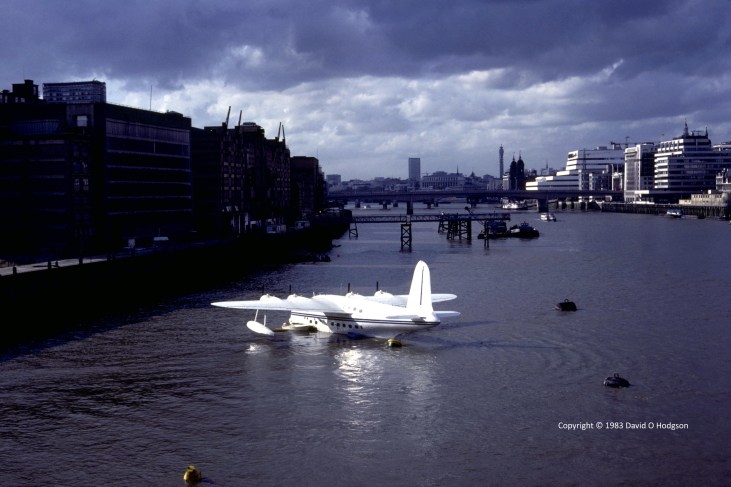
One Sunday afternoon in 1983, I was strolling over Tower Bridge in London, when I happened to look down at the Thames. There, moored in the Pool of London, was a vintage Short Sunderland flying boat. The photo above shows the scene from the South Bank (after I’d walked around from Tower Bridge), with the Tower of London in the background.

I learned later that this aircraft, registered G-BJHS, was the last flying Sunderland. It originally carried the military serial ML814, and served with the Canadian and New Zealand air forces before being civilianized. It now resides at Fantasy of Flight in Florida, but hasn’t flown since 1996.

Incidentally, the “Imperial Airways” markings on the aircraft, visible above, were fictitious and were probably applied for movie work. Imperial Airways was in fact defunct before the Sunderland entered service.

The photo below shows the first view I saw of the aircraft, from Tower Bridge. The same Google Streetview today is almost unrecognizable; the only common features seem to be the River Thames and the Tower of London!

Short Sunderland from Tower  Bridge, London, 1983

Short Sunderland from Tower Bridge, London, 1983

In the background you can clearly see the British Telecom Tower, and, in front of it, the blackened twin towers of Cannon Street Station. The top of the dome of St. Paul’s Cathedral is just visible behind the office blocks on the far right.

This aircraft was already quite the globetrekker that I some day hoped to be, but, back in 1983, my immediate travel ambitions stretched no further than London. The idea that I would soon leave all this behind, and would look back on living in London as a mere stepping-stone to greater things, would probably have been incomprehensible to me.