Reinventing Myself: From Hardware to Software


OCVS Booth, Windows Solutions Conference 1993

OCVS Booth, Windows Solutions Conference 1993

The 1993 photo above shows me effectively embarking on a new career, and not quite sure what I’d started! I was at my business’s own booth, during the first trade show where I was promoting my own product.

Of course, I’d attended, and even worked at, many trade shows prior to that, but I’d always been there as a representative of someone else’s company or organization.

Short-Sighted Employers

The series of events that led to my first attempt to develop and sell my own software provided a thought-provoking lesson in the tragic short-sightedness of many employers and businesses. Until then, I had implicitly but naively assumed that, as technology changed, my employers would “keep their eyes on the ball” and change their products (and my role in the organization) accordingly.

Far from it, in reality! Most employers seemed to think of their employees as fitting into neat, predefined boxes, and their view was that the box (and the employee within it) should stay the same for ever more. Their attitude seemed to be that, if they had once hired an oil-lamp lighter, then that person should continue to light the oil lamps for ever more, even if oil lamps had in the meantime become obsolete!

As a result of my education and industry experience, I felt that I could discern something about the way computer technology would evolve in the future, and it seemed obvious that I should attempt to evolve in the same direction. Unfortunately, as explained below, not only were my attempts to redefine my role not supported by my employer, but they even actively resisted my attempts to change!

Going with the Flow (or Trying to)

As I’ve mentioned in previous posts, my goal in obtaining an electronics degree had been to get a job working “in video”. I’d come to consider that as a desirable career as a result of one day’s teenage experience, when my friend Graham Roberts took me along with him to his shift as a Continuity Announcer for Yorkshire Television.

I really hadn’t considered electronics for any other reason. Unlike some other boys, I was not an electronics hobbyist, and I didn’t even have a “microcomputer” to tinker with.

When I started my video engineering career, the reality was that real-time digital video processing required special hardware. General-purpose computers simply weren’t even fast enough to stream video in real time, let alone modify the pixels.

However, as processing speeds increased, computers became able to handle digital video in real time. As a result, it became possible to write software to process video in ways that would previously have required specialized hardware.

I wanted to move over to some type of software development, but my employer at the time (Media Vision) seemed to be trying to restrict me to hardware development only. My manager apparently decided (without consulting me) that I should become an integrated circuit design engineer, and bought development equipment for me to do that!

Frustrated by their short-sightedness, I quit my job and started my own business, initially with the intention of producing video in some form.

(As things turned out, Media Vision collapsed quite spectacularly some time after I left, so my decision to quit seemed very smart in retrospect!)

No Video Available

Oddly enough, despite my prior programming experience, when I started my own business I did not set out to develop a software product! My initial project was to develop an instructional video, which would be distributed on standard VHS tapes.

I’d created a “treatment” for my video, but I did not myself possess video cameras and editing equipment. It seemed fortunate that a friend of mine had simultaneously started his own video editing business, so we agreed to co-operate on the production. Unfortunately, as the months went by, it seemed that he was never quite ready to begin shooting, and I reluctantly realized that I was going to have to find another way to deliver my product.

My job at Media Vision had had me designing PC hardware for the new “multimedia” technology (which basically involved adding audio and video capabilities to PCs). It struck me, therefore, that perhaps I could create some kind of “multimedia computer tutorial” as a substitute for the planned video.

I had learned to program while at college, and as I related in a previous post, even before that, I had undergone an aptitude test that indicated that I would make a good programmer. Nonetheless, the only complete programs I’d written at that point were small utilities for my own use, or that of my colleagues, when processing data as part of our hardware design jobs. I had also written “embedded” software for custom hardware, but I had never tried to create what is called a “shrink-wrap” software application. Shrink-wrap software is a standalone product that can be sold to consumers, who then install it on their own computers and expect it to run with little or no further involvement from me.

Creating a shrink-wrap software application seemed like a significant challenge, and I wasn’t sure that I could actually do it. Nonetheless, there seemed to be little alternative, so I sat down to learn a multimedia software creation tool called Asymetrix Toolbook.

My First App

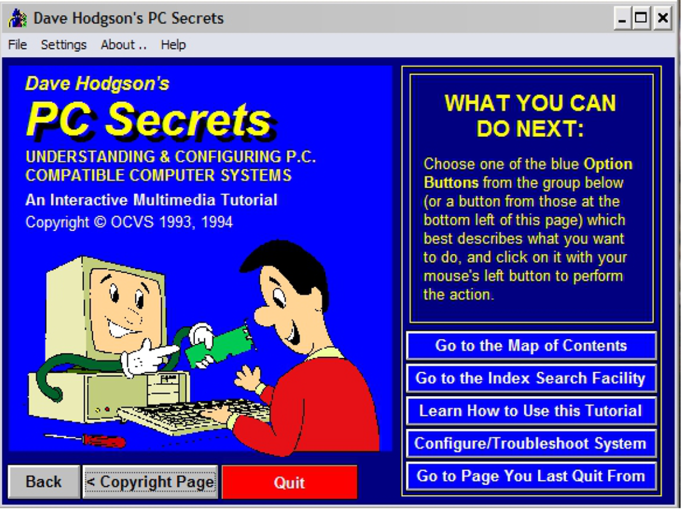
The eventual result was “Dave Hodgson’s PC Secrets”, which was a software application for Windows computers (what would now be called an “app”). The initial screen looked like this:

PC Secrets Software Title

PC Secrets Software Title

Unfortunately, sales of the product were not great, which led me to seek consulting work. Although I did accept a couple of hardware design consulting projects, it was obvious that much more work was available for software consultants.

Fortunately, I discovered that the fact that I’d just created my first software “app” qualified me for consideration as a Windows software consultant! That led to many years of work for me as a consulting software developer.

Do Anything You Want to Do, But Don’t Expect Our Support!

That was how I learned that I couldn’t rely on my employer to have my best interests at heart, nor even to be concerned about my career development. It had been clear to me that the future of video (for me, at least) lay in software, but my employer would not support my ambitions.

While I think that most self-help advice along the lines of “do what you want” is simply naïve, I did find that, in order to achieve my goals, I had to define those goals myself, then actually invest considerable time and effort of my own to achieve the results I desired.

The Truth About US Visas (In My Experience)


H1 Visa Passport Stamp

H-1 Visa Passport Stamp

Today’s “flashback” relates to my early experiences in the USA. The image above shows my H-1 visa stamp, in my UK passport, which was obtained for me by Sony so I could start working for them in 1989.

I moved to the USA to work about 30 years ago, initially on an E-2 (Treaty Trader) visa (for a different employer). The H-1 visa shown above was my second and final US visa (because I became a legal permanent resident in 1991).

Ever since I first began working in the US, I’ve heard controversial claims about the working visa scheme. The H-1 visa type was replaced by the H-1B visa in 1999, but many of the controversies surrounding its use have remained.

  • On the negative side, there are complaints that employers use visas to hire foreigners and undercut American workers, or that some employers prefer workers who require visas because such people can be treated as “indentured servants”.
  • Conversely, defenders of the system claim that employers have no choice but to hire visa workers, because the USA simply doesn’t produce anyone with the required skills. Is that really true, and, if so, why?

Some Criticisms are Justified

As someone who has benefited from the availability of US work visas, you may be surprised when I say that I agree with some of the criticisms. I’ve seen personally that some employers do seem to abuse the visa scheme, do use it to undercut American workers, and do treat visa employees as “captive workers”.

On the other hand, not all employers abuse the system. In my case, I have a clear conscience, because I really was hired due to having skills that my employer could not find in any available American workers, as I explain below.

Sony did not treat me as a “captive”; in fact they treated me quite generously, and even agreed to help me obtain Permanent US Residency (which became moot about a year later, when I married Mary, who is a US citizen).

After I began working for Sony, my manager explained to me that they had gone to considerable lengths to hire me because I really did have experience that no other available candidate possessed. Ironically, that experience came from an earlier job that I had, until then, regarded as a “wasted year”!

When Life hands you Lemons…

In 1985, while still living in the UK, I obtained work with Link Electronics Ltd. Link was a manufacturer of television cameras for the BBC and many other worldwide broadcasting organizations. At the time, this seemed like a positive move, given my background in video production and training at the BBC, so I moved away from London to Andover, where Link was located.

Unfortunately, Link succumbed to a pattern that seemed all too common in British engineering companies. There was no doubt that Link’s products were technically brilliant, but it was not a well-managed company, and, unknown to me, was in fact already in severe trouble by the time that I started there. As a result, despite making recognized contributions to their hardware and software, I was laid off from Link after only one year, leaving me feeling that my move there had been a very bad decision. (To this day, it remains the only occasion on which I’ve been made redundant by an employer, as opposed to leaving voluntarily.)

It was, therefore, very gratifying when, about 4 years later and 5500 miles away, I discovered that my one year’s experience at Link had opened the door to a great job at Sony. By the end of the 1980s, there were no remaining television camera manufacturers in the US, so Sony really couldn’t find any available Americans with that experience.

(The reason why Sony were so eager to hire someone with experience of television camera design was because they wanted to develop a film scanner that could convert high-resolution film into HDTV video. The video could then be used instead of the film for editing and compositing cinematic movies, which made the process far more efficient.)

Visa from Tokyo

It may seem odd that my H-1 visa states that it was issued at “Tokyo”, rather than London or San Francisco. That is correct, and occurred because of the oddities of the visa issuing process. In order to get the visa stamped in my passport, I had to visit a US embassy outside the United States. My first opportunity to do that, after being hired by Sony, was when I visited their plant in Atsugi for a project meeting. We stayed at the Keio Plaza Hotel in Tokyo, and, one morning, I went along to US Embassy in Tokyo to get the visa stamped into my passport.

Finally, in 1991, Mary and I got married, as a result of which I no longer needed a visa to work in the US. Of course, there are also many stories of immigrants who marry US citizens simply to obtain residency, but the Immigration Service is well aware of that and conducts extensive checks to prevent that kind of fraud. Now that Mary and I have been married for over 26 years, I think we have adequate proof that there was nothing dishonest about the motivation for our marriage!

The few photos remaining from my 1990 Tokyo visit include a couple of portraits that Mary took of me in the hotel. One of these is shown below.

KeioPlazaDavid2Cright

David Hodgson at the Keio Plaza, Tokyo, 1990

Tragedy in Manchester

Piccadilly Square, Manchester, Summer 1981

Piccadilly Gardens, Manchester, Summer 1981

I heard the tragic news about the bombing in Manchester this evening. Unfortunately, it was far from being the first terror attack in Manchester.

I lived in Manchester during the Summers of 1981-83, during my apprenticeship at Ferranti. At the time, I had mixed feelings, both about the place and the apprenticeship, but now I look back on it as an interesting if challenging part of my life.

Fortunately, there were no terrorist attacks in Manchester while I lived there, but there were other forms of severe violence. For example, in July 1981, there were major riots in parts of the city, and I almost found myself dragged into a follow-up disturbance one Saturday in Piccadilly Gardens.

During 1996, long after I’d left Manchester and Britain, there was an IRA bomb attack at the Arndale Centre, which housed a bus station that I’d used regularly when traveling between my digs in Middleton and the City Centre.

My thoughts and best wishes go out to those affected by the bombing in Manchester today.

And There’s Always the Rain…

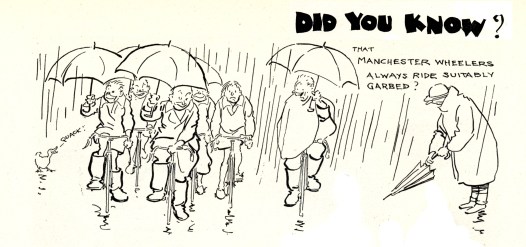
On a much lighter note, Britain is a damp country, but Manchester has a reputation (apparently undeserved) for the being the wettest place in Britain, and there are many tales about that. Here’s a 1938 cartoon by the talented line artist and cycling enthusiast, Frank Patterson.

Frank Patterson: Manchester Wheelers

Frank Patterson: Manchester Wheelers


Back to the Bungalow: Swifts of Scarborough

In April 2007, I found myself revisiting my home town, Scarborough, and took the opportunity to return to the location of my first ever full-time “permanent” job, which was at a light engineering company called Swifts of Scarborough.

I didn’t actually work at Swifts for very long — only from September 1979 to June 1981 — but so much happened to me during that approximately eighteen-month period that, in retrospect, it seems as though I was there for much longer.

After having had to drop out of Warwick University in 1979, without a degree, I found myself back in Scarborough, where job prospects are not good at the best of times (unless perhaps you want to work in a hotel). My father had just died, and my mother was trying to support a family of three on her teacher’s widow’s pension, so there was much urgency for me to start earning a living as soon as possible.

After several dispiriting months of job-hunting, I obtained an interview at Swifts, for an Accounts Clerk position, and was hired. I had no professional accounting qualifications, but I’d always been good at math (and had 2 A-levels in it), which was presumably what impressed them.

As I was to learn, Swifts was already a long-established Scarborough business. The factory had originally been in a downtown location near William Street, but had moved out to a larger site on Cayton Low Road during the 1960s. Traditionally, the company’s main product had been aluminium milk churns, but, when demand for churns evaporated, the company switched to the manufacture of cable support systems (cable tray and cable ladder). Cable support systems are a simple and unglamorous product, but there is a steady industrial demand for those components, which the company’s successors still manufacture today.

[I haven’t been able to find any photographs of Swift’s original premises. However, the out-of-print book Scarborough in the 50s and 60s does include a couple of photographs of the William Street area. On page 69 the old Swift’s refreshment block is shown, and on page 26 you can see Swift’s sign on a wall near Hope Street.]

In 1979, the company’s accounting department was housed in a building separate from the main factory, called “The Bungalow”, which was literally that, being a former private home that sat on what was now Swift’s land. This building is shown derelict in my 2007 photo at the head of this article.

I Keep Getting the Same Advice

It soon became obvious that, although Swifts was a “solid” company, its products were “not rocket science”, and I felt that continuing there would not make good use of my abilities.

Realizing that there were few suitable jobs for me in Scarborough, I began applying for more challenging jobs in other parts of the country. I attended several promising interviews, in London, Aylesbury, and elsewhere, and a pattern soon became apparent. Every time I applied for a job, I was rejected on the grounds that I didn’t have some specialized knowledge, or was in some way overqualified, and I was told to go back to university and get a degree.

That was much easier said than done, but I did eventually reapply and was accepted by several universities. Thanks to the award of a Royal Scholarship, I ended up graduating in electronics from Imperial College, London. At that point, I recalled the advice I’d received from one potential employer who had declined to hire me pre-university—the BBC—so I reapplied and, this time, I got the job!

To Richmond At Last

Back when I worked at Swifts, the company had a satellite location at Richmond in Surrey. This had originally been the premises of a company called Walker Mainstay, which Swifts had taken over. The Richmond premises were not used for manufacturing, but only for warehousing the products that were made in Scarborough. Trucks loaded with Swift’s products left Scarborough for Richmond on an almost daily basis.

During my eighteen-month period of employment, I was never allowed to visit the Richmond premises. In 1981, finding myself now a student in London, curiosity compelled me to go to Richmond and seek out the location. The photograph below shows the Richmond premises one dull weekend afternoon. I realized that I hadn’t been missing much!

Swifts of Scarborough warehouse in Richmond, Surrey, 1981

Swifts of Scarborough warehouse in Richmond, Surrey, 1981

As I mentioned at the beginning of this article, I returned to “The Bungalow” during a visit to Scarborough in 2007, to find it still standing but derelict.

The remainder of Swifts premises on Cayton Low Road still exist. The company was taken over first by Wiremold, and then by Legrand, and continues in essentially the same business in the same location.