Short Sunderland at the Tower of London

Short Sunderland at the Tower of London, 1983

Short Sunderland at the Tower of London, 1983

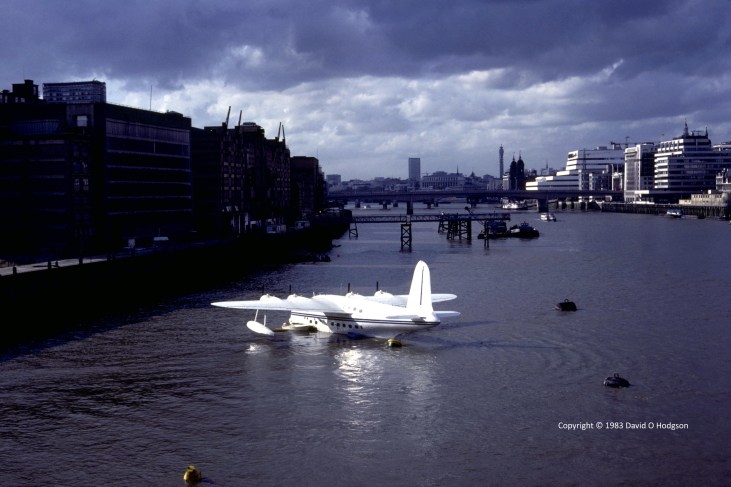
One Sunday afternoon in 1983, I was strolling over Tower Bridge in London, when I happened to look down at the Thames. There, moored in the Pool of London, was a vintage Short Sunderland flying boat. The photo above shows the scene from the South Bank (after I’d walked around from Tower Bridge), with the Tower of London in the background.

I learned later that this aircraft, registered G-BJHS, was the last flying Sunderland. It originally carried the military serial ML814, and served with the Canadian and New Zealand air forces before being civilianized. It now resides at Fantasy of Flight in Florida, but hasn’t flown since 1996.

Incidentally, the “Imperial Airways” markings on the aircraft, visible above, were fictitious and were probably applied for movie work. Imperial Airways was in fact defunct before the Sunderland entered service.

The photo below shows the first view I saw of the aircraft, from Tower Bridge. The same Google Streetview today is almost unrecognizable; the only common features seem to be the River Thames and the Tower of London!

Short Sunderland from Tower  Bridge, London, 1983

Short Sunderland from Tower Bridge, London, 1983

In the background you can clearly see the British Telecom Tower, and, in front of it, the blackened twin towers of Cannon Street Station. The top of the dome of St. Paul’s Cathedral is just visible behind the office blocks on the far right.

This aircraft was already quite the globetrekker that I some day hoped to be, but, back in 1983, my immediate travel ambitions stretched no further than London. The idea that I would soon leave all this behind, and would look back on living in London as a mere stepping-stone to greater things, would probably have been incomprehensible to me.

Architectural Redevelopment: Vandalism or Progress?

St. Pancras International Station, London, 2010

St. Pancras International Station, London, 2010

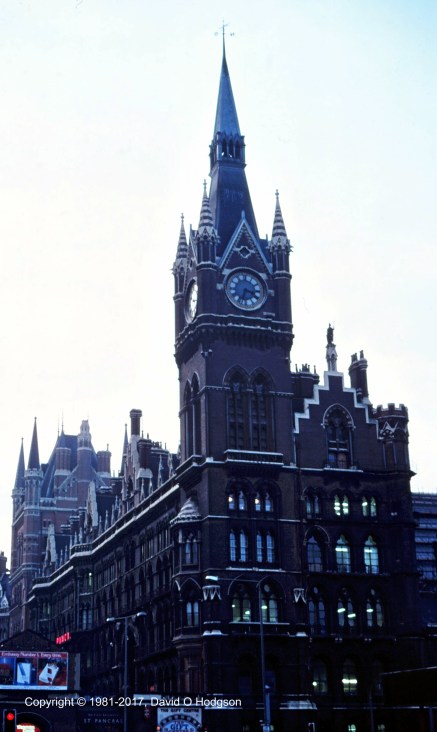
In 2010, I visited a spectacularly transformed St. Pancras Station in London, for the first time since I had lived in the city. In the photograph (below) taken during a 1981 visit, St. Pancras was a dowdy, run-down relic, the only possible future for which seemed to be closure and demolition.

St. Pancras Station, 1981

St. Pancras Station, 1981

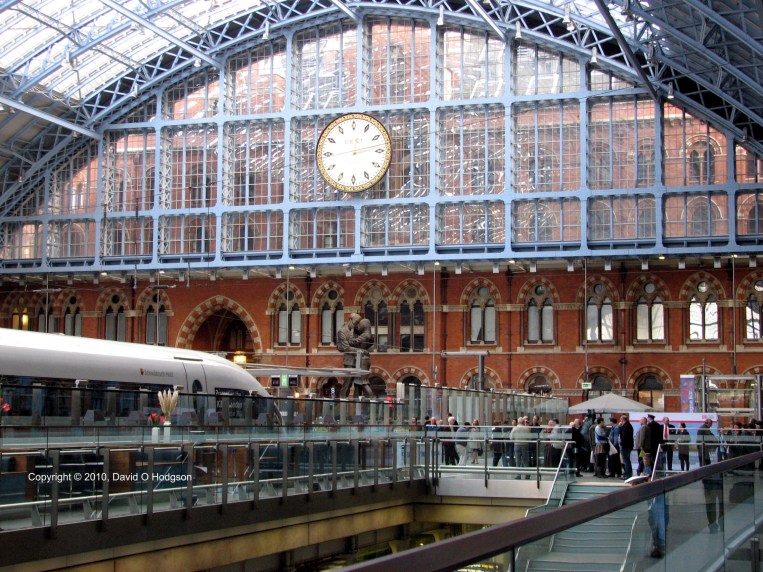
But, thankfully, it was not to be, partly due to the efforts of one man, and instead, the huge Victorian edifice was not only saved, but was transformed into the impressive, functional St. Pancras International Station. The photograph below shows the beautiful and airy interior of the trainshed of St. Pancras International, on a day when a German ICE train was visiting to promote future usage of the station by DB.

Interior of St. Pancras International Station, 2010

Interior of St. Pancras International Station, 2010

Although the redevelopment of St. Pancras is one of the most internationally famous triumphs of architectural rehabilitation, there have been many other examples of success and failure.

Yesterday, someone posted on the Facebook page of my alma mater, Imperial College, a photograph of the Imperial Institute, which was a predecessor building in South Kensington, the site of which is now occupied by Imperial College. That reminded me of the many heated battles that have occurred during my lifetime over architecture, and the demolition or redevelopment of buildings. In the past, the usual result was demolition, but, during the past twenty years or so, more enlightened thinking has prevailed, resulting in such wonderful renovations as St. Pancras.

During the 1960s (long before I became a university student), the Imperial Institute building was the focus of a heated dispute between those who wanted to demolish the Victorian edifice completely, and those who wanted to preserve it.

The redevelopers of the Imperial College campus wanted to sweep away all the Victorian architecture and replace it with what they considered to be modern and functional structures.

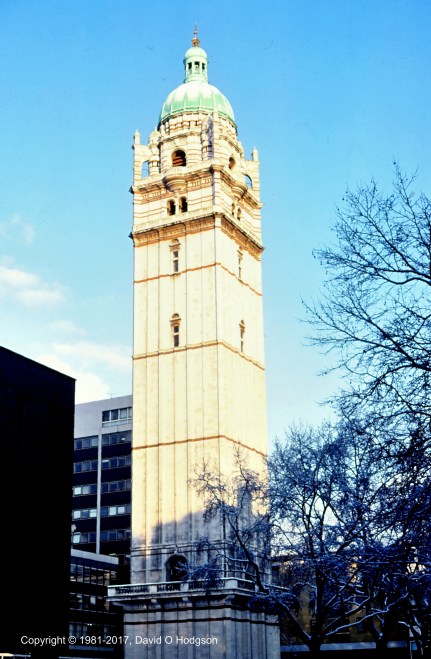
However, an organization called the Victorian Society, led by the poet Sir John Betjeman, fought for the preservation of Victorian architecture, and became particularly involved in the Imperial College plans. Although they were not able to save everything, the Victorian Society won a partial victory in that case, and managed to force the developers to retain the central tower of the Imperial Institute, which, as a freestanding building, was renamed the Queens Tower, as shown in my 1981 photograph below.

Queens Tower, Imperial College, in snow, 1981

Queens Tower, Imperial College, in snow, 1981

Now, whenever anyone needs a general photograph of “Imperial College”, you can be fairly certain that they’ll choose a view that includes the Queen’s Tower. The sad reality is that most of Imperial College’s modern architecture has very little character, and the Queen’s Tower has become a de facto icon of the college. (Incidentally, the tower is not the only pre-1960s architecture remaining on the Imperial College campus. For example, the original City & Guilds College building still survives on Prince Consort Road. However, that structure is relatively undistinguished and squat, as you can see in this current Google Streetview.)

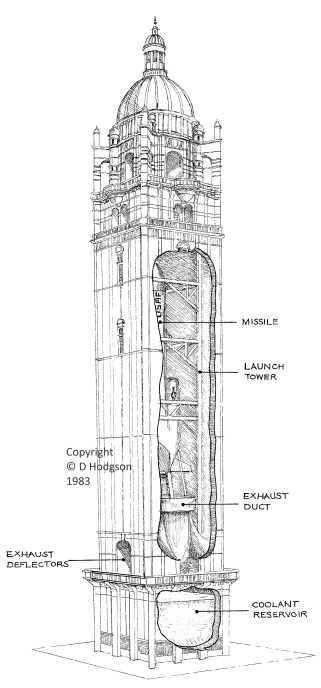
I must admit that, while a student at Imperial College, I myself was responsible for heaping further derision on the Queens Tower. As part of a spoof Felix article about the stationing of US troops within Imperial College, I contributed the illustration below, showing how the Queen’s Tower was to be converted into a launch platform for cruise missiles! (“Felix” was and still is the Imperial College student newspaper, tracing its roots back to the days when H G Wells was a student at the college.)

Queens Tower Missile Installation, 1983

Queens Tower Missile Installation, 1983

Betjeman and the Victorian Society were also instrumental in frustrating plans for the demolition of St. Pancras Station, which preserved the building for its eventual renovation. Appropriately, Betjeman’s contribution has been commemorated with a statue of him on the platform at St. Pancras, as shown below.

Statue of Sir John Betjeman at St. Pancras International Station

Statue of Sir John Betjeman at St. Pancras International Station

Personally, I don’t regard “high Victorian” architecture as being the epitome of good taste, but surely it is preferable to characterless, badly-constructed concrete boxes that replaced so much of it.

In a previous post, I showed how the architecture of Scarborough Central Station was redeveloped from the simple neoclassical design of 1845, to the ornate high-Victorian “wedding cake” that still survives today.

The Value of University


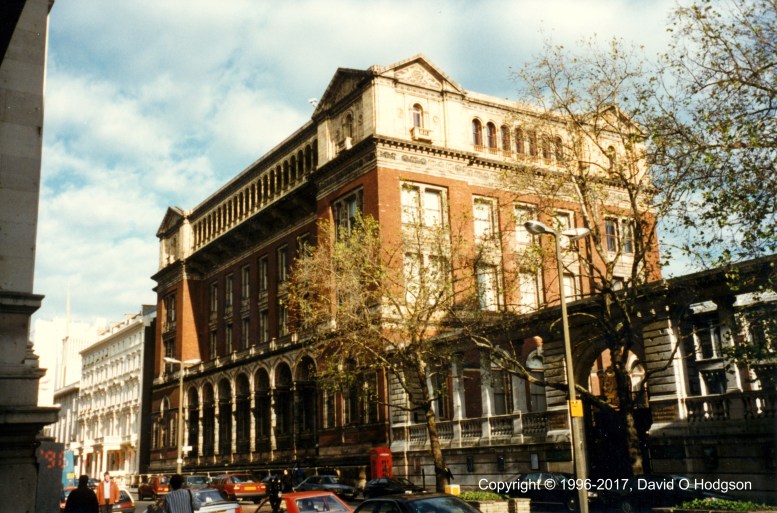
The original Imperial College: now the Henry Cole Wing of the Victoria & Albert Museum

The original Imperial College: now the Henry Cole Wing of the Victoria & Albert Museum

What is the “value of a degree”? We frequently see articles in the media engaging in hand-wringing about the “value of a degree” or the “value of university”. Many such articles make questionable assumptions about the meaning of the word “value”. The real value of a degree, and of the university experience, to any individual, depends on many factors, including the skills, goals and personality of the individual.

There’s the frequently-unspoken question of whether the “value” of the qualification is purely financial, or else has less tangible value to the person possessing it. Do you just treat your entire future life as some kind of balance sheet, where you offset the cost of obtaining the degree against the extra earnings that you think it may bring you? What, also, of the value of the experience of obtaining the degree, and the skills learned during that process?

Finally, there’s the issue of the quality of the institution granting the so-called degree. These range from world-leading universities with established track records, to “Mickey Mouse” colleges that seem to be operating mostly for easy money rather than through any commitment to the furtherance of knowledge.

Each individual must evaluate his or her personal situation, but, as the first member of my family ever to have gone to university, I offer here my own experiences and reflections.

My Own Experience

Thunder over South Kensingtion, 1981. View over Imperial College and Knightsbridge Barracks

Thunder over South Kensington, 1981. View over Imperial College and Knightsbridge Barracks

In my case, I enjoyed learning for its own sake, and discovering more about how the universe works. (I realize that most of the population do not seem to share this view.)

Despite subsequent disappointments and unanticipated setbacks, I’m glad that I went to university and got the degree that I did. I would not have regretted it even if my degree had not led to better jobs.

Non-Academic Benefits

There are also many benefits to the university experience that are not directly related to courses of study, and those who haven’t had the experience often seem completely unaware of these aspects.

I had many non-academic experiences as a student that would simply never have been available to me had I not gone to university. For example, I became involved in the Student Television Club at Imperial College, which led to my meeting and interviewing many celebrities, such as Michael Palin, Sir Cliff Richard, Paul Eddington, Gordon Jackson, Sir David Attenborough, and so on. What chance would I ever have had to do any of that otherwise?

Now, in response to my comments, some people would point out that “It’s easy for you to say that”, because my degree was free to me, and I even got a grant for my living expenses. Although that was generally true for undergraduate students in Britain at that time, it wasn’t necessarily true for me when I decided to return to university after taking two years “out” in industry. There was no guarantee that I could obtain a grant for the year that the authorities considered “wasted”, although in the end I was persuasive. I do concede, though, that the threat of a long-term financial burden might have made me think again.

I realize that I was incredibly lucky to have obtained my degree free of any financial burden. Whenever I’m feeling how unfair life can be, I always try to remind myself of my good fortune in that regard!

I was also lucky to obtain a place in one of the world’s top ten universities. I must admit that the value of qualifications from low-caliber universities is more questionable.

Learning to Discover

The university academic experience also has benefits beyond what you actually learn while there. My university studies taught me how to do research and how to develop original ideas, which has led to my making many innovations and inventions. Some of the inventions have been patented, and I continue to strive to innovate today in the fields that interest me.

Summary & Recommendations
Queens Tower, Imperial College, in snow, 1981

Queens Tower, Imperial College, after a snow shower, 1981

Despite the financial concerns, my recommendation would be to try not to view obtaining a degree in purely mercenary terms. If you view the value of a degree and of university experience as being purely financial, then you’ll be missing out on many other tangible benefits.

In my case, one reason that I chose to go back to university after working in industry for a few years was because I realized that, the longer I waited, the more difficult it would become to return and obtain a degree. I decided that, if I went back and graduated, then, even if my qualification turned out to be less useful than I’d anticipated, the worst that would happen would be that I’d wasted a couple of years of my life. On the other hand, if I didn’t go back, I’d continue to be shut out of many jobs that I was quite capable of doing, and I’d never be able to get those years back.

After all, life is not a mechanical process where you press “Start” and then go through a mindless sequence of predictable operations, which inevitably will only culminate in your death. Surely, it’s just as important to enjoy each stage as much as you can, and it’s about appreciating the journey at least as much as the final destination.

My First Cat

Dusky with My Mother, 1969

Dusky with My Mother, 1969

Here’s a photo that my father took in 1969, showing my mother sitting near the pond in our back garden, with my first cat.

Strictly speaking, the cat wasn’t mine, and wasn’t really anybody’s, because she was what would now be called a “feral” who simply showed up in our garden one day, along with several other ferals who were even wilder than she was. This particular cat liked being fed and petted to some extent, and didn’t mind coming into our house occasionally. She always went out at night, but I’m not sure whether that was because she wanted to do so, or because my parents simply had the attitude that “at night you put the cat out”.

I wanted our cat to have a name, of course, but nobody seemed willing to agree on anything. I had an old book that I’d inherited from a neighbor called Calling All Kittens, which featured large paintings of various cute kittens. The kitten in the book who most resembled our feral was named “Dusky”, so that was the name I gave her. However, nobody else in the family seemed willing to use that name, always referring to her by the unimaginative title of “Puss”!

How Not to Transport a Feral

We moved in 1970 to a house on the other side of Scarborough, and my mother attempted to move Dusky along with us. It didn’t go well.

Firstly, Dusky had never before ridden in a car, and didn’t like it at all. She jumped around in a panic for the entire journey.

When we arrived at the new house, my mother decided to keep her indoors for the day. However, when night came, she just did the same as always and “put the cat out”.

We never saw Dusky again.

Of course, now I know that that’s absolutely not the way to move your cat from one house to another! At that time, I was only ten years old, so, even if I’d known what to do, I doubt that my parents would have listened to my advice.

I’ve also learned since then that “putting the cat out at night” is neither necessary nor desirable. In California, it’s almost a death sentence, since cats can encounter common animals such as raccoons that can inflict major injury or death.

Of Lost Maps & Lost Towns

East Yorkshire Wall Map, Bridlington, 1977

East Yorkshire Wall Map, Bridlington, 1977

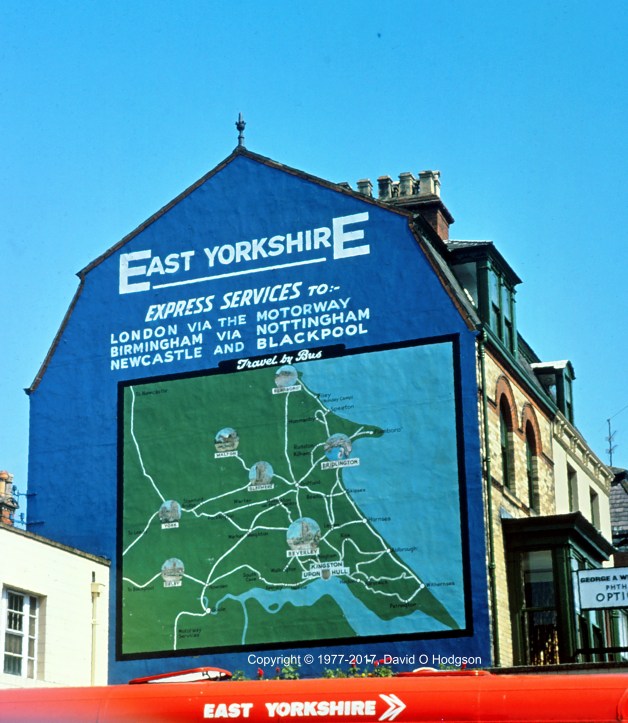
The Map shown above in my 1977 photograph was for many years displayed on a wall that overlooked the Promenade Bus Station in Bridlington. I was recently scanning some old photographs, and that led me to wonder what had become of the map, and indeed the bus station below it.

At the time of my birth, Bridlington was in the county of the East Riding of Yorkshire, then, in 1974, that became part of the unloved county of Humberside. In 1996, Humberside was abolished, and Bridlington found itself once again in the East Riding of Yorkshire.

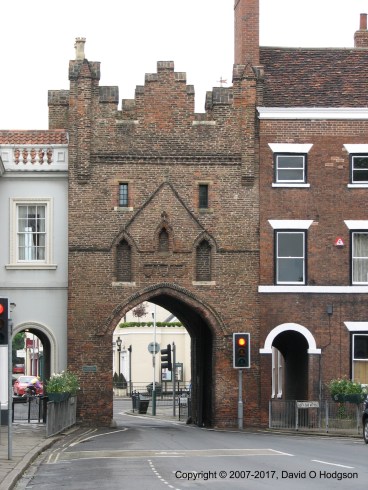
The local bus company in Bridlington was, and still is, East Yorkshire Motor Services (EYMS), which created and maintained the map. EYMS is perhaps most famous for the unique “Gothic” roofs of its double-deck buses, which were specially shaped to fit through the North Bar in the East Riding county town of Beverley. (See this article for a photo of one of the gothic buses squeezing through the bar.) Built in the 15th century, Beverley Bar still exists today, as shown in my 2007 photo below, and is the only remaining brick-built town gate in Britain.

Beverley Bar, 2007

Beverley Bar, 2007

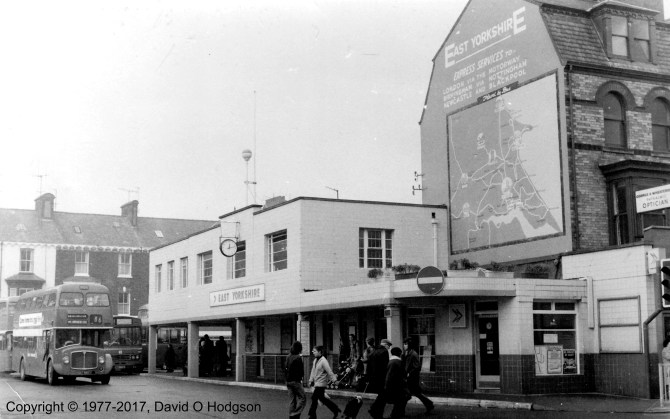
The photo below shows a general view of Bridlington bus station at around the same time as the color photo of the map above.

Bridlington Promenade Bus Station, 1977

Bridlington Promenade Bus Station, 1977

EYMS built the bus station during the 1930s, and the main building was finished in pleasant blue and cream tiles, reflecting the company’s bus liveries, which also used shades of blue and cream.

Unfortunately, the privatization of the British bus industry during the 1980s made such town-centre sites prime targets for sale and redevelopment, as the privatized companies saw opportunities to “externalize their costs” by selling off their own premises and stopping their vehicles on the streets instead, causing further traffic congestion.

Bridlington Bus Station suffered this fate, and closed down years ago, but I wondered what had become of the site. Looking on Google Streetview, I was initially unable to spot any evidence of the location. Eventually, however, I noticed that, even though the station is gone, the building on which the map was painted still exists, and is now a very tatty branch of Boots. Here is the latest Streetview image.

For convenience, here’s an excerpt from that view. You can see the gable end of the building on which the map was painted, and even the finial is still there!

Site of Bridlington Promenade Bus Station

Site of Bridlington Promenade Bus Station

As you can see, the “Promenades” shopping center has been built over the site of the Bus Station. I’m not sure it’s much of an improvement…

They Keep Losing Towns Too!

The East Riding of Yorkshire actually continues to suffer more significant losses of property than just Bridlington Bus Station and its map.

As a teenager, I was a fairly frequent visitor to Scarborough Library, which had some obscure old books about Yorkshire history.

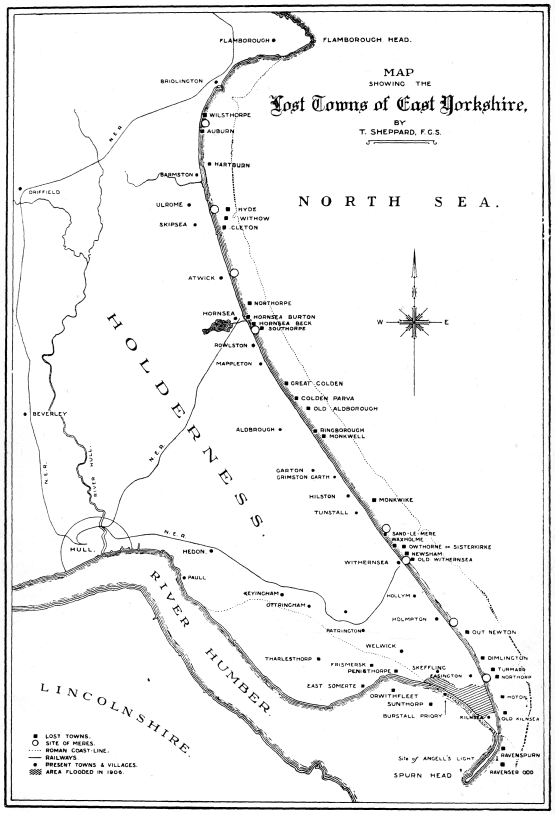
One of these books was “The Lost Towns of the Yorkshire Coast” by Thomas Sheppard, published in 1912. The book describes the severe coastal erosion in East Yorkshire, south of Bridlington. While Bridlington itself is built on the same chalk that forms the Flamborough promontory, the area southwards to Spurn Point (called Holderness) is a soft glacial moraine, which the sea is eroding away very quickly.

The map below is from the frontispiece of the 1912 book, and shows the medieval and modern coastlines of the county. The loss of entire towns due to erosion is quite obvious.

Lost Towns of East Yorkshire

Lost Towns of East Yorkshire

Short of building a sea wall all the way along the coastline, the erosion process is really unstoppable. In the future, there will presumably be some towns and villages sitting on peninsulas where defences have been built locally (such as at Withernsea), but the remainder of Holderness will eventually just be washed away.

The most recent losses of property have been around Aldbrough, as shown in these photos. See it while you can!

Incidentally, Beverley in Yorkshire has no connection to Beverly Hills in California, although the different spellings do sometimes trip people up!

The Ambivalence of Easter


Scarborough from Cumboots Brow, Easter 1977

Scarborough from Cumboots Brow, Easter 1977

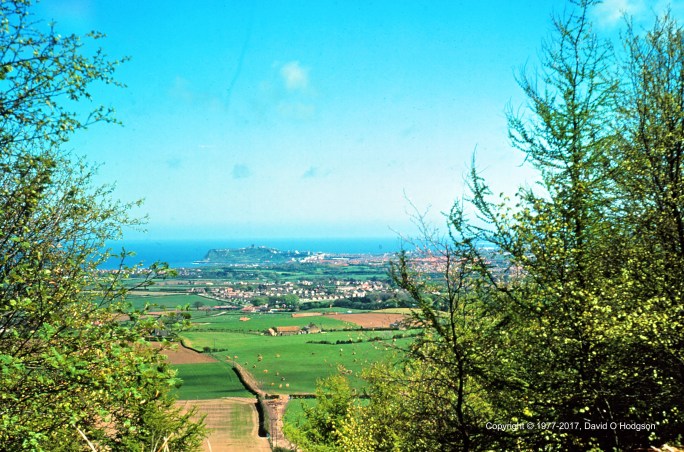
Easter occurs this weekend, although the event has almost zero importance for me now that I live in California. On reflection, the decline in its significance seems remarkable, given that Easter was, and still is, a national holiday in Britain, and holds many ambivalent memories for me from the days when I lived there.

The photograph above shows my birth town, Scarborough, on a beautiful day during Easter, 1977. My color slide was taken from the curiously-named Cumboots Brow, and displays a vista over lush farmland to the suburban village of Scalby, then Scarborough Castle headland beyond that, and finally the North Sea on the horizon.

In terms of positive memories of Easter, as a kid, I naturally looked forward to the break from school offered by the Easter vacation, and also to the abundance of Easter eggs, hot cross buns, and similar treats.

On the negative side, the Christian Easter festival, which was supposedly what was being commemorated, brings back memories of its absurd and macabre claims, which teachers at our schools drilled into us. In my case, I had the misfortune to have to attend a Church of England School for a couple of years, where such superstitious nonsense was particularly rife, but in Britain even state schools promoted the religious agenda to a lesser extent.

Is Easter Christian or Pagan?

Is Easter a religious festival, or merely a celebration of Spring? Should it or shouldn’t it be an official holiday for everyone?

Most people in Britain seem to take it for granted (as I did before emigrating) that Easter should be a recognized holiday.

Conversely, when I talk to people in California about it, they often seem puzzled that it should be recognized as a secular holiday at all.

People sometimes seem surprised when I remind them that, unlike the USA, Britain has no “separation of church and state”. Indeed, England has an official state religion (Church of England Christianity), the bishops of which still sit unelected in the House of Lords. Few people in Britain seem to see any problem in having a Christian festival as a national holiday, even though the vast majority now practice no religion at all and are de facto atheists, whatever they choose to call themselves.

But what actually is being celebrated? After all, the term “Easter” has a pagan origin, in that it is derived from the name of a goddess named Ēostre. Is it not really just a celebration of the Springtime renewal of life? As I recall, that inconvenient reality seemed to reemerge frequently. For example, at the state school, we were instructed to create Easter cards, but thankfully it was specified that these should feature eggs and chicks, instead of a man nailed to a wooden cross.

At the church school, the priests insisted that, despite its morbid associations, their Easter festival was supposed to be a “victory” over death rather than a wallowing in the gory details. Even as a child, it struck me that their resurrection story made no sense. Those adults insisted that their leader had physically risen from the dead. When we questioned the current whereabouts of this Jesus who had supposedly “conquered death” and thus must obviously still be living somewhere, we were told that we couldn’t meet this immortal individual in the flesh because he had somehow “gone up to heaven”. But we already knew that “going up to heaven” was just a euphemism for dying, so is he supposed to be dead or alive?

Easter in Scarborough: the “Season” Begins

Easter had a more practical significance for me during my schooldays because, in Scarborough, in the 1970s (and perhaps even now), the weekend marked the start of “the Season”, when tourists began arriving for vacations in the town following the winter shutdown. Typically, the major influx of tourists occurred from Easter to September each year.

For a few years during the 1970s, my parents owned the “West Lodge Guest House”, which they opened to guests each Easter. That building is still open as a hotel today. I took the photo below during a visit to Scarborough in 2006.

West Lodge Guest House in 2006

West Lodge Guest House in 2006

Easter: Goodbye to All That

Until I wrote this article, it hadn’t occurred to me that emigrating to California freed me to enjoy the positive aspects of Easter, revolving around the Springtime rebirth of life, without all the baggage of the macabre and primitive religious connotations.

It’s just one more good thing to celebrate…

Location of the Heading Photograph

Due to tree growth since 1977, it seems that it may be difficult to reproduce the view at the head of this article now. Here is the latest Google Streetview image.

Postscript

The Daily Mash has just weighed in with a report about Easter!

Tomorrow Never Knows

Stories of Mr Wolf, 1966

Stories of Mr Wolf, 1966

Last week, Mary and I went to see the movie of Scott Freiman’s lecture Tomorrow Never Knows: Deconstructing the Beatles (Revolver).

The Beatles created their famous album “Revolver” during the summer of 1966. I’m afraid that my artistic creations during that summer were less sophisticated, probably because I’d just turned six at the time. Above is an illustration from my 1966 book “Stories of Mr Wolf”. According to a date on the page, the drawing was created on Sunday, July 3rd of that year.

The stories turned out to be rather short, and much less psychedelic than the Beatles’ music! Mind you, they did involve talking wolves who visited Scarborough, so they could have been described as being “far out”…

I scanned the surviving contents of my 1966 book recently. As you can see, the paper is becoming extremely yellow, and it’s very fragile. Fifty more years from now, the whole thing will probably have turned to dust, but then so will I!

When I penned that drawing, back in July 1966, my father was the same age that I am now. Did I imagine then that, fifty years later, I’d be scanning my drawing into a digital image, then posting it on a publicly-networked page for all the world to see? Of course not! I wouldn’t even have known what those concepts were. That wasn’t just because I was only six years old at the time, since I’m sure that my parents would not have understood those concepts either. There were contemporary TV shows that attempted to predict what life would be like in the twenty-first century, such as Thunderbirds, but all of those shows completely missed the emergence of the internet. It really was a case of “Tomorrow Never Knows”…

Airspeed York

Former Airspeed Factory, York, in 1979

Former Airspeed Factory, York, in 1979

During an Easter 1979 visit to York, I sought out and photographed the rather tatty and unremarkable building shown above. On close examination, the exterior revealed some vaguely “Art Deco” embellishments, but in general it gave the impression of being just another old warehouse.

The building was located on Piccadilly, York, and was in use as Reynard’s Garage in 1979. It had originally been built as a trolleybus garage in the early 1920s. In 1931, after the trolleybuses had been relocated to larger premises, the building took on a new function as the home of Airspeed Ltd., an aircraft manufacturing company founded by, among others, Nevil Shute and Amy Johnson.

By 1933, Airspeed were ready to expand into larger premises, but York Corporation refused to provide any assistance. Other municipalities around the country took a more enlightened view, and so Airspeed were tempted away from York to Portsmouth, where they built large new premises, then went on to design and build many successful aircraft designs, such as the Oxford and Horsa.

Sadly, in 2015 the now-derelict building was finally demolished, despite public pressure to save it. Perhaps York Corporation wanted to rid themselves of this daily reminder of their own lack of foresight back in the 1930s?

This link displays the current Google Streetview of this location.

The Colored Pencil Craze


Portrait in Colored Pencil

Portrait in Colored Pencil

I’ve been puzzled and amused by the recent fad for “Adult Coloring Books”. Apparently, the popularity of these books has led to a shortage of colored pencils to buy! (See for example this article.) As a result of using them at school, it took me many years to realize that colored pencils were not “just for kids”.

My school experiences with colored pencils led me to rather a cynical view of the results that could be obtained, because our teachers required us to use them, but didn’t teach us how to use them. From the teachers’ viewpoint, pencils were naturally preferable to paint, because they didn’t produce so much mess. The problem was that, because we were never taught appropriate techniques, most of the results were very poor.

My experiences with coloring books were also not positive! Relatives would sometimes buy me coloring books as presents when I was young, but I don’t recall ever using one. My view (which apparently went unconsidered) was, “Why would I want to color in someone else’s drawings, when I’m churning out my own drawings every day?”

Nonetheless, later on, in the 1980s, when I was studying Illustration at St. Martins School of Art in London, I invested a sizable sum in a set of 72 Derwent colored pencils (my “life savings”, as my instructor described it). Despite that, the only finished work that I ever produced solely with colored pencil was the portrait at the top of this post. I was quite pleased with the results, but found the technique very time-consuming.

Since then, I have sometimes used colored pencils for concept sketches, such as that below for a fictitious piece of jewelry.

Sketch of Fictitious Jewelry

Sketch of Fictitious Jewelry

I’ve also used pencils in “mixed-media” illustrations, but never as the only medium for a finished work.

There are some excellent artists who specialize in producing photo-realistic colored pencil art. I’m left in no doubt that colored pencil can produce excellent-quality art, but only very slowly!


Covent Garden: Then & Now

Covent Garden after the Rain, 1982

Covent Garden after the Rain, 1982

I took the color transparency above in Covent Garden, London, one afternoon in 1982, just after a short rain shower. Even though the buildings were against the sun and mostly in darkness, the wet cobbles reflected the sunset and created a fantastic lighting effect. It really was a case of being in the right place at the right time, and with the right equipment.

I’d actually been inside the London Transport Museum, which was immediately behind me in the photograph. While in the museum, I heard the rain on the roof, but couldn’t see it because of the building’s high windows. Soon after the rain stopped, I noticed a brilliant orange glow reflecting onto the ceiling. Thinking that this might be a great opportunity, I rushed outside, and I wasn’t disappointed. Ever since then, I’ve been glad that I impetuously cut short my visit to the museum that afternoon!

Yesterday’s pointless atrocity in London brought to mind this photo, and the terrorist threats that always hung over us, even back when I lived there in the 1980s. In those days, most of the threats came from the IRA (or people claiming to represent them), but only a very small number were real.

As a student, I worked as a Sales Assistant at Selfridges store in Oxford Street during some of the university breaks, and sometimes on Saturdays. As part of our training, we received specific instructions as to what to do if we were notified of a bomb threat, because the store received such threats almost every day! Fortunately, while I lived in London, all the threats at Selfridges were hoaxes, but there was a car bomb at Harrods during Christmas 1983, and I had worked at Harrods only the previous Christmas.

Covent Garden in 2001

Covent Garden in 2001

In 2001, I returned to Covent Garden, and took the photo above from almost the same position as the 1982 photograph, but in obviously different weather conditions. (It’s true that a further 16 years have passed since I took the “Now” photograph!)

At first, everything seemed to be just the same as it had been in 1982, and it wasn’t until I compared the two photographs that I realized what had changed.

The building that was originally Covent Garden market hall is still visible on the right, and it’s as popular a destination now as it was then.

In the earlier photograph, there’s a multi-storey building on the left with many rooms obviously lit by fluorescent strip lights. By the time of the later photograph, this building had been completely replaced. Had that happened a couple of decades earlier, it’s likely that the entire street would have been razed and replaced with examples of “modern architecture”, but fortunately lessons have been learned since then. Many modern redevelopments at least attempt to blend with the surrounding architecture.